


From RevOps to COO: Build Strategic Influence, Forecasts, and GTM Leadership [Framework]


RevOps is one of the clearest paths to the COO seat because you already see how revenue actually gets built. You sit at the intersection of Salesforce data, forecasting, planning, process design, and cross-functional execution.
But being close to the work isn’t the same as operating at executive level. The move from RevOps to COO happens when you shift from fixing requests to directing the operating rhythm of the business.
This framework shows where that gap usually is, which skills prove you’re ready, what company cadences to own, and which metrics make your business impact obvious to the CEO, CRO, and board.
[banner type="download" url="https://www.weflow.ai/content/revops-to-coo-cheat-sheat" text="From RevOps to COO" subtitle="Frameworks, gap-analysis prompts, and role-mapping checklists to move from RevOps to COO." button="Get it free"]RevOps vs. COO mindset: bridge the gap to executive leadership
Most RevOps leaders already have the raw materials for COO scope: cross-functional visibility, trusted access to the data layer, and a front-row seat to how Sales, Marketing, CS, and Finance interact. That matters because COOs don’t win on functional depth alone—they win by seeing the full GTM system, spotting where it breaks, and aligning teams around a common plan.
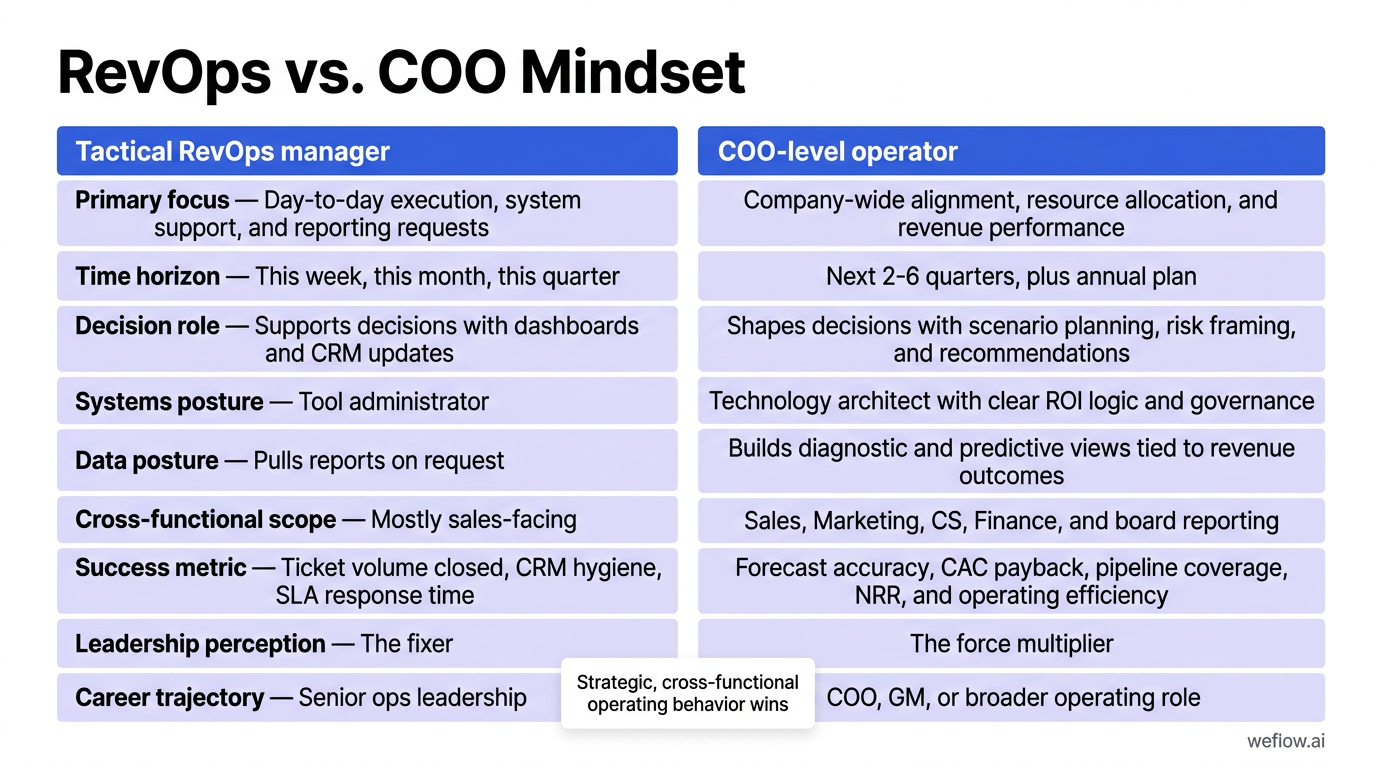
The difference is posture. A tactical RevOps leader keeps the machine running. A strategic operator decides where the machine should go next, what it should optimize for, and which tradeoffs the business should make.
| Dimension | Tactical RevOps manager | COO-level operator |
|---|---|---|
| Primary focus | Day-to-day execution, system support, and reporting requests | Company-wide alignment, resource allocation, and revenue performance |
| Time horizon | This week, this month, this quarter | Next 2-6 quarters, plus annual plan |
| Decision role | Supports decisions with dashboards and CRM updates | Shapes decisions with scenario planning, risk framing, and recommendations |
| Systems posture | Tool administrator | Technology architect with clear ROI logic and governance |
| Data posture | Pulls reports on request | Builds diagnostic and predictive views tied to revenue outcomes |
| Cross-functional scope | Mostly sales-facing | Sales, Marketing, CS, Finance, and board reporting |
| Success metric | Ticket volume closed, CRM hygiene, SLA response time | Forecast accuracy, CAC payback, pipeline coverage, NRR, and operating efficiency |
| Leadership perception | The fixer | The force multiplier |
| Career trajectory | Senior ops leadership | COO, GM, or broader operating role |
Verdict: Strategic, cross-functional operating behavior wins because it shows you can guide the business, not just support it.
If you want a quick read on your current posture, use this self-assessment before you do anything else.
| Checkpoint | Why it matters | What to look for | Status |
|---|---|---|---|
| I contribute meaningfully to annual and capacity planning | Planning is core COO scope | You model rep capacity, pipeline requirements, hiring timing, and quota risk | Yes / Not yet |
| I lead or co-lead the QBR and forecast cadence | Owning the operating rhythm builds executive trust | You run cross-functional reviews with decisions, owners, and follow-ups | Yes / Not yet |
| I turn data into revenue-backed recommendations | Executives need judgment, not just dashboards | You present trends as business impact plus action plan | Yes / Not yet |
| I lead cross-functional initiatives with measurable outcomes | Execution across teams is what separates operators from analysts | You’ve owned work like pipeline acceleration, renewal handoffs, or territory redesign | Yes / Not yet |
| I partner proactively with Finance, CS, and Marketing | COO credibility depends on broad trust | You’re involved before plans are finalized, not after | Yes / Not yet |
| I present a clear RevOps roadmap in business terms | Roadmaps show whether you think strategically or reactively | Stakeholders know what work matters, why it matters, and what it should change | Yes / Not yet |
Audit your current tactical vs. strategic focus
If most of your time still goes to inbound requests, ad hoc reporting, or broken Salesforce workflows, you’re probably still operating in execution mode. That’s normal—but it won’t get you mistaken for a future COO.
- Short-term habit: You optimize this week’s fire drill. Strategic equivalent: You block time weekly to review next-quarter risks across coverage, velocity, churn, and hiring capacity.
- Tool administrator habit: You own every Salesforce field change, report fix, and routing adjustment yourself. Strategic equivalent: You design the architecture, governance, and prioritization model so the org scales without depending on you for every change.
- Operational efficiency habit: You measure success by how fast a request gets done. Strategic equivalent: You measure success by what changed in win rate, cycle time, forecast error, CAC payback, or NRR.
- Reporting habit: You send dashboards and assume the numbers speak for themselves. Strategic equivalent: You explain what changed, why it matters, and what leadership should do next.
- Reactive collaboration habit: You join late after leadership has already made the plan. Strategic equivalent: You influence assumptions early, before headcount, coverage, and budget decisions get locked.
One of the most common career traps in RevOps is becoming the person who can fix anything in Salesforce. That makes you useful, but it also makes you easy to pigeonhole. The fixer closes tickets; the force multiplier changes how the business runs so fewer tickets exist in the first place.
Shift from reactive tasks to proactive orchestration
The practical shift is simple to describe and harder to practice: stop waiting for asks, and start surfacing issues before someone else names them. That’s how you move from order-taker to operator.
| Shift to make | COO-level mindset |
|---|---|
| Spot issues before they hit the exec meeting | Operate as an early warning system for revenue risk, not a cleanup team after the fact |
| Connect disconnected signals across teams | See lead quality, pipeline coverage, onboarding friction, and churn risk as one operating system |
| Lead with business framing, not system detail | Explain the expected effect on ARR, margin, payback, or retention before discussing workflow design |
| Pre-align before major meetings | Use meetings to confirm alignment, not to win the argument live |
| Say “not now” with context | Prioritize by business impact and tradeoff, not by who asked loudest |
| Delegate, automate, or systematize repetitive work | Spend your time on judgment, planning, and cross-functional coordination |
Think like a GM, not just a systems owner. A GM starts with business logic—where growth is slowing, where margin is leaking, where retention is softening—and then uses systems, reporting, and process design to correct it. That order matters. If your logic starts and ends with Salesforce architecture, you’ll stay in systems leadership instead of enterprise leadership.
Strategic skill map: master competencies that drive promotion
You don’t need 20 new skills to move toward COO scope. You need a tighter set of operating skills across four themes: planning, communication, execution, and financial judgment.
These 10 are the ones that show up most often in the jump from senior RevOps leader to broader operating leader.
-
Charter
- Develop it: Write a one-page definition of your team’s scope, operating principles, and priorities.
- Signal you’re on track: Fewer ad hoc asks hit your team, and leaders ask for your view during planning instead of after.
-
Annual planning
- Develop it: Build bottom-up models for ramp time, quota capacity, coverage, and hiring timing.
- Signal you’re on track: You’re invited into planning reviews because you’re pressure-testing assumptions, not just pulling historical data.
-
Forecasting and QBR cadence
- Develop it: Standardize forecast definitions, stage logic, and QBR structure across functions.
- Signal you’re on track: Exec meetings spend less time arguing about the number and more time deciding how to improve it.
-
Data storytelling
- Develop it: Tie every key metric to financial impact, risk, or decision.
- Signal you’re on track: Your framing gets reused in board decks, staff meetings, or CRO updates.
-
GTM orchestration
- Develop it: Map the buyer journey end to end, identify breakdowns in handoffs, and drive fixes across functions.
- Signal you’re on track: Sales, Marketing, and CS leaders treat you as the neutral operator who can align definitions and execution.
-
Strategic prioritization
- Develop it: Rank work by revenue impact, effort, and strategic fit—not urgency alone.
- Signal you’re on track: Your roadmap gets respected even when you decline low-impact work.
-
Financial fluency
- Develop it: Partner with Finance on CAC, LTV, margin, payback, GRR, and NRR.
- Signal you’re on track: You naturally ask how a process change affects efficiency, not just adoption.
-
Internal influence
- Develop it: Socialize proposals in 1:1s, test objections early, and build support before the meeting.
- Signal you’re on track: Your initiatives move faster because resistance gets handled upstream.
-
Execution visibility
- Develop it: Build dashboards that track pipeline coverage, stage velocity, activity completeness, churn risk, and follow-through by owner.
- Signal you’re on track: You surface operational risks before they show up in missed numbers.
-
Roadmap communication
- Develop it: Present your roadmap in business terms, with tradeoffs, expected outcomes, and clear sequencing.
- Signal you’re on track: Leadership sees RevOps as part of company planning, not just GTM support.
Define your team charter and strategic roadmap
A clear charter does two things at once: it sets boundaries, and it raises the level of conversation. Without one, RevOps becomes a glorified internal help desk for Salesforce changes, dashboard requests, and one-off process patches.
- Draft a one-page charter. Include your mission, functional scope, key stakeholders, and the outcomes your team owns. Write it in business language, not platform language.
- Define what’s in and out. Separate strategic work like forecasting, planning support, pipeline governance, and GTM analytics from low-value admin work that should route through a service process.
- Rank incoming work by impact and effort. A simple matrix works: revenue impact, operational risk, effort, and strategic alignment.
- Turn priorities into a quarterly roadmap. Organize initiatives by expected business result, such as improved forecast accuracy, faster lead routing, or lower churn risk.
- Review the roadmap with leadership in business terms. Don’t say, “We’re rebuilding opportunity workflows.” Say, “We’re reducing stale pipeline and forecast inflation by tightening stage exit criteria and inspection rules in Salesforce.”
Build financial fluency and data storytelling skills
If you want COO credibility, you have to connect operational metrics to financial outcomes. That means knowing how CAC payback shifts when routing speeds improve, how margin changes when sales cycles drag, and how retention patterns change the quality of growth.
Start by partnering closely with Finance. Ask how they define CAC, whether renewals sit in the same model as new logo revenue, how they calculate LTV, and which assumptions the board scrutinizes most. Then make sure your Salesforce reporting, forecast rollups, and QBR views support those same definitions.
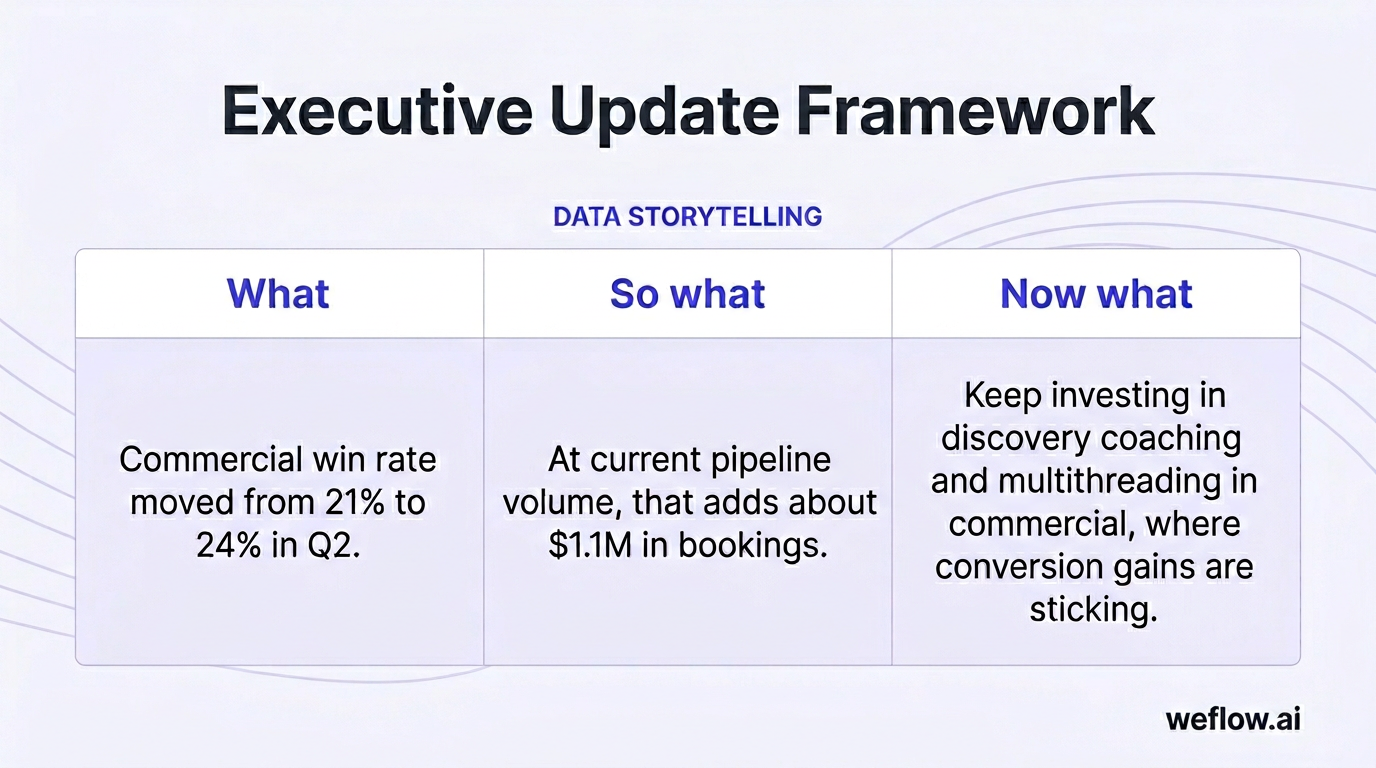
Use this framework in every executive update:
| Framework step | What to say |
|---|---|
| What | State the metric change clearly: “Commercial win rate moved from 21% to 24% in Q2.” |
| So what | Translate it into business impact: “At current pipeline volume, that adds about $1.1M in bookings.” |
| Now what | Recommend the next move: “Keep investing in discovery coaching and multithreading in commercial, where conversion gains are sticking.” |
That’s the shift. A “win rate increase” is an interesting metric. “An extra $1.1M in bookings at current coverage” is a business case.
Orchestrate cross-functional GTM alignment
RevOps professionals who move into COO roles usually stop treating GTM functions as separate queues. They manage the handoffs, feedback loops, and shared definitions that determine whether revenue execution holds together at scale.
- Map the full buyer journey from lead creation through renewal, including where Salesforce ownership changes across SDRs, AEs, onboarding, CS, and renewals.
- Identify friction points that create measurable drag, such as slow lead routing, weak opportunity-to-onboarding handoffs, or missing renewal risk signals.
- Pre-align with Sales, Marketing, CS, and Finance leaders before major meetings so the room isn’t seeing your recommendation for the first time.
- Standardize shared definitions for pipeline coverage, stage exit criteria, CAC, and churn risk so cross-functional decks don’t contradict each other.
- Build execution visibility dashboards that show the health of the full motion, not just sales pipeline—coverage, conversion, stage velocity, onboarding completion, expansion readiness, and churn signals.
Influence happens before the meeting, not during the presentation. If you wait until the formal review to introduce a cross-functional change, you’re already late.
COO training ground: own the systems that scale revenue
The strongest proof that you’re ready for broader operating scope is simple: you can run the company cadences that keep revenue predictable. When a CEO sees that you can manage QBRs, board metrics, forecasting, process engineering, and annual GTM planning, they stop seeing you as a systems specialist and start seeing you as part of the company’s operating core.
Lead structured QBRs and board-ready reporting
A good QBR is not a status meeting with better slides. It’s a decision-making cadence that explains what changed, what it means, and where the business needs intervention.
Include these elements in every strategic QBR:
- A single set of KPI definitions used across internal decks and board reporting
- Leading indicators such as pipeline coverage, stage velocity, activity completeness, and conversion by segment
- Lagging indicators such as bookings, win rate, churn, NRR, and quota attainment
- Variance to plan by team, segment, and region
- The top 3-5 risks affecting the next quarter, with expected impact
- Recommended actions, owners, and dates—not just observations
- A short readout of what changed since the last review and whether prior interventions worked
Boards care about patterns, risks, and whether management understands cause and effect. They do not want raw Salesforce dashboards dumped into slides without interpretation.
Optimize forecasting accuracy and revenue intelligence
If you want faster executive trust, improve forecast accuracy. Few RevOps initiatives build credibility faster because forecasting sits right at the intersection of data quality, sales process discipline, and leadership judgment.
| Key area | Strategic impact |
|---|---|
| Standardized forecasting methodology | Creates common language across commit, best case, upside, and pipeline so managers stop using categories inconsistently |
| Stage-to-close probability modeling | Turns historical conversion patterns into more realistic coverage targets and forecast ranges |
| Forecast hygiene in Salesforce | Close date discipline, amount accuracy, and validation rules reduce inflation and late-quarter surprises |
| Variance tracking between forecast and actuals | Shows where judgment breaks down by rep, segment, manager, or forecast category |
| Pipeline health and deal inspection | Identifies slippage, stagnation, weak multithreading, and low-touch deals before they miss the quarter |
| Activity completeness and conversation data | Improves deal risk assessment because leaders can inspect actual customer engagement instead of rep memory alone |
| Tech stack and data footprint | Exposes whether data gaps, shallow field mapping, or weak Salesforce write-back are distorting forecast reviews |
For Salesforce-centric teams, this is where system design becomes business impact. If forecast categories aren’t enforced, stage definitions are soft, and activity data never lands cleanly on the opportunity or custom object structure you report from, your forecast call becomes opinion theater.
Engineer the sales process for faster deal velocity
Process engineering is where RevOps leaders often prove they can run a broader GTM machine. The goal isn’t more admin. The goal is a cleaner sales process that improves conversion, cycle time, and forecast reliability.
- Define stage entry and exit criteria in plain language, then enforce them with Salesforce validation rules and manager inspection.
- Operationalize your sales methodology—such as MEDDICC—through required fields, stage gating, and deal review templates.
- Audit time in stage by segment, team, and rep to identify where deals stall and where qualification breaks down.
- Tighten lead routing and assignment logic so speed-to-lead doesn’t quietly raise CAC and lower conversion.
- Flag stale opportunities, missing next steps, and inconsistent close date movement in dashboards managers actually use weekly.
- Document the process in a living playbook so the system, enablement content, and manager coaching all reinforce the same motion.
Process compliance feeds forecast accuracy. If reps move opportunities without meeting exit criteria, your stage-based probabilities stop meaning anything. Cleaner process means cleaner forecast inputs.
Drive annual GTM planning and capacity modeling
Annual planning is one of the clearest proving grounds for future COOs because it forces you to connect top-line targets to actual execution capacity. This is where good operators challenge assumptions before the business commits to them.
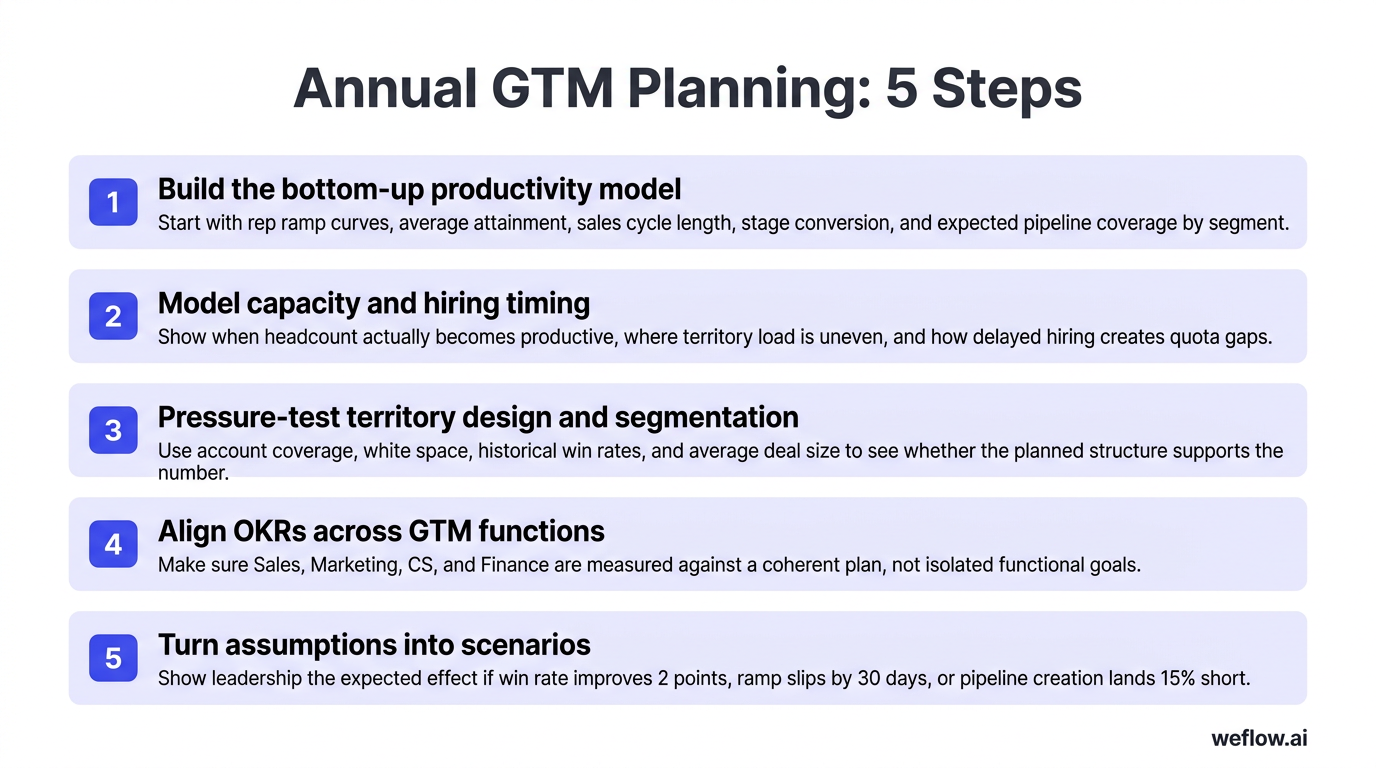
- Build the bottom-up productivity model. Start with rep ramp curves, average attainment, sales cycle length, stage conversion, and expected pipeline coverage by segment.
- Model capacity and hiring timing. Show when headcount actually becomes productive, where territory load is uneven, and how delayed hiring creates quota gaps.
- Pressure-test territory design and segmentation. Use account coverage, white space, historical win rates, and average deal size to see whether the planned structure supports the number.
- Align OKRs across GTM functions. Make sure Sales, Marketing, CS, and Finance are measured against a coherent plan, not isolated functional goals.
- Turn assumptions into scenarios. Show leadership the expected effect if win rate improves 2 points, ramp slips by 30 days, or pipeline creation lands 15% short.
If you’re excluded from annual planning today, don’t wait for a formal invitation. Use this script: “I built a bottom-up capacity model that shows ramp timing, coverage gaps, and quota risk by segment. Can I walk you through it before planning starts so we can pressure-test assumptions?”
Executive KPIs: track metrics that prove business impact
COOs don’t measure success with revenue alone. They care just as much about efficiency and retention because weak payback or poor NRR can hide behind top-line growth for a while, then hit hard later. That’s why a strong strategic dashboard balances growth, operating efficiency, and customer outcomes.
| Metric category | Key indicator | Target | What it proves |
|---|---|---|---|
| Revenue | Forecast accuracy | Within 5% of actual | The business can plan with confidence |
| Revenue | Pipeline velocity | 15-20% faster cycle time | Revenue converts faster and execution friction is falling |
| Revenue | Win rate | 10-15% year-over-year improvement | Qualification, messaging, and process quality are improving |
| Revenue | Average deal size | 20%+ growth where mix supports it | The team is moving up-market or selling broader value |
| Efficiency | CAC payback period | Under 12 months | Growth is efficient enough to justify continued investment |
| Efficiency | Sales productivity | 10%+ improvement in quota attainment | Capacity, enablement, and process are working together |
| Efficiency | Lead-to-customer conversion rate | 25%+ improvement from baseline | Routing, qualification, and handoffs are getting tighter |
| Efficiency | Time to productivity | 30% faster ramp | New hires contribute sooner and hiring dollars work harder |
| Customer | Net revenue retention | 110%+ | The business retains and expands revenue after the sale |
| Customer | Churn rate | Under 5% where model allows | Post-sale execution and customer fit are improving |
| Customer | Customer lifetime value | 20%+ growth over time | Retention and expansion economics are getting stronger |
Monitor revenue growth and pipeline velocity
- Forecast accuracy target: Keep the forecast within 5% of actual results, and track variance by rep, manager, and segment.
- Pipeline velocity target: Reduce cycle time by 15-20%, especially in stages with repeated slippage or heavy legal and security drag.
- Average deal size target: Grow average deal size by 20%+ where segment mix and pricing strategy support it.
If pipeline velocity drops, don’t wait for the quarter-end miss. Inspect time in stage, meeting-to-next-step conversion, multithreading, close date push patterns, and whether high-value deals are stalling in the same inspection stage. That tells you whether the problem is qualification, rep behavior, buyer friction, or process design.
Measure operational efficiency and CAC payback
- CAC payback target: Aim for under 12 months, with a clear view of channel-level variation.
- Sales productivity target: Improve quota attainment by 10% or more through better territory design, ramp support, and manager inspection.
- Lead-to-customer conversion target: Improve by 25%+ by tightening routing logic, lead qualification, and follow-up SLAs.
RevOps can influence CAC payback more directly than many teams realize. Faster routing cuts response-time decay, cleaner attribution helps Finance shift spend toward productive channels, and better enablement plus process compliance helps new reps reach productive pipeline generation sooner.
Track customer lifecycle and net revenue retention
- NRR target: Aim for 110%+ if your model includes healthy expansion potential.
- Customer lifetime value target: Improve by 20%+ through stronger retention and expansion timing.
- Churn reduction target: Reduce churn by 15-25% from baseline, with clear segment-level visibility.
This is where post-sale data matters. If product usage drops, support volume spikes, executive sponsors go quiet, or onboarding milestones slip, those signals should feed a churn-risk model that Sales, CS, and leadership can act on. In practice, that often means syncing product and CS data into Salesforce or a governed reporting layer so renewal risk doesn’t live in a separate system no one checks during forecast reviews.
Your next steps: start operating like a COO today
The COO title is a lagging indicator. The real transition starts when your work shifts from tool updates and request intake to operating decisions that change revenue outcomes.
- Score yourself against the progression checklist and pick the lowest-scoring area.
- Choose one cross-functional gap to solve this quarter, such as lead routing, renewal handoffs, or forecast hygiene.
- Rewrite your roadmap in business terms: revenue impact, efficiency gain, risk reduction, or retention effect.
- Ask to join one planning or board-prep workflow with a concrete model or recommendation in hand.
FAQ
What is the difference between RevOps and a COO?
RevOps usually owns the systems, data quality, forecasting inputs, and process design for the GTM team inside Salesforce. A COO owns the broader operating model across Sales, Marketing, CS, Finance, planning, and company execution against board-level goals.
How do I transition from RevOps to COO?
Move from reactive ticket-taking to proactive revenue orchestration by owning one company cadence and one company model—for example, the QBR process and annual capacity planning. The jump happens when you’re known for judgment, cross-functional alignment, and business recommendations, not just clean dashboards and workflow fixes.
What metrics should a strategic RevOps leader own?
A strategic RevOps leader should own a mix of revenue, efficiency, and customer metrics: forecast accuracy, pipeline coverage, velocity, CAC payback period, quota attainment, lead-to-customer conversion, and net revenue retention. That mix shows whether growth is predictable, efficient, and durable.
How can RevOps get involved in annual GTM planning?
Build a draft bottom-up model before planning starts that covers rep ramp, territory capacity, coverage needs, and hiring timing, then use it to flag risks leadership hasn’t modeled yet. When you bring scenario analysis instead of asking for access, you give leadership a reason to pull you into the planning room.
.webp)

.webp)
.webp)

.webp)

.webp)
.webp)
.webp)

.webp)