


Revenue Planning Fast-Track: Build Fair Territories, Quotas, and Comp Plans [Step-by-Step]


Most revenue plans fail for a simple reason: the target gets set first, and the math gets forced to fit later. That’s how you end up with overloaded territories, inflated quotas, avoidable comp disputes, and forecast calls nobody trusts.
This guide gives you a step-by-step framework to build a B2B revenue plan from the bottom up. You’ll start with clean planning inputs, model capacity by month, balance territories by account potential, set quotas that the core team can actually hit, and design comp plans that pay for the outcomes the business wants.
[banner type="download" url="https://www.weflow.ai/content/revenue-planning-fast-track-cheat-sheet" text="Revenue Planning Fast-Track Cheat Sheet" subtitle="Quota-sizing framework, territory-balance checklist, and comp-plan scoring model for B2B teams." button="Download now"]Revenue planning inputs: build a predictable growth model
Start with the data that determines selling capacity, not with the board number alone. If your inputs are wrong, every downstream output—territories, quotas, pipeline targets, and compensation cost—will be wrong too.
The goals are straightforward: hit the target, keep pay fair, drive the right selling behavior, and improve forecast accuracy. To do that, RevOps needs one locked planning model with clear ownership across the CRO, CFO, Finance, Marketing, Customer Success, and Business Systems.
| Required data input | Source system |
|---|---|
| Active sellers by role, segment, and region | HRIS, ATS, Salesforce user table |
| Start dates, manager assignments, and ramp status | HRIS, ATS, Salesforce user data, enablement tracker |
| Historical ARR per AE, win rate, and median sales cycle by segment | Salesforce opportunity history, CPQ, finance bookings data |
| Current pipeline coverage and monthly pipeline creation pace | Salesforce pipeline reports, SDR reporting, marketing automation |
| ICP tier, geography, vertical, employee count, revenue band, and parent-child account structure | Salesforce accounts, enrichment vendors, data warehouse |
| Renewal base, expansion pool, and retention data for AM/CSM planning | Salesforce, billing system, finance data, customer success platform |
Use medians, not averages, for core productivity assumptions. Averages get pulled up by a few outlier deals or one unusually productive rep, while medians reflect what the middle of the team actually does by segment, role, and ACV band.
Freeze the data before planning begins. If account assignments, opportunity stages, field mappings, or headcount assumptions keep changing mid-model, you’ll spend the cycle debating numbers instead of making decisions.
Gather headcount and historical productivity data
Before you model quotas or books, get clear on baseline selling capacity. That means looking at rep availability, ramp timing, pipeline creation, and actual closed-won performance from Salesforce—not management estimates.
- Active sellers: Count fully active reps by role, segment, and region, and exclude open reqs that haven’t started.
- Start dates: Pull exact hire dates and effective dates for internal transfers so monthly ramp logic holds up.
- Ramp status: Tag each rep by ramp month and expected productivity percentage.
- Median ARR per AE: Use the last 4–6 quarters of Salesforce opportunity data, segmented by role and market.
- Win rate: Measure closed-won divided by qualified opportunities, not all created opportunities.
- Sales cycle length: Use median days from stage entry to close so time-phased quotas reflect reality.
- Current pipeline coverage: Compare pipeline-to-quota by segment against a 3–4x coverage target.
- Pipeline creation pace: Track how much net-new pipeline each team creates per month, not just the snapshot sitting in quarter.
Dirty Salesforce data at this stage creates quota problems later. If close dates slip without updates, stage progression is inconsistent, or activity data sits outside standard objects—as often happens with partial Einstein Activity Capture setups—your productivity medians and cycle assumptions will be off, and that error will roll directly into quota math.
Align cross-functional stakeholders and org design
Revenue planning is shared work, but it needs a single model owner. The CRO sets the growth stance and field trade-offs, the CFO sets budget guardrails and risk posture, and RevOps builds the model that reconciles the two.
RevOps callout: RevOps should own the planning model, the assumption log, the scenario analysis, and the final system-ready outputs for Salesforce, CPQ, and compensation administration.
Your GTM design also matters because it determines how hard territory and quota planning will be to operationalize:
| GTM archetype | Best fit | What it changes in planning |
|---|---|---|
| Segmented | Different ACVs and sales motions across SMB, mid-market, and enterprise | Requires separate productivity baselines, quota ranges, and coverage targets by segment |
| Geo-based | Regional buying patterns or field sales motions | Adds territory balancing complexity and raises the need for strong rules of engagement |
| Pod-based | Velocity motions with SDR, AE, and SE teams working together | Pushes you to plan rep capacity, SDR support, and manager ratios together |
| Product-line | Multiple products with different buyers and cycle lengths | Often requires different quota units, different comp logic, and tighter account ownership rules |
Choose the archetype early. A segmented model with clean rules is easier to plan than a hybrid org where territory ownership, product ownership, and expansion ownership all overlap.
Capacity planning: turn targets into realistic headcount
Capacity planning answers one question: how many productive sellers do you need, by month, to support the number Finance expects? This is where bottom-up math protects the business from top-down only targets that look fine on a board slide but fail in quarter one.
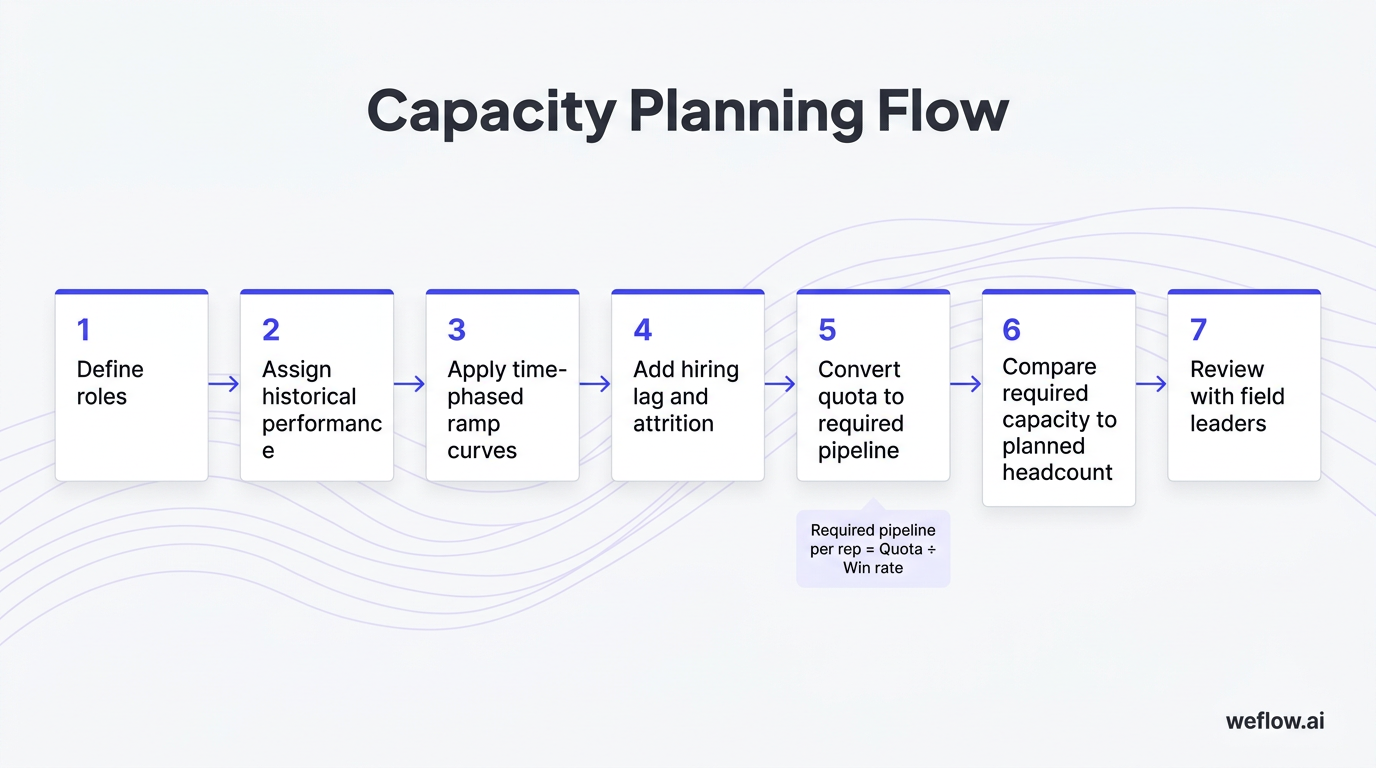
- Define the roles you’re planning for. Separate AE, SDR, AM, CSM, overlay, and partner roles if they have different productivity patterns or quota units.
- Assign historical performance by role and segment. Pull median ARR, win rate, cycle length, and coverage from Salesforce for each role that carries revenue responsibility.
- Apply time-phased ramp curves. Build monthly productivity percentages by role so new hires aren’t counted as fully productive on day one.
- Add hiring lag and attrition. Include time to open, hire, and onboard a rep, plus a standard attrition buffer so the model survives normal churn.
- Convert quota to required pipeline. Use win rate and cycle length to calculate how much pipeline each rep needs to create and progress.
- Compare required capacity to planned headcount. This is where you find the real gap: not “we need more reps,” but “we’re short 3.2 fully ramped mid-market AEs by May.”
- Review the result with field leaders. Frontline managers usually catch ramp assumptions, territory load problems, or SE coverage issues before the model goes live.
Top-down only targets create rep burnout because they ignore hiring lag, ramp time, territory quality, and pipeline creation reality. Bottom-up capacity math is the only way to show the executive team what extra headcount, pipeline, or budget the number actually requires.
Model time-phased rep ramp and attrition rates
Ramp isn’t a single assumption. It should vary by role, segment, and sometimes region if onboarding quality or deal complexity differs.
- Build monthly ramp percentages by role: for example, month one at 20%, month two at 40%, month three at 60%, then full productivity later in the year.
- Add 30–90 day hiring lead times: include time for sourcing, interviews, notice periods, and onboarding before any quota-bearing output appears.
- Include an attrition buffer: many B2B teams model 15–20% annual sales attrition as a baseline, then adjust by historical segment data.
If you ignore ramp time, you create forecast risk immediately. The first two quarters look healthy on paper because headcount appears “full,” but the team doesn’t have enough productive capacity to support the commit.
Map pipeline requirements to hiring timelines
Once quota is set, the pipeline requirement follows. That math should drive hiring timing, SDR capacity, and demand generation targets.
Formula: Required pipeline per rep = Quota ÷ Win rate
If a rep carries a $1,000,000 annual quota and wins 25% of qualified opportunities, that rep needs $4,000,000 in qualified pipeline over the period. If your median cycle length is six months, you also need that pipeline in market early enough for it to close inside the fiscal year.
Aggregate the requirement by segment and month, then compare it to:
- current pipeline already in Salesforce,
- expected pipeline creation from SDR and Marketing, and
- the output implied by the hiring plan.
This is where capacity planning connects directly to Marketing and SDR goals. If the model says the enterprise team needs another $12,000,000 of pipeline by Q2 to support quota, that isn’t a sales problem alone—it’s a demand generation target that needs executive sign-off.
Run base, upside, and downside scenario models
One scenario isn’t a plan. RevOps should show the executive team what happens if win rates improve, ramp speeds up, or pipeline creation misses.
| Base case | Upside case | Downside case |
|---|---|---|
| Uses current headcount, current productivity assumptions, current ramp curves, and the hiring plan already approved. | Improves key drivers by 10–20%, such as win rate, ramp speed, or pipeline creation pace, and may include incremental budget. | Models pipeline shortfalls, slower hiring, weaker conversion, or higher attrition to show likely exposure. |
| Useful for operating cadence and monthly forecast baselines. | Useful for deciding where extra headcount, marketing spend, or enablement investment could pay back. | Useful for early pull-backs, revised hiring plans, or cost control if the market softens. |
| Primary question: can the team hit the number with the plan as approved? | Primary question: what additional revenue is available if a few drivers improve? | Primary question: what needs to change if the assumptions break? |
These scenarios make trade-offs concrete. Instead of debating optimism, the CRO and CFO can decide whether a higher number needs more sellers, more pipeline investment, or a lower risk posture on comp and hiring.
Territory design: balance account books to maximize win rates
Territory design should give each rep a fair mathematical chance at quota. The fastest way to break trust with the field is to assign books by account count instead of account potential.
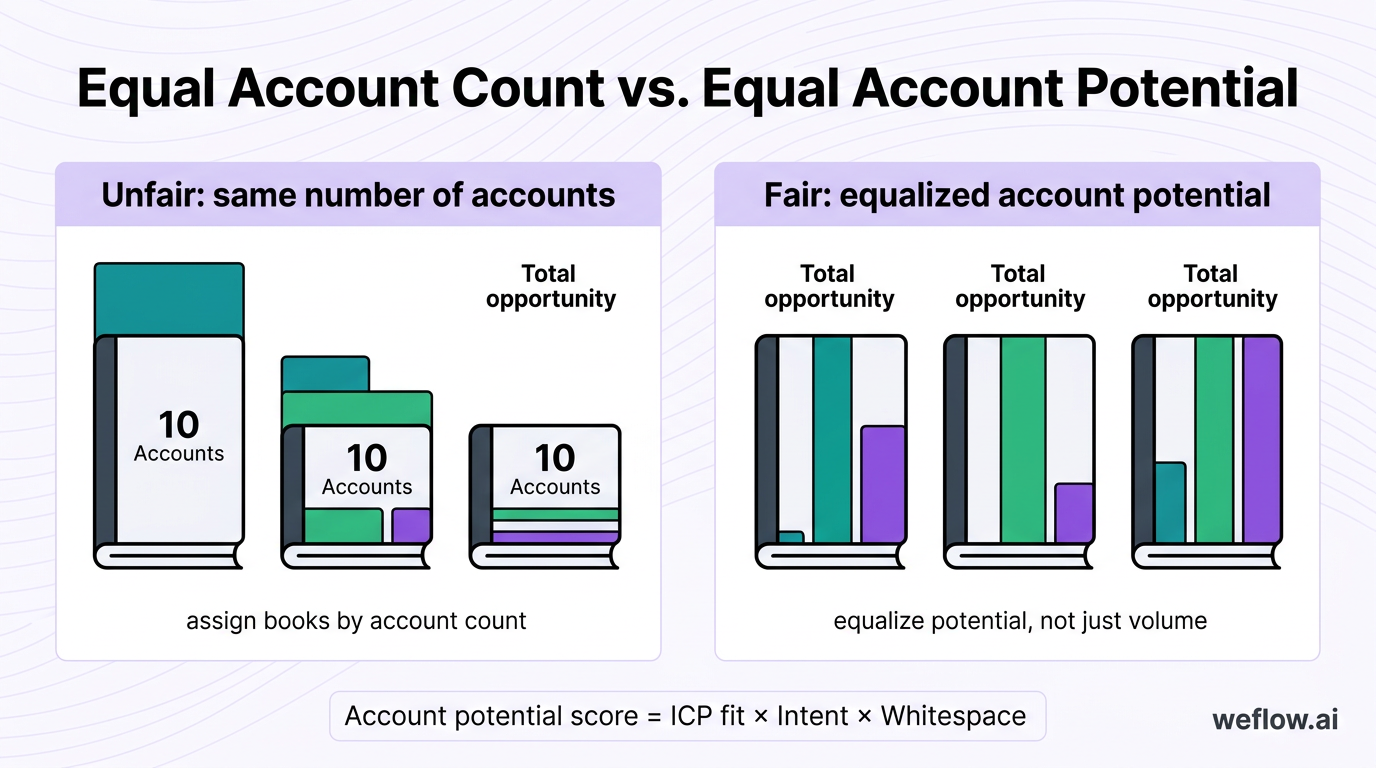
- Score every account for potential. Use ICP fit, intent, and whitespace to estimate revenue opportunity.
- Choose the primary territory cut. Decide whether books will be built by geography, segment, vertical, or a strategic named-account layer.
- Equalize potential, not just volume. Make sure the total opportunity in each book lands in a tight range.
- Check bandwidth. Accounts-per-rep, meeting load, SDR support, and SE support should match the rep’s actual capacity.
- Publish the roster and change rules. Reps should see what changed, why it changed, and when it takes effect.
The shift that matters most is simple: stop asking whether each rep has the same number of accounts, and start asking whether each rep has the same amount of realistic opportunity.
Score account potential using ICP and intent data
Territory fairness starts with a standard score on every account in Salesforce. That requires cleaner account data than many teams realize.
Formula: Account potential score = ICP fit × Intent × Whitespace
A simple version works well:
- ICP gate: yes or no based on minimum fit criteria.
- ICP fit score: 1–3 based on firmographics and buyer profile.
- Intent score: 1–3 based on buying signals, engagement, or known project timing.
- Whitespace score: 1–3 based on installed base, product penetration, or room to expand.
Freeze the fields that drive the score before you map territories—industry, employee band, revenue band, region, parent account, tech stack, current spend, and any custom account score fields. If those values change during the design cycle, books stop being comparable.
Most teams need enrichment help here. Without current firmographic coverage from providers like ZoomInfo or Clearbit, account scores depend too heavily on incomplete Salesforce records, and territory quality varies for reasons that have nothing to do with selling skill.
Map boundaries and equalize total potential scores
Once every account has a score, you can build books around a primary dimension and then rebalance until total potential lands in range.
- Select the primary dimension: geography, segment, vertical, or strategic named accounts.
- Group accounts into books: keep parent-child relationships intact where possible so ownership stays clear.
- Equalize the total potential score: compare each book’s total opportunity, not just account count.
- Create the rep-to-book roster: one roster should show rep, manager, segment, book name, potential score, and effective date.
- Flag strategic accounts separately: if one or two accounts would distort the book, carve them into a named overlay or house-account structure with explicit rules.
Strategic accounts often skew territory math. The clean fix is usually to isolate them with clear ownership and quota crediting rules, not to pretend they belong in a standard book and then wonder why one rep’s attainment profile looks nothing like the rest of the segment.
Review coverage models and optimize boundaries
A fair book still has to be sellable. After the first draft of territories, check whether the book can support the rep’s required pipeline and whether the rep can physically work the account set.
Warning: If account fields are missing, duplicate accounts remain unresolved, or territory changes are communicated late, you’ll create coverage gaps, manager escalations, and lost selling time in the first month of the plan.
- Verify 3–4x pipeline coverage by segment: the accounts in the book should support the rep’s quota based on historical win rate.
- Compare historical attainment to new book potential: this helps separate rep performance issues from weak account assignment.
- Set a bi-annual refresh cycle: frequent redraws waste selling time and erode trust, so change boundaries on a schedule and maintain a change log.
If a book is overloaded, adding SDR or SE support is often better than redrawing boundaries again. Constant territory changes can hurt more than a targeted support adjustment, especially in mid-market and enterprise motions with longer cycles.
Quota planning: set attainable targets that prevent rep burnout
Quota planning turns your capacity model and territory design into individual targets. The goal isn’t to make quota easy—it’s to make quota supportable.
- Start with modeled capacity. Use segment-level productivity, win rate, and cycle data to define what a fully ramped rep can realistically carry.
- Adjust for territory potential. Books with lower modeled potential shouldn’t carry the same target as books with more whitespace or stronger ICP concentration.
- Choose quota architecture by role. AEs usually carry ARR or bookings; AM and CSM teams often need GRR, NRR, or a split model.
- Time-phase the quota. Apply seasonality, start dates, and ramp status so monthly and quarterly numbers match selling reality.
- Publish exception rules before launch. Mid-year hires, transfers, and leave policies should be fixed before the first dispute hits Slack.
Quota inflation creates the wrong behaviors. When reps see “stretch” targets that don’t match territory quality or selling capacity, they sandbag late-stage deals, disengage from the plan, or leave.
Anchor quota architecture in modeled capacity
Quota architecture is the set of rules behind the number: what unit the rep carries, when full quota applies, and how much variance you allow across comparable roles.
- Pull segment medians: use median win rate, cycle length, and ARR per rep by role and segment as the starting point.
- Define the unit clearly: AEs usually carry ARR or bookings; AM and CSM roles usually carry GRR, NRR, or expansion depending on ownership.
- Set a quota ceiling: cap the number at what the role and segment can support based on bottom-up math, not wishful planning.
- Separate ramped and fully ramped logic: monthly ramp quotas should follow the same cohort rules for every eligible rep.
Bottom-up capacity math and top-down board targets won’t always match. When they don’t, reconcile them explicitly: either raise headcount, increase pipeline investment, change ramp assumptions, or accept a wider forecast risk band. Don’t hide the gap inside quota inflation.
Calibrate distribution for a 70-80% attainment rate
Most healthy sales organizations aim for 70–80% of fully ramped reps to hit goal. That’s a better design target than a blended average across the whole team, which can mask weak attainment under a wave of new hires.
P10/P50/P90 callout: Use an attainment curve to show the expected spread. P10 shows what low-end performance looks like, P50 shows the median rep outcome, and P90 shows strong but still plausible performance. If the median fully ramped rep can’t land near target, your quota design is too aggressive.
- Set floor, median, and stretch ranges by segment: this makes variability visible instead of burying it.
- Apply a calibration factor: many teams set quotas at roughly 85–95% of modeled capacity, then adjust for book quality.
- Review fully ramped attainment separately: boards care about the mature core team because it says more about the health of the sales engine than blended attainment does.
Handle mid-year exceptions and territory transfers
Exceptions should follow math, not negotiation. If you don’t publish rules upfront, every transfer and leave request turns into an escalation.
| Case | Rule | Math example |
|---|---|---|
| Late mid-period hire | Pro-rate quota by working days active and apply the rep’s ramp percentage for that period. | Monthly quota = $100,000; rep starts on day 11 of 20 workdays; ramp month = 40%. Quota = $100,000 × 40% × 10/20 = $20,000. |
| Territory transfer | Split quota by working days in each territory and document the effective date in the change log. | Monthly quota = $90,000; transfer on day 16 of 20. Old book = $90,000 × 15/20 = $67,500. New book = $90,000 × 5/20 = $22,500. |
| Leave of absence | Pause quota for full calendar days on leave, then resume the ramp curve where it stopped. | Quarterly quota = $120,000; rep is out 30 of 90 days. Adjusted quota = $120,000 × 60/90 = $80,000. |
Set a no retro changes policy and publish it in a central one-pager. If the effective date wasn’t approved before the period closed, the plan shouldn’t be rewritten after the fact.
Compensation design: drive profitable behaviors with simple math
Comp plans work when reps can explain them back to you in one minute. If the plan needs a spreadsheet and a manager interpretation to understand, it will create confusion, shadow accounting, and payout disputes.
- Keep it to one or two core measures per role. Reps should know exactly what gets paid and what doesn’t.
- Tie behavior to the business outcome. Pay AEs for new ARR and profitable deal structure, not for noisy activity counts.
- Use predictable math. One threshold and one accelerator tier are easier to administer and easier for reps to trust.
- Model cost before launch. RevOps and Finance should simulate payout at different attainment levels before the plan is approved.
- Lock policy in writing. Proration, crediting, discount treatment, clawbacks, and timing should live in one policy document.
Complex plans with hidden levers or micro-tiers usually demotivate reps. They make payout harder to predict, invite deal gaming, and create more manual work for Finance and RevOps at quarter end.
Tie core payout measures to specific role outcomes
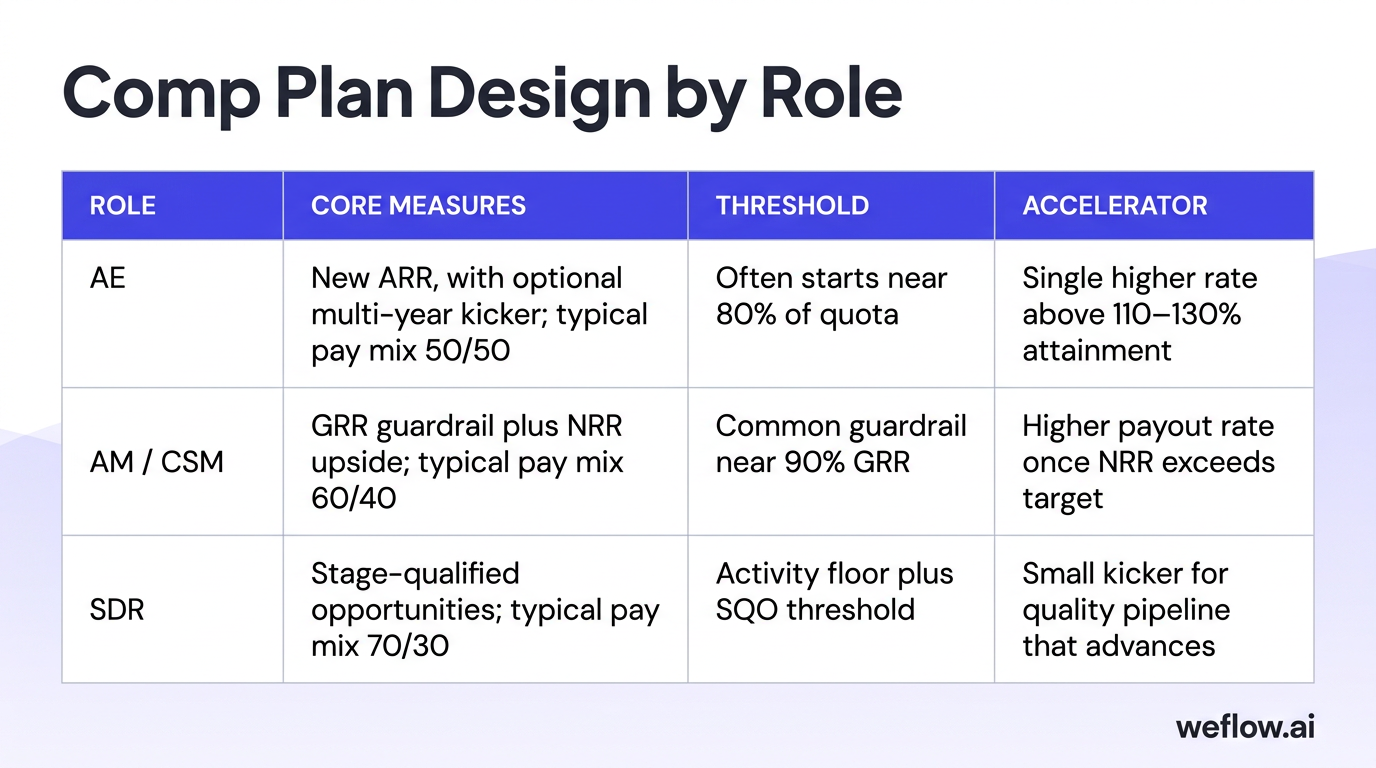
Each role should be paid on the outcomes it controls most directly. That keeps the plan fair and makes performance coaching easier.
| Role | Core measures | Threshold | Accelerator |
|---|---|---|---|
| AE | New ARR, with optional multi-year kicker; typical pay mix 50/50 | Often starts near 80% of quota | Single higher rate above 110–130% attainment |
| AM / CSM | GRR guardrail plus NRR upside; typical pay mix 60/40 | Common guardrail near 90% GRR | Higher payout rate once NRR exceeds target |
| SDR | Stage-qualified opportunities; typical pay mix 70/30 | Activity floor plus SQO threshold | Small kicker for quality pipeline that advances |
Pay on post-discount figures whenever possible. If commission pays on pre-discount ARR while Finance books less, you create margin problems and reward behavior the business doesn’t actually want.
Design predictable payout curves and accelerators
The payout curve should be easy to calculate without side rules buried in policy.
- Set a clear performance threshold: for many AE plans, payout starts near 80% attainment; for retention roles, a GRR guardrail may sit higher.
- Use linear math: steady earnings growth between threshold and target is easier to understand than stacked micro-tiers.
- Add one accelerator tier: a single rate increase above target usually gives enough upside without making cost hard to forecast.
- Use strategic modifiers carefully: multi-year, prepaid, or strategic product kickers should be limited and easy to audit.
- Keep SPIFFs time-boxed: use them for one strategic focus per quarter, not as a permanent patch for a weak plan.
Model total compensation costs across scenarios
Before launch, Finance and RevOps should test the plan at 70%, 100%, and 120% attainment. That shows whether the payout curve stays affordable when performance moves.
- Include headcount by role and start date.
- Apply monthly ramp assumptions to commissionable output.
- Include seasonality so payout timing matches expected bookings timing.
- Model thresholds, accelerators, and strategic modifiers.
- Define discount treatment and whether credits use net or gross ARR.
- Document proration, transfers, leaves, clawbacks, FX handling, and payment timing.
- Lock the approval path for exceptions.
- Publish the final policy as a one-pager.
This is where RevOps and Finance should work as one team. If RevOps designs payout logic without a cost model, or Finance models cost without field reality, commission overruns show up late and trust breaks fast.
Performance tracking: monitor metrics that signal revenue health
Once the plan is live, the job shifts from design to monitoring. Your dashboards should tell you early whether the model is holding or whether headcount, territory quality, pipeline creation, or manager capacity is drifting.
- Quota attainment: Track percent of reps hitting quota, split between ramping and fully ramped cohorts.
- ARR per rep: Measure productivity by segment, region, and manager to spot where capacity is working.
- Headcount vs. plan: Compare planned hires, actual hires, ramping reps, fully ramped reps, and attrition.
- Ramp time actuals: Compare modeled time-to-productivity against actual time-to-productivity for each cohort.
- Manager-to-rep ratio: Watch span of control, especially once teams push past 1:6.
- Pipeline coverage: Measure pipeline-to-quota by segment and month, not just at quarter start.
- Meeting volume and duration: Use these to understand rep workload and selling capacity, not as a quota proxy by themselves.
- Email reply rate and response time: These help explain buyer engagement and cycle movement when they’re written back to Salesforce cleanly.
Activity data quality matters here. Weflow, a Salesforce-native revenue AI platform, writes meeting, email, and call activity back to Salesforce so RevOps teams can track activity completeness, response patterns, and selling load with less manual cleanup. That matters because planning dashboards are only as good as the activity sync and Salesforce write-back behind them.
Track quota attainment and rep productivity trends
These are the metrics most likely to come up in quarterly board reviews because they explain whether the engine is scaling or just getting bigger.
Callout: Tracking rep tenure against productivity is one of the fastest ways to spot enablement gaps. If reps with six to nine months of tenure still perform like early-ramp hires, the issue is usually onboarding quality, manager coaching load, territory design, or pipeline support—not just rep talent.
- ARR per rep by region and manager: shows where territory quality or frontline coaching differs.
- Modeled ramp time vs. actual ramp time: tells you whether the headcount plan is producing the expected capacity.
- Headcount actuals vs. hiring plan: highlights whether missed starts or unexpected attrition are creating forward forecast risk.
These metrics answer the questions boards usually ask: Is the mature team hitting? Are new hires ramping on time? Are we hiring fast enough to support the plan? Are productivity gains real, or are they coming from a small number of outlier reps?
Compare compensation against industry benchmarks
Benchmarking helps you check whether your plan is competitive enough to hire and retain talent. Use these ranges as a baseline, then adjust for geography, market conditions, deal complexity, and company stage.
| Role / segment | Base salary | OTE | Quota range |
|---|---|---|---|
| SMB AE | $55,000–$75,000 | $100,000–$130,000 | $400,000–$600,000 |
| Mid-market AE | $70,000–$90,000 | $150,000–$180,000 | $700,000–$1,000,000 |
| Enterprise AE | $90,000–$140,000 | $200,000–$300,000+ | $1,200,000–$2,000,000+ |
| Sales manager | $100,000–$130,000 | $180,000–$240,000+ | Team quota: $2,000,000–$5,000,000+ |
| VP of Sales, $1M–$5M ARR company | $160,000–$180,000 | $250,000–$300,000 | Equity: 0.5%–1.0% |
| VP of Sales, $5M–$20M ARR company | $180,000–$200,000 | $300,000–$400,000 | Equity: 0.3%–0.7% |
| VP of Sales, $20M–$50M ARR company | $200,000–$225,000 | $350,000–$450,000 | Equity: 0.15%–0.4% |
| VP of Sales, $50M–$100M ARR company | $225,000–$250,000+ | $400,000–$500,000+ | Equity: 0.05%–0.2% |
Benchmark data moves with geography and market conditions, so don’t use it as a hard rule. Use it to pressure-test whether your OTEs, quotas, and pay mixes are close enough to market to support hiring and retention.
FAQ
How often should we update sales territories?
Twice a year is the right default for most B2B teams because it gives you room to rebalance for headcount and performance without resetting the field every quarter. If you change territories more often, publish a change log and keep strategic account exceptions tightly controlled.
What is a healthy pipeline coverage ratio?
Most teams plan around 3–4x pipeline-to-quota coverage, but the right number depends on segment win rate and sales cycle length. Lower win rates, longer cycles, and weaker stage hygiene usually mean you need to be closer to the high end of that range.
How do we handle quotas for reps on leave?
Pause quota for the full calendar days the rep is out, and resume the ramp curve exactly where it stopped when the rep returns. Keep the leave rule separate from any draw or earnings guarantee so quota math and payroll policy don’t get mixed together.
What is the ideal manager-to-rep ratio?
A 1:6 ratio is a strong operating benchmark because it gives managers enough time for deal inspection, coaching, and onboarding support. Once teams push much beyond that, ramp slows, forecast inspection gets thinner, and rep churn risk usually goes up.
.webp)

.webp)
.webp)

.webp)

.webp)
.webp)
.webp)

.webp)