


Revenue Cadence Framework to Build Accurate Forecasts and Stronger Pipeline Reviews [With Examples]


Inaccurate forecasts usually aren’t a math problem. They’re a process problem—too many opinion-based updates, not enough inspection, and no consistent rhythm for turning Salesforce data into decisions.
A defined revenue cadence fixes that. It gives reps, managers, RevOps leaders, and executives a clear schedule for reviewing pipeline, validating commits, and catching deal risk before it shows up in the board deck.
[banner type="download" url="https://www.weflow.ai/content/revenue-cadence-guide" text="Revenue Operating Cadence Guide" subtitle="Get the cadence framework, meeting checklist, and accountability template revenue leaders use." button="Download now"]Revenue cadence fundamentals: stop sandbagging and hit quota
Revenue creation works best as an ongoing operating process, not a once-a-week forecast call. The goal of a revenue cadence is simple: create a repeatable system that helps teams inspect pipeline quality, pressure-test commit numbers, and improve how opportunities move through the quarter.
That matters because sandbagging is expensive. If a team carries a $4 million quarterly quota and two $150,000 deals sit in best case when they should be in commit—or get quietly pushed until the last week—that’s a 7.5% swing before you even look at churn, slip rate, or pipeline generation gaps. The cost isn’t just a missed number. It shows up in hiring plans, board reporting, marketing spend, and sales capacity decisions built on the wrong forecast.
A structured cadence also improves win rates because it forces accountability earlier. Reps know they’ll need evidence for commit deals. Managers inspect close dates, stage progression, and next steps every week. RevOps can spot where activity completeness, forecast category usage, or stage hygiene are breaking down in Salesforce before reporting accuracy falls apart.
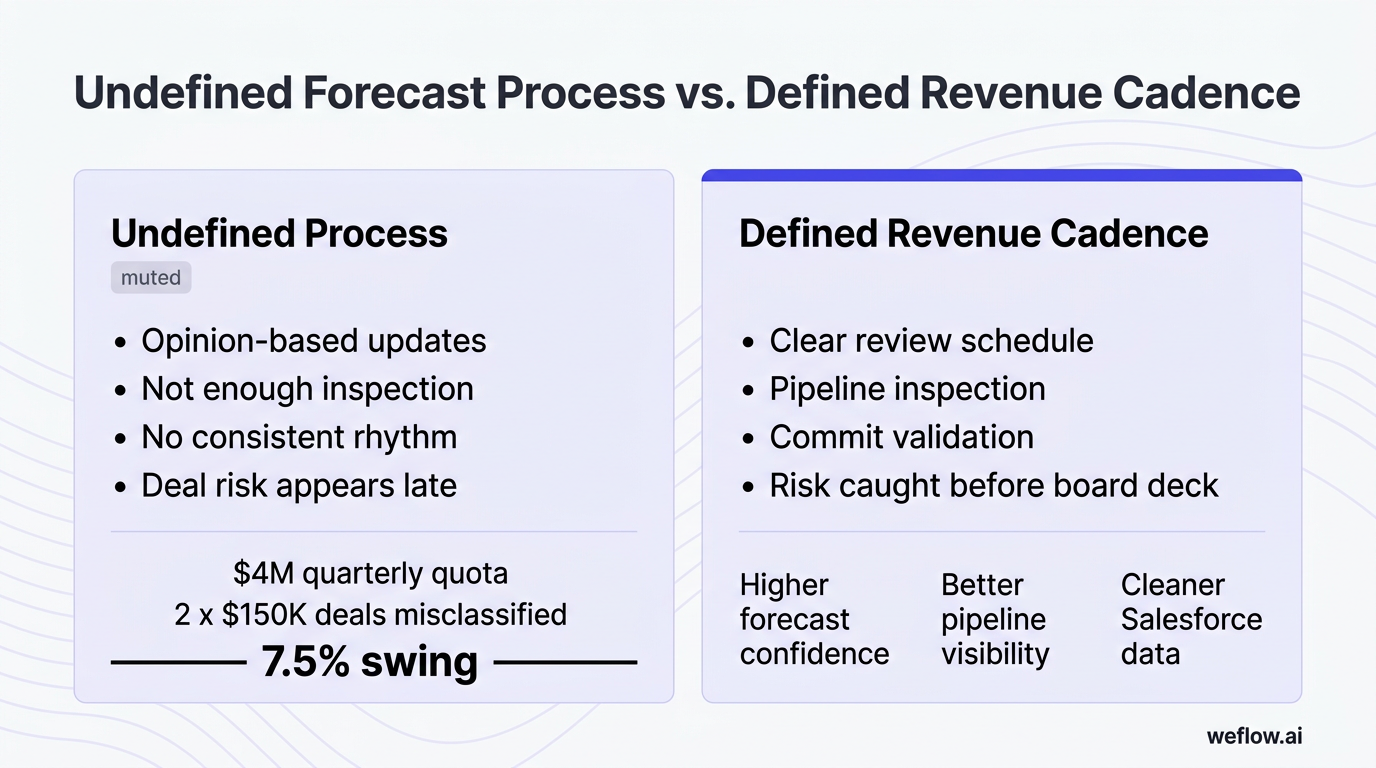
Core benefits: A defined revenue cadence reduces sandbagging, improves forecast confidence, raises pipeline visibility, and gives leaders cleaner Salesforce data to work from every week—not just at quarter end.
Core revenue ceremonies: align teams without wasting time
Not every revenue meeting should have the same purpose or the same audience. A strong cadence uses a small set of ceremonies, each with a specific job: inspect current quarter execution, roll up forecast changes, review top-of-funnel health, or plan for the next quarter. When meetings stay focused, teams spend less time narrating pipeline and more time deciding what to do next.
Smaller meetings almost always produce better pipeline visibility than large all-hands forecast calls. In a 1:1 or segment-level review, managers can challenge a rep on stage movement, buyer engagement, or a missing mutual action plan. In a large group call, most updates become performance theater—high-level summaries with little room to validate what’s actually changed.
Map meeting types to specific revenue goals
The easiest way to design a cadence is to map each ceremony to one revenue outcome. If a meeting doesn’t produce a decision, a commit, or a clear action list, it usually doesn’t need to exist.
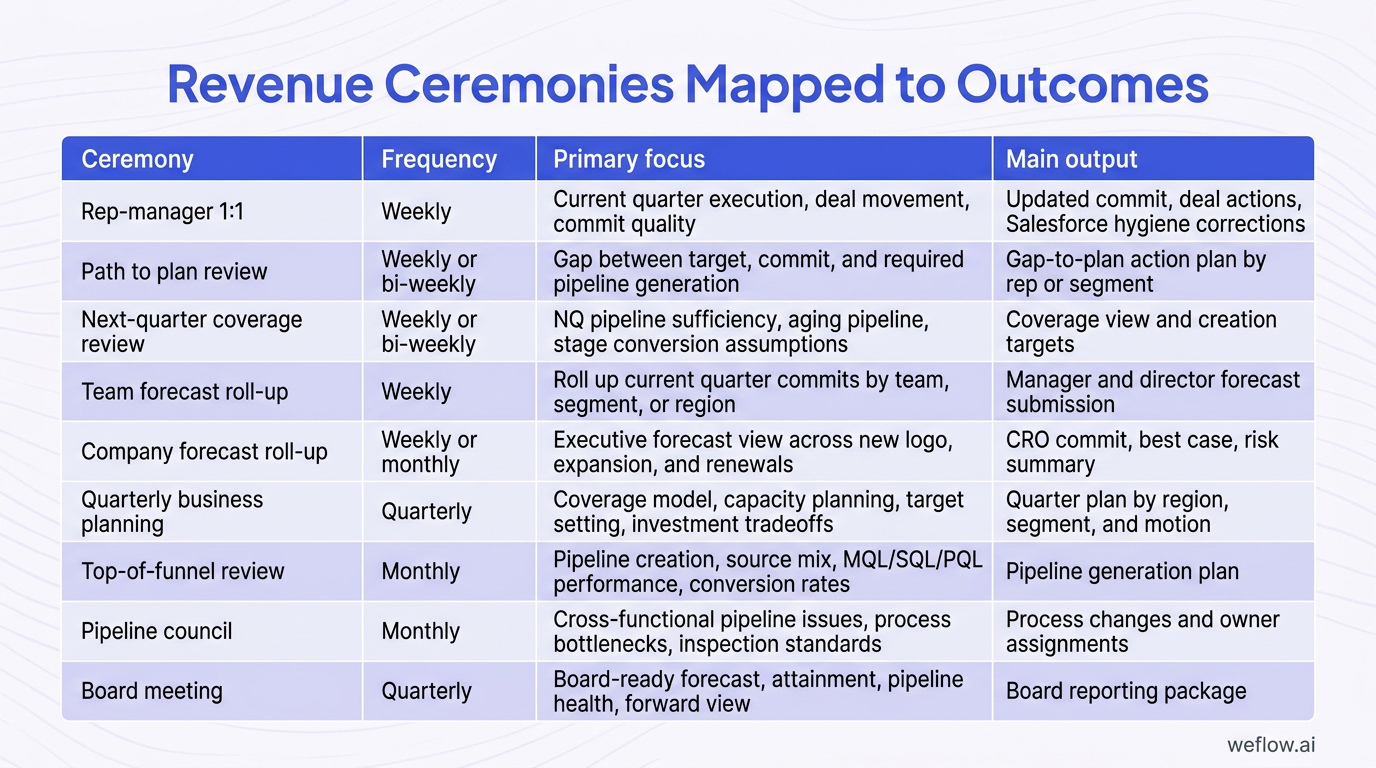
| Ceremony | Frequency | Primary focus | Main output | Typical attendees |
|---|---|---|---|---|
| Rep-manager 1:1 | Weekly | Current quarter execution, deal movement, commit quality | Updated commit, deal actions, Salesforce hygiene corrections | Manager, rep |
| Path to plan review | Weekly or bi-weekly | Gap between target, commit, and required pipeline generation | Gap-to-plan action plan by rep or segment | Manager, director, rep as needed |
| Next-quarter coverage review | Weekly or bi-weekly | NQ pipeline sufficiency, aging pipeline, stage conversion assumptions | Coverage view and creation targets | Manager, director |
| Team forecast roll-up | Weekly | Roll up current quarter commits by team, segment, or region | Manager and director forecast submission | Managers, directors, selected reps if needed |
| Company forecast roll-up | Weekly or monthly | Executive forecast view across new logo, expansion, and renewals | CRO commit, best case, risk summary | CRO, RevOps, VPs, directors |
| Quarterly business planning | Quarterly | Coverage model, capacity planning, target setting, investment tradeoffs | Quarter plan by region, segment, and motion | CRO, RevOps, VPs, directors |
| Top-of-funnel review | Monthly | Pipeline creation, source mix, MQL/SQL/PQL performance, conversion rates | Pipeline generation plan | CRO, RevOps, VPs, directors |
| Pipeline council | Monthly | Cross-functional pipeline issues, process bottlenecks, inspection standards | Process changes and owner assignments | CRO, RevOps, VPs |
| Board meeting | Quarterly | Board-ready forecast, attainment, pipeline health, forward view | Board reporting package | CRO, RevOps as needed |
A Path to Plan meeting is about the gap between the number you need and the number you have. A Forecast Roll-Up is about consolidating rep and manager commits into a leadership view the CRO can use.
Limit participant lists to drive efficient reviews
Participant lists should follow how your business actually sells. If your sales motions differ by ACV, region, buying process, or renewal model, your meetings should too.
- By vertical: Run separate reviews for Healthcare, Financial Services, Telecom, or any market with distinct compliance, procurement, or use case patterns.
- By territory: Split by US, EMEA, APAC, or subregions when close timing, legal cycles, and rep coverage differ.
- By segment: Separate SMB, Mid-Market, and Enterprise when deal velocity, stakeholder count, and commit confidence work differently.
- By record type: Keep New Logos, Expansions, and Renewals apart when they rely on different pipeline sources and forecast rules.
Mixing SMB and Enterprise reps in one review usually wastes time for both groups. The SMB team needs fast inspection on volume, conversion, and close-date movement, while Enterprise managers need time to discuss procurement, security review, executive alignment, and multi-quarter deal risk. One meeting can’t do both well.
Assign specific roles to each revenue ceremony
Every ceremony should have a clear owner and a small set of required participants. The simplest rule: include the people who can validate the data and change the outcome, and leave everyone else out.
| Ceremony | CRO | RevOps | VP/Director | Manager | Rep |
|---|---|---|---|---|---|
| Weekly 1:1 | Not needed | Not needed | Optional | Required | Required |
| Team forecast roll-up | Not needed | Optional | Required | Required | Optional |
| Company forecast roll-up | Required | Required | Required | Not needed | Not needed |
| Quarterly business planning | Required | Required | Required | Optional | Not needed |
| Quarterly business review | Required | Required | Required | Required | Optional |
| Top-of-funnel review | Required | Required | Required | Optional | Not needed |
| Pipeline council | Required | Required | Required | Not needed | Not needed |
| Board meeting | Required | Optional | Not needed | Not needed | Not needed |
RevOps has a specific role in these meetings: provide data truth, not field commentary. That means owning the definitions behind pipeline coverage, forecast category usage, activity completeness, stage conversion, and close-date movement inside Salesforce. Sales leaders bring the qualitative read on the deal. RevOps makes sure everyone is arguing from the same data.
Pipeline inspection questions: uncover risks and drive action
Pipeline reviews fail when the discussion stays at the level of “this deal feels good” or “I think it’ll close.” Good inspection questions force teams to look at objective evidence, not rep optimism. The best questions usually fall into two buckets:
- Pipeline Health: Are we carrying enough qualified pipeline, with the right coverage and conversion profile, to hit the plan for this quarter and the next one?
- Deal Risk: Which opportunities, accounts, or renewals have missing evidence, weak buyer engagement, or timing risk that could change the commit?
Assess quota gaps and pipeline coverage health
- Do we have enough qualified pipeline in the current quarter to achieve quota?
- What’s the gap between quota, manager commit, and leadership commit?
- How much pipeline coverage do we historically need to hit quota by segment, region, and motion?
- How much pipeline do we already have for next quarter, and how much still needs to be created?
- How much new pipeline has each team generated since the last review?
- How are stage-to-stage conversion rates trending compared with the last two quarters?
- What’s the ROI on MQLs, SQLs, and PQLs by source and segment?
- Do we have enough staff and manager capacity to support the plan we’re carrying?
If the answer to “Do we have enough pipeline?” is no, don’t jump straight to asking reps for a higher commit. Reset the math first: review historical coverage, identify where conversion assumptions broke, and assign pipeline creation targets by segment, territory, or record type. A weak pipeline problem usually needs a generation plan, not a louder forecast call.
Identify at-risk deals and strategic new logos
At the opportunity level, the goal is to separate real progress from rep confidence. An objective positive indicator is a buyer action that signals movement—like a completed security review, an executive sponsor meeting on the calendar, confirmed procurement steps, a signed mutual action plan, or legal redlines already in progress.
- Which deals in commit are at risk, and what changed since the last review?
- What objective positive indicators exist for every commit and best-case deal?
- Which deals have no buyer-verified next step in Salesforce?
- Which strategic new-logo opportunities matter most for this quarter or the next two quarters?
- Which accounts are showing risk signals for churn, contraction, or stalled expansion?
- Where do we have renewals coming up in the next 3, 6, 9, and 12 months?
- Which opportunities advanced stages without the required proof points or sales methodology fields completed?
These questions work best when the supporting fields already exist in Salesforce. If your managers need to ask for next steps, close-date justification, MEDDIC fields, forecast category, and activity history every time, the review will drift into cleanup work instead of inspection.
Revenue cadence examples: structure your weeks and quarters
The best cadence is the one your team can actually run every week. Treat the examples below as starting points, then adapt them to your sales cycle, deal size, renewal motion, and methodology. A team selling enterprise new logos on 9-month cycles will run a different rhythm than a team managing fast-moving SMB pipeline or a heavy renewal book.
The weekly cadence feeds data upward into the quarterly cadence. If rep commits, close-date changes, and pipeline hygiene aren’t updated consistently in Salesforce each week, the quarterly roll-up turns into a manual re-forecast exercise.
Build a weekly cadence for immediate accountability
| Monday | Tuesday | Wednesday | Thursday | Friday | |
|---|---|---|---|---|---|
| Sales | Manager-rep 1:1 pipeline review. Reps submit current quarter commit and update close dates, next steps, and forecast category. | Managers follow up on exceptions: slipped deals, missing activity, weak next steps, and stage changes without evidence. | Leadership forecast and commit call. Directors and VPs review team roll-ups, risk deals, and gap to plan. | Managers review next-quarter coverage, pipeline generation progress, and top new-logo priorities. | Reps clean up Salesforce records, log missing next steps, and resolve stale opportunities before the week closes. |
| Operations | RevOps rolls up rep commits, refreshes dashboards, and flags data completeness issues. | RevOps validates forecast categories, activity sync status, and close-date movement against reporting rules. | RevOps publishes leadership views for commit, best case, coverage, and risk by segment and region. | RevOps prepares next-quarter coverage, top-of-funnel, and conversion trend reporting. | RevOps monitors pipeline hygiene, resolves field-mapping exceptions, and locks in clean data for Monday reviews. |
| Deliverable | Rep current quarter commit | Manager exception list and follow-up actions | Leadership current quarter commit and gap-to-plan summary | Next-quarter coverage plan and creation targets | Clean pipeline, ready for next week’s 1:1s |
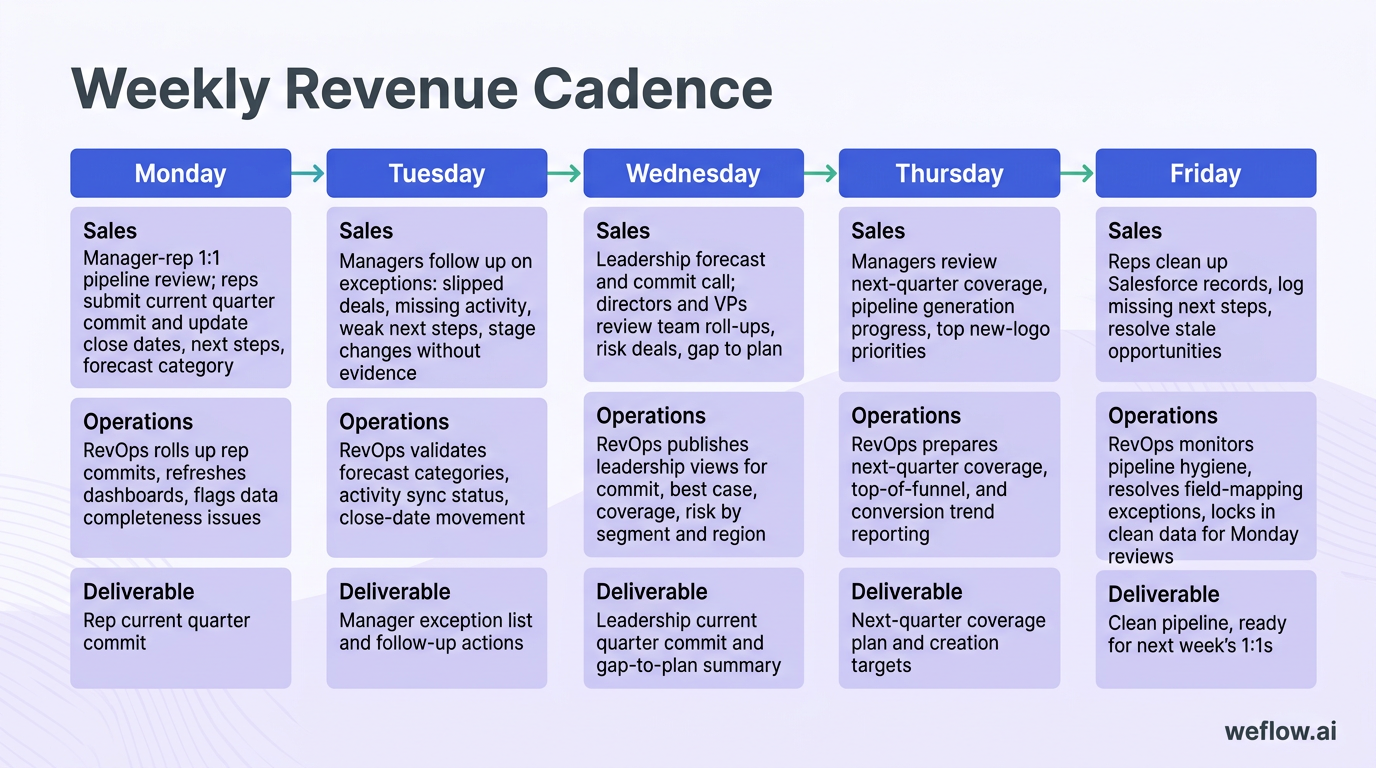
Friday is the right day for CRM cleanup because it closes the loop on the selling week without disrupting mid-week forecast work. If reps wait until Monday morning to fix Salesforce, managers walk into 1:1s arguing about stale close dates and missing next steps instead of discussing real deal strategy.
Map a quarterly cadence to track long-term targets
Quarterly rhythm matters because the questions change as the quarter progresses. Early on, you’re inspecting pushed deals and commit quality. By mid-quarter, you should already be shifting attention to next-quarter coverage. Late in the quarter, the cadence tightens around daily movement on top deals, renewals, and expansion.
| Week | Primary focus | Rep and manager motion | Deliverable |
|---|---|---|---|
| 1 | Review pushed deals from the prior quarter and reset current quarter reality | 1:1 pipeline inspection on slipped deals, close-date validity, and forecast category | Current quarter commit |
| 2 | Current quarter pipeline review and expansion pipeline | 1:1s focused on coverage gaps and deal progression | Current quarter commit |
| 3 | Top deals review for current quarter | Inspect objective positive indicators on commit deals | Current quarter commit |
| 4 | Current quarter pipeline review and expansion follow-up | Recheck stage movement, next steps, and risk accounts | Current quarter commit |
| 5 | Next-quarter pipeline and top deals | Shift inspection to NQ coverage and pipeline creation needs | Current quarter commit |
| 6 | Current quarter pipeline review and expansion | Focus on deal support, resource needs, and commit quality | Current quarter commit |
| 7 | Top deals review for current quarter | Revalidate buyer engagement and procurement timing | Current quarter commit |
| 8 | Current quarter pipeline review and renewals | Inspect renewal risk and expansion timing | Current quarter commit |
| 9 | Top deals review for current quarter | Pressure-test every commit deal for evidence and timing | Current quarter commit |
| 10 | Next-quarter pipeline and top deals | Build NQ confidence before the quarter closes | Current quarter commit |
| 11 | Next-quarter commit | Managers finalize NQ view while protecting current quarter close focus | Next-quarter and current quarter commit |
| 12 | Daily stand-ups for top deals, renewals, and expansions | Fast inspection of blockers, approvals, legal, procurement, and close readiness | Final NQ and current quarter commit |
Revenue cadence implementation: start small and scale up
You don’t need 10 meetings to improve forecast accuracy. Start with the two ceremonies that create the most discipline: weekly rep-manager 1:1s and a weekly leadership forecast roll-up. Once those are consistent, add next-quarter coverage reviews, top-of-funnel reviews, and quarterly planning.
- Standardize the inputs: Decide which Salesforce fields are required for every forecast review—forecast category, close date, next step, deal amount, stage, renewal date, and sales methodology fields.
- Define inspection rules: Managers should ask the same questions every week so commit quality doesn’t depend on management style.
- Use validation where it helps: Validation rules, required fields, and exception reporting can keep stage progression and forecast updates clean without creating unnecessary admin burden.
- Give RevOps ownership of reporting truth: RevOps should manage dashboards, gap-to-plan views, and pipeline hygiene reporting so leaders aren’t debating definitions in the meeting.
- Support the cadence with the right platform: Weflow, a Salesforce-native revenue AI platform, helps RevOps teams improve activity completeness, reduce manual forecast prep, and keep pipeline reviews grounded in live Salesforce data. Because Weflow writes back to Salesforce, teams can enforce the cadence where forecasting and board reporting already happen—and deploy in weeks, not quarters.
FAQ
What is a revenue operating cadence?
A revenue operating cadence is a structured schedule of meetings, deliverables, Salesforce updates, and inspection rules used to manage revenue performance. It aligns sales leadership, managers, marketing, and RevOps around one operating rhythm so forecast changes, pipeline gaps, and deal risks get reviewed before they become end-of-quarter surprises.
How often should revenue teams review pipeline?
Weekly is the baseline for rep-manager pipeline reviews. Broader forecast roll-ups usually happen weekly for current quarter execution and bi-weekly or monthly for next-quarter coverage, depending on sales cycle length, average deal size, and how much pipeline volatility your business carries.
Who should attend weekly forecast roll-ups?
Weekly forecast roll-ups should usually include sales managers, directors, VPs, and RevOps if reporting support is needed. Individual reps are better used in 1:1s, where managers can inspect deals in detail without turning a leadership call into a 20-person status meeting.
How do revenue ceremonies prevent sandbagging?
They make deal movement visible and repeatable. When reps have to update commit status, next steps, and close-date changes in Salesforce every week—and managers inspect those updates against objective proof points—it becomes much harder to hide strong deals, delay escalation, or carry weak opportunities in commit without evidence.
.webp)

.webp)
.webp)

.webp)

.webp)
.webp)
.webp)

.webp)