


Customer Success Operations: Build Health Scores, Renewal Forecasts, and Scalable Playbooks [Framework]


Customer Success Operations exists to make post-sale execution repeatable, measurable, and forecastable. When it’s working, CSMs spend less time fixing data and more time driving adoption, renewals, and expansion.
This framework covers the core CS Ops function, how it fits into RevOps, how to operationalize the Bowtie Model, and how to build health scores, renewal workflows, and playbooks that hold up as the business grows.
[banner type="download" url="https://www.weflow.ai/content/cs-ops-cheat-sheet" text="Customer Success Operations Cheat Sheet" subtitle="Definitions, role responsibilities, lifecycle frameworks, and core metrics checklist for CS Ops." button="Download now"]CS Ops fundamentals: scale the post-sales lifecycle
Customer Success Operations is the operating layer behind onboarding, adoption, retention, and expansion. It owns the systems, data standards, reporting logic, process design, and forecasting model that let Customer Success run as a revenue function instead of a reactive support queue.
That shift matters. Without CS Ops, post-sale work usually lives inside individual CSM habits: one rep updates Salesforce after every meeting, another keeps renewal notes in a spreadsheet, and a third tracks risks in Slack. You can’t build a reliable renewal forecast or health model on top of that.
The five core functions of CS Ops usually look like this:
- Insights and strategy: Turn adoption, retention, NPS, and churn data into operating decisions. This includes Voice of Customer programs, trend analysis, and cross-functional planning with Product, Sales Ops, and Finance.
- Process optimization: Standardize how post-sale work gets done. CS Ops maps handoffs, defines milestones, creates playbooks, and sets the operating cadence for onboarding, risk reviews, renewals, and expansion.
- Data and reporting: Define the metrics that matter, maintain data completeness, and build reports leaders can trust. That covers health, product adoption, renewal risk, NRR, GRR, and forecast accuracy.
- Systems and automation: Own the post-sale tech stack and the data flows between systems. That includes Salesforce, the CS platform, product usage sources, surveys, support data, and activity sync.
- Planning and forecasting: Build renewal and churn forecasts, support segmentation and book-of-business design, and connect CS performance to company OKRs.
Most teams also organize CS Ops work across five operating model domains: strategy and planning, enablement, data and analytics, business systems, and pricing and Deal Desk. Together, those domains move Customer Success from reactive account management to proactive revenue protection and growth.
Define the core functions and operating model
Day to day, CS Ops sits between customer-facing execution and systems administration. The function translates strategy into workflows, field requirements, dashboards, automations, and forecast rules that frontline teams can actually follow.
| Operating model domain | Primary objective |
|---|---|
| Strategy and planning | Turn CS goals into staffing plans, target metrics, renewal programs, and quarterly priorities. |
| Enablement | Give CSMs the process, documentation, training, and system guidance needed to execute consistently. |
| Data and analytics | Convert customer data into health models, renewal forecasts, executive reporting, and operating insight. |
| Business systems | Manage the CS tech stack, field mapping, automation logic, permissions, and integration health. |
| Pricing and deal desk | Support renewal structure, expansion packaging, and commercial consistency across post-sale revenue motions. |
Separating operations from frontline CSM work prevents two predictable failures. First, CSMs burn time on admin work instead of adoption and risk management. Second, data hygiene degrades because the same person trying to save an account is also expected to maintain fields, task states, and forecast notes with perfect consistency.
Map CS Ops to the broader RevOps organization
In most B2B organizations, CS Ops works best under the same revenue operating model as Sales Ops and Marketing Ops. That reporting structure gives the business one set of definitions, one planning cadence, and one source of truth for revenue.
- CRO
- Customer Success
- Revenue Operations
- CS Ops
- Sales Ops
- Marketing Ops
- Sales
- Marketing
- CFO
- FP&A
That structure matters because the post-sale lifecycle starts with sales data. If Sales Ops defines Closed-Won one way and CS Ops uses a different handoff rule, onboarding starts late, ARR gets misstated, and renewal dates drift. The same is true for churn, contraction, reactivation, expansion, and onboarding complete.
A short alignment checklist:
- Use one definition for Closed-Won, including which required fields must exist before handoff.
- Use one definition for churn, contraction, renewal, and expansion ARR.
- Agree on which Salesforce objects hold contract dates, subscription terms, and renewal ownership.
- Align on forecast categories and review cadence across Sales, CS, RevOps, and Finance.
- Maintain one GTM metrics dictionary so leadership isn’t debating definitions in forecast calls.
The Bowtie Model: operationalize the customer journey
The Bowtie Model is useful because it treats the customer lifecycle as one continuous revenue system. Pre-sale activity creates post-sale conditions, and post-sale health determines retention and expansion.
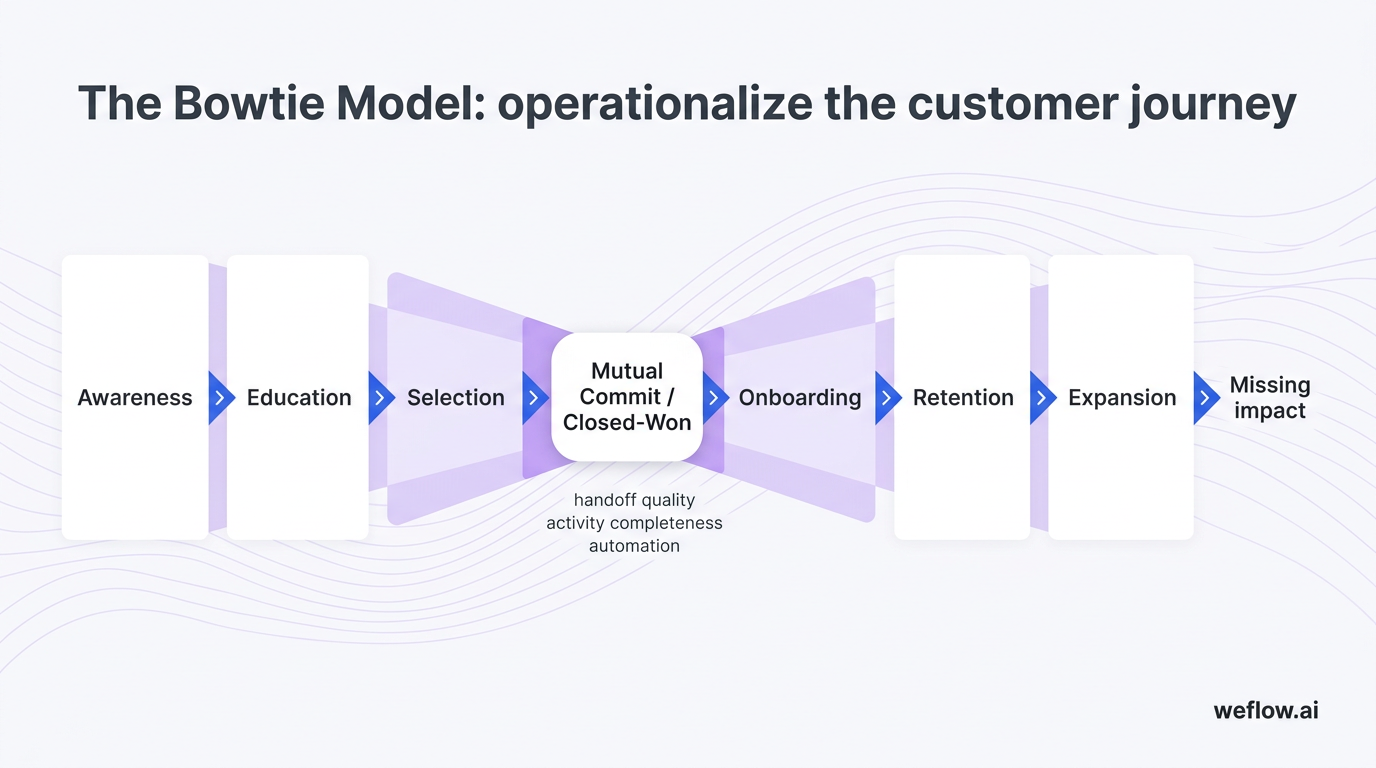
At a high level, the journey moves through awareness, education, selection, mutual commit, onboarding, retention, and expansion. In practice, CS Ops cares most about where handoff quality, activity completeness, and automation affect revenue outcomes.
- Awareness: Early demand creation. CS Ops usually has little direct ownership here, but it benefits from clean segmentation and attribution definitions set by RevOps.
- Education: Buyer learning and evaluation. The important downstream requirement is that stakeholder roles, use cases, and buying context are captured cleanly in Salesforce.
- Selection: Commercial evaluation and deal shaping. Product scope, contract terms, and implementation expectations need to be structured for post-sale use.
- Mutual Commit / Closed-Won: The operational handoff point. CS Ops defines the readiness checklist, field requirements, templates, task creation, and ownership model.
- Onboarding: Time-to-value execution. CS Ops tracks milestones, task SLAs, kickoff completion, and onboarding health.
- Retention: Ongoing adoption and risk management. This is where health scores, activity coverage, support trends, and renewal forecasting start to matter.
- Expansion: Growth within the account. CS Ops converts usage and engagement patterns into expansion signals and clean handoffs to Sales.
- Missing impact: The customer isn’t getting the expected value. CS Ops needs a system for detecting that gap before it shows up as churn.
The Bowtie breaks when data doesn’t move cleanly between systems. In Salesforce terms, that usually means the Opportunity closes, but product details, stakeholders, success criteria, contract dates, and next-step tasks never make it to the CS platform or back into the right Salesforce objects. CS Ops turns the model into field mapping, automation rules, validation rules, and sync monitoring.
Standardize onboarding to accelerate time-to-value
Onboarding is the first place where weak operations show up. If the handoff is incomplete, the CSM starts by chasing missing context instead of driving customer outcomes.
- Set a closed-won readiness standard in Salesforce. Before an opportunity can move to Closed-Won, require core handoff fields such as ARR, products sold, contract term, renewal date, implementation scope, primary contacts, and success criteria.
- Write sold data to the right records. Map opportunity data into the correct Salesforce objects—usually Account, Contact, Opportunity, Contract, and subscription or entitlement custom objects if your model uses them.
- Create onboarding work automatically. Use record-triggered flows or your CS platform to generate kickoff tasks, milestone templates, and ownership assignments as soon as the handoff passes validation.
- Pre-fill the success plan. Bring over business goals, products purchased, use case, stakeholders, and target outcomes so the CSM isn’t starting from a blank page.
- Track milestone progress. Measure kickoff scheduled, implementation complete, first value reached, and onboarding complete with explicit criteria—not CSM judgment alone.
- Monitor exceptions. Flag overdue milestones, no-show kickoffs, and accounts with low early engagement so managers can intervene before onboarding stalls.
A clean Salesforce handoff is the foundation of successful onboarding. If the account starts with missing renewal dates, unclear product scope, or incomplete stakeholder mapping, every downstream playbook gets weaker.
Automate retention workflows and renewal forecasts
Retention becomes predictable when CS Ops combines timing, customer health, and activity data into one operating model. The goal isn’t just to know which renewals are due. It’s to know which ones are at risk early enough to change the outcome.
Renewal workflow trigger points:
- 90 days before renewal: Create or validate the renewal opportunity in Salesforce, confirm ARR and term dates, assign ownership, and start the renewal cadence.
- 60 days before renewal with weak health: Mark the renewal as at risk, notify CS leadership, and schedule a save plan review.
- No meaningful activity in 30 days: Create a task for outreach and flag the account for activity completeness review.
- NPS below 7 or support tickets spike: Trigger a risk review, update the forecast assumption, and log mitigation steps.
- Open commercial questions within final renewal window: Route to Deal Desk or Finance so discounting, billing, or term issues don’t delay close.
Renewal forecasting also works better when CS Ops and Finance use the same operating assumptions. Finance cares about revenue timing, churn exposure, and plan attainment. CS Ops provides the inputs behind that forecast: health trend, usage trend, recent activity, stakeholder engagement, and renewal stage movement. That’s how renewal forecasting ties back to company OKRs instead of living as a separate CS report.
Identify expansion signals for proactive upsells
Expansion should not depend on a CSM remembering to mention a customer comment from last week. CS Ops turns those signals into repeatable rules, opportunity creation logic, and conversion tracking in Salesforce.
Common expansion triggers include:
- Usage exceeds licensed seats, storage, or consumption thresholds
- High adoption across core features with stable executive engagement
- NPS of 9 or 10 paired with active product usage
- Customer asks for adjacent features not in the current contract
- New team, region, or business unit starts using the product
- Contracted modules are fully adopted and adjacent modules show fit
- Strong onboarding completion followed by steady recurring usage
There’s a big difference between a CSM noticing an opportunity and CS Ops systematizing the signal. One is anecdotal. The other is a defined threshold, a Salesforce trigger, an alert to the right owner, and a report on conversion rate by segment, product line, or book of business.
Scalable playbooks: turn data into CSM action
A playbook is the bridge between a metric and a behavior. If a dashboard shows low adoption or rising churn risk but doesn’t tell the CSM what to do next, the reporting isn’t helping the team operate.
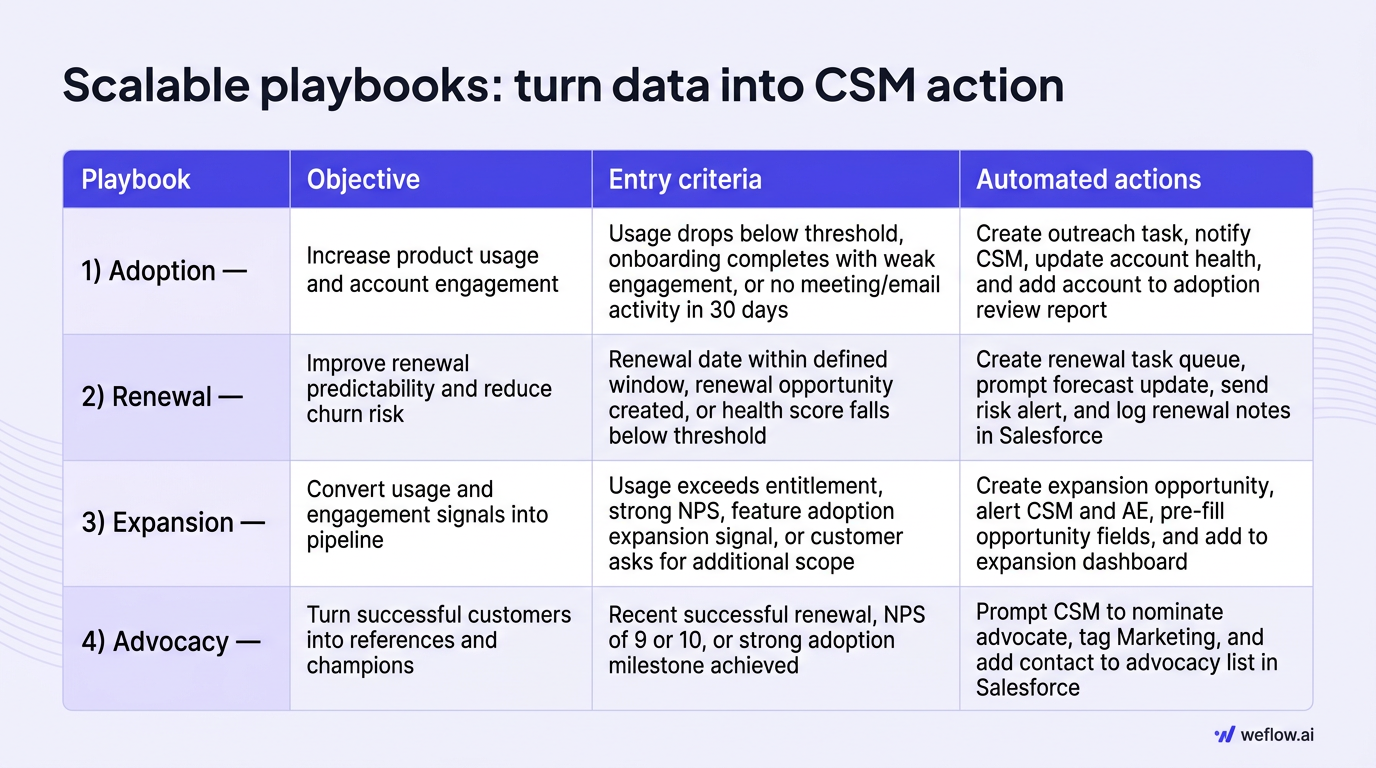
Every CS playbook should answer four questions: what is the objective, what triggers entry, who owns the response, and which systems hold the required data. That structure keeps the process consistent even as team size, segment mix, and customer volume grow.
| Playbook | Objective | Entry criteria | Automated actions |
|---|---|---|---|
| Adoption | Increase product usage and account engagement | Usage drops below threshold, onboarding completes with weak engagement, or no meeting/email activity in 30 days | Create outreach task, notify CSM, update account health, and add account to adoption review report |
| Renewal | Improve renewal predictability and reduce churn risk | Renewal date within defined window, renewal opportunity created, or health score falls below threshold | Create renewal task queue, prompt forecast update, send risk alert, and log renewal notes in Salesforce |
| Expansion | Convert usage and engagement signals into pipeline | Usage exceeds entitlement, strong NPS, feature adoption expansion signal, or customer asks for additional scope | Create expansion opportunity, alert CSM and AE, pre-fill opportunity fields, and add to expansion dashboard |
| Advocacy | Turn successful customers into references and champions | Recent successful renewal, NPS of 9 or 10, or strong adoption milestone achieved | Prompt CSM to nominate advocate, tag Marketing, and add contact to advocacy list in Salesforce |
Dashboards are useless unless they connect to a specific playbook or CSM action. A health score alone doesn’t reduce churn. A health score tied to a defined escalation path, task set, owner, and timeline can.
Build health scores and risk escalation triggers
Most teams make health scoring too complicated too early. Start with a small set of high-confidence inputs you can trust, then add complexity only after you’ve measured whether the score actually predicts retention.
- Choose a short list of inputs. Start with product usage, support ticket volume, NPS or CSAT, recent executive engagement, and CSM sentiment if it’s captured consistently.
- Standardize the data window. Decide whether each signal is measured over 7, 30, or 90 days. Mixed windows create noisy scores.
- Normalize the inputs. Convert each signal to a consistent scale so usage, survey data, and support data can be compared fairly.
- Apply simple weighting. Weight signals based on observed correlation with churn or renewal outcomes, not team intuition alone.
- Define score bands. Set clear green, yellow, and red thresholds, then attach an operating response to each band.
- Write the score back to Salesforce. Store the current score, score trend, last update date, and risk reason in fields that reporting and workflows can use.
- Set escalation rules. For example: red score plus renewal inside 60 days triggers manager review; red score plus executive sponsor inactivity triggers leadership escalation.
- Review false positives and misses monthly. A health score is useful only if the team trusts it enough to act on it.
A simple model with 4 trusted signals beats a 20-input model nobody believes. Start with what you can measure consistently, then improve the model as your data quality and historical retention data improve.
Deploy automations without losing human oversight
Automation should remove repetitive work, not replace judgment. The fastest way to make alerts irrelevant is to fire too many of them with weak signal quality.
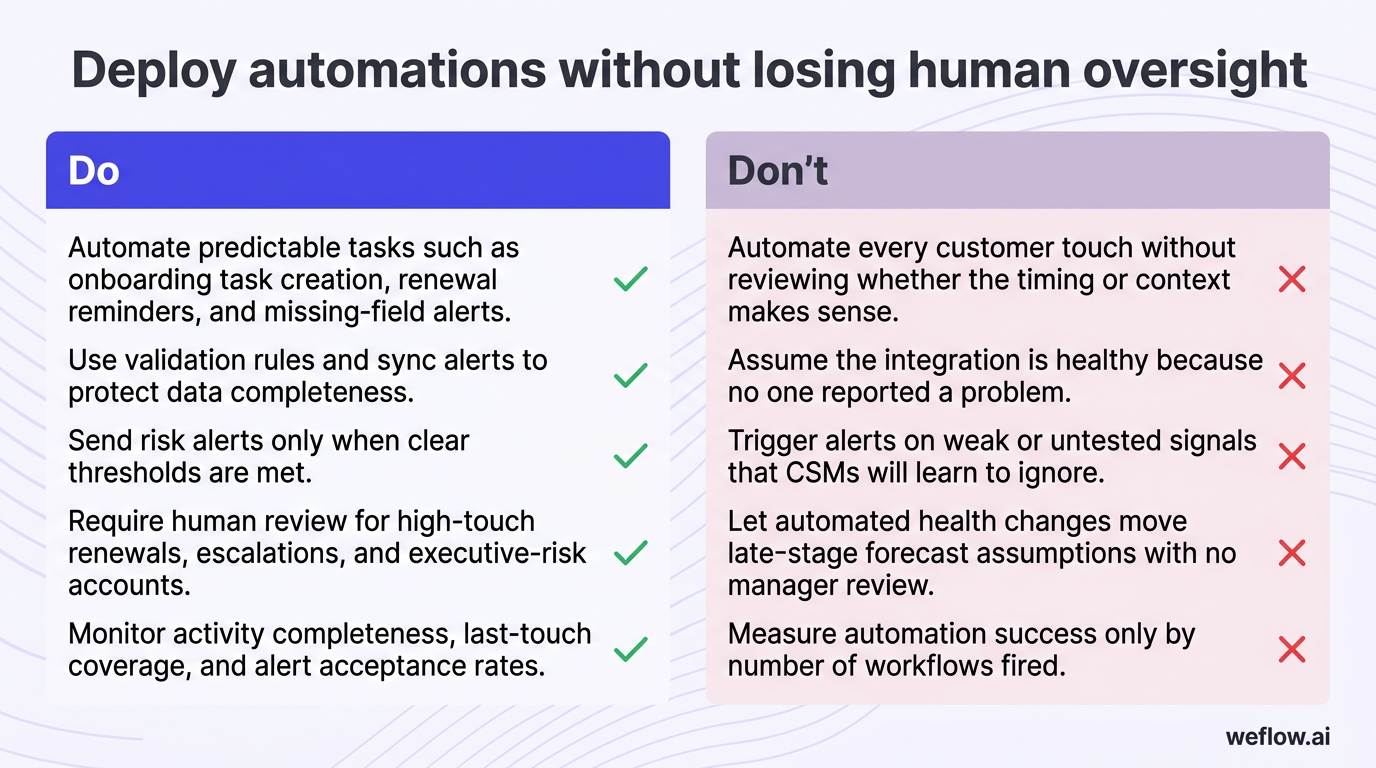
| Do | Don't |
|---|---|
| Automate predictable tasks such as onboarding task creation, renewal reminders, and missing-field alerts. | Automate every customer touch without reviewing whether the timing or context makes sense. |
| Use validation rules and sync alerts to protect data completeness. | Assume the integration is healthy because no one reported a problem. |
| Send risk alerts only when clear thresholds are met. | Trigger alerts on weak or untested signals that CSMs will learn to ignore. |
| Require human review for high-touch renewals, escalations, and executive-risk accounts. | Let automated health changes move late-stage forecast assumptions with no manager review. |
| Monitor activity completeness, last-touch coverage, and alert acceptance rates. | Measure automation success only by number of workflows fired. |
Over-automation leads to alert fatigue. Once CSMs see enough false alarms, they stop trusting the system entirely. That’s why activity coverage, task completion, and escalation acceptance are more useful than raw alert volume.
If your team relies on Salesforce Einstein Activity Capture or Gong for post-sale activity visibility, audit whether those activities are actually reportable, mapped to the right records, and available for workflow logic. Many CS Ops teams discover activity gaps only when renewal forecasting breaks. A Salesforce-native write-back model is usually easier to govern because the activity lives in the same system as the forecast, validation rules, and reporting logic.
Systems and data governance: build a single source of truth
CS Ops needs more than a CS platform. It needs a clean data architecture across Salesforce, product data, support data, survey data, and reporting layers. If those systems disagree, your health scores and renewal forecasts will drift.
The cost of fragmented systems is straightforward: double data entry, failed handoffs, weak activity completeness, and inaccurate churn reporting. Most teams don’t notice the full cost until leadership asks why Finance, Customer Success, and RevOps all have different renewal numbers.
A practical CS Ops tech stack usually includes these layers:
- System of record layer: Salesforce for account, contact, opportunity, contract, renewal, and revenue data.
- Execution layer: CS platform, support platform, project management tools, and team collaboration systems.
- Data layer: Product analytics, data warehouse, ETL processes, and BI tooling.
- Engagement layer: Survey tools, email and meeting activity capture, customer communications, and chat.
- Governance layer: Data dictionary, field ownership, validation rules, field-level security, permission sets, and compliance controls.
Integrate the CS tech stack with CRM architecture
For most B2B organizations, Salesforce is still the ultimate source of truth for revenue. The CS platform can calculate health and coordinate work, but it still has to push customer status, renewal risk, and activity data back into Salesforce accurately enough for reporting and forecasting.
Use this integration health checklist:
- Define the source of truth for each object and field: Account, Contact, Opportunity, Contract, renewal object, subscription custom object, health score, product usage summary, and owner fields.
- Confirm required field mapping in both directions, including ARR, renewal date, segment, products sold, account status, health score, and risk reason.
- Check how failed sync jobs are surfaced and who owns remediation.
- Audit validation rules to make sure integrations don’t bypass the same data quality standards expected from users.
- Review field-level security and permission set access so write-back jobs can update the right records without overexposing sensitive data.
- Track API usage and sync cadence, especially in Salesforce Enterprise and Unlimited editions with multiple GTM tools hitting the same objects.
- Confirm whether activities are stored as native Salesforce records, external references, or UI-only artifacts that reporting can’t use.
- Run weekly reconciliation for renewal dates, ARR, health values, and owner assignments between Salesforce and the CS platform.
- Make sure SOC 2 Type II, compliance requirements, and retention policies are documented before rollout.
If you’re migrating from Gong, evaluate the project at the field-mapping level, not the demo level. The usual problem CS Ops is trying to solve is shallow Salesforce mapping, incomplete post-sale activity write-back, and manual workarounds to make the data usable in renewal workflows. Weflow, a Salesforce-native revenue AI platform, gives Business Systems teams a smaller integration footprint and direct Salesforce write-back, so the migration is usually measured in weeks, not quarters.
Track retention metrics and revenue churn rates
CS Ops owns more than health scores. It also owns the operating metrics that explain whether onboarding, adoption, and renewal systems are working.
| Metric | Definition | Benchmark |
|---|---|---|
| Net Revenue Retention (NRR) | Revenue kept from existing customers after churn, contraction, and expansion are all included | Good: >100%; strong: >110% |
| Gross Revenue Retention (GRR) | Revenue kept from existing customers before counting any expansion | Good: >85%; strong: >90%; top teams: >95% |
| Time to first value | Time between purchase and the first meaningful customer outcome | Enterprise teams often target 1-3 months or better depending on implementation scope |
| Product adoption rate | Percentage of purchased features or modules actively used by customers | Good: >60%; strong: >80% |
| Renewal forecast accuracy | How close the committed renewal forecast is to actual retained revenue | High-performing teams often target forecast error within 5%-10% |
GRR vs. NRR: GRR tells you how much recurring revenue you retained before expansion. NRR adds expansion and contraction on top of that base. That means a company can post healthy NRR while still hiding a weak GRR underneath. CS Ops should track both so expansion doesn’t mask retention problems.
CS Ops maturity model: transition from reactive to strategic
Most CS Ops teams grow through four stages. The right next step depends on your current operating reality, not the most advanced model you’ve seen in another company’s deck.
- Foundational: Data is scattered, forecasting is manual, and CS Ops work is mostly reactive. The team has basic churn and renewal reporting, early playbooks, and a heavy focus on CRM hygiene.
- Operationalized: Core workflows are defined, reporting cadence is regular, and ownership is clearer. Health scoring exists, renewal pipeline tracking is in place, and CSMs follow a standard process more consistently.
- Scaled: The CS tech stack is integrated, key playbooks are automated, and the business can forecast renewals and expansion with reasonable confidence. Data flows are more reliable, and leadership can inspect customer health by segment or book of business.
- Strategic: CS Ops acts as a planning partner to RevOps, Finance, and Product. The team uses predictive models, capacity planning, and customer insight to shape company decisions, not just report on them.
The goal isn’t to jump straight to predictive AI modeling. Most teams first need clean handoffs, activity completeness, renewal dates they trust, and playbooks that actually get followed.
Audit your current stage and strategic focus
Use a short self-assessment before you add another tool or rebuild your entire workflow.
- Are ARR, renewal date, segment, product entitlements, and customer owner complete in Salesforce for at least 95% of active accounts?
- How much CSM time still goes to manual status updates, task tracking, and renewal note cleanup?
- Do CS Ops, Sales Ops, and Finance share the same definitions for churn, contraction, expansion, and onboarding complete?
- Can managers explain why an account is red, yellow, or green without reading free-text notes?
- Do your alerts drive behavior, or do CSMs ignore them because the signal quality is weak?
- Can Finance trace renewal forecast changes back to system data rather than last-minute opinion?
- Does every key dashboard map to an owned playbook and named response?
- Are integration failures reviewed weekly, or only after leadership notices reporting issues?
Moving from stage 1 to stage 2 is usually a data cleanup and process standardization project. Moving from stage 3 to stage 4 is more about predictive analytics, cross-functional planning, and tighter alignment with Finance and Product.
Solve common operational bottlenecks and pitfalls
| Problem | Why it breaks CS Ops | Solution |
|---|---|---|
| Dashboard factory | CS Ops produces more reporting, but CSMs don’t know what to do with it. The team gets visibility without execution. | Attach every dashboard to a playbook, an owner, and a response SLA. If a metric doesn’t change behavior, stop reporting it at the frontline level. |
| Weak change management | New processes get rolled out once, then drift across segments and managers. Adoption falls, and data quality follows. | Document the process, train to it, assign ownership, and review compliance in manager cadence—not just at launch. |
| Misaligned definitions with RevOps | Different teams report different churn, renewal, and expansion numbers, which destroys trust in the forecast. | Maintain one metrics dictionary, one ownership model, and one planning cadence across CS Ops, Sales Ops, RevOps, and Finance. |
| No success metrics for CS Ops | The function measures everyone else but can’t prove its own impact, which makes hiring and tooling harder to justify. | Track CS Ops KPIs such as data completeness, process adoption, automation usage, sync error rate, and renewal forecast accuracy. |
The dashboard factory problem is common because reporting feels productive. But more charts rarely fix post-sale performance on their own. When CSMs get too much data without a playbook, they either chase the loudest metric or ignore the dashboard entirely. Good CS Ops reduces ambiguity. It tells the team what changed, why it matters, and what to do next.
FAQ
What is the difference between CS Ops and RevOps?
CS Ops is the post-sale branch of the broader RevOps model. RevOps covers the full go-to-market system across marketing, sales, and customer success, while CS Ops focuses on onboarding, adoption, retention, expansion, and renewal forecasting.
In practice, RevOps usually owns company-wide revenue architecture, planning cadence, and CRM governance. CS Ops applies that operating discipline to the customer lifecycle after the deal closes, including health scoring, playbooks, customer data quality, and renewal operations.
How do you calculate a customer health score?
Start with a small set of signals that are both reliable and predictive: product usage, support ticket volume, NPS or CSAT, recent customer engagement, and CSM sentiment if it’s captured consistently. Normalize those inputs to a common scale, apply simple weighting, and group the result into clear score bands such as green, yellow, and red.
The important part isn’t the math alone. A useful health score also includes score trend, reason codes, and an operating response. If a red score doesn’t trigger a defined review, escalation, or renewal risk workflow, the model won’t change outcomes.
What are the most important CS Ops metrics?
The core metrics are NRR, GRR, time to first value, product adoption rate, churn rate, and renewal forecast accuracy. Those numbers tell you whether customers are reaching value, staying healthy, and renewing at the rate the business expects.
Beyond revenue metrics, strong CS Ops teams also track operational inputs such as data completeness, activity coverage, onboarding completion rate, sync error rate, and process adoption. Those are the metrics that explain why retention numbers move up or down.
When should you hire a CS Ops manager?
Hire a CS Ops manager when manual post-sale work starts breaking your data quality or forecast accuracy. A common trigger is a CS team with 8-10 or more CSMs, multiple segments, or enough renewal volume that spreadsheets and manager judgment no longer hold up.
Another sign is when Salesforce data can’t support reliable onboarding tracking, health scoring, or renewal reporting without constant cleanup. At that point, the cost of not having CS Ops usually shows up as missed handoffs, weak activity completeness, and forecast calls built on opinion instead of system data.
.webp)

.webp)
.webp)

.webp)

.webp)
.webp)
.webp)

.webp)