


5 Value Selling Steps That Help Reps Win With Customer Value [Framework]


Value selling works when a rep can connect their product to a problem the buyer cares enough to fix. If that connection never gets made, the conversation usually falls back to features, pricing, and a generic demo.
This five-step framework shows reps how to build product conviction, run better discovery, teach instead of pitch, follow up with relevance, and stay human when deals slow down. The goal is simple: move from describing what your product does to showing why it matters for this buyer.
[banner type="download" url="https://www.weflow.ai/content/value-selling-checklist" text="Value Selling Framework Checklist" subtitle="Checklist with self-assessment prompts to uncover product value, fit, objections, and positioning." button="Download now"]Product conviction: find the value before you sell it
Before a rep can sell value, they need a clear point of view on the product itself. That means understanding where it helps, where it wins against alternatives, and where it’s a poor fit.
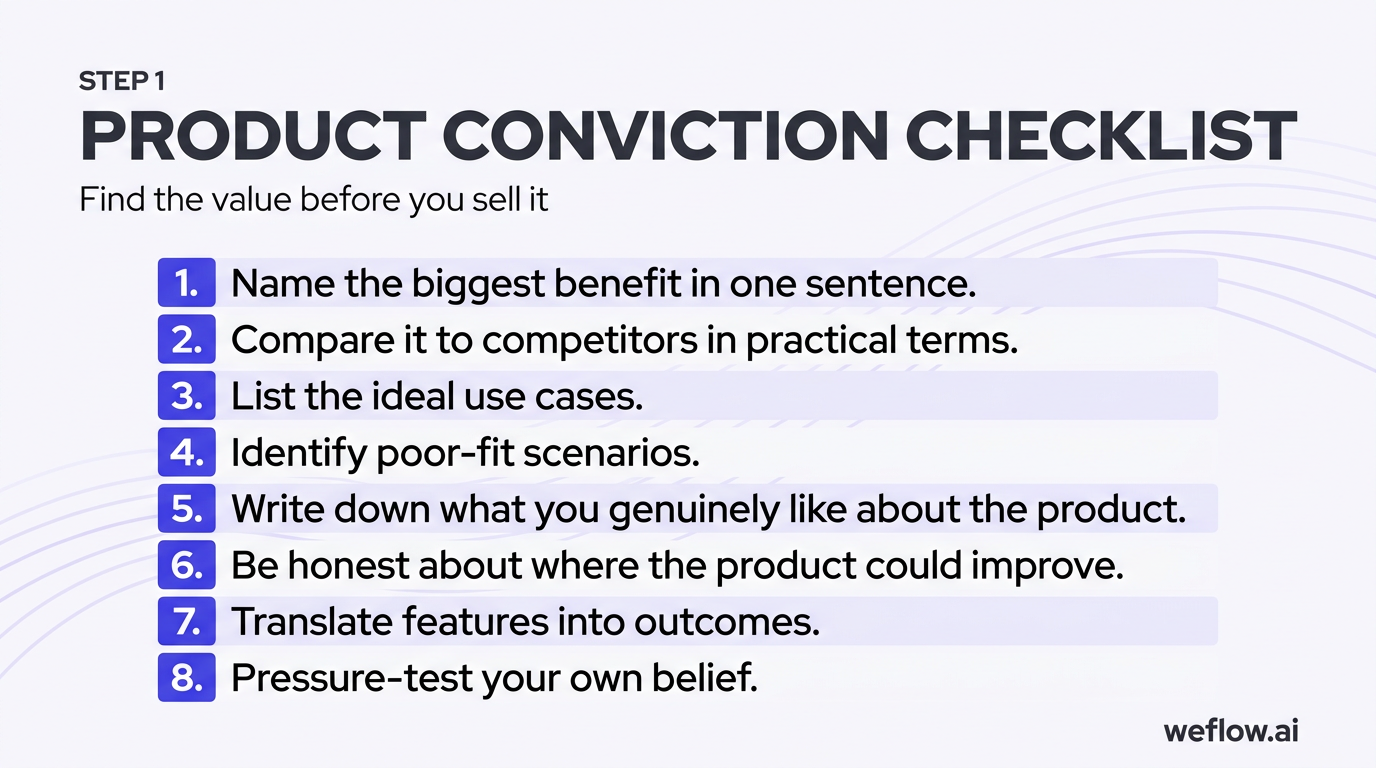
- Name the biggest benefit in one sentence. If you can’t explain the primary outcome clearly, your buyer won’t be able to either.
- Compare it to competitors in practical terms. What does your product do better, faster, or more reliably—and what does it not do?
- List the ideal use cases. Which roles, teams, or company stages get the most value from it?
- Identify poor-fit scenarios. Which buyers are unlikely to see enough value to justify a purchase?
- Write down what you genuinely like about the product. This usually becomes the part of the story you tell with the most confidence.
- Be honest about where the product could improve. Buyers trust reps who can talk about tradeoffs without getting defensive.
- Translate features into outcomes. Don’t stop at “it has automation” or “it has reporting.” Ask what that changes for the buyer’s day-to-day work.
- Pressure-test your own belief. Would you recommend this product to a former colleague in the target role? Why or why not?
Rep conviction matters because buyers can tell when someone is reciting a script. A rep who genuinely believes in the product sounds clearer, answers objections with more confidence, and is less likely to force a fit that isn’t there.
Customer discovery: uncover what buyers actually value
Discovery is where value selling either gets specific or falls apart. Skip it, and reps default to the same pitch for every account—usually a feature-led pitch that sounds polished but doesn’t address the buyer’s real problem.
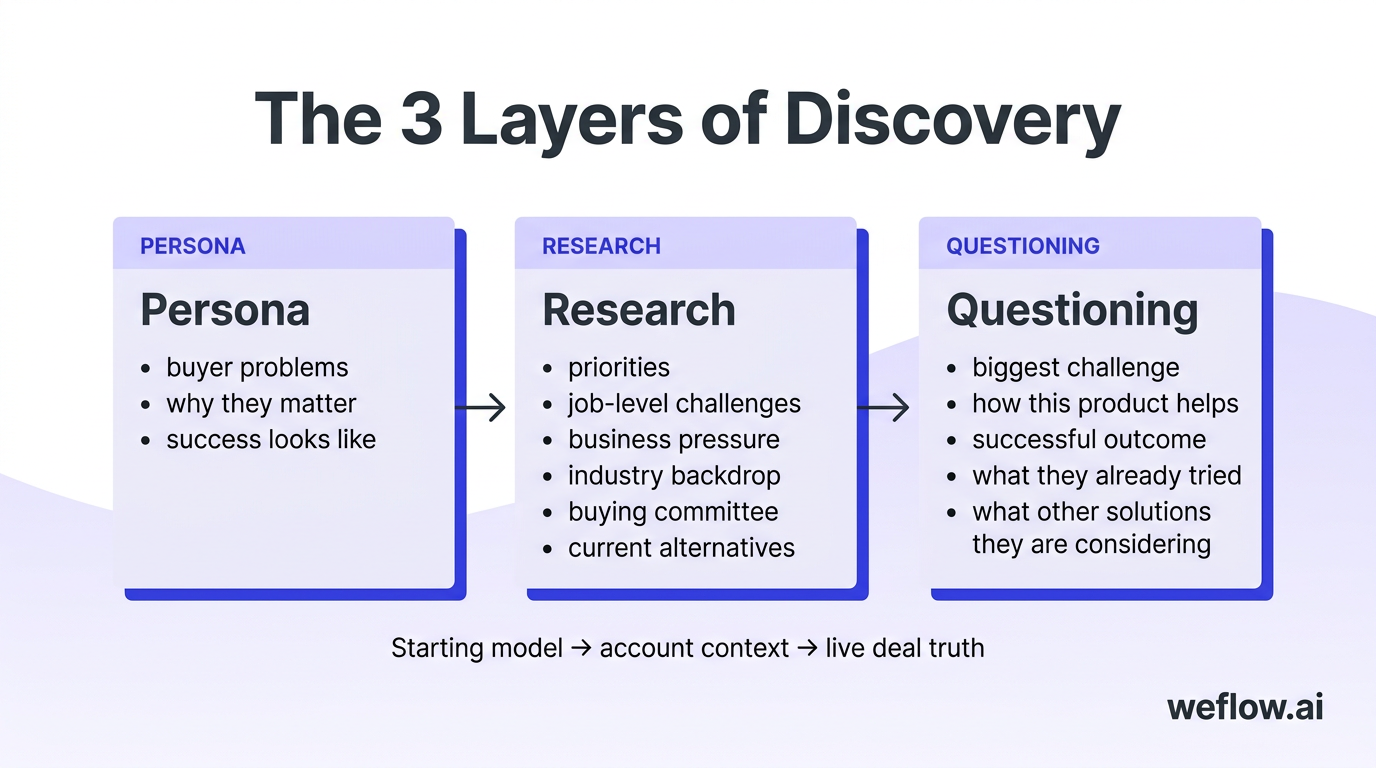
A useful discovery process has three layers: persona, research, and questioning. Persona gives you a starting model of the buyer, research adds account context, and questioning confirms what is actually true in the live deal.
Draft an ideal customer persona profile
Your persona should explain more than job title and company size. It should capture the buyer’s problems, why those problems matter, and what success looks like from their point of view.
- Who is the ideal customer? Define the role, level of seniority, reporting line, and type of company they usually work in.
- What is this person struggling with? List the daily issues, recurring blockers, and business pressures they’re dealing with.
- How does your product help solve those challenges? Match each common struggle to a specific product outcome.
- Why is solving the problem important to them? Tie the issue to performance, team credibility, revenue goals, or career impact.
- What other problems does this challenge create? Good discovery looks at downstream effects, not just the surface pain.
- What is the most important thing this person wants to accomplish? This helps you separate nice-to-have value from urgent value.
- What does this person value most? Speed, accuracy, control, visibility, cost, risk reduction, team capacity—be specific.
Use real data to answer these questions. Review closed-won opportunities in Salesforce by title, segment, industry, and primary pain point. Look at call notes, opportunity history, loss reasons, and expansion patterns from similar accounts so your persona reflects actual buying behavior, not assumptions.
Research the prospect and their industry
Once you have a baseline persona, add account-specific context before the first meeting. This is where reps start separating a generic target account from a real buying environment.
- Find the prospect’s current priorities. Look for signs of growth targets, hiring plans, territory changes, cost pressure, or system changes.
- Map the job-level challenges. A VP, manager, and admin can all care about the same purchase for different reasons.
- Identify the broader business pressure. Is the company trying to improve margins, reduce risk, enter a new market, or increase output without adding headcount?
- Understand the industry backdrop. Regulation, buyer behavior, market consolidation, or budget freezes can all change what the prospect values.
- Map the buying committee. Who else needs to see value for the deal to move forward—finance, security, IT, procurement, or a second operational stakeholder?
- Look for signs of current alternatives. Existing tools, internal workarounds, spreadsheets, consultants, or a competitor already in the stack all shape the deal.
Two efficient research sources are LinkedIn Sales Navigator for role changes, team structure, and account activity, and industry reports or earnings materials for market pressure and strategic priorities. A few minutes of focused research usually gives you better discovery questions than another hour memorizing product slides.
Ask questions that reveal core challenges
The best discovery questions don’t just confirm that a problem exists. They help the buyer describe the cost of the problem, the result they want, and why prior attempts fell short.
Use discovery questions like these:
- What is the biggest challenge you’re dealing with right now?
- How do you expect purchasing this product will help you improve or solve that challenge?
- What outcome would need to happen for you to view this purchase as successful?
- What solutions have you already tried, and why didn’t they work?
- What other solutions are you considering, and what do you find appealing about them?
Ask the question, then listen for what the buyer repeats, quantifies, or says with emotion. That’s usually where the real value signal is. If they start talking about reporting delays, failed adoption, or internal pressure from leadership, follow that thread instead of rushing to the next question on your list.
Educational selling: prove product value through teaching
Value selling gets stronger when the rep teaches the buyer something useful about their own workflow. That can happen in a demo, a webinar, or a trial—as long as the experience is built around the buyer’s use case rather than a standard product tour.
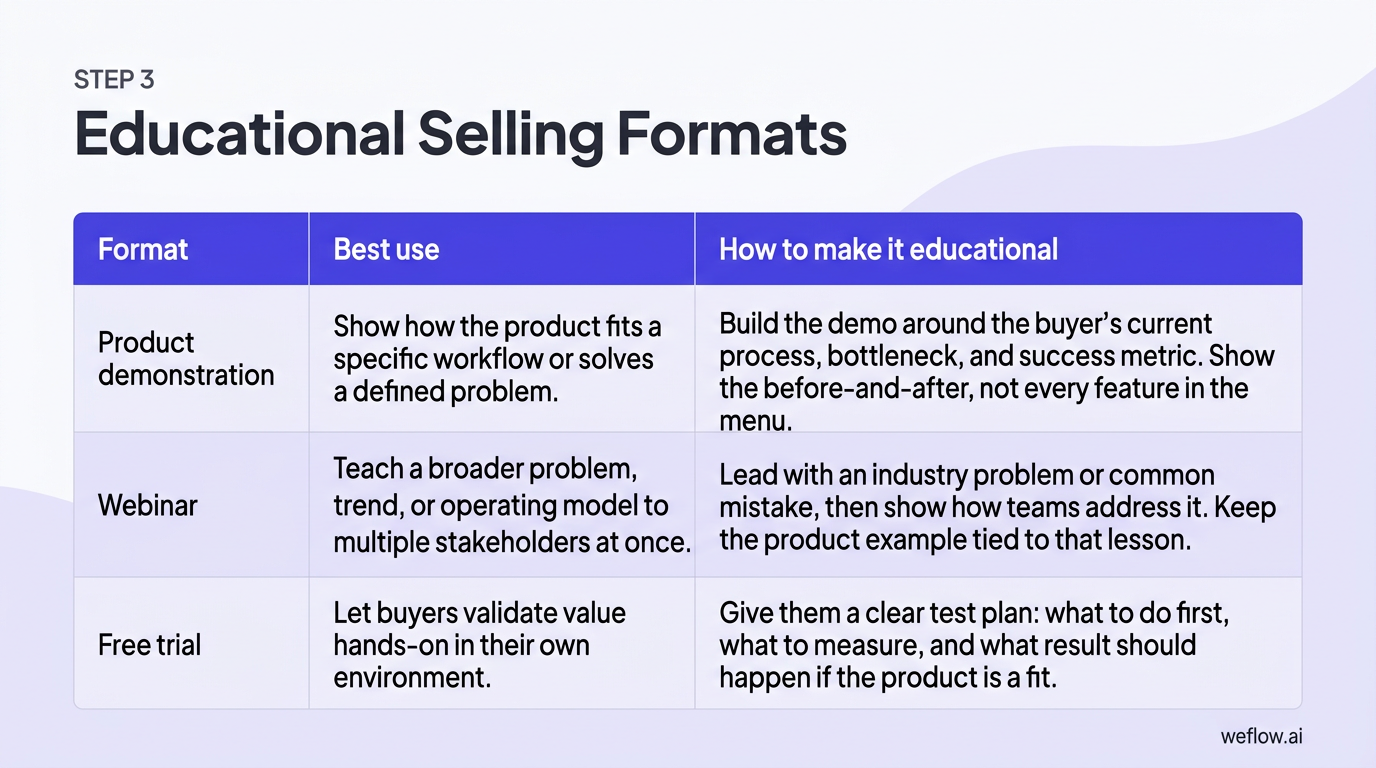
| Format | Best use | How to make it educational |
|---|---|---|
| Product demonstration | Show how the product fits a specific workflow or solves a defined problem | Build the demo around the buyer’s current process, bottleneck, and success metric. Show the before-and-after, not every feature in the menu. |
| Webinar | Teach a broader problem, trend, or operating model to multiple stakeholders at once | Lead with an industry problem or common mistake, then show how teams address it. Keep the product example tied to that lesson. |
| Free trial | Let buyers validate value hands-on in their own environment | Give them a clear test plan: what to do first, what to measure, and what result should happen if the product is a fit. |
A good educational demo is narrow on purpose. If the buyer cares about forecast visibility, show how the workflow improves forecast visibility. If they care about rep adoption, show the shortest path to rep usage and manager visibility. The same principle applies to trials: give buyers a short path to a meaningful result, not a blank environment and a hope that they’ll figure it out.
Meaningful outreach: build trust through thoughtful follow-ups
Follow-up is where a lot of value selling breaks down. A generic “just checking in” email tells the buyer you either weren’t listening or don’t have anything useful to add.
Hi [Prospect Name],
Hope you’re doing well. I’ve attached our team’s most recent ebook on [topic]. This should answer some of your questions on [concerns you discussed]—there’s a strong infographic on [page number] that I think will be useful.
Happy to schedule a call if you want to talk through any concerns. I’m available [date].
Thanks!
The template works when you customize it with specifics from the last conversation. Reference the exact issue they raised, the metric they care about, or the internal blocker they mentioned. If the note could be sent to 50 prospects without changing a word, it will sound like an automated sequence instead of a thoughtful follow-up.
Authentic relationships: retain prospects when deals stall
The goal isn’t just to close the deal in front of you—it’s to be useful enough that the buyer wants to keep the relationship. Timing, budget, and internal priorities can kill a deal even when the fit is real. If you stay genuine, helpful, and easy to work with after a “no,” you often keep the door open for a future cycle, a referral, or a reactivation when the problem becomes urgent again.
Value selling adoption: turn these steps into daily habits
These five steps work together: build product conviction, run disciplined discovery, teach through the sales process, follow up with relevance, and stay human when the outcome is uncertain. Value selling isn’t a script you use once—it’s a habit you bring into every call, demo, and follow-up. If you want to start today, begin with Step 1: write down the biggest benefit of your main offering, the buyer who gets the most value from it, and the situations where you should disqualify early.
FAQ
What is a value selling framework in B2B sales?
A value selling framework is a sales methodology that focuses on the buyer’s business needs, desired outcomes, and expected return instead of leading with product features. It depends on strong discovery, clear problem-to-outcome mapping, and educational outreach that helps the buyer understand why change is worth it.
How do you measure value selling success?
- Win rate: Higher-quality discovery usually improves deal conversion.
- Average deal size: Buyers are more likely to buy broader scope when value is tied to business impact.
- Sales cycle length: Clearer alignment often reduces delay between evaluation stages.
- Discount rate: Value-led deals rely less on end-of-quarter price cuts because the buyer sees a stronger business case.
- Expansion and retention: Customers who bought for clear business reasons are easier to retain and grow.
What are the best value selling questions?
The best value selling questions are open-ended and focused on pain, outcomes, and failed attempts. Ask what challenge matters most, what success would look like, what they’ve already tried, and why those options fell short. For a practical list, use the discovery questions in the section above and adapt them to the buyer’s role.
How does value selling differ from solution selling?
Solution selling focuses on fixing a defined problem, while value selling goes a step further by tying that fix to measurable business impact. A solution seller might say, “We can replace your manual reporting process,” while a value seller says, “We can cut reporting time by 10 hours a week so your team can inspect pipeline earlier and improve forecast accuracy.”
-p-1600.png)

-p-1600.png)
-p-1600.png)

-p-1600.png)
-p-1600.png)
-p-1600.png)
-p-1600.png)
-p-1600.png)
-p-1600.png)
-p-1600.png)