


7 Sandler Sales System Steps Reps Run to Qualify Deals Better [Step-by-Step]


The Sandler Sales System gives reps a clear path from first conversation to closed deal. It’s a seven-step qualification framework built to help you uncover real buyer pain, confirm budget, map the decision process, and avoid pushing deals that were never real.
In this guide, we’ll walk through each Sandler step in order, explain what the rep is trying to learn, and show how to use the framework in live sales calls. If your team’s discovery calls drift, demos happen too early, or deals stall after “good conversations,” this is the structure to fix that.
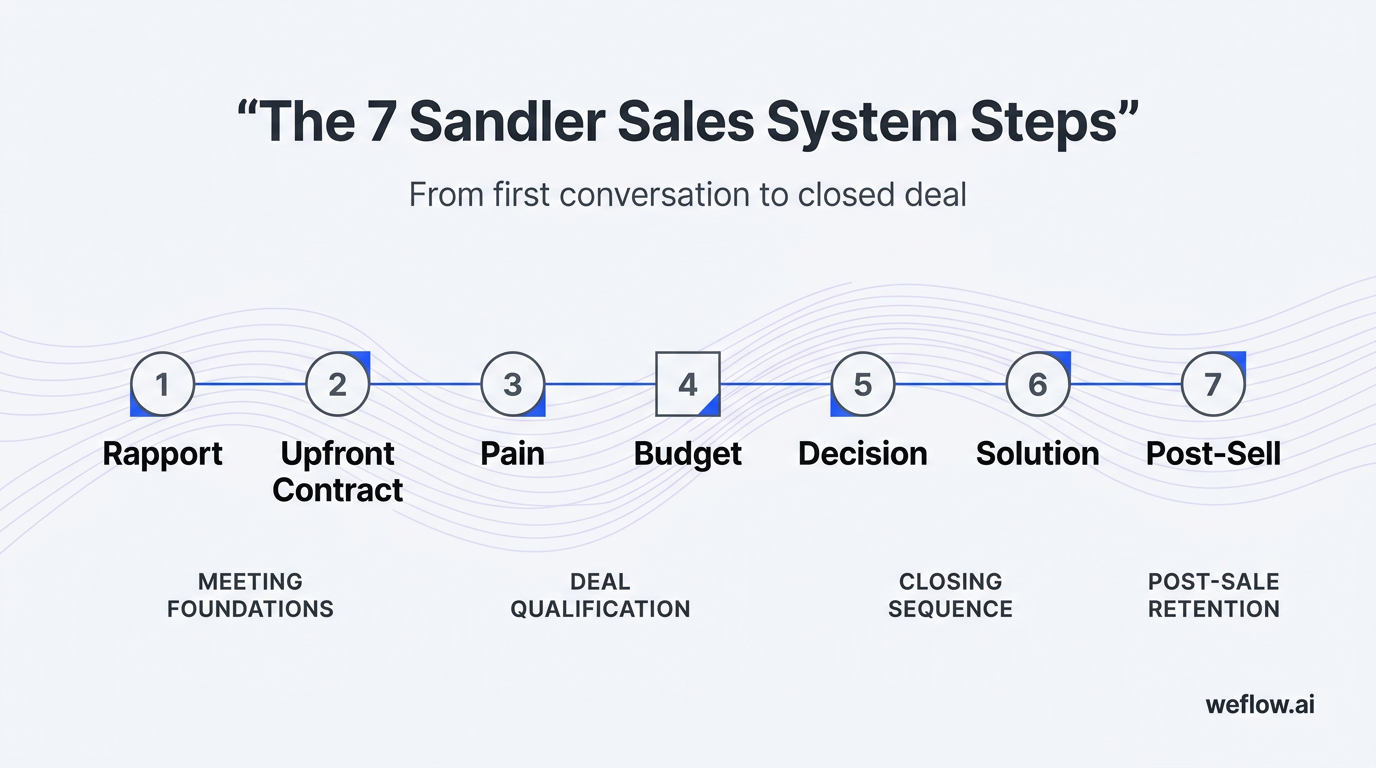
Meeting foundations: build trust and set clear expectations
The first two Sandler steps matter because they shape the rest of the deal. If the rep skips trust-building or fails to set expectations, the meeting turns reactive fast—discovery becomes scattered, the buyer controls the agenda by default, and key qualification gaps show up later when the rep is trying to close.
Sandler starts by helping the rep earn the right to ask deeper questions. First, you establish enough trust to understand the buyer’s situation. Then, you define how the conversation will work so both sides know what the meeting is for and what should happen next.
Establish rapport to understand buyer challenges
Step one is rapport, but in Sandler, rapport is not casual small talk. The point is to create enough comfort that the buyer will share useful business context, explain why they took the meeting, and tell you what isn’t working in their current setup.
A strong rapport conversation helps the rep understand three things early: what triggered the buyer’s interest, what they’re trying to change, and what concerns could slow the deal down later. That context makes the rest of discovery sharper.
Question themes to cover in rapport:
- Reason for the meeting: What were you hoping I could help you with? What motivated you to take this call?
- Timing: When did you first decide to look into solutions for this problem?
- Current state: What are one or two things you don’t like about your current solution?
- Change resistance: What concerns do you have about switching providers or changing the current process?
- Business context: What should we know about your business to put together the right solution, terms, or plan?
- Recent developments: Has anything changed since the last time we spoke?
- Open questions: Is there anything I haven’t covered that you’d like to know more about?
The main mistake reps make here is treating rapport like a warm-up before the “real” sales conversation starts. In Sandler, this is part of the real conversation. Done well, it gives you the buyer’s language, priorities, and level of urgency before you move deeper.
Define upfront contracts to align meeting goals
Step two is the upfront contract. This is one of the most recognizable parts of the Sandler method because it forces clarity before discovery or demo starts. Instead of hoping the meeting goes well, the rep sets terms for how the conversation will run.
The goal is simple: remove ambiguity. An upfront contract gives both sides a shared understanding of the meeting purpose, what will be discussed, how long it will take, and what happens after the call.
Use this five-part upfront contract checklist:
- Objective: State the purpose of the meeting and ask the buyer what they want to get from it.
- Rep agenda: Explain what you plan to cover and how you’ll guide the conversation.
- Buyer agenda: Confirm what the buyer wants to discuss, review, or evaluate.
- Time: Set the meeting length clearly and confirm it still works for them.
- Outcome: Define what a useful end to the meeting looks like, including the next step or no-step outcome.
Simple script example: “We’ve got 30 minutes today—I’d like to understand what pushed this up your priority list, share how we usually help teams in a similar spot, and then decide together whether it makes sense to schedule a deeper session or stop here; does that work for you?”
This step works because it gives the rep permission to ask direct questions later. It also makes it easier to close the meeting cleanly, since the expected outcome was already agreed at the start.
Deal qualification: uncover real pain and secure budget
Steps three and four are where qualification gets serious. After rapport and meeting alignment are in place, the rep needs to understand whether the buyer has a problem worth solving and whether the organization is willing to fund the fix.
The order matters. Sandler does not jump to budget first. If the buyer has only described a mild inconvenience, the budget conversation will go nowhere. Reps need to uncover pain that is specific, costly, and unresolved before they ask how the company plans to pay for a solution.
Probe pain points to measure business impact
Step three is pain. This is the core of the Sandler system because buyers rarely move for vague problems. They move when the issue is persistent, expensive, visible, and tied to outcomes the business cares about.
Good pain discovery goes beyond “what’s not working?” The rep needs to understand the problem itself, why it continues, what’s already been tried, and what it costs the buyer if nothing changes. That’s what turns a generic need into a qualified deal.
It helps to separate two layers of pain:
- Surface-level pain: The technical or process issue the buyer mentions first.
- Business impact: The operational, financial, or personal consequence of that issue continuing.
For example, “our handoff process is messy” is surface pain. “That delay is pushing implementation back by two weeks and hurting expansion revenue” is business impact. Sandler pushes reps to keep going until the second layer is clear.
Those questions work because they move the buyer from description to consequence. Once the buyer explains the cost of inaction in their own words, urgency becomes easier to validate and easier to revisit later in the deal.
Confirm budget to validate investment capacity
Step four is budget. By this point, the buyer should already agree that the problem is real and worth fixing. Now the rep needs to find out whether there is money, where it could come from, and who controls it.
Budget in Sandler is not just “what number do you have?” It’s a willingness-and-ability check. A prospect may not have a line item in place, but they can still be budget-qualified if the pain is serious enough and there’s a path to fund the purchase.
Run budget qualification in this order:
- Test for expected resistance: Ask whether the buyer is likely to say there’s no budget at this stage.
- Check for departmental flexibility: Find out whether their team can invest in a broader solution if the business case is there.
- Understand current spend: Ask what they’re paying today for the current solution or workaround.
- Set an expected range: Ask how much they expect to spend to solve the problem properly.
- Find the source of funds: Ask where the investment would come from.
- Identify budget control: Confirm who owns the budget and whether that person needs to join the process now.
A common objection here is, “We have no budget.” In Sandler, that answer is not the end of the conversation—it’s a signal to go back and test seriousness. Sometimes “no budget” means the problem is not urgent. Sometimes it means the money sits in another department, depends on headcount savings, or needs executive approval. The rep’s job is to separate lack of urgency from lack of funding path.
If the buyer cannot connect the problem to a budget source, the deal is still weak. If they can explain how the company would pay once the case is proven, the opportunity may still be real.
Closing sequence: map the decision and finalize the solution
Once pain and budget are established, the rep can move into the closing sequence. This is where many deals go off track, because reps start presenting before they understand how the purchase will actually be made.
In Sandler, the solution comes after the decision process is clear. That order protects the rep from giving a polished pitch to someone who likes the product but cannot buy it.
Map decision processes to ensure buyer fit
Step five is decision. The rep needs to know who is involved, what timeline matters, what alternatives are being considered, and whether the current contact can actually move the deal forward.
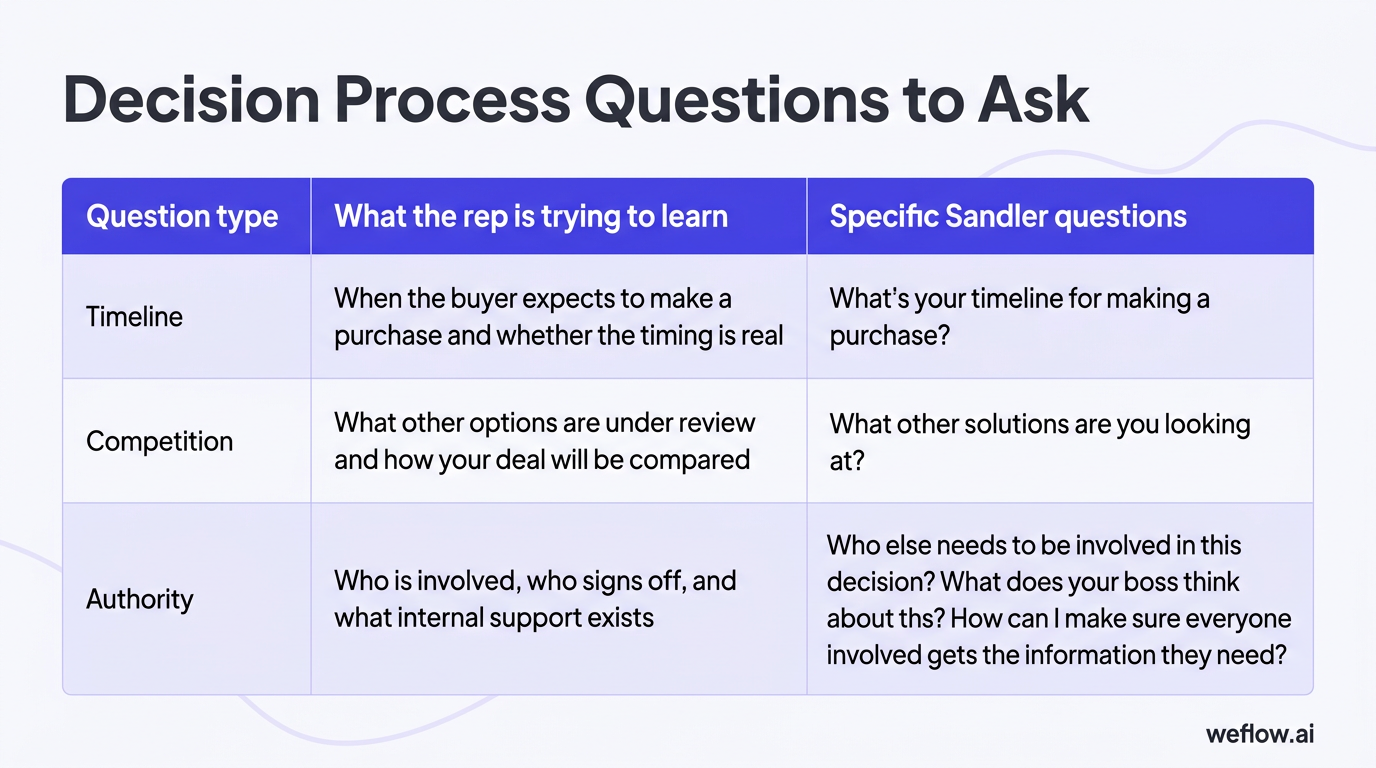
This stage is both a qualification check and a deal navigation step. You’re not just collecting names. You’re figuring out whether the buyer has enough authority, influence, and internal support to advance the opportunity.
| Question type | What the rep is trying to learn | Specific Sandler questions |
|---|---|---|
| Timeline | When the buyer expects to make a purchase and whether the timing is real | What’s your timeline for making a purchase? |
| Competition | What other options are under review and how your deal will be compared | What other solutions are you looking at? |
| Authority | Who is involved, who signs off, and what internal support exists | Who else needs to be involved in this decision? What does your boss think about this? How can I make sure everyone involved gets the information they need? |
The biggest risk in this step is presenting too early to a single champion and assuming that interest equals authority. A strong evaluator can still lose internally if procurement, finance, IT, or executive leadership was never brought into the process. Sandler helps reps expose that gap before time is spent on a tailored pitch.
Present the solution to tie up loose ends
Step six is solution. By now, the rep should know the buyer’s pain, expected budget path, and decision process. The goal is not to introduce new ideas. The goal is to confirm that the proposed solution matches the requirements already uncovered and to surface any final concerns before asking for commitment.
This is where the rep checks for unresolved friction. If something still feels unclear to the buyer, it’s better to find it here than after a verbal yes that never turns into a signature.
Use these final confirmation checks before the close:
- Confirm whether the team has tried or reviewed the demo.
- Ask what else would help them finalize the decision.
- Test readiness by asking when they would want to get started.
- Revisit the desired outcome and ask what success would look like if the solution fixes the problem.
- Ask what the decision would mean for the buyer personally.
- Check whether any topic has not been covered.
- Address any remaining concern directly before moving forward.
The personal-impact question matters more than many reps expect. Deals often have a human dimension—a project owner wants credibility, a manager wants fewer escalations, or a leader wants to hit a target tied to compensation. Knowing that helps the rep understand motivation beyond the company-level use case.
To transition smoothly into the close, summarize the agreed pain, the desired outcome, and the confirmed process in one sentence, then ask for the next concrete commitment. That could be legal review, a stakeholder meeting, procurement intake, or a start date. The close should feel like the next logical step, not a jump.
Post-sale retention: keep customers happy after the close
The Sandler system does not end at signature. Step seven is post-sell, and it exists for a practical reason: a closed deal is not fully won if the buyer starts second-guessing the purchase during onboarding.
This phase helps reduce buyer’s remorse, strengthen trust, and create a cleaner handoff from sales to onboarding or customer success. It also gives the rep one more chance to reconnect the purchase to the original problem that made the buyer act.
Offer proactive support to drive onboarding
In step seven, the rep checks back in after the deal closes and helps the customer start well. That means revisiting the initial reason they engaged, confirming what matters most in onboarding, and making sure any open questions are handled before frustration builds.
Use this checklist for the post-sale handoff conversation:
- Reconfirm what made the customer reach out in the first place.
- Ask what they need to get started with the product or service.
- Clarify what a strong onboarding experience looks like from their side.
- Invite questions about implementation, rollout, or next steps.
- Confirm ownership for the handoff and who will lead the customer through onboarding.
A good rule is to run this post-sell check-in within the first one to two weeks after signature, depending on how quickly onboarding starts. That timing is early enough to catch confusion, but late enough that the customer has had time to process the handoff and gather questions.
This step supports long-term account health because it reduces friction at the exact point where new customers are most likely to feel uncertainty. Better onboarding usually leads to stronger adoption, fewer surprises, and lower churn risk later.
Next steps: implement the Sandler system to close deals
The value of the Sandler Sales System is structure. It gives reps a repeatable seven-step path to qualify harder, avoid false-positive pipeline, and move deals forward based on buyer reality instead of rep optimism. If you want one place to start today, make it the upfront contract—have every rep open their next discovery call by setting the agenda, time, and expected outcome before asking a single qualification question.
FAQ
What is the Sandler Sales System methodology?
The Sandler Sales System is a seven-step consultative sales methodology built around qualification, buyer alignment, and clear next steps. It focuses on understanding pain, budget, and decision process before the rep presents a solution or tries to close.
How do upfront contracts improve sales calls?
Upfront contracts improve sales calls by setting the meeting objective, agenda, timing, and expected outcome before discovery starts. That removes ambiguity, gives the rep permission to guide the conversation, and makes next steps easier to confirm at the end.
Why does the Sandler system focus on pain?
Sandler focuses on pain because buyers usually act when a problem is serious enough to justify change, internal effort, and budget. When the rep quantifies that pain, the deal has a stronger business case and a clearer reason to move now.
When should reps discuss budget in Sandler?
Budget comes in step four, after the rep has built rapport and uncovered a real, measurable problem. If budget is raised before the buyer agrees the pain is costly and urgent, the conversation usually stays shallow.
-p-1600.png)

-p-1600.png)
-p-1600.png)

-p-1600.png)
-p-1600.png)
-p-1600.png)
-p-1600.png)
-p-1600.png)
-p-1600.png)
-p-1600.png)