


3-Step Strategic Selling Framework to Map Buyers and Tailor Winning Pitches


Complex B2B deals rarely stall because the product is weak. They stall because the team pitches the wrong message to the wrong stakeholder at the wrong time.
This framework gives you a practical way to fix that. You’ll map each contact by buyer role, assess their attitude toward change, and use both signals to build pitches that fit how decisions actually get made inside a buying committee.
If you run sales process design in Salesforce, this framework also gives RevOps leaders a clean way to standardize deal inspection, Multi-threading, and contact strategy across the pipeline.
[banner type="download" url="https://www.weflow.ai/content/strategic-selling-checklist" text="Strategic Selling Framework Checklist" subtitle="Role-mapping checklist, buyer prompts, and qualification questions for every stakeholder." button="Download now"]Buyer categorization: map contacts to understand purchasing power
The first step is simple: stop treating every contact on an opportunity the same. Early in the deal, you need to sort contacts by the role they play in the decision so reps know what each person cares about, what proof they need, and how much influence they actually carry.
This matters because buyer role shapes message fit. A technical buyer wants to know how implementation, security, and integration footprint will work. An economic buyer wants to know why this is worth the budget and what happens if the business waits.
The four buyer categories below give you a practical map to work from.
| Buyer type | Primary concern | What they need from you | Risk if you miss them |
|---|---|---|---|
| Champion | Internal momentum and consensus | A clear story they can repeat internally | Deals lose internal traction |
| User buyer | Day-to-day workflow impact | Proof the solution will make their job easier or better | Low adoption after purchase or silent resistance before it |
| Technical buyer | Risk, compliance, architecture, and rollout effort | Answers on security, systems fit, data handling, and implementation | Late-stage blockers appear during review |
| Economic buyer | Budget, business case, and ROI | A financial reason to act now | Deals stall at approval or lose budget priority |
The difference between a user buyer and an economic buyer is worth making explicit. The user buyer feels the day-to-day impact of the purchase, while the economic buyer decides whether the business should spend money on it. In many deals, the user buyer wants the change more than anyone else—but still can’t approve it.
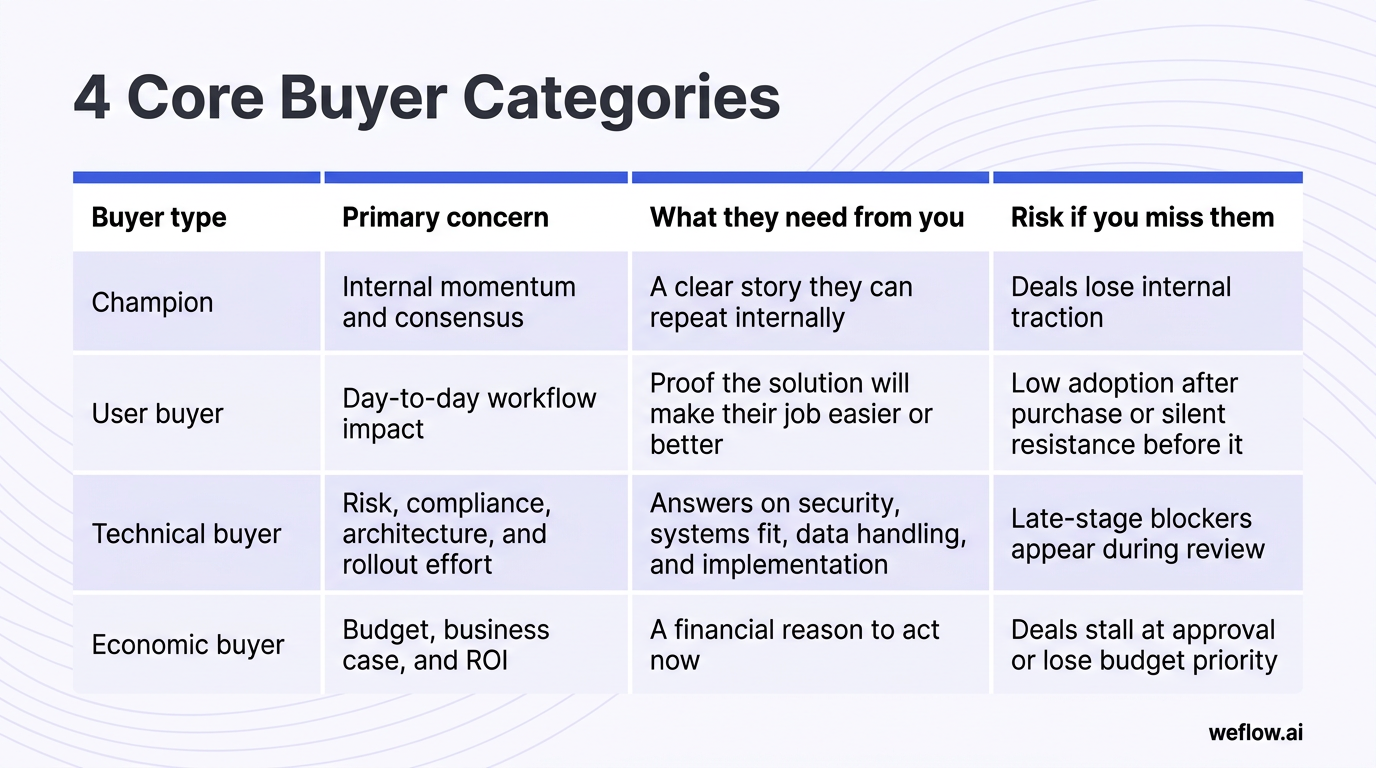
Identify the four core buyer personas
- Champion: The internal advocate who believes in the change and helps move the deal forward. Example: A frontline sales manager who sees forecast inconsistency every week and pushes for a new process.
- User buyer: The person or team that will use the product or live with the process change day to day. Example: An SDR manager whose reps will rely on the workflow every day.
- Technical buyer: The stakeholder who evaluates technical fit, security, implementation risk, and governance. Example: The IT Director or Salesforce admin checking security review, field mapping, and deployment effort.
- Economic buyer: The person with budget authority or approval power for the purchase. Example: A VP Sales approving spend based on forecast accuracy, productivity gains, or faster ramp.
Ask discovery questions to map buyer roles
You don’t need to ask these questions back to back like a form. Weave them into a normal discovery call as you move from business context to workflow impact to decision process. If the conversation feels natural, you’ll get better answers—and fewer surface-level responses.
Discovery call checklist
- What is this contact’s role in the company, and what does success look like for them this quarter?
- What goals are they directly responsible for hitting?
- How would this purchase change their day-to-day work?
- What matters most to them: speed, risk reduction, visibility, productivity, cost, or control?
- What information will they need before they can support or approve a decision?
- Who else will weigh in on implementation, budget, procurement, or security?
- Who would feel the pain if nothing changes?
- Who can say yes, and who can still say no?
For RevOps teams, this is where process discipline starts. If reps can’t name the buyer role for each key contact by stage two, the opportunity usually isn’t threaded enough to forecast with confidence.
Buyer attitudes: assess mindset to predict deal friction
Role tells you who the contact is. Attitude tells you how they’re likely to respond. Two buyers with the same title can require completely different messaging depending on whether they feel pain, see upside, or think the current state is good enough.
This is why attitude matters almost as much as purchasing power. A motivated manager with a clear problem can create urgency fast. A budget owner who thinks everything is fine can slow a deal for months, even when the business case is solid.
| Attitude state | What the buyer is thinking | Effect on deal momentum | Common source of friction | What your message should do |
|---|---|---|---|---|
| Growth | “We need to improve and scale.” | Usually faster if the upside is clear | Competing priorities | Show how your solution supports expansion, efficiency, or better execution |
| Problem | “Something is broken and we need to fix it.” | Often the fastest | Fear of implementation risk | Connect the product directly to the known pain and the cost of delay |
| Everything is fine | “We’re okay for now.” | Usually slow | Lack of urgency | Teach the buyer what risk, inefficiency, or missed opportunity they’re not seeing yet |
| Euphoria | “Things are going great—we should capitalize on this moment.” | Can move fast or get distracted fast | Overconfidence and shifting priorities | Position the purchase as a way to protect momentum and avoid future strain |
“Everything is fine” is often the hardest attitude to sell against. A buyer with a visible problem is already looking for change. A buyer who feels no pressure has no reason to spend political capital, time, or budget. In those cases, your job is not to push harder—it’s to reframe the status quo as more expensive or risky than it appears.
Classify contacts into four attitude states
- Growth: The buyer is focused on expansion, scale, efficiency, or a new target. They may not be in pain, but they know the current process won’t support the next stage.
- Problem: The buyer feels an active issue right now—missed targets, poor adoption, low conversion, messy handoffs, or reporting gaps—and wants a fix.
- Everything is fine: The buyer believes the current setup works well enough. They may have hidden pain, but they don’t yet see it as urgent or costly.
- Euphoria: The buyer is riding positive momentum, such as a funding round, strong quarter, major launch, new market entry, or leadership win. In B2B sales, this often creates openness to investment—but also shorter attention spans and changing priorities.
Evaluate current and future buyer challenges
To classify attitude well, ask questions that uncover both present friction and future risk. You’re not just looking for stated pain. You’re also looking for blind spots, workarounds, and signs that the current system breaks under scale.
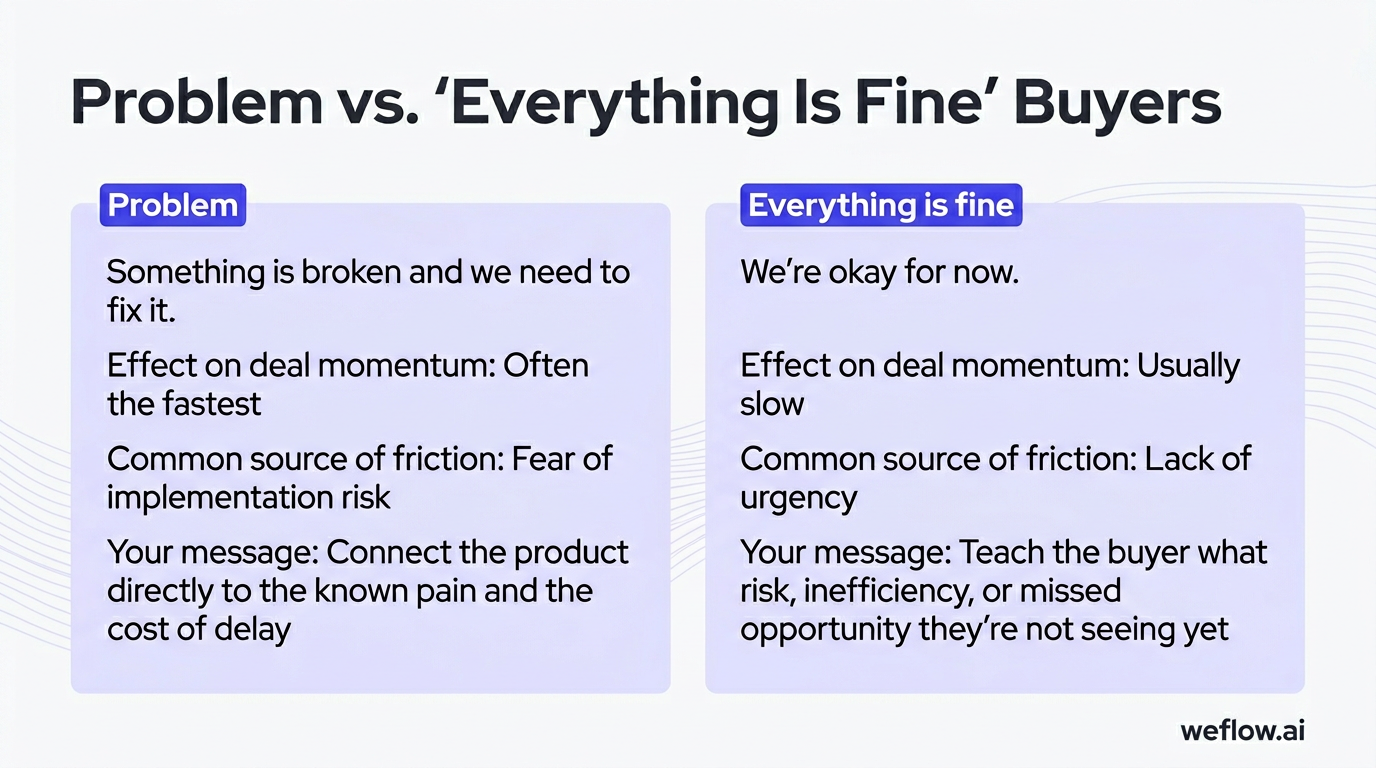
- What challenges are you dealing with today in this area?
- How are you handling those challenges right now?
- What has already been tried, and where has it fallen short?
- What roadblocks are making progress harder than it should be?
- What happens if nothing changes in the next two quarters?
- What new pressure could show up as the team grows, the process expands, or targets increase?
- Where do you feel confident in the current approach, and where do you still rely on manual workarounds?
- What risk do you think the business may be underestimating here?
For Salesforce teams, log attitude where reps can actually use it. A practical setup is to add two picklist fields—Buyer role and Buyer attitude—on Opportunity Contact Role, or use a custom junction object if you need more history and reporting flexibility across opportunities. That lets RevOps report on deal coverage by persona, enforce completion with validation rules at stage changes, and use those fields in forecast reviews.
Pitch personalization: combine role and attitude to win deals
Once you know the buyer’s role and attitude, the pitch gets easier to build. You’re no longer guessing what message might land. You can decide what matters most to this person, what proof they need, and how much persuasion the situation calls for.
- Start with the buyer role. Define the lens they use to judge the purchase—workflow impact, technical risk, business case, or internal influence.
- Add the attitude signal. Decide whether the contact already feels urgency, needs education, or needs a path to protect current momentum.
- Name the contact’s core concern. Write one sentence that captures what they’re trying to avoid or achieve.
- Match the proof to the person. User buyers need examples of daily workflow improvement. Technical buyers need security, systems fit, and rollout detail. Economic buyers need ROI, cost of inaction, and business impact.
- Calibrate persuasion level. Problem and growth contacts often need direction and proof. “Everything is fine” contacts usually need reframing. Euphoria contacts need a clear case for acting before momentum fades.
- Set the next action by stakeholder. Don’t end every conversation with the same ask. Some contacts should get a business case, others a technical review, and others internal talking points.
Here’s what that looks like in practice. An economic buyer with a problem attitude should hear a direct case for financial impact, time to value, and the cost of waiting. A user buyer with a growth attitude should hear how the solution helps them execute faster, reduce friction, and support a larger target without adding process drag.
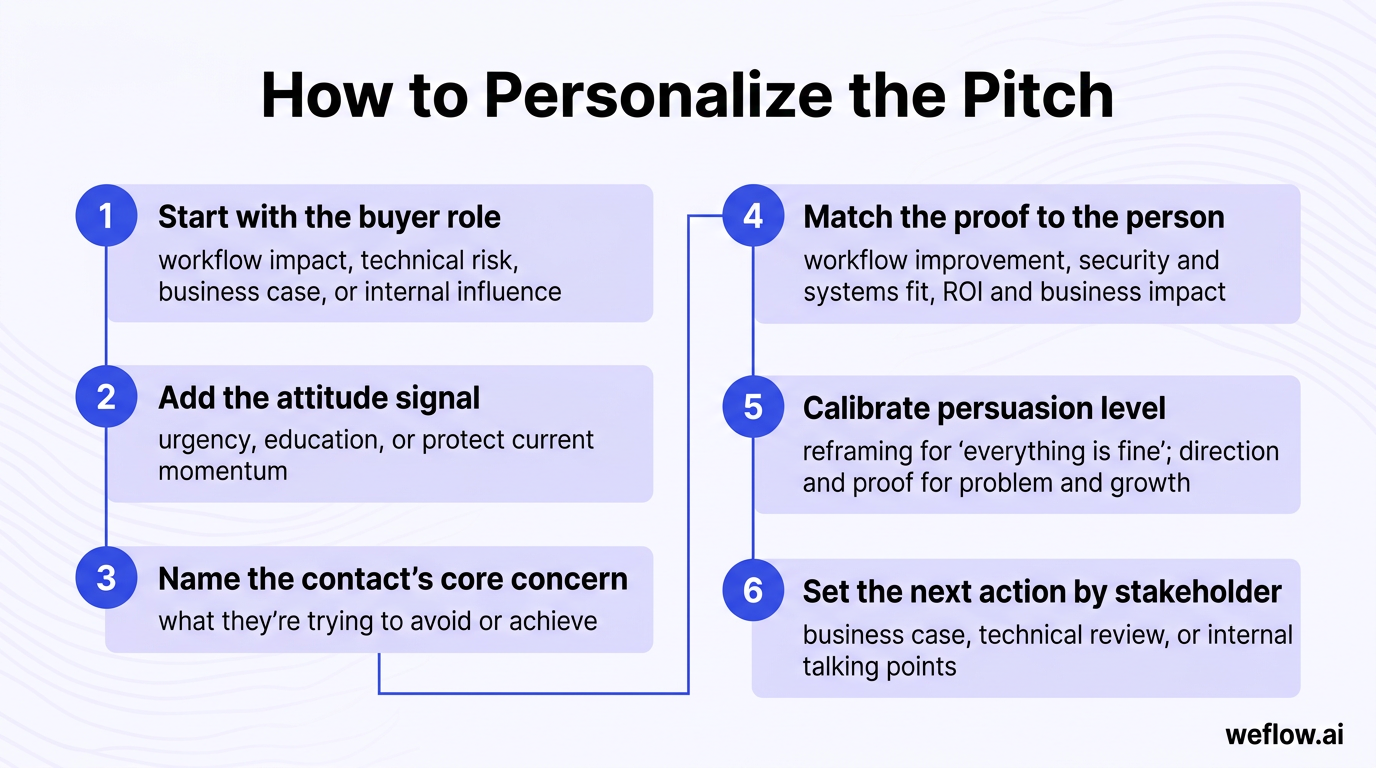
Draft individualized pitches for each contact
Your pitch should stay anchored to one consistent value proposition at the account level, then shift the proof and framing by stakeholder. That keeps the deal story coherent while still speaking to each contact’s own KPIs, constraints, and concerns.
- For a champion: Give them a short internal narrative they can repeat—problem, business impact, why this approach, why now.
- For a user buyer: Focus on what changes in their day-to-day, what gets easier, and what results they should expect after rollout.
- For a technical buyer: Address implementation effort, security review, data handling, integration footprint, governance, and timeline.
- For an economic buyer: Focus on ROI, budget justification, risk reduction, and the expected business outcome if the team moves now.
- For a problem attitude: Be direct. Tie your case to the pain they already recognize.
- For a growth attitude: Show how the purchase supports scale, efficiency, or a strategic initiative.
- For an “everything is fine” attitude: Lead with missed opportunity, hidden cost, or future risk—not product detail.
- For a euphoria attitude: Position the purchase as a way to preserve momentum and avoid operational strain as success compounds.
The key is consistency. The account-level story should not change from contact to contact. What changes is the angle. One stakeholder hears business impact, another hears rollout risk, and another hears workflow benefit—but all three should still recognize the same core reason to buy.
Align team members to persuade key buyers
Pro tip: Multi-threading means building relationships with multiple stakeholders in the same account so the deal does not depend on a single contact. In practice, that also means matching your internal team to the buyer’s role: an account executive may be best with the champion, a solutions engineer or internal technical lead may be better suited to the prospect’s technical buyer, and an executive sponsor may help with the economic buyer.
If a deal is heading toward security review, procurement, or budget approval, ask one operational question early: who on our side is the best messenger for this buyer? That one move often matters more than adding another follow-up email.
Next steps: implement the strategic selling framework today
The framework is straightforward: categorize the buyer, assess the attitude, then personalize the pitch. Pick one active deal in your pipeline right now, map every key contact to a buyer role and attitude, and check whether your current messaging actually matches the people who will decide the outcome.
FAQ
What is the strategic selling framework?
The strategic selling framework is a way to manage complex B2B sales by mapping the buying committee instead of treating the account as one decision-maker. It helps teams identify who influences the purchase, what each stakeholder cares about, and how to move the sales cycle forward with the right message for each contact.
How do you identify an economic buyer?
You identify an economic buyer by finding the person who can approve spend or materially influence whether budget gets allocated to the deal. In many B2B sales cycles, that person is focused less on product detail and more on business impact, timing, and financial tradeoffs.
- They ask questions about ROI, payback period, budget source, or priority against other investments.
- They can approve, block, or redirect the purchase even if other decision-makers support it.
The economic buyer is not always the CEO. In many mid-market and enterprise deals, it may be a VP, department head, or budget owner based on deal size and purchasing process.
Why map buyer attitudes during sales cycles?
Attitude mapping helps you predict objection patterns, urgency level, and likely deal friction before they show up late in the sales cycle. It also improves forecast accuracy because reps can separate real momentum from polite interest by understanding whether decision-makers feel pain, see upside, or still think the current state is good enough.
How does buyer categorization improve pitches?
Buyer categorization improves pitches by replacing generic demos with stakeholder-specific messaging tied to each contact’s KPIs, concerns, and decision criteria. That cuts back-and-forth clarification, keeps B2B sales conversations relevant, and usually shortens the sales cycle because decision-makers get the information they need earlier.
-p-1600.png)

-p-1600.png)
-p-1600.png)

-p-1600.png)
-p-1600.png)
-p-1600.png)
-p-1600.png)
-p-1600.png)
-p-1600.png)
-p-1600.png)