


Sales Discovery Questions Checklist to Qualify Buyers and Uncover Pain Fast


A discovery call should do three things: map the buyer’s current state, test whether there’s a real fit, and earn a clear next step. If you skip any of those, you end up with vague pipeline, weak demos, and deals that stall after “sounds interesting.”
This guide turns the sales discovery questions checklist into a practical framework you can use on live calls. It’ll help reps move from initial fact-finding to pain discovery to securing the next meeting on the calendar.
[banner type="download" url="https://www.weflow.ai/content/sales-discovery-questions-checklist" text="Sales Discovery Questions Checklist" subtitle="Checklist of fact-finding prompts to uncover workflows, KPIs, challenges, and current tools." button="Download now"]Discovery phase: map the current state and qualify fit
The first job of discovery is simple: understand how the prospect works today and whether they’re a real buyer. Reps who jump from small talk straight into a pitch usually miss the operating context, the decision criteria, and the business case they’ll need later in the cycle.
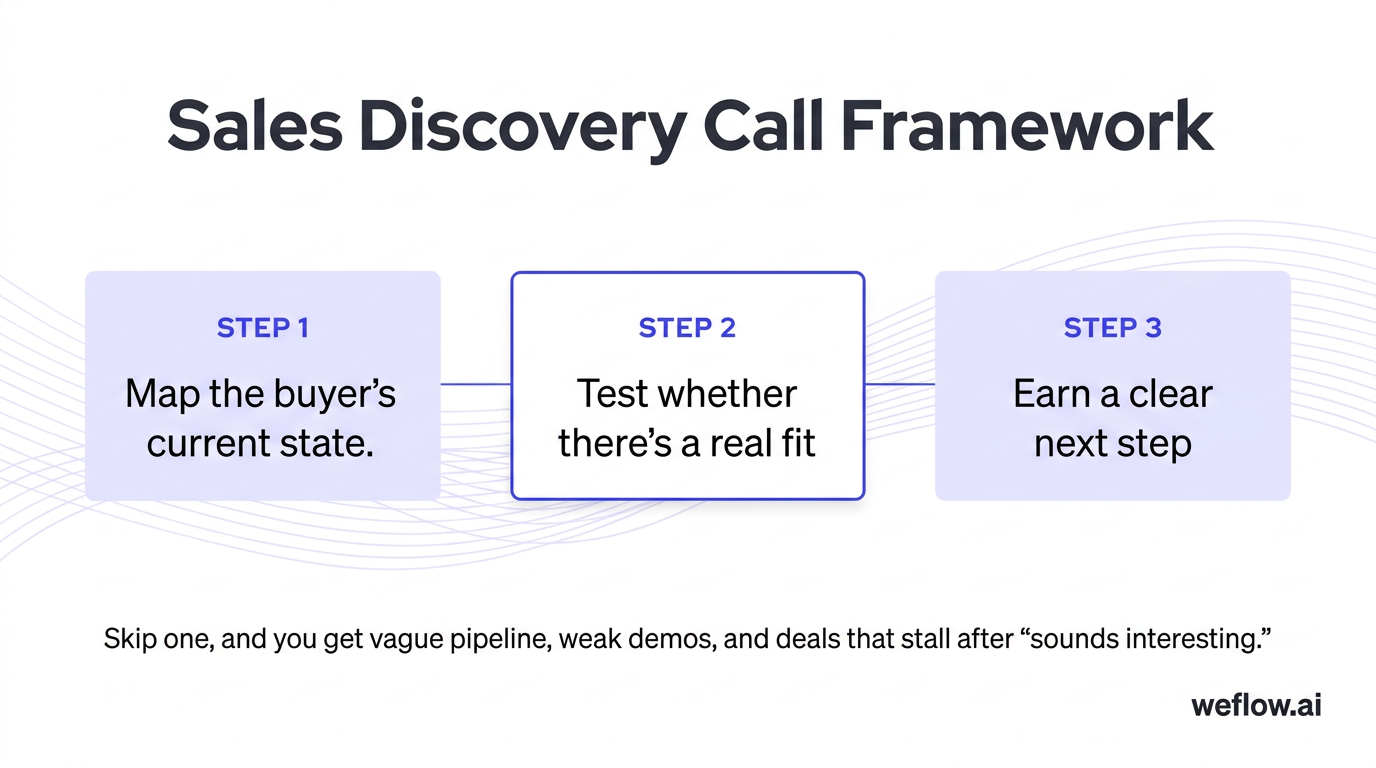
Good discovery starts by getting specific. What does their team look like? What process are they using now? Where is the current approach breaking down? Once you have that baseline, you can qualify whether the problem is worth solving, whether the timing is real, and whether there’s a path to budget.
Gather facts about their daily environment
Use the first part of the call to understand the prospect’s day-to-day reality. You’re not collecting trivia—you’re building a map of their workflow, their responsibilities, and the metrics they’re measured on.
- Start with company and role context: Ask questions like “Tell me about your company” and “What does your day-to-day look like?” to understand team structure, market, growth stage, and where this person sits in the org.
- Clarify their operating environment: “What is your work environment like?” helps surface whether they’re working across regions, functions, or systems that add complexity to the problem.
- Find the metrics that matter: Ask “What metrics or KPIs are you responsible for?” so you know whether this buyer is measured on revenue, efficiency, response time, margin, retention, or something else.
- Map the current process: Questions like “What is your current process for dealing with this?” show how work actually gets done—not how the org chart says it should get done.
- Identify the existing solution: “What solution are you using today?” gives you the current stack, internal workaround, or manual process you’ll need to displace.
- Understand what’s broken: Ask “What’s working or not working with your current solution?” to separate minor complaints from structural issues.
- Pin down the core challenge: “What’s the biggest challenge you face with that solution?” forces prioritization and keeps the conversation from drifting into a laundry list.
As they answer, listen hard for numbers. If a prospect mentions missed quota, six-hour handoffs, 20% churn, or a three-week approval process, capture that exactly. Those are the metrics you can return to later when you tie your value to business impact.
Qualify the prospect against your solution
Once you understand the environment, qualify whether this is a problem they’ll actually pay to solve. Qualification isn’t about forcing a framework onto the buyer. It’s about finding out if there’s a real goal, a real deadline, and a real path to investment.
- Ask about goals first: “What are your goals?” tells you what outcome matters most and whether your solution fits the job they need done.
- Tie goals to a timeline: “What’s your timeline for achieving those goals?” separates active projects from background interest.
- Name the problem directly: “What problem are you trying to solve?” gives the buyer a chance to frame the issue in their own words.
- Test for known pain areas: Ask whether they’re experiencing specific issues your solution addresses. That keeps discovery grounded in real use cases rather than abstract interest.
- Find the source of the problem: “What is the source of the problem?” tells you whether the issue is process, tooling, staffing, leadership alignment, or something else entirely.
- Explore budget without rushing it: Questions like “Do you have room in your budget for this investment?” and “Where would that budget come from?” help you understand procurement reality.
- Get an investment range: “How much can you spend on solving this problem?” sets practical boundaries before the deal advances too far.
A natural way to ask about budget is to connect it to the project, not to price. For example: “If fixing this is a priority this quarter, how does your team usually budget for something like that?” That feels operational, not transactional.
Pain and urgency: measure the cost of doing nothing
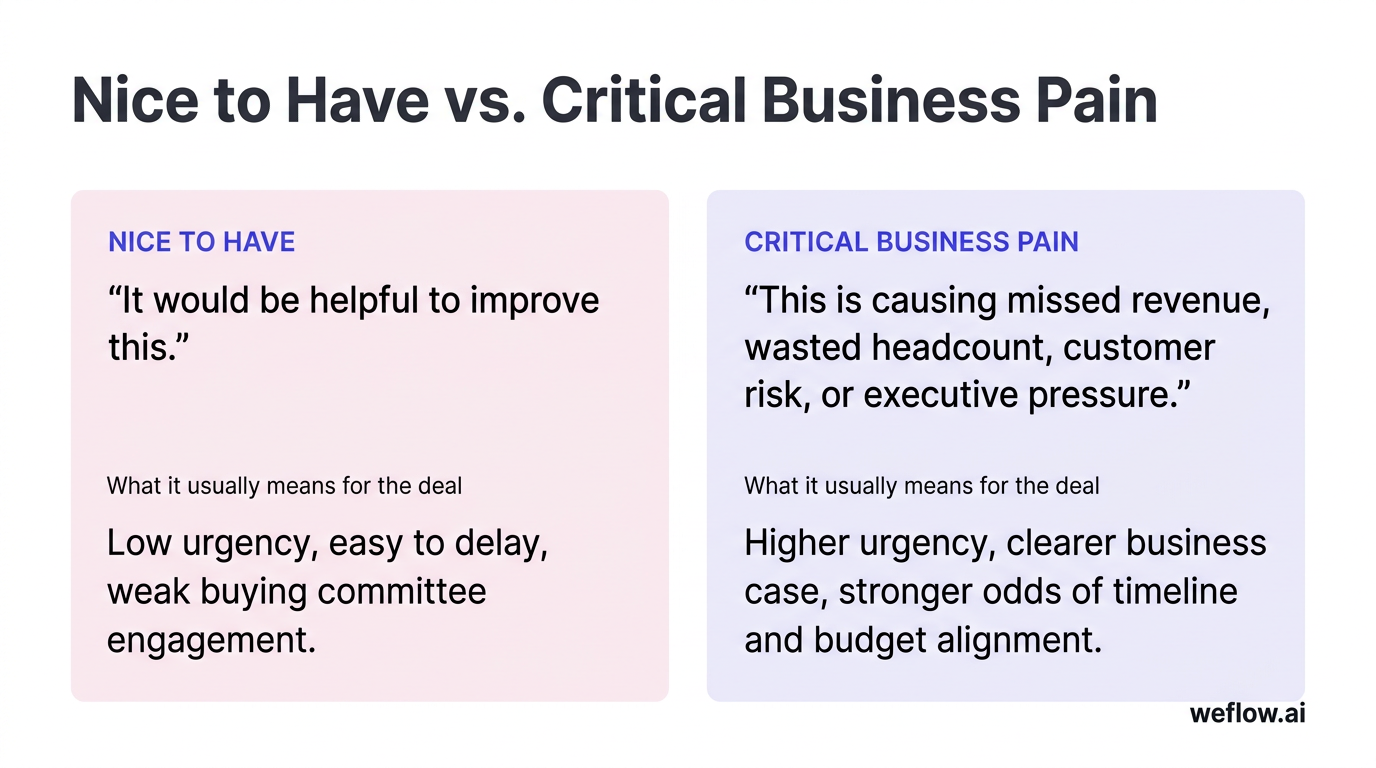
Surface-level pain doesn’t close deals. Real urgency comes from understanding what the problem is costing the buyer right now—and what happens if they keep living with it. That’s the difference between a “nice to have” issue and a purchase that gets approved.
| Problem type | What it sounds like | What it usually means for the deal |
|---|---|---|
| Nice to have | “It would be helpful to improve this.” | Low urgency, easy to delay, weak buying committee engagement. |
| Critical business pain | “This is causing missed revenue, wasted headcount, customer risk, or executive pressure.” | Higher urgency, clearer business case, stronger odds of timeline and budget alignment. |
Your job in this phase is to turn vague frustration into measurable impact. If the buyer can’t explain the cost of the problem, the deal usually won’t survive procurement, leadership review, or internal prioritization.
Probe for business and personal pain points
| High-impact financial questions |
|---|
Ask these when you need to quantify the cost of inaction:
|
- Measure satisfaction with the status quo: “How satisfied are you with your existing solution?” tells you whether they’re mildly annoyed or actively trying to replace it.
- Test the cost of doing nothing: “What happens if you don’t solve this problem?” forces the buyer to think beyond inconvenience.
- Quantify financial impact: Ask about lost revenue, wasted spend, missed deals, avoidable headcount, or delayed projects so the problem has a number attached to it.
- Surface missed opportunities: “What opportunities have you missed out on?” often reveals growth impact that standard process questions miss.
- Understand team impact: “How does that affect your team?” gets you into execution pain such as overtime, rework, missed targets, or low morale.
- Understand personal impact: “How does it affect you personally?” can uncover stress, lost credibility, weekend work, or pressure from leadership.
- Find the blockers: “What roadblocks are preventing you from hitting critical goals?” helps you understand whether the pain is solvable with your approach.
- Probe for risk readiness: “If this gets worse, do you have a plan?” shows whether they’re acting from urgency or just reacting in the moment.
Personal impact often moves deals faster than company-wide impact because it’s immediate. A buyer may tolerate inefficiency for months, but they’ll act sooner when the problem is causing late nights, executive scrutiny, or missed career goals.
Assess their timeline and commitment to change
Once the pain is clear, the next question is whether they’re ready to act. Some prospects will openly describe a costly problem and still treat it as next year’s issue. This part of discovery tells you whether the opportunity is real now or just well-articulated curiosity.
A clean transition phrase here is: “It sounds like this issue has real impact. Help me understand what needs to happen on your side to actually solve it.”
- Define expected outcomes: “What kind of results do you expect from a new solution?” tells you what success looks like in their words.
- Attach a deadline to results: “When do you expect to see those results?” helps you gauge urgency and implementation expectations.
- Test current priority: “Is this a priority right now? Why or why not?” is one of the fastest ways to separate active deals from passive interest.
- Ask about vendor criteria: “Have you defined criteria for selecting a vendor?” shows how mature the buying process is.
- Understand the competitive set: “What other solutions are you considering?” gives you context on alternatives, internal options, and how serious the evaluation is.
- Check for feature or capability gaps: “Does our solution fully address this challenge?” invites honest feedback before the deal advances on false assumptions.
- Identify what’s missing: If the answer is no, ask directly what they still need to see or solve.
- Offer practical help: “What would make this process easier?” can uncover legal concerns, stakeholder alignment issues, or implementation questions you can address early.
Deal momentum: guide buyers toward the next milestone
Discovery isn’t complete when the buyer says the problem is real. It’s complete when there’s a clear path forward, the right people are involved, and the next meeting is booked. If you end the call with “I’ll follow up,” you’ve given control of the deal back to the prospect.
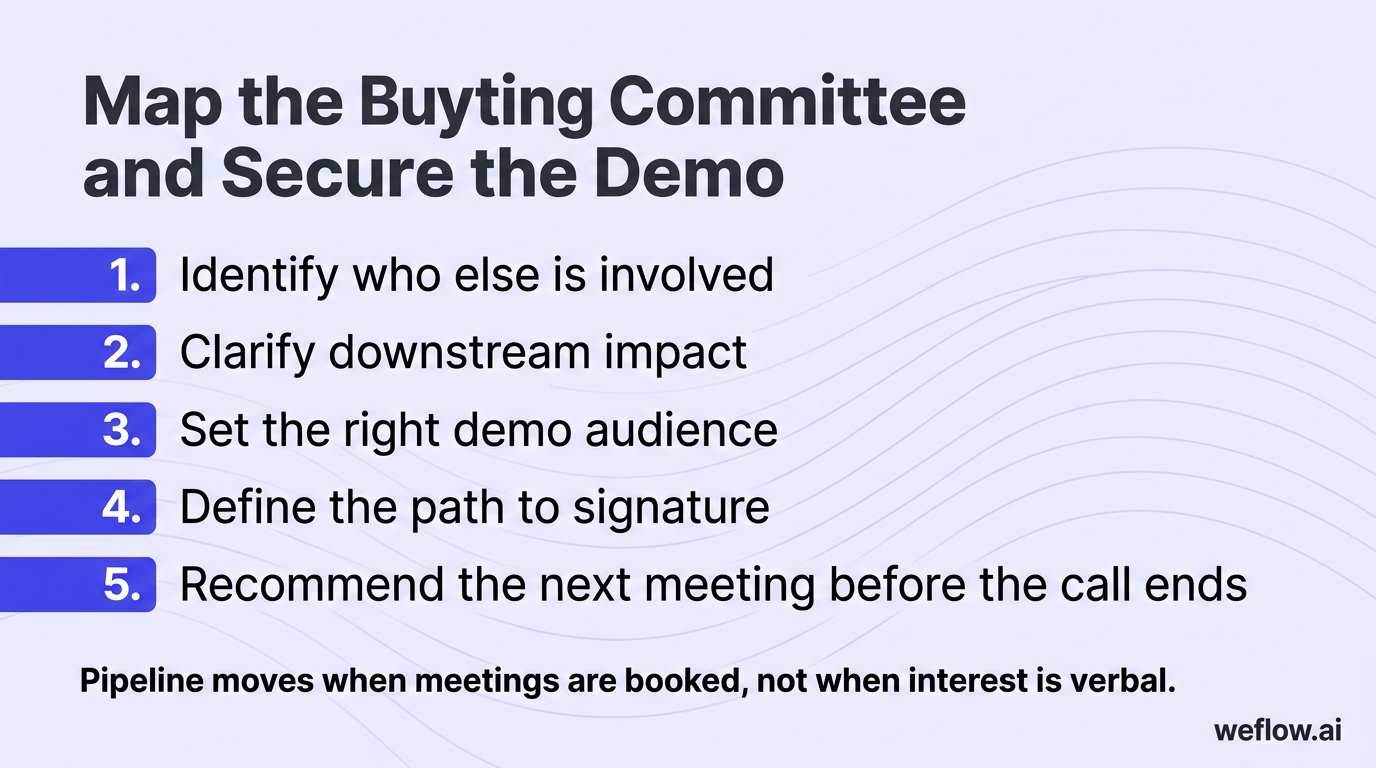
The golden rule is simple: never leave a discovery call without a scheduled next step on the calendar. Pipeline moves when meetings are booked, not when interest is verbal.
Map the buying committee and secure the demo
- Identify who else is involved. Ask “Who else should be involved in this decision?” to uncover economic buyers, functional stakeholders, procurement, security, and anyone with veto power.
- Clarify downstream impact. “Who else will this change affect?” helps you understand which teams need buy-in before rollout or purchase.
- Set the right demo audience. Ask “Who should be invited to the demo?” so you’re not presenting only to a champion with no influence.
- Define the path to signature. “If I can help you achieve this outcome, what would we need to do to make a deal happen?” gives you the buying process in plain language.
- Recommend the next meeting before the call ends. Summarize what you heard, name the logical next step, and get time on the calendar while everyone is still engaged.
If a prospect claims they’re the sole decision-maker but the deal size suggests otherwise, don’t challenge them head-on. Instead, ask operational questions: who signs the agreement, who owns budget approval, who will use the solution, and who needs to review implementation or security. That usually surfaces the real buying committee without creating friction.
FAQ
What makes a good sales discovery question?
A good discovery question is open-ended, specific to the buyer’s situation, and designed to uncover measurable impact. Instead of asking for simple facts, it helps you understand process, pain, urgency, and what success needs to look like. The strongest questions usually come from the “Gather facts about their daily environment” and “Probe for business and personal pain points” sections.
How many discovery questions should I ask?
Don’t treat discovery like a script you need to finish line by line. In most calls, 11 to 14 well-chosen questions is enough if you’re listening, following up, and letting the buyer talk. The goal is a two-way conversation, not a checklist recital.
When should I bring up budget in discovery?
Bring up budget after the buyer has explained the problem and the cost of leaving it unsolved. That way, the investment is framed against lost revenue, wasted time, or operational risk—not as a standalone number. Use the qualification questions after you’ve established pain, not before.
How do I uncover pain without being pushy?
Lead with curiosity and empathy, not pressure. Phrases like “Help me understand,” “What happens if this continues,” and “How does that affect you personally?” make it easier for buyers to explain the real impact without feeling interrogated. If you need a starting point, use the personal and business impact questions from the pain section.
-p-1600.png)

-p-1600.png)
-p-1600.png)

-p-1600.png)
-p-1600.png)
-p-1600.png)
-p-1600.png)
-p-1600.png)
-p-1600.png)
-p-1600.png)