


GAP Selling Questions That Uncover Pain, Urgency, and Decision Criteria [Cheat Sheet]


GAP selling works when you can prove the distance between a prospect’s current reality and the outcome they need. If you sell into RevOps leaders, CROs, Sales Ops managers, or Business Systems teams, that distance usually shows up in missed forecasts, weak reporting, manual Salesforce work, and process gaps the team has learned to work around.
This guide turns a simple cheat sheet into a discovery framework you can use on live calls. You’ll start with current state, move into future state, then test whether the gap is big enough—and urgent enough—to justify change.
[banner type="download" url="https://www.weflow.ai/content/gap-selling-checklist" text="GAP Selling Questions Checklist" subtitle="Question checklist for uncovering current state, gaps, and buying urgency." button="Download now"]
Current state analysis: map the prospect's daily reality
The goal of current state discovery is simple: build a factual baseline of how the prospect operates today. That means understanding their reporting setup, the tools they rely on, who uses them, where the process breaks, and how confident they are in hitting near-term goals.
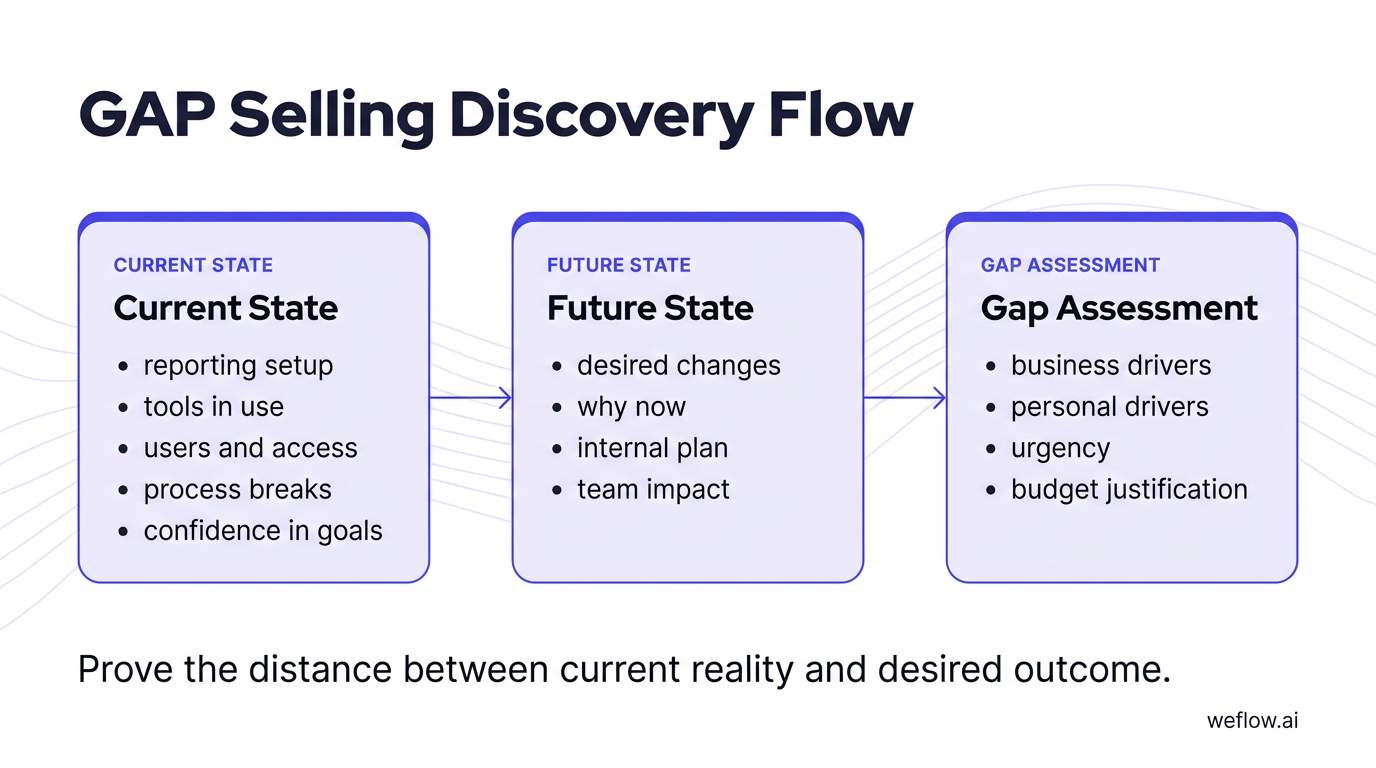
This is the part of discovery where reps often get impatient and start pitching too early. Don’t. If you skip baseline facts, you’ll end up presenting a solution to the wrong problem—or worse, solving a problem the prospect doesn’t think matters.
Category | Cheat Sheet Questions |
|---|---|
Reporting and technology | Tell me about your current reporting solutions. If you had to change something about your current technology, what would you change? What are the biggest shortcomings with your current solution? |
What’s working today | What features do you like most about your current solution? |
Environment and access | What is your business environment like? How many users have access to this solution? When do they work, and where? |
Goals and confidence | How confident are you that you’ll hit this goal by next quarter? |
Process and inefficiency | What activities or processes do you use this solution for? Why do you think that process is so inefficient? |
Assess existing technology and workflows
This part of discovery is an audit of the prospect’s operating environment. You’re trying to understand not just what tools exist, but how the team actually uses them day to day.
How are you handling reporting today?
If you could change one thing about your current technology, what would it be?
What are the biggest shortcomings in the tools you use now?
What do you like most about the current setup?
How many users need access to the solution?
What does the working environment look like—office-based, hybrid, distributed, across time zones?
When are people actually using the system during the day or week?
That question about what they like is easy to skip, but it matters. If a prospect values a specific workflow, permission structure, reporting view, or Salesforce write-back behavior, you need to know that before you position a replacement. Otherwise, you risk pitching a change that fixes one pain while creating another.
Identify process inefficiencies and blockers
Once you understand the stack, move to the process. The point here is to find the exact moment the workflow breaks—not just the symptom the prospect mentions first.
Callout: questions that expose inefficiency
What activities or processes rely on this solution today?
Why is that process inefficient right now?
How confident are you that you’ll hit next quarter’s goal?
If the prospect says they missed a goal, don’t leave it there. Use active listening: repeat the issue back, ask what caused it, who felt the impact, and what had to change as a result. The first answer usually names the problem on the surface. The follow-up is what gets you to the operational blocker underneath it.
Future state vision: define life after the problem is solved
Future state mapping gets the prospect to describe success in their own words. That matters because a buyer who clearly articulates the outcome they want is already building the value case for making a change.
What changes would you like to see first?
Why do those changes matter now?
What is your plan for making the change?
What steps do you expect to take internally?
What would solving this problem mean for your team?
What would you be able to accomplish with extra time, resources, or better reporting?
Notice the sequence. You start with desired change, then move into the plan, then measure the downstream impact. When the prospect verbalizes the future state themselves, the value of solving the problem becomes more concrete before you’ve shown a slide or a demo.
Outline the desired changes and action plan
Desired outcomes are helpful, but they’re not enough on their own. You also need to know whether the prospect has an internal roadmap for getting there.
Check the change: What specific change does the prospect want to see?
Check the reason: Why is that change the priority?
Check the plan: What is their current plan for making the change?
Check the sequence: What steps do they believe need to happen next?
If the prospect doesn’t have a plan, that’s not always a bad sign. It can be an opening for the rep to act like a trusted advisor—helping define the rollout path, the stakeholder map, and the criteria that would make the project viable.
Quantify the impact of extra resources
Once the future state is clear, attach value to it. This is where broad goals turn into a usable business case.
Ask what solving the problem would change for the broader team, not just the primary contact.
Ask what they could get done with extra time, cleaner reporting, or fewer manual steps.
Ask which projects would move faster if the current blocker disappeared.
Ask what better data or reporting would change for forecasting, planning, or leadership reviews.
These answers often become the core of the ROI narrative later. If a prospect says better reporting would save managers five hours a week, reduce end-of-quarter cleanup, and improve forecast confidence, you now have concrete operational value to bring to an economic buyer.
Internal gap assessment: qualify the business drivers
In GAP selling, the gap is the distance between the current state and the future state the buyer says they need. Your job is to decide whether that distance is large enough to justify budget, urgency, and a real buying process.
Rep Self-Check
Why is achieving this goal so critical to the prospect’s business?
Why does this goal matter to the prospect personally?
What catalyst is driving the change?
What specific business drivers are in play?
If you can’t answer those questions, you haven’t done enough discovery. Don’t force the deal forward. Loop back, keep digging, and find the business case before you ask for next steps.
Evaluate personal and business catalysts
Business drivers justify the investment. Personal drivers often determine how fast the prospect moves.
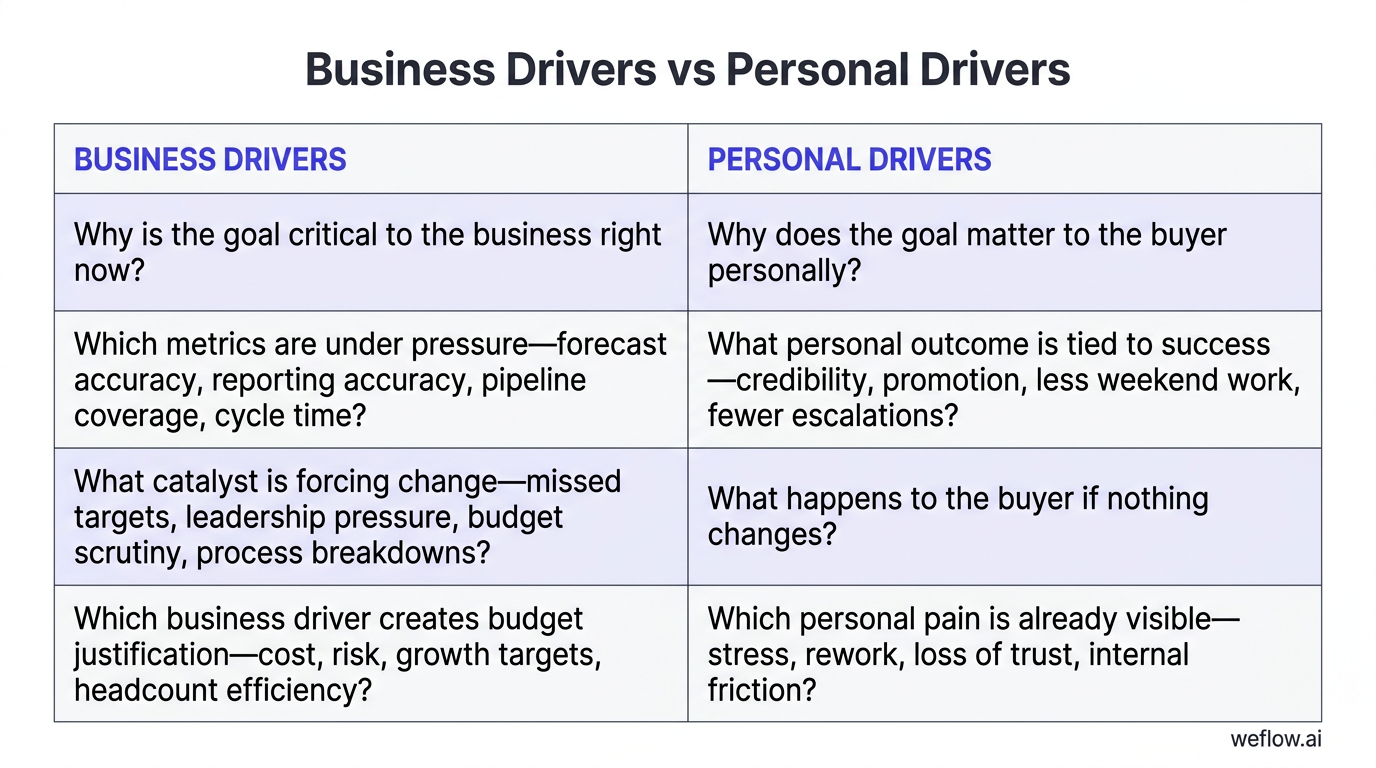
Business Drivers | Personal Drivers |
|---|---|
Why is the goal critical to the business right now? | Why does the goal matter to the buyer personally? |
Which metrics are under pressure—forecast accuracy, reporting accuracy, pipeline coverage, cycle time? | What personal outcome is tied to success—credibility, promotion, less weekend work, fewer escalations? |
What catalyst is forcing change—missed targets, leadership pressure, budget scrutiny, process breakdowns? | What happens to the buyer if nothing changes? |
Which business driver creates budget justification—cost, risk, growth targets, headcount efficiency? | Which personal pain is already visible—stress, rework, loss of trust, internal friction? |
Personal motivation often drives urgency faster than the company metric alone. A prospect may say the business needs better forecasting, but the real reason they care is that they’re tired of defending numbers they don’t trust in front of the CRO.
Prospect gap questions: test commitment and urgency
Once you understand the current state and the future state, stop guessing about urgency. Ask direct questions that test whether the prospect is prepared to act, what has blocked action so far, and what success would need to look like.
Past effort: What have you done to solve the problem so far?
Commitment: Are you and your team committed to taking action?
Requirements: If not, what needs to happen so you can move forward?
Timeline: When do you need to see results?
Success metrics: How will you measure success?
These questions can sound confrontational if you ask them like a checklist. They work better when you keep the tone consultative: explain why you’re asking, tie the question back to the outcome they described, and make it clear you’re trying to qualify fit—not trap them.
Gauge historical effort and team commitment
Past behavior is one of the clearest indicators of whether a buyer is serious. A prospect who has already tried to fix the problem internally usually understands the cost of delay much better than someone who is only exploring.
Ask what they’ve already tried to solve the issue.
Ask whether those attempts involved process changes, internal builds, consultants, or other vendors.
Ask what happened after those attempts—stall, partial adoption, no measurable result, or a new problem.
Ask whether the broader team is aligned on taking action now.
Ask what would need to happen internally if commitment is still weak.
Prospects who have tried and failed to solve the problem on their own often have a higher willingness to pay. They’ve already learned that the status quo has a real cost in time, effort, and internal credibility.
Establish timelines and success metrics
A deal without a deadline and a scorecard usually slips. You need both.
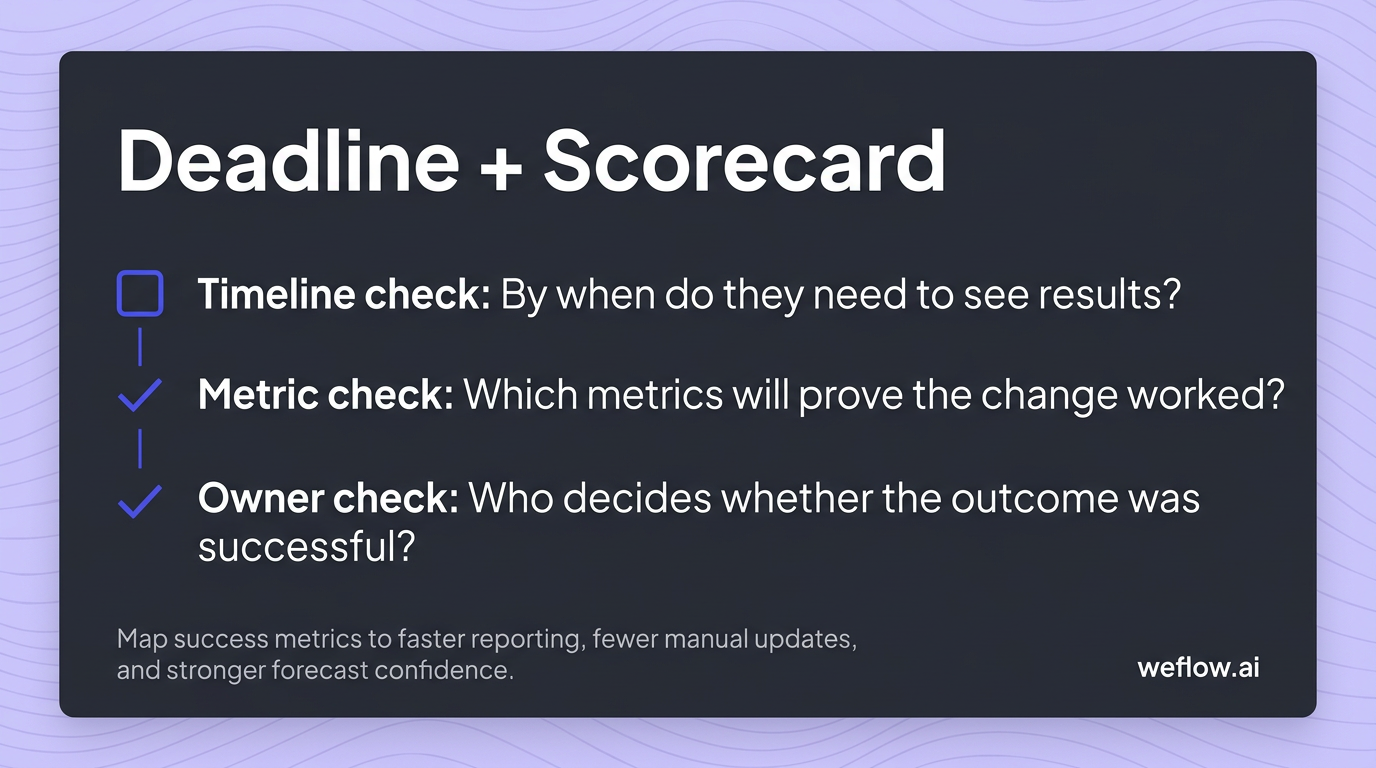
Timeline check: By when do they need to see results?
Metric check: Which metrics will prove the change worked?
Owner check: Who decides whether the outcome was successful?
Those success metrics should line up with the future state the prospect already described. If they said they want faster reporting, fewer manual updates, and stronger forecast confidence, your evaluation criteria should map directly to those outcomes.
FAQ
What is the main goal of GAP selling?
The goal of GAP selling is to identify the distance between a prospect’s current reality and their desired future state. Once that distance is clear, the seller can position their solution as the most credible way to close it.
How do you uncover a prospect's true pain?
You uncover true pain by asking follow-up questions after the first answer. The surface issue might be “reporting is messy,” but the real pain is usually the business impact behind it—missed targets, wasted time, weak forecast confidence, or lost trust in the data.
What makes a gap large enough to justify ROI?
A gap is large enough when the cost of staying in the current state is higher than the cost of fixing it. That includes hard costs like time and money, and operational costs like missed goals, poor decision-making, and repeated manual work.
How do you transition from current to future state?
The cleanest transition is to summarize the current pain back to the prospect, then ask what they want the ideal environment to look like. That shift keeps the conversation grounded in their reality while opening the door to impact, priorities, and success criteria.
-p-1600.png)

-p-1600.png)
-p-1600.png)

-p-1600.png)
-p-1600.png)
-p-1600.png)
-p-1600.png)
-p-1600.png)
-p-1600.png)
-p-1600.png)