


Question-Based Selling Checklist to Uncover Buyer Goals and Blockers Faster [With Examples]


Question-based selling works when your questions do more than collect surface-level pain. They need to expose what the buyer is trying to change, why it matters now, what value they expect, and what could stall the deal later.
This checklist turns a simple discovery framework into a practical call guide. You’ll get example questions, transition prompts, and ways to use buyer answers to build a stronger business case in Salesforce.
[banner type="download" url="https://www.weflow.ai/content/question-based-selling-checklist" text="Question-Based Selling Checklist" subtitle="Get example discovery questions and a checklist to uncover goals and priorities." button="Download now"]Goal discovery questions: map immediate needs to business impact
The first job of discovery is to move from day-to-day friction to business-level stakes. If you stay at the pain-point level, you’ll get a problem statement. If you keep asking with context, you’ll get urgency, executive relevance, and a path to consensus.
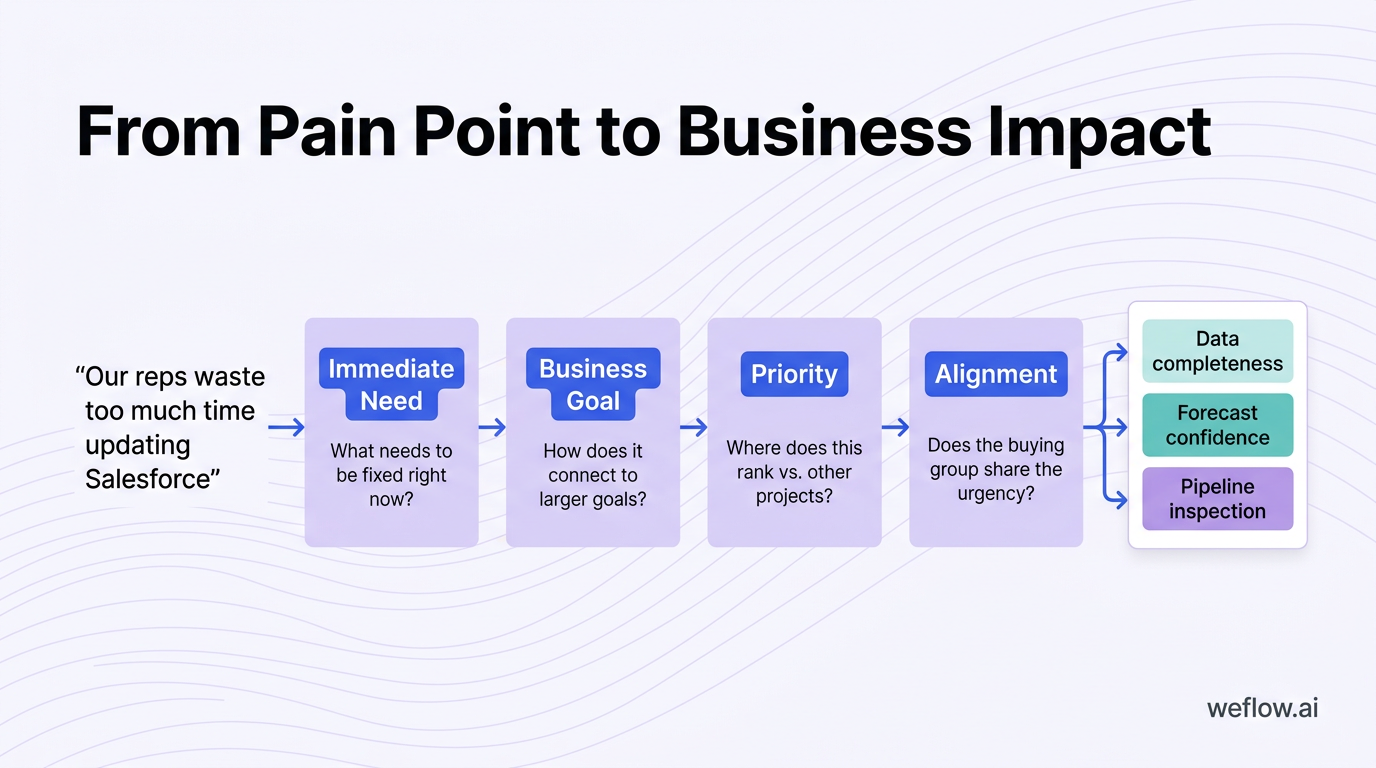
The key is active listening. Don’t treat the buyer’s first answer like a box to check. Use their wording as your pivot point: if they say, “Our reps waste too much time updating Salesforce,” your next question should connect that pain to a bigger outcome like data completeness, forecast confidence, or pipeline inspection.
- Immediate need: Ask what the buyer needs to fix right now, and why it matters today.
- Business goal: Ask how solving that immediate issue connects to larger team or company goals.
- Priority: Ask where this initiative sits against other active projects, and why it ranks there.
- Alignment: Ask whether the rest of the buying group sees the same urgency, or whether other goals are competing for attention.
Identify immediate needs and drivers
Start with the issue the buyer feels every week, not the strategy slide they’ll show next quarter. That approach builds trust because it shows you understand the work before you ask them to explain the board-level impact.
Example questions
- “What is your biggest need today?”
- “Why is this need important to you and your team?”
- “What happens if this doesn’t get fixed this quarter?”
- “Who feels the impact most right now?”
If the buyer gives you a short answer, don’t rush to the next topic. Stay on it long enough to understand whether the pain is about time loss, missed pipeline coverage, poor activity capture, low CRM adoption, or something else. That detail will shape the rest of the conversation.
Connect daily tasks to business goals
Once the buyer has named the immediate issue, move up one level. This is where discovery shifts from “we have a problem” to “this problem affects revenue outcomes.” That connection is what increases deal size and helps your champion justify the project to leadership.
- “What are the larger business goals your team is hoping to achieve?”
- “How would solving this issue bring you closer to those goals?”
- “What happens when you achieve this goal? What comes next?”
- “If this gets fixed, what does it change for leadership?”
A practical transition sounds like this: “You mentioned reps are spending too much time on manual updates. How does that affect the bigger goals your team is measured on?” That keeps the conversation natural while pushing toward business impact.
Assess team alignment on priorities
Deals slow down when your champion cares more than everyone else. You need to know whether the broader team shares the same urgency, or whether you’re looking at a single-threaded opportunity with weak internal support.
- Check for shared urgency: “Does the rest of your company or team see this as a priority?”
- Check for competing initiatives: “Are there other goals that are equally important right now?”
- Check for executive sponsorship: “Who else cares about this outcome?”
- Check for timing risk: “If priorities shift, what project would bump this down the list?”
Misalignment is a major red flag. If the champion says the problem is urgent, but finance, IT, Sales Ops, or sales leadership sees it as optional, you need to address that gap early or expect the deal to stall after a strong first call.
Value realization questions: quantify the upside of a solution
After you understand the problem, shift the conversation to measurable upside. This is where the buyer starts defining success in their own words rather than reacting to your pitch.
That matters because buyers trust their own reasoning more than your claims. When they say the outcome out loud—less time spent updating Salesforce, higher activity completeness, cleaner forecast calls, fewer manual workarounds—they start building the internal case themselves.
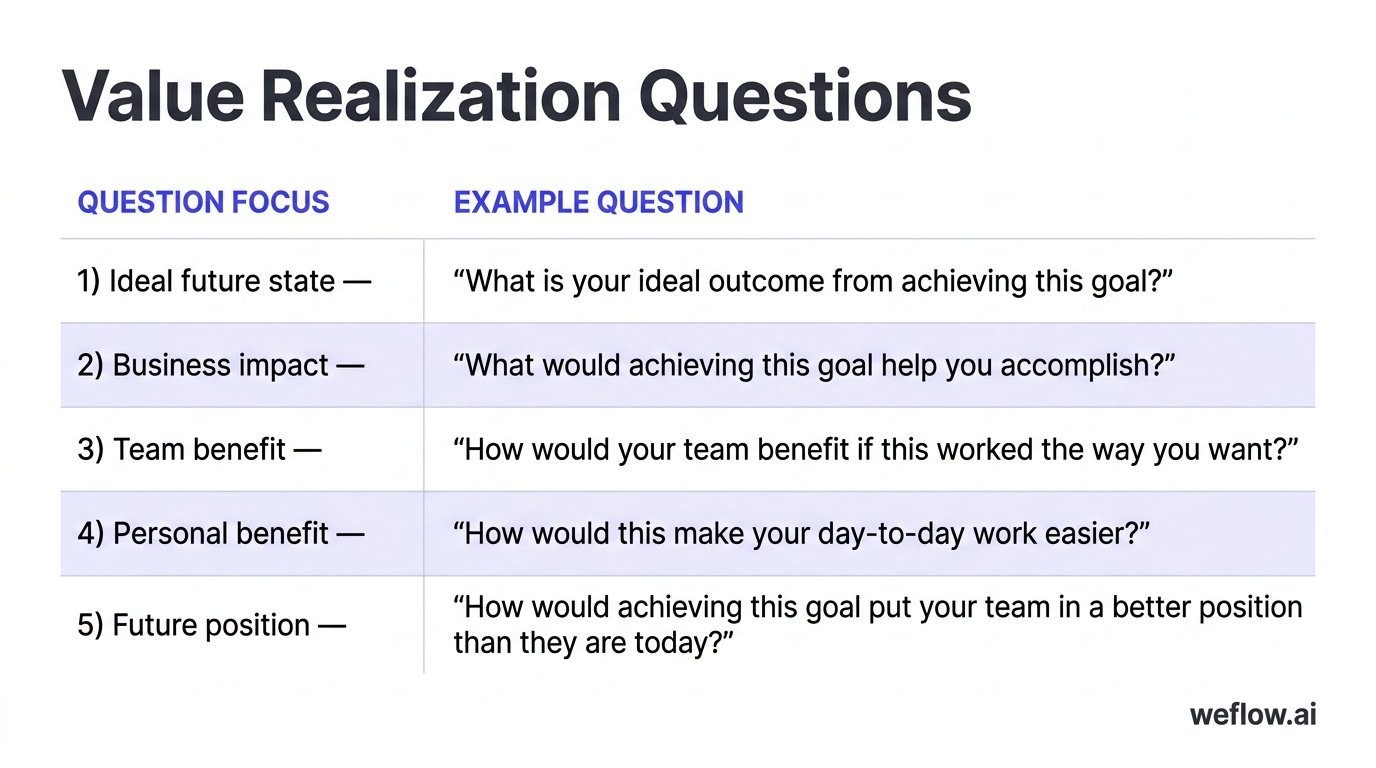
| Question focus | Example question |
|---|---|
| Ideal future state | “What is your ideal outcome from achieving this goal?” |
| Business impact | “What would achieving this goal help you accomplish?” |
| Team benefit | “How would your team benefit if this worked the way you want?” |
| Personal benefit | “How would this make your day-to-day work easier?” |
| Future position | “How would achieving this goal put your team in a better position than they are today?” |
Define the ideal future state and outcomes
If goal discovery tells you what’s broken, future-state questions tell you what success needs to look like. Good answers here give you the language for the business case, proposal, mutual action plan, and later-stage recap.
- “What is your ideal outcome from achieving this goal?”
- “What would achieving this goal help you accomplish?”
- “What would good look like 90 days after rollout?”
- “What would leadership expect to see if this project worked?”
Document the buyer’s exact phrasing. If they say, “We need reliable Salesforce activity data before forecast calls,” reuse that sentence later. It’s stronger than replacing their language with generic value statements.
Measure team and individual benefits
Not every buying reason is financial, and not every buying reason is personal. Strong discovery captures both. Company-wide ROI might show up as better reporting accuracy or lower forecast error rate, while personal and team value usually shows up as less admin work, fewer cleanup projects, and less frustration.
- “How would you benefit from achieving this goal?”
- “How would your team benefit?”
- “What would this free your team up to do instead?”
- “How would this put your team in a better position than they’re in today?”
These answers matter more than many reps think. A buyer might justify the project with revenue impact, but internally push it forward because their team is tired of fixing the same Salesforce data issues every month.
Roadblock identification: surface hurdles before they kill deals
Most late-stage deal losses are not sudden. The blockers were there early, but nobody asked about them directly. If you avoid uncomfortable questions about failed projects, internal disagreement, or implementation risk, you’re choosing surprise later.
You don’t need to turn discovery into an interrogation. You do need to make it safe for the buyer to tell you what could go wrong. That’s how you avoid building a proposal around assumptions that won’t survive procurement, security review, or executive scrutiny.
Audit past failures and success gaps
Past attempts tell you what the buyer already tried, what they liked, and what they won’t tolerate again. This keeps you from pitching an approach they’ve already rejected.
Q: “Have you tried to achieve this goal before?”
Aim: Learn whether this is a new initiative or a recycled one with baggage.
Q: “Why weren’t you successful?”
Aim: Identify whether the failure came from weak adoption, poor field mapping, shallow Salesforce write-back, limited budget, or lack of executive sponsorship.
Q: “What solutions have you tried on your journey to making this goal a reality?”
Aim: Map the evaluation history and understand replacement context.
Q: “Where did they fail? Where did they succeed?”
Aim: Separate real product gaps from process issues inside the buyer’s team.
This step is useful in competitive deals and migration projects. If the buyer says their current system creates activity gaps in Salesforce or forces manual workarounds, you now know which proof points matter in the next call.
Uncover internal team disagreements
Champions rarely volunteer internal resistance unless you ask. They may know exactly who will object, but wait to see whether you can handle the answer.
- “Is there anyone on your team who disagrees with this goal?”
- “Who might push back on this initiative?”
- “Why don’t they agree?”
- “What would they need to see to support the project?”
Once the champion identifies a detractor, don’t argue through secondhand feedback. Ask for a direct path to the concern—another meeting, a written requirement list, or a security and systems review. You want the objection in the open while there’s still time to address it.
Anticipate future implementation hurdles
Good discovery looks past signature and into rollout. That protects deal quality and sets the customer success team up with a cleaner handoff.
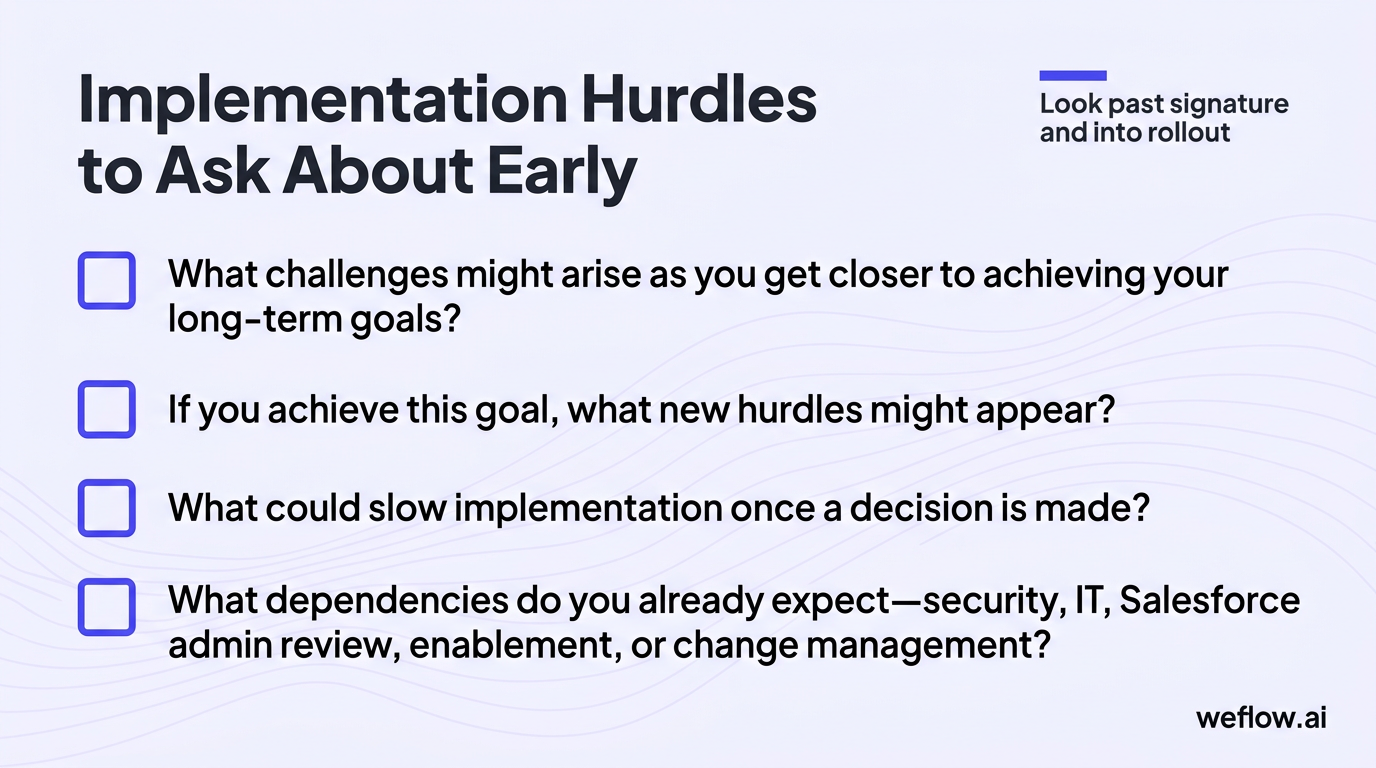
- “What challenges might arise as you get closer to achieving your long-term goals?”
- “If you achieve this goal, what new hurdles might appear?”
- “What could slow implementation once a decision is made?”
- “What dependencies do you already expect—security, IT, Salesforce admin review, enablement, or change management?”
These questions help you uncover adoption risk, systems constraints, and timing issues before they show up as “we need more time.” They also give your post-sale team the context they need to guide onboarding, training, and usage milestones.
FAQ
What is the question-based selling methodology?
Question-based selling is a discovery approach built around strategic questions instead of a feature-first pitch. The goal is to uncover business needs, desired outcomes, and decision risk so the buyer helps define the case for change.
How many questions should I ask on a discovery call?
Most discovery calls need 4-7 high-value questions, not a long script. Focus on depth, follow-up, and transitions rather than volume, because one strong answer usually opens the door to the next topic.
How do I transition between different question types?
Use the prospect’s last answer as the bridge to your next question. A simple transition like “You mentioned reporting accuracy is a problem—how does that affect the larger goals your team is measured on?” keeps the flow natural and shows you’re listening.
What if the prospect refuses to answer goal questions?
Step back and explain why you’re asking so the buyer understands the context. If they still hesitate, offer a hypothesis they can react to, and don’t force it—sometimes you need more rapport before they’ll share strategic priorities.
-p-1600.png)

-p-1600.png)
-p-1600.png)

-p-1600.png)
-p-1600.png)
-p-1600.png)
-p-1600.png)
-p-1600.png)
-p-1600.png)
-p-1600.png)