


Challenger Sales Questions That Reframe Prospect Pain and Build Urency [With Examples]


Most discovery calls fail for one reason: the rep learns the prospect’s current pain, but never changes how the prospect understands it. That leaves you competing on requirements the buyer already had before you showed up.
The Challenger approach fixes that. In this article, we’ll walk through a five-phase question framework—Warm Up, Reframe, Connect, Imagine the Future, and Pitch—and show how to use each phase to move from polite discovery to real deal momentum.
[banner type="download" url="https://www.weflow.ai/content/challenger-checklist" text="Challenger Sales Questions Checklist" subtitle="Phase-by-phase question checklist with example prompts for warm-up and reframe conversations." button="Download now"]Discovery questions: uncover baseline assumptions and hidden flaws
Before you challenge a prospect’s thinking, you need to hear their current model in their own words. Neutral discovery gives you the business context, the tools they’re already leaning toward, and the language you’ll reuse when you introduce the reframe.
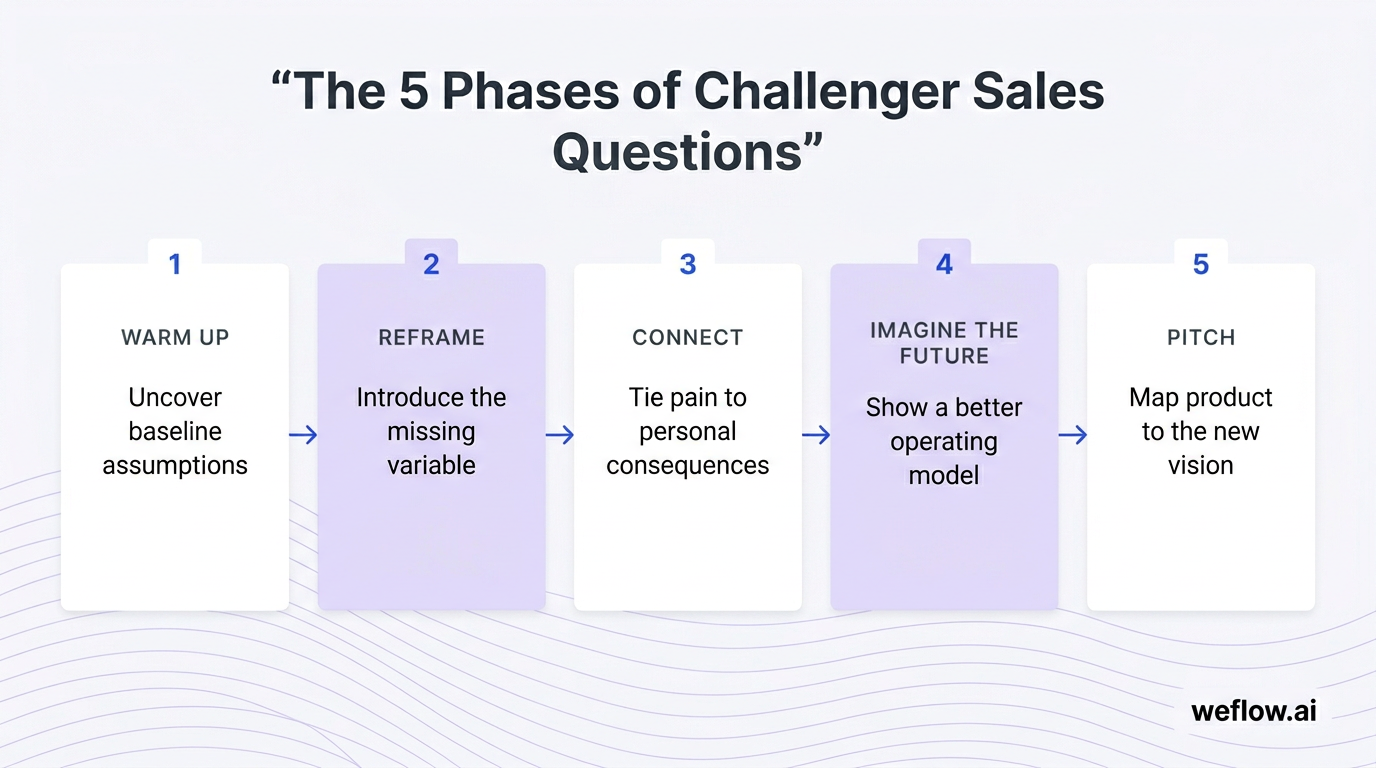
Starting here also matters for tone. If you jump straight into “what they’re missing,” most buyers will defend their current plan. If you let them explain the current state first, they’re more likely to stay open when you point out the gap.
- Gather the baseline business context behind the deal.
- Identify the solutions the prospect is already evaluating.
- Build your first talking points from the buyer’s own words.
Cheat sheet examples: “What problems are you facing?” and “What solutions are you considering?”
Map current solutions and business goals
Your first job is to get the prospect’s perceived problem on the record. If you’re selling to RevOps leaders, Sales Ops managers, or Business Systems teams, that usually means getting specific about Salesforce data completeness, forecast accuracy, rep adoption, activity sync, and the manual work required to keep reporting usable.
- “What problems are you facing?”
- “What solutions are you considering?”
- “Where does the process break today—activity capture, field mapping, forecast rollups, or manager inspection?”
- “What are you trying to improve this quarter: forecast error rate, pipeline hygiene, CRM adoption, or board reporting speed?”
- “What’s creating the most manual work for your ops team right now?”
Keep this phase neutral. You’re not trying to correct the buyer yet. You’re collecting the raw material for the next step. If the prospect says they’re evaluating a conversation intelligence platform, a forecasting layer, or another automation tool, that tells you where their logic starts—and where it may be incomplete.
Those answers become the ammunition for the reframe. Once the buyer states the problem in simple terms, you can show why the problem may be larger, more expensive, or more upstream than they think.
Challenge logic to reveal missing perspectives
This is where Challenger selling starts to feel different. The goal is not to argue with the buyer. The goal is to introduce a missing variable that changes how they evaluate the problem.
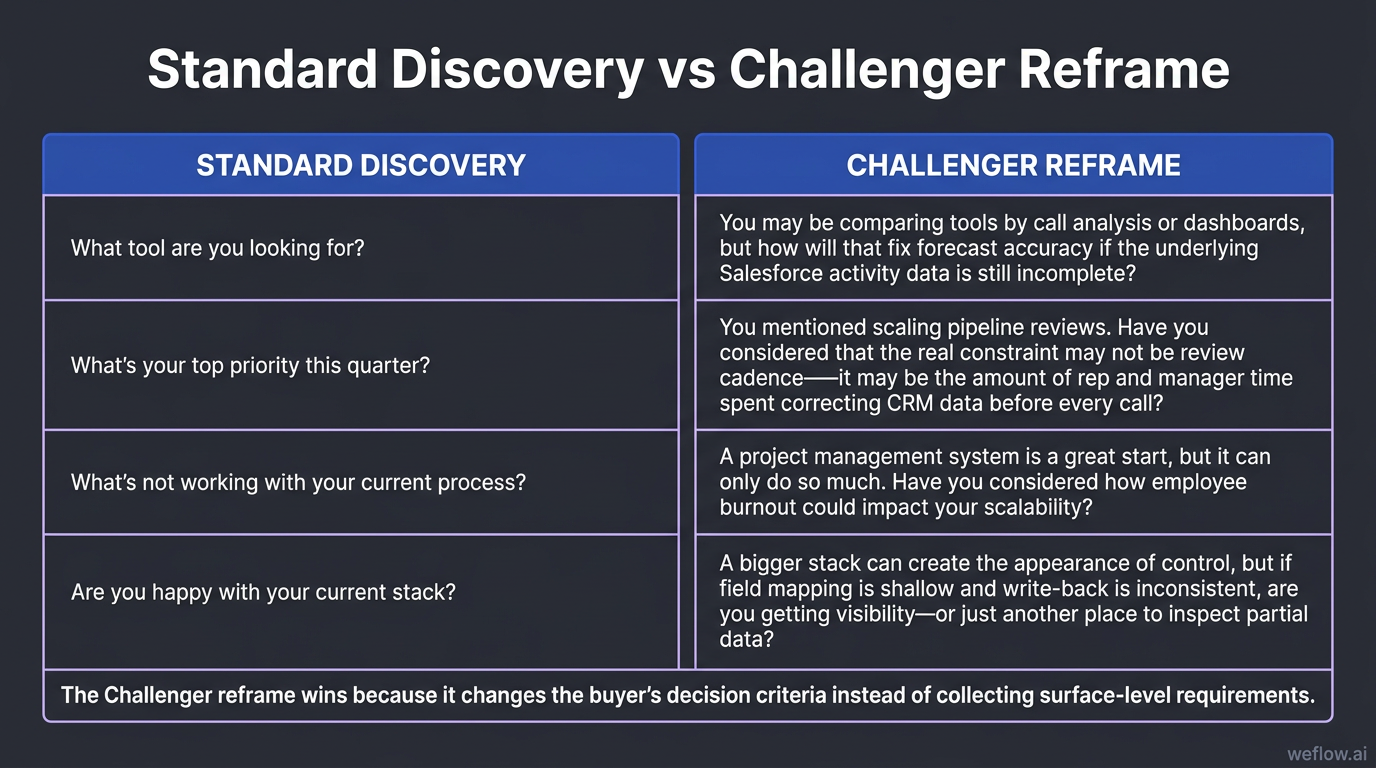
A good reframe exposes the weakness in the buyer’s current plan. Maybe they think better call recordings will fix forecast accuracy, when the real issue is shallow Salesforce write-back. Maybe they think process discipline is a manager problem, when the system itself allows activity gaps and inconsistent stage movement. You’re helping them see the flaw in the path they’re already on.
| Standard discovery | Challenger reframe |
|---|---|
| “What tool are you looking for?” | “You may be comparing tools by call analysis or dashboards, but how will that fix forecast accuracy if the underlying Salesforce activity data is still incomplete?” |
| “What’s your top priority this quarter?” | “You mentioned scaling pipeline reviews. Have you considered that the real constraint may not be review cadence—it may be the amount of rep and manager time spent correcting CRM data before every call?” |
| “What’s not working with your current process?” | “A project management system is a great start, but it can only do so much. Have you considered how employee burnout could impact your scalability?” |
| “Are you happy with your current stack?” | “A bigger stack can create the appearance of control, but if field mapping is shallow and write-back is inconsistent, are you getting visibility—or just another place to inspect partial data?” |
Winner: The Challenger reframe wins because it changes the buyer’s decision criteria instead of collecting surface-level requirements.
Delivery matters here. The reframe should sound calm, specific, and grounded in pattern recognition. Don’t say, “You’re solving the wrong problem.” Say, “Where teams usually get stuck is…” or “What we often see in Salesforce is…” That keeps the conversation credible and lowers the chance that the buyer hears your point as ego instead of insight.
Emotional stakes: tie business pain to personal consequences
Once the buyer sees the logical flaw, you need to raise the cost of leaving it unresolved. Logic gets agreement. Emotion creates urgency.
This doesn’t mean being dramatic. It means connecting the business issue to the people who feel it every week. A forecast miss is not just a metric problem. For the CRO, it can become a board credibility problem. For RevOps, it can mean late nights fixing reports, constant fire drills, and no time left for system improvements that actually matter.
- Leadership credibility: repeated misses make every forecast call harder and every board update more tense.
- Team burnout: manual cleanup, repetitive admin work, and reactive reporting grind down ops teams and frontline managers.
- Rep frustration: when systems create extra work, CRM adoption drops and pipeline hygiene gets worse.
- Retention risk: strong operators and strong reps rarely stay in broken processes forever.
“When your team burns out, you risk a dip in productivity, an unhealthy work environment, and losing top performers to new opportunities. All of these things can make scaling even harder.”
This is the key transition from business pain to human impact. “Scalability” is abstract. “Your RevOps team spends every Friday reconciling pipeline changes because activity sync is incomplete” is not. Buyers move faster when they can feel the operational weight of the problem, not just describe it on a slide.
Paint the cost of ignoring the problem
If the buyer keeps the status quo, what gets worse? This is the moment to make that cost concrete.
- Productivity drops because managers and ops teams spend hours validating data before forecast calls.
- Reporting quality falls when Salesforce records are incomplete, stale, or updated in batches after the fact.
- Work becomes more reactive because every inspection cycle starts with cleanup instead of coaching or decision-making.
- The team culture gets worse when strong performers carry extra admin work created by weak systems.
- Top operators and top reps are more likely to leave when the process feels harder every quarter.
Loss aversion is stronger than upside at this stage. Buyers will often tolerate an inefficient process for months if the pitch is only about improvement. They move faster when they understand what they stand to lose by staying where they are—time, team trust, forecast credibility, and people they can’t easily replace.
Project a future state with your solution
After you’ve made the current state feel expensive, shift the tone. The buyer should now see a better operating model, not just a list of software functions.
This is where you help them imagine what daily work looks like after the problem is fixed. Keep it outcome-based. Talk about time saved, fewer handoffs, lower operating drag, clearer reporting, and a team that can keep up without constant cleanup.
- Before: Reps update Salesforce late, managers inspect deals with partial data, and RevOps has to patch reports before leadership meetings.
After: Activity data lands in Salesforce consistently, managers review deals with confidence, and leadership sees numbers they don’t have to second-guess. - Before: The ops team spends too much time on repetitive work and manual enforcement.
After: The team spends more time improving process design, field mapping, and forecasting logic. - Before: Scaling means adding more inspection work and more admin burden.
After: Scaling means a cleaner process that handles more volume without the same rise in operational effort. - Before: The system feels like work.
After: The system helps the team do more in less time and stay focused on higher-value work.
“If you make your team’s job easier, you can do more in less time. You’ll reduce costs, improve productivity, and let your team focus on the work they love.”
That’s the right shape of the message. Notice that it sells outcomes: lower cost, higher productivity, better morale. It does not jump straight into feature detail. The product matters, but the buyer has to want the future state before they care about how the system produces it.
The final pitch: position your product as the clear solution
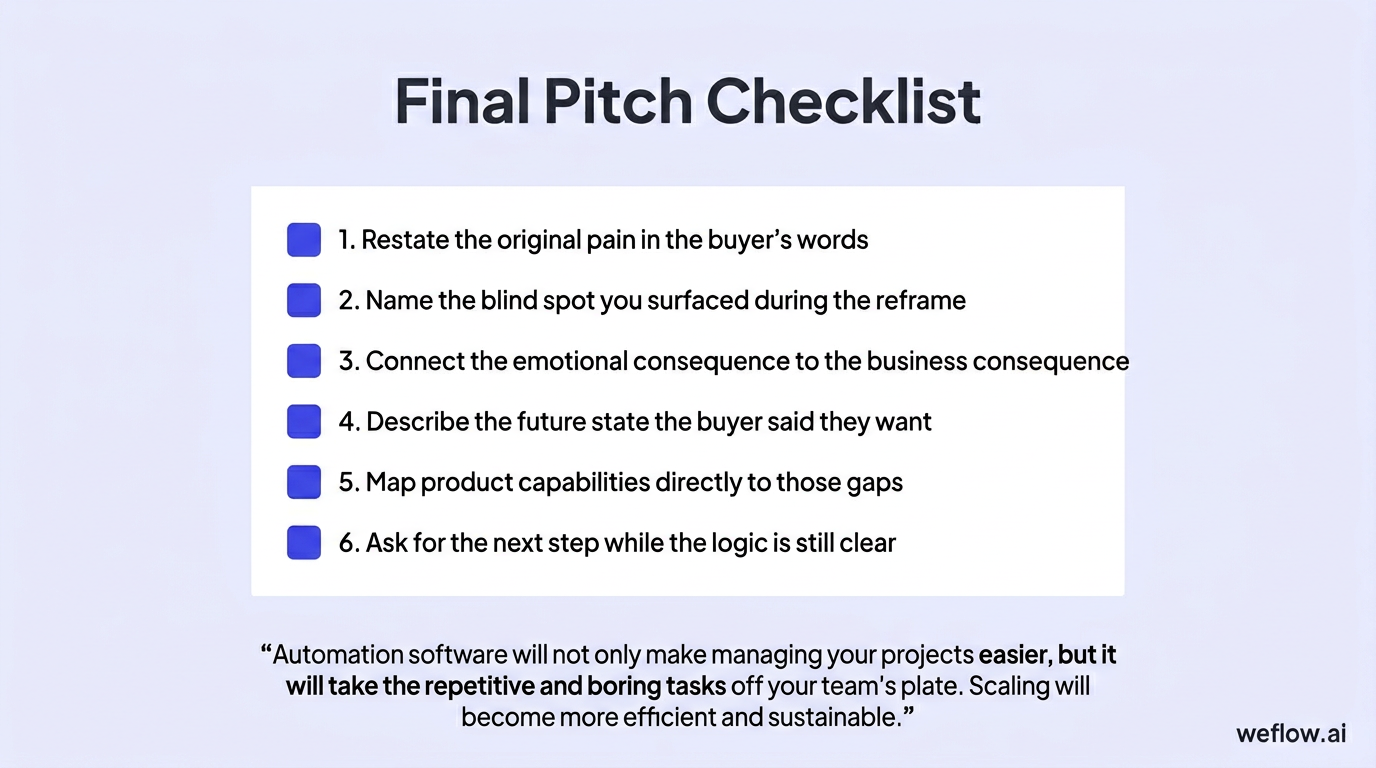
Now you can pitch. At this point, the buyer has already agreed on four things: the current state, the flaw in their existing logic, the emotional cost of leaving it alone, and the shape of a better future. The product is no longer the conversation starter. It’s the vehicle that gets them where they already want to go.
- Restate the original pain in the buyer’s words.
- Name the blind spot you surfaced during the reframe.
- Connect the emotional consequence to the business consequence.
- Describe the future state the buyer said they want.
- Map product capabilities directly to those gaps.
- Ask for the next step while the logic is still clear.
- Final cheat sheet example: “Automation software will not only make managing your projects easier, but it will take the repetitive and boring tasks off your team’s plate. Scaling will become more efficient and sustainable.”
The strongest pitches sound specific because they are. If the buyer said Salesforce activity data is incomplete, talk about activity sync and write-back. If they said field mapping breaks during process changes, talk about deployment effort, admin control, and integration footprint. If they said the forecast is only trusted after manual cleanup, show how your system reduces that cleanup. The pitch should feel like a direct answer to what came up in the Warm Up phase, not a generic company overview.
Connect product capabilities to the new vision
The product pitch works when capabilities function as proof. Automation is persuasive because it removes repetitive work. Salesforce write-back matters because it improves data completeness and reporting accuracy. Better process enforcement matters because it reduces the gap between what the sales process says and what actually gets captured in the system.
Takeaway: The clearest pitch is the one where every capability closes a gap you already exposed in the buyer’s current approach.
Don’t let the conversation drift after this. Ask for a concrete next step right away: a working session with the Salesforce admin, a deeper review of field mapping, or a follow-up with the CRO and RevOps lead to pressure-test the business case.
FAQ
What is a Challenger sales question?
A Challenger sales question is designed to disrupt a prospect’s current thinking, expose a blind spot, and reframe how they understand their own business problem. It does more than collect information. It changes the lens the buyer uses to evaluate the issue and, in many cases, the criteria they use to evaluate solutions.
How do you reframe a prospect’s problem?
You reframe a prospect’s problem by starting with the issue they already admit, pointing out a flaw or missing variable in their current logic, and then introducing a new perspective they hadn’t considered. In practice, that often means moving the conversation upstream—from a visible symptom like poor forecast calls to a root cause like incomplete Salesforce activity data, weak process enforcement, or high manual reporting effort.
When should you introduce the product pitch?
You should introduce the pitch only after you’ve successfully reframed the problem, built emotional stakes, and painted the future state. If you pitch before that, the buyer hears a product description. If you pitch after that, the buyer hears the logical next move.
Why is emotional connection important in B2B sales?
Because B2B purchases are justified with logic, but they’re often driven by emotion. Buyers act when the business problem becomes personally relevant—fear of team burnout, frustration with repeated fire drills, pressure from leadership, or the desire to scale without adding more manual work. Emotion doesn’t replace ROI. It gives the buyer a reason to care about the ROI now instead of later.
-p-1600.png)

-p-1600.png)
-p-1600.png)

-p-1600.png)
-p-1600.png)
-p-1600.png)
-p-1600.png)
-p-1600.png)
-p-1600.png)
-p-1600.png)