


GPCT Sales Process Checklist to Qualify Deals and Uncover Buying Signals [Framework]


GPCTBA/C&I is a qualification framework for teams that need more than a quick budget check. It helps reps understand buyer goals, pressure-test the path to those goals, and spot deal risk before an opportunity turns into forecast noise.
This guide breaks down the framework step by step—Goals, Plans, Challenges, Timeline, Budget, Authority, and Consequences/Implications—so you can run better discovery calls and qualify deals with more confidence.
[banner type="download" url="https://www.weflow.ai/content/gpct-selling-checklist" text="GPCT Sales Process Checklist" subtitle="Get GPCT qualifying questions, discovery prompts, and a sales checklist." button="Download now"]Core GPCT framework: map prospect journeys to close deals
GPCT starts with the buyer’s context. Instead of jumping straight to price, authority, or procurement, it asks what the prospect is trying to achieve, how they plan to get there, what’s blocking progress, and when they need results.
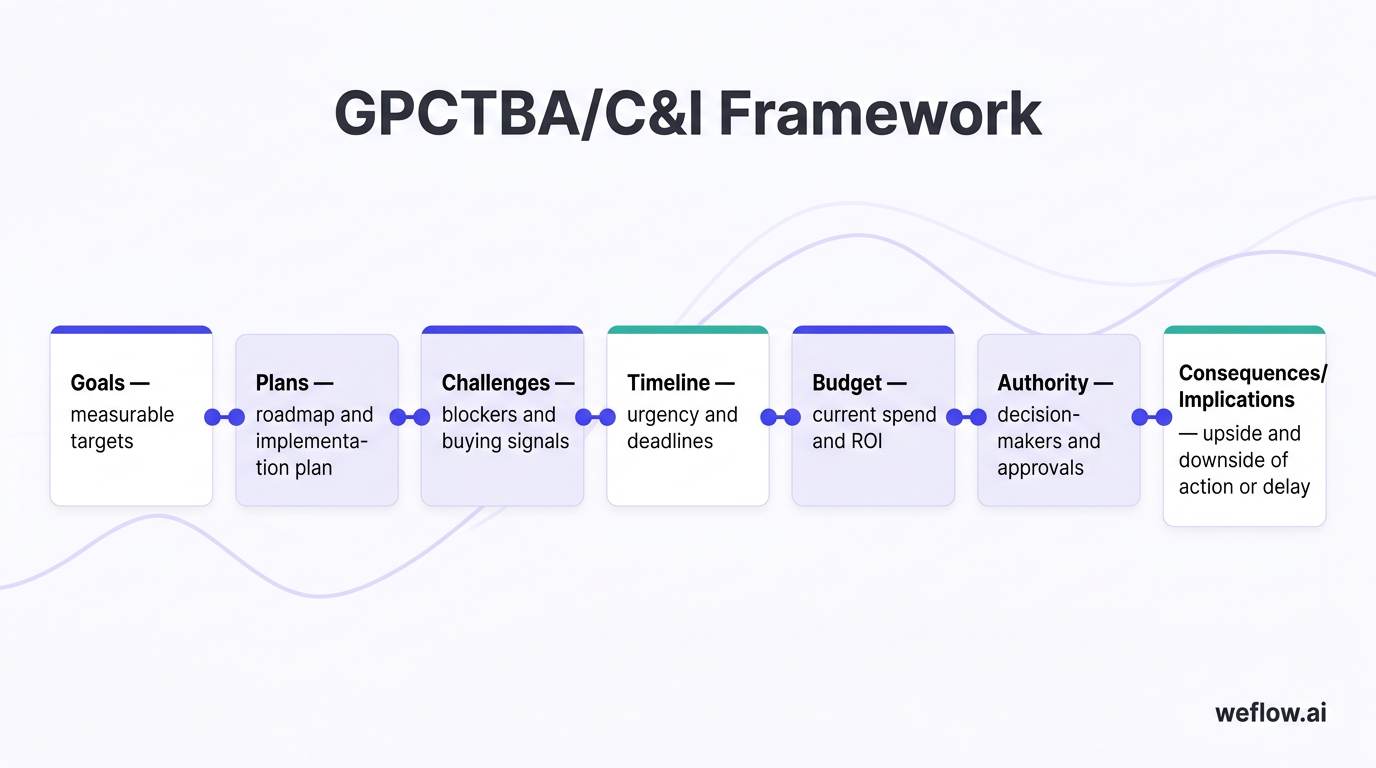
That sequence matters because it shifts the conversation from selling to consulting. When you start with the prospect’s business goals and operating reality, you build trust faster and get better information than you would from a feature-led pitch.
Define short and long-term business goals
Start discovery with outcomes. If the buyer says they want to “grow faster” or “fix pipeline quality,” that’s not enough to qualify a deal. You need to know whether the problem is tied to a specific initiative, a broader company objective, or both.
The best goal questions help the prospect move from vague ambition to measurable targets. That gives you something concrete to qualify against later.
- Is this initiative tied to a specific project, or are you looking for a solution that supports the business over the long term?
- What are the company’s goals over the next three years?
- How many new customers, how much revenue, or how many sales leads do you need to hit target?
- Which of those targets matters most this quarter or this fiscal year?
If the buyer can’t quantify the goal yet, don’t treat that as failure. Treat it as signal. It usually means one of three things: the initiative is still early, the internal business case hasn’t been built, or the problem isn’t tied to a real priority yet. Your job is to help them put numbers around the outcome—revenue, conversion rate, win rate, lead volume, pipeline coverage, or customer growth.
Assess current plans and implementation strategies
Once goals are clear, move to the current plan. This tells you whether the prospect already has a strategy in motion, whether they’re looking for outside guidance, or whether the project exists only as an idea.
Plans are where you start to see buying intent. A buyer with a defined roadmap, internal owner, and change plan is closer to action than a buyer who only agrees the problem exists.
- Are you already working on a solution, or do you need guidance on how to reach these goals?
- Is there a roadmap or implementation plan in place today?
- What are you doing differently this year compared with previous years?
- Which teams are responsible for execution once the project starts?
If the plan sounds weak, challenge it carefully. You don’t need to “catch” the prospect being wrong. You need to help them see the gap between their target and their current approach. A simple way to do that is to reflect the mismatch: You want to increase win rate by 10%, but the team is running the same process as last year. What needs to change for that target to be realistic?
Uncover past obstacles and future challenges
Challenges are often the strongest buying signals in the whole framework. Buyers rarely make a change because a goal sounds nice. They make a change because something in execution, budget, decision-making, or internal alignment is getting in the way.
Challenge callout:
- What’s preventing you from reaching the end goal today?
- What challenges have you already overcome, and how did you handle them?
- Where does the current plan break down—execution, budget, internal alignment, or timing?
- Are there issues in the decision-making process that could slow this down?
This is the part of discovery where active listening matters most. When a prospect shares frustration—missed targets, failed internal projects, poor vendor fit, budget pressure—don’t rush into solution mode. Slow down, repeat back what you heard, and confirm the impact. That does two things: it shows empathy, and it helps you separate surface-level complaints from the problem that will actually drive a purchase.
Establish realistic timelines for project delivery
Timeline tells you whether the opportunity is urgent, whether it’s funded, and whether other priorities could knock it off course. It also gives you a way to test whether the close date in the CRM reflects reality.
- Do you need to hit these goals by a fixed deadline?
- Are you already working toward that deadline, or is the project still in planning?
- If the current timeline proves unrealistic, can the deadline or the goals change?
- What other priorities could compete with this initiative?
- Is budget available now, or does funding sit in a future planning cycle?
Good reps don’t manufacture urgency. They connect timing to business impact. If the buyer needs a solution in place before annual planning, before a product launch, or before the next board cycle, the urgency already exists. Your job is to make that dependency clear and confirm whether the timeline is operationally realistic.
Advanced qualification: secure budget and confirm authority
Once you’ve covered GPCT, move into BA/C&I: Budget, Authority, and Consequences/Implications. This is where discovery turns into true qualification.
These steps matter because many deals look healthy until procurement, finance, or executive review gets involved. Budget and authority questions help you confirm whether the buyer can actually move. Consequences and implications help you confirm whether they have a strong enough reason to move now.
Verify budget expectations and current spend
Budget conversations go better when they’re framed around financial reality instead of price pressure. If you ask only, “Do you have budget?” you’ll often get a vague answer. If you ask what the problem costs today and what return would justify a change, buyers usually get more specific.
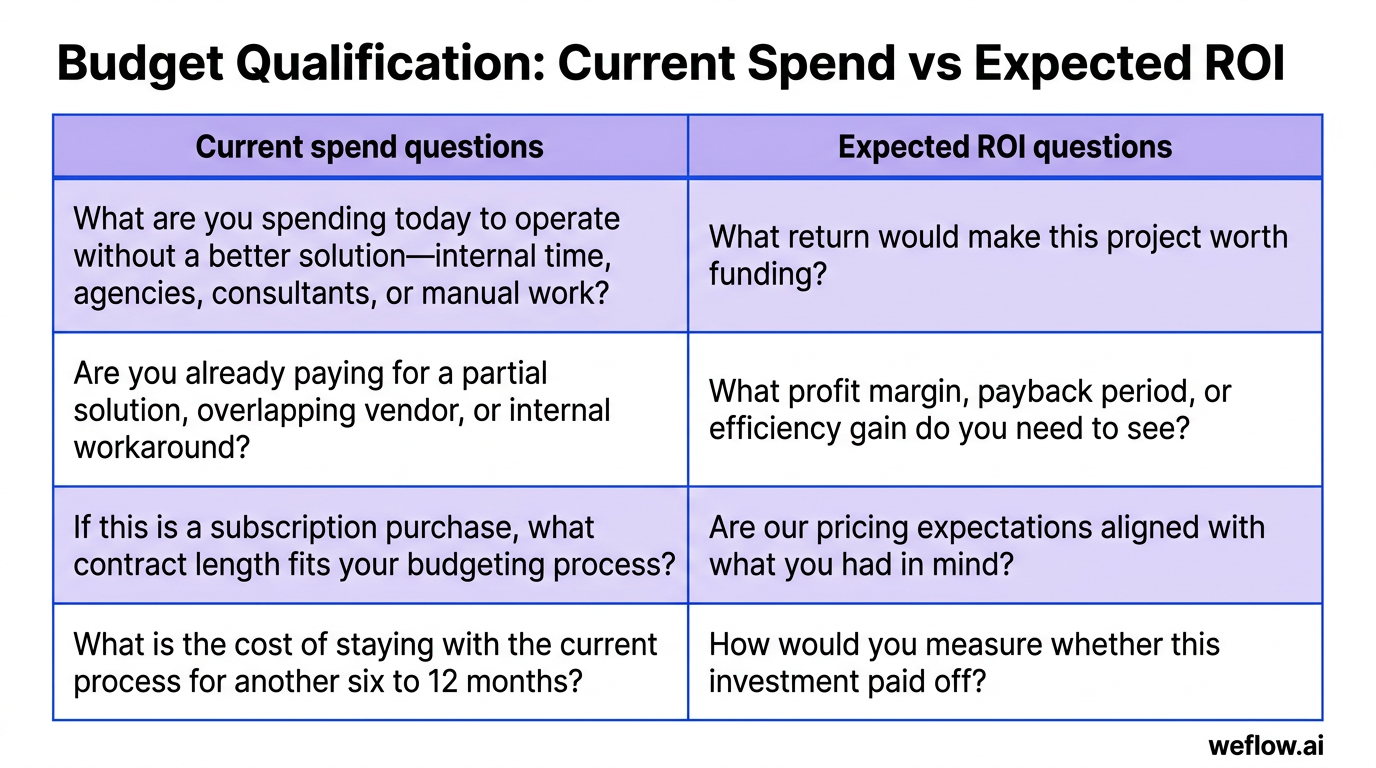
| Current spend questions | Expected ROI questions |
|---|---|
| What are you spending today to operate without a better solution—internal time, agencies, consultants, or manual work? | What return would make this project worth funding? |
| Are you already paying for a partial solution, overlapping vendor, or internal workaround? | What profit margin, payback period, or efficiency gain do you need to see? |
| If this is a subscription purchase, what contract length fits your budgeting process? | Are our pricing expectations aligned with what you had in mind? |
| What is the cost of staying with the current process for another six to 12 months? | How would you measure whether this investment paid off? |
Framing budget around ROI makes the conversation less defensive because it shifts the discussion from sticker price to business case. It also helps you qualify the opportunity more accurately. A buyer who can explain current spend and expected return is usually much further along than a buyer who only says, “We’ll find budget if we like it.”
Identify decision-makers and purchasing authority
A champion is useful, but a champion without authority is still a risk. You need to know who signs, who approves budget, who handles procurement, and who can quietly block the deal if they aren’t involved early.
- Have you reviewed other offers, and what made you reject them?
- Who else is involved in the buying decision?
- Is the buying committee aligned on the business outcome you’re trying to achieve?
- Has the business tried to solve this problem internally before?
- If so, what challenges came up with that approach?
Multi-threading is easier when you position it as help, not pressure. Instead of asking, “Who’s the economic buyer?” try asking, Who else should be part of this conversation so the team can evaluate this cleanly? That keeps your champion respected while giving you access to the people who control budget, timing, security review, and final approval.
Highlight positive implications and negative risks
This is where qualification becomes real. If the buyer can clearly describe what success creates and what failure puts at risk, you’re no longer discussing a nice-to-have project. You’re discussing business impact.
| Positive implications | Negative consequences |
|---|---|
|
|
Tying company outcomes to personal stakes often speeds up a deal. A buyer may care about pipeline growth, but they care even more if a missed target affects their credibility, compensation, or path to promotion. That doesn’t mean forcing emotion into the conversation. It means asking enough questions to understand what’s truly on the line.
If you want to put GPCT into practice quickly, start with the first two categories on your next discovery call: Goals and Plans. That alone will give you a clearer picture of buyer intent, and it usually surfaces the right follow-up questions for the rest of the framework.
FAQ
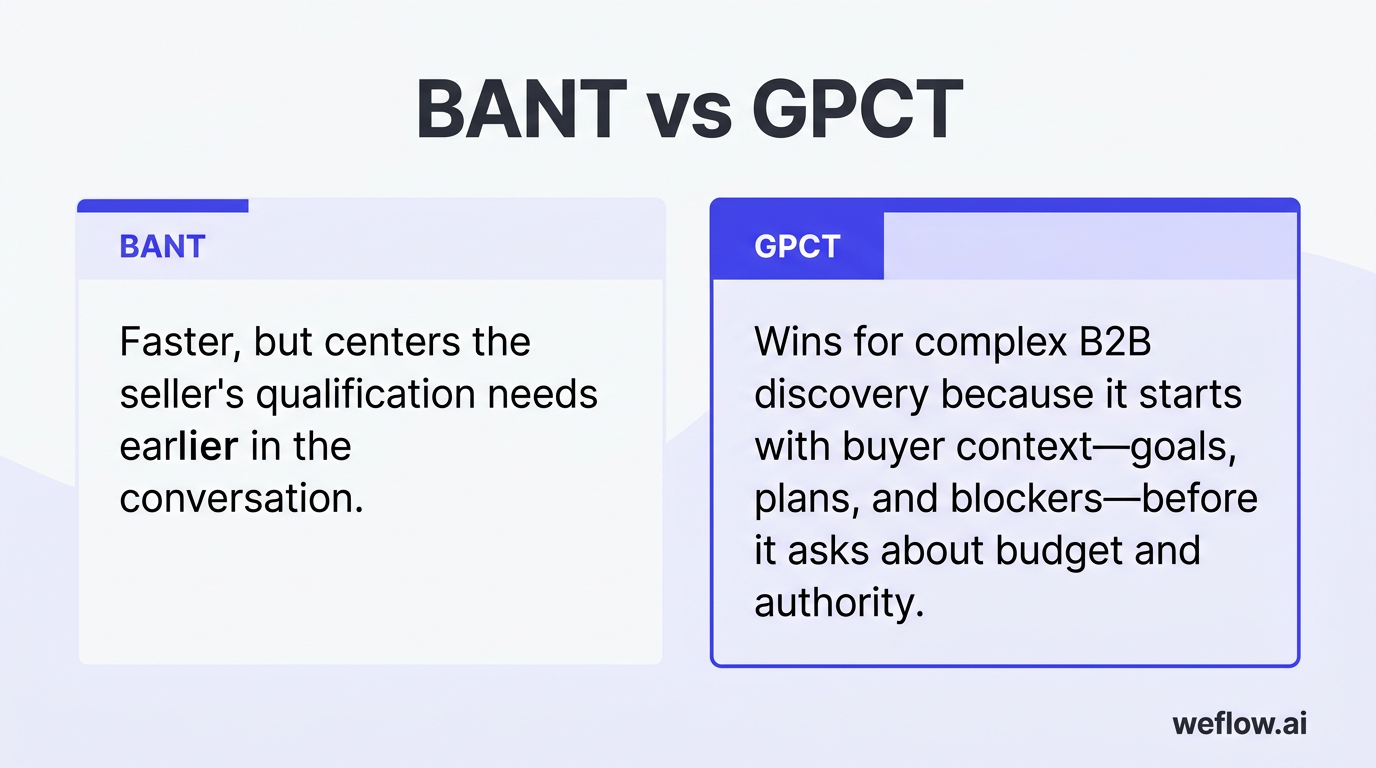
What is the difference between BANT and GPCT?
GPCT wins for complex B2B discovery because it starts with buyer context—goals, plans, and blockers—before it asks about budget and authority. BANT is faster, but it centers the seller’s qualification needs earlier in the conversation.
When should sales reps use the GPCT framework?
Use GPCT during early discovery and initial qualification, especially in deals with multiple stakeholders, longer evaluation cycles, or a real implementation process. It works best when the buyer needs to justify change internally, not just approve a purchase.
How do you transition between GPCT questions?
Summarize what the prospect just said, then bridge naturally to the next category. For example: You need 20% more pipeline next half—how is the team planning to get there today?
Can GPCT be used for short sales cycles?
Yes, but you should compress it. In shorter cycles, ask one strong question on goals, one on the current plan, one on the blocker, and one on timing instead of running the full framework word for word.
-p-1600.png)

-p-1600.png)
-p-1600.png)

-p-1600.png)
-p-1600.png)
-p-1600.png)
-p-1600.png)
-p-1600.png)
-p-1600.png)
-p-1600.png)