


MEDDPICC Sales Process Checklist to Qualify Deals and Unblock Sales Cycles


MEDDPICC helps sales teams qualify complex deals with more rigor, but the value isn’t in memorizing the acronym. It’s in using each part of the framework to pressure-test pipeline quality, expose deal risk early, and keep late-stage opportunities from stalling.
This checklist turns the MEDDPICC framework into a practical guide you can use in discovery, deal reviews, and Salesforce qualification workflows. If you’re a sales leader, RevOps leader, or AE working enterprise deals, this is the set of questions and checkpoints that matter most.
[banner type="download" url="https://www.weflow.ai/content/meddpicc-sales-process-checklist" text="MEDDPICC Sales Process Checklist" subtitle="Get the MEDDPICC checklist plus qualification questions for every deal stage." button="Download now"]Pain and metrics: quantify the cost of doing nothing
The strongest MEDDPICC deals don’t start with ROI math. They start with a problem the buyer already feels. First, you need to understand what is broken, what happens if it stays broken, and why the status quo is costly enough to justify action. Then you attach numbers to it.
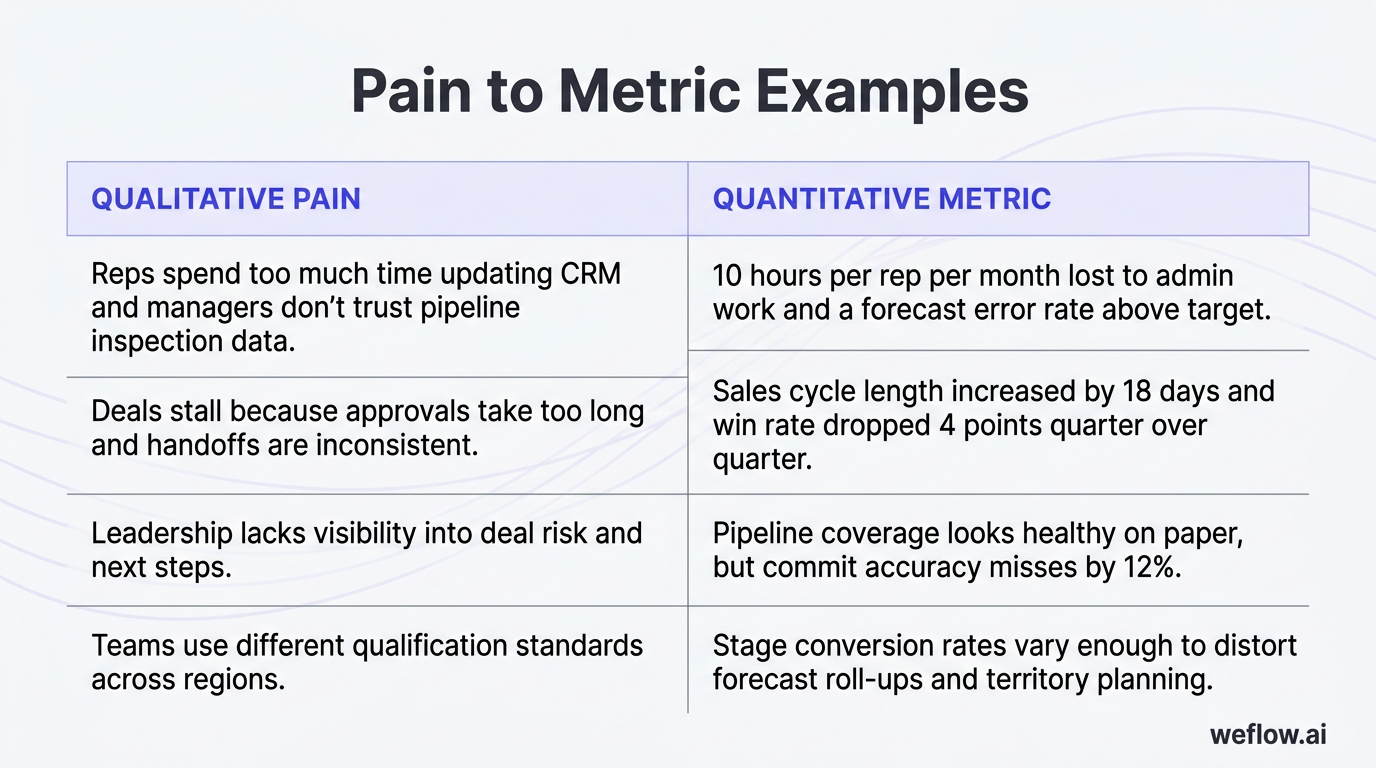
That sequence matters. If a rep leads with numbers before the buyer agrees the pain is real, the metric sounds manufactured. If the buyer has already described the operational drag, missed targets, or wasted headcount tied to the problem, the metric becomes a shared business case instead of a pitch slide.
| Qualitative pain | Quantitative metric |
|---|---|
| Reps spend too much time updating CRM and managers don’t trust pipeline inspection data. | 10 hours per rep per month lost to admin work and a forecast error rate above target. |
| Deals stall because approvals take too long and handoffs are inconsistent. | Sales cycle length increased by 18 days and win rate dropped 4 points quarter over quarter. |
| Leadership lacks visibility into deal risk and next steps. | Pipeline coverage looks healthy on paper, but commit accuracy misses by 12%. |
| Teams use different qualification standards across regions. | Stage conversion rates vary enough to distort forecast roll-ups and territory planning. |
Identify implications of unresolved pain
“Implications of pain” is where reps move past surface-level complaints and get to the real cost of inaction. The core question is simple: what happens if you do nothing?
- Current challenge: What operational, financial, or team-level problem is causing friction right now?
- Downstream impact: How does that problem affect revenue, efficiency, customer experience, or internal credibility?
- Status quo risk: What happens this quarter or this year if nothing changes?
- Executive exposure: Who feels the pain most directly—frontline users, managers, finance, or the executive team?
- Urgency: Is this a known issue with a deadline, or just a recurring annoyance with no owner?
Ask these questions like you’re diagnosing a process issue, not cornering the buyer. Start with what they’re seeing day to day, mirror their language, and then go one level deeper. “What happens if that continues?” lands better than firing off three abstract impact questions in a row.
Define metrics to quantify solution impact
Once the buyer has acknowledged the pain, move to metrics. This is where you quantify the result they need and tie it to business value the buying group can defend internally.
- Business goals: What are they trying to improve this quarter or fiscal year?
- Required outcomes: Which cost, efficiency, pipeline, or revenue metrics matter most?
- Financial value: If those metrics improve, what does that save or generate?
- Baseline: What are they measuring against today?
- Proof threshold: What level of improvement would justify budget approval?
Vanity metrics vs. business metrics: “More user activity” is a vanity metric. “Reduce time to produce board-ready pipeline reporting from three days to three hours” is a business metric because it changes labor cost, operating cadence, and executive confidence.
A strong buyer metric sounds like this: “If we can cut rep admin time by five hours per week across 80 sellers, we can recover selling capacity without adding headcount.” That gives you a real ROI anchor for the rest of the cycle.
Stakeholder mapping: find buyers and build champions
Most enterprise deals don’t fail because the product was weak. They fail because the rep mistook a user for a buyer, or a helpful contact for a champion. MEDDPICC forces you to map the people side of the deal with the same rigor you apply to product fit.
Your champion and your economic buyer are rarely the same person. One helps you navigate the account and build internal momentum. The other can approve budget, accept tradeoffs, and push the deal through competing priorities.
| Role | What they do | What to verify |
|---|---|---|
| Champion | Advocates for your solution internally and helps you understand the account. | Do they have influence, urgency, and a personal reason to drive change? |
| Economic buyer | Owns budget, final sign-off, or the authority to approve the investment. | Can they say yes without asking someone else for permission? |
| User or coach | Provides information, feedback, or access, but may not drive the purchase. | Are they helping because they care, or because they’re being polite? |
Locate the true economic buyer for the deal
The economic buyer isn’t always the most senior person in meetings. It’s the person who can approve spend and decide the project is worth prioritizing now.
- Test sponsorship early: Ask your contact whether they’re sponsoring the project or socializing it on behalf of someone else.
- Clarify approval authority: Ask what needs to happen to get the deal to the finish line and who has final sign-off.
- Map the budget path: Find out whether budget already exists, needs to be reallocated, or depends on a new planning cycle.
- Identify hidden stakeholders: Ask who else will weigh in on risk, ROI, security, or strategic fit.
- Secure access before late stage: If you haven’t met the economic buyer before pricing or procurement, the deal is less qualified than it looks.
A low-friction way to ask for access is: “To make sure we build the right business case, would it make sense to include the person who owns final approval for 20 minutes?” That respects your current contact instead of implying they lack authority.
Assess and empower your internal champion
A real champion does more than like your product. They spend political capital on the project when you’re not in the room.
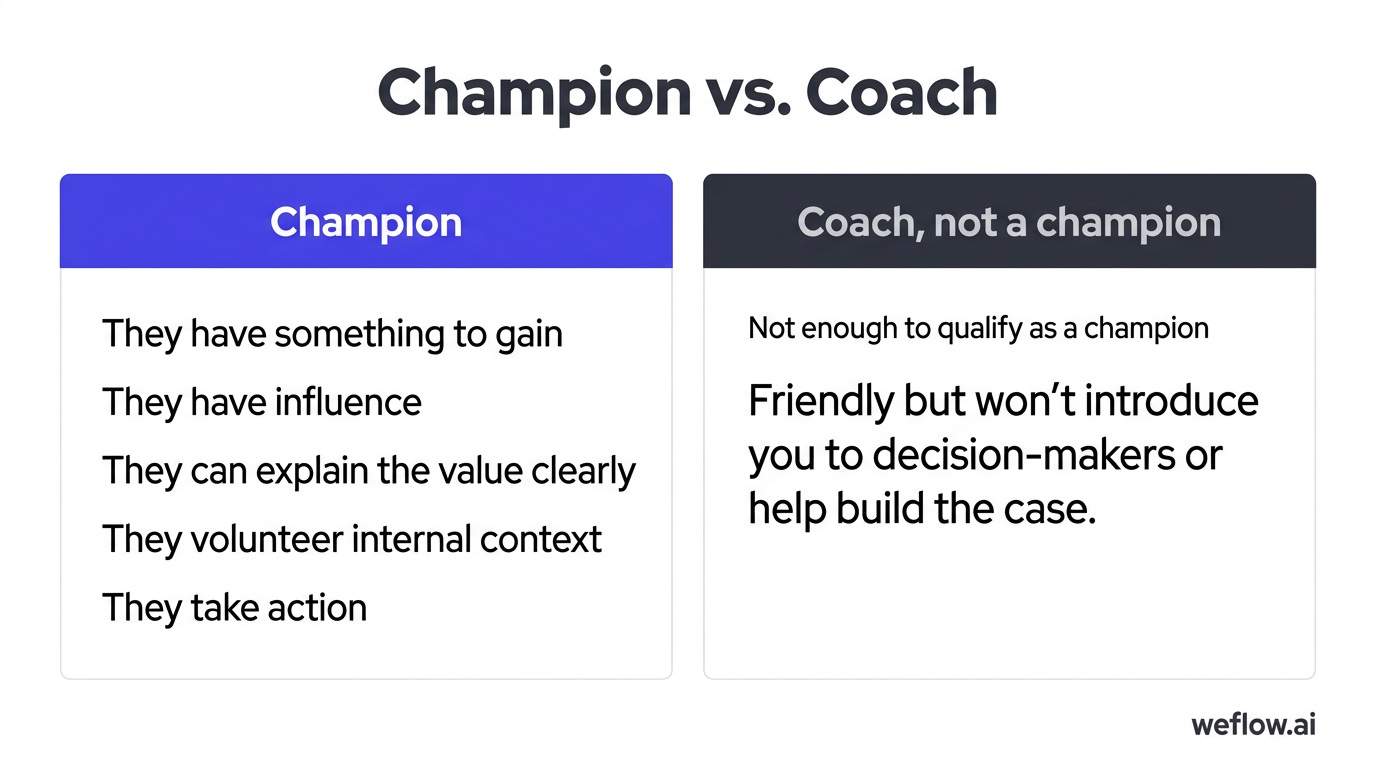
- They have something to gain: A workflow improves, a target gets easier to hit, or a known problem gets solved.
- They have influence: Decision-makers trust them, or they have direct access to the buying group.
- They can explain the value clearly: They understand the business case well enough to repeat it accurately.
- They volunteer internal context: They share obstacles, priorities, and who might block the deal.
- They take action: They schedule meetings, pull in stakeholders, and keep internal next steps moving.
If your contact is friendly but won’t introduce you to decision-makers or help build the case, they’re a coach, not a champion.
Give champions one piece of collateral they can reuse internally: a one-page business case that summarizes the pain, target metrics, expected ROI, implementation effort, and decision timeline. That’s easier for them to forward than a full deck.
Evaluation criteria: position against rival solutions
By the time many reps hear the formal buying criteria, the deal is already tilted toward a competitor. MEDDPICC helps you shape how the buyer evaluates solutions before the shortlist hardens into an RFP or scorecard.
This is where “decision criteria” and “competition” work together. First, uncover what the buyer says they need. Then influence those criteria toward areas where your product is strongest and rival vendors are weaker.
| Decision criteria | Competitive positioning move |
|---|---|
| Required integrations, deployment effort, admin overhead | Emphasize time to value, implementation risk, and systems impact early. |
| ROI model and payback period | Anchor on measurable business outcomes the buyer already agreed matter. |
| User adoption and workflow fit | Show how the solution fits existing process instead of adding more process. |
| Security, procurement, and scale requirements | Bring technical and compliance answers forward before they become blockers. |
That is the practical version of shaping the RFP. You’re not gaming the process. You’re helping the buyer evaluate the category using criteria that predict success after purchase, not just criteria that mirror the incumbent vendor’s strengths.
Uncover the core decision criteria for buyers
You need to know exactly how the buyer plans to grade vendors. Otherwise, your team is presenting to one set of priorities while the account is scoring another.
- Ask for the ideal state: “Describe your perfect solution. What does it include?”
- Prioritize the list: “What are the most important criteria when you make this decision?”
- Understand the business case: “How are you calculating ROI for this project?”
- Separate must-haves from preferences: Some requirements are real. Others are habits or internal opinions.
- Map criteria to proof: For each requirement, determine what evidence the buyer needs to believe you meet it.
If the criteria are unrealistic or clearly skewed toward a competitor, don’t argue with them. Reframe them. Show what the buyer may be underweighting—implementation burden, adoption risk, data completeness, or the total cost of maintaining workarounds. That gives you a path back into the evaluation without sounding defensive.
Differentiate your product from competitors
Competitive deals are easier to manage when your differentiation shows up before the buyer asks for it. If you wait until the end to explain what makes you different, you’re reacting to a frame someone else already set.
Sample talk track: “You mentioned that time to value and clean Salesforce data matter. When buyers compare options here, I’d make sure you test not just feature depth, but also implementation effort, write-back quality, and what your ops team has to maintain after go-live. That’s usually where the differences become clear.”
Never badmouth a competitor directly. It lowers trust and makes you sound like you’re avoiding the buyer’s actual evaluation criteria. A better move is to acknowledge what a competitor does well, then redirect to the factors that matter most for this deal.
Purchasing workflows: navigate decisions and legal tape
A deal is not closed when the buyer says the product looks good. It’s closed when the internal decision path is complete and the contract is signed. MEDDPICC separates the buying motion into two parts that often get conflated: the decision process and the paper process.
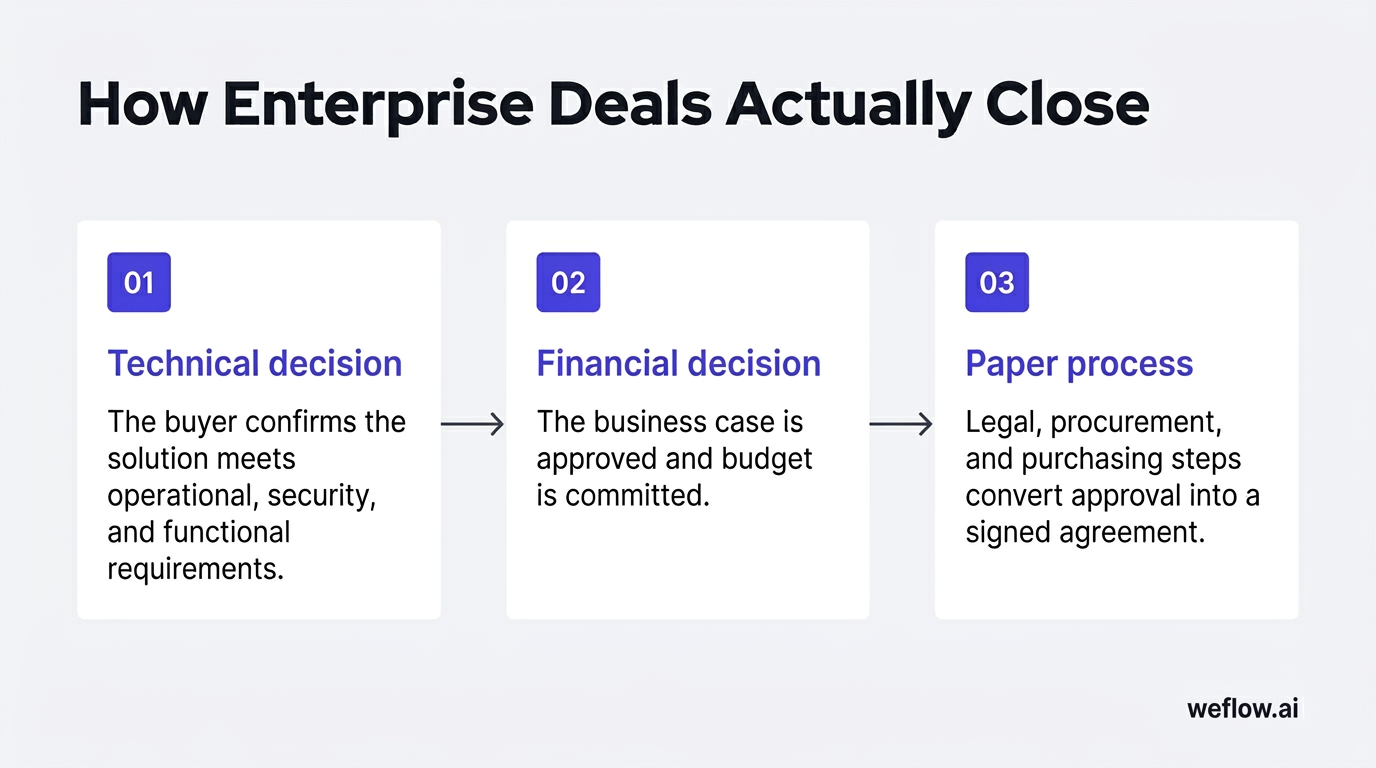
Reps who map both early are less likely to carry inflated late-stage pipeline. Reps who wait until the target close date to learn about procurement, legal review, or security approval usually end up in slip territory.
- Technical decision: The buyer confirms the solution meets operational, security, and functional requirements.
- Financial decision: The business case is approved and budget is committed.
- Paper process: Legal, procurement, and purchasing steps convert approval into a signed agreement.
Discover the paper process weeks before the close date, not after verbal approval. By then, the buyer may want the deal done, but procurement timing and legal queues can still push it out a month.
Map the technical and financial decision steps
Decision process means every internal hurdle the buyer needs to clear between interest and approval.
- Technical validation: What process does the buyer use to confirm the solution works, integrates, and meets security standards?
- Financial validation: What process does the buyer use to justify spend and get budget approval?
- Stakeholder sequence: Who is involved, in what order, and which step creates the most delay?
- Timeline: What is the decision tied to—a quarter end, a planning cycle, a board meeting, or an active initiative?
- Priority level: Where does this purchase rank against other projects competing for the same resources?
Technical validation usually covers items like security review, IT approval, data handling, and systems fit. Financial validation is different—it covers budget ownership, ROI sign-off, and approvals from finance or an executive sponsor. You can pass the first and still lose the second.
Track the paper process to accelerate closing
Paper process is the operational path from “yes” to signature. If you don’t know how that path works on the buyer side, you can’t forecast the deal cleanly.
- Contract owner: Who manages the paperwork process internally?
- Legal review: Is legal handled by in-house counsel or outside counsel?
- Procurement intake: Is a vendor setup, purchase order, or procurement portal submission required?
- Security attachments: Are security questionnaires, DPAs, or compliance documents part of the package?
- Approval sequence: Which signatures must happen before the agreement can be executed?
- Typical cycle time: How long does this process usually take when the deal is a priority?
Multi-thread with legal and procurement as soon as you have buyer approval to do so. If your contact is willing, ask for direct coordination between your legal team and theirs. That removes a layer of relay communication and keeps redlines from stalling in someone’s inbox.
FAQ
What does the MEDDPICC acronym stand for?
MEDDPICC stands for Metrics, Economic buyer, Decision criteria, Decision process, Paper process, Implications of pain, Champion, and Competition. It is a B2B sales methodology used to qualify complex deals by covering business value, stakeholder influence, buying process, and competitive context.
How does MEDDPICC differ from MEDDIC?
MEDDPICC expands on MEDDIC for more complex enterprise deal qualification. It adds Paper process to account for procurement and legal friction, places more emphasis on Implications of pain to sharpen urgency, and includes Competition so reps can manage multi-vendor evaluations more directly.
Who should use the MEDDPICC sales framework?
MEDDPICC is most useful for B2B enterprise sales teams working deals with multiple stakeholders, formal buying committees, and longer approval cycles. Account executives, sales managers, enablement teams, and revenue leaders use it to improve qualification consistency, forecast quality, and deal inspection.
When should reps introduce MEDDPICC questions?
Reps should use MEDDPICC across the full discovery and evaluation phase, not as a script for one call. Some questions belong early, like pain and metrics. Others, like paper process and final approval steps, should be confirmed before procurement starts so late-stage deals do not slip for preventable reasons.
-p-1600.png)

-p-1600.png)
-p-1600.png)

-p-1600.png)
-p-1600.png)
-p-1600.png)
-p-1600.png)
-p-1600.png)
-p-1600.png)
-p-1600.png)