


SNAP Selling Questions That Uncover Buyer Priorities and Advance Deals [Framework]


SNAP Selling works because most buyers don’t need more information—they need less friction. Jill Konrath’s idea of the frazzled customer describes the reality in most B2B deals: decision-makers are juggling deadlines, internal politics, and too many competing asks.
The SNAP framework gives reps a way to sell into that environment without adding more noise. Used well, it helps you simplify decisions, build credibility, align to what matters now, and keep your deal attached to a real business priority.
[banner type="download" url="https://www.weflow.ai/content/snap-selling-checklist" text="SNAP Selling Questions Checklist" subtitle="Get buyer-focused sales question checklists and conversation prompts for frazzled prospects." button="Download now"]Simplicity tactics: cut noise to accelerate decisions
The first job in SNAP Selling is reducing cognitive load. Frazzled buyers don’t stall because they’re lazy. They stall because every new option, feature, and follow-up creates more work on their side.
- Run fewer, better meetings. If the buyer only remembers one thing from the call, make sure it’s the problem you help solve and the next decision they need to make.
- Answer the question they asked before introducing anything else. If they asked about implementation, don’t jump into roadmap slides or six unrelated use cases.
- Limit options. Two paths are easier to compare than five. More choice often means more internal review, not more momentum.
- Keep presentations short. A 12-slide deck with a clear agenda beats a 40-slide walkthrough of everything your company does.
- Set the agenda at the start of every meeting. Buyers relax when they know what’s coming, how long it will take, and what decision the conversation is meant to support.
- Close every call with confirmed next steps. “We’ll follow up” is not a next step. A dated next meeting, owner, and purpose is.
- Map touchpoints in advance. Know which interaction is for discovery, which is for validation, which is for technical review, and which is for commercial alignment.
To clarify immediate focus without overwhelming the buyer, ask tight questions that force prioritization:
- “If we only solve one issue from today’s list, which one would make the biggest difference this quarter?”
- “What’s the main decision you’re trying to make from this meeting?”
- “What’s competing for attention internally that could slow this down?”
Limit options to simplify buyer choices
One of the fastest ways to slow a deal is showing every feature you have. Reps often do this to prove value, but buyers experience it as extra evaluation work.
Decision fatigue is real in B2B sales. The more options a buying group has to compare, the more likely they are to delay, ask for another meeting, pull in more stakeholders, or default to the current process. That’s not a product problem—it’s an attention problem.
Callout: Over-pitching creates friction because buyers now have to sort what matters from what doesn’t, defend that scope internally, and revisit criteria they may have already agreed on.
A better move is to stay inside the buyer’s stated lane. If they asked about forecast accuracy, show the reporting workflow and the outcome. Don’t add call coaching, adjacent use cases, or future-state expansions unless they ask.
Map touchpoints to control meeting flow
SNAP Selling gets easier when each interaction has a job. Buyers move faster when the sales process feels predictable and low-effort.
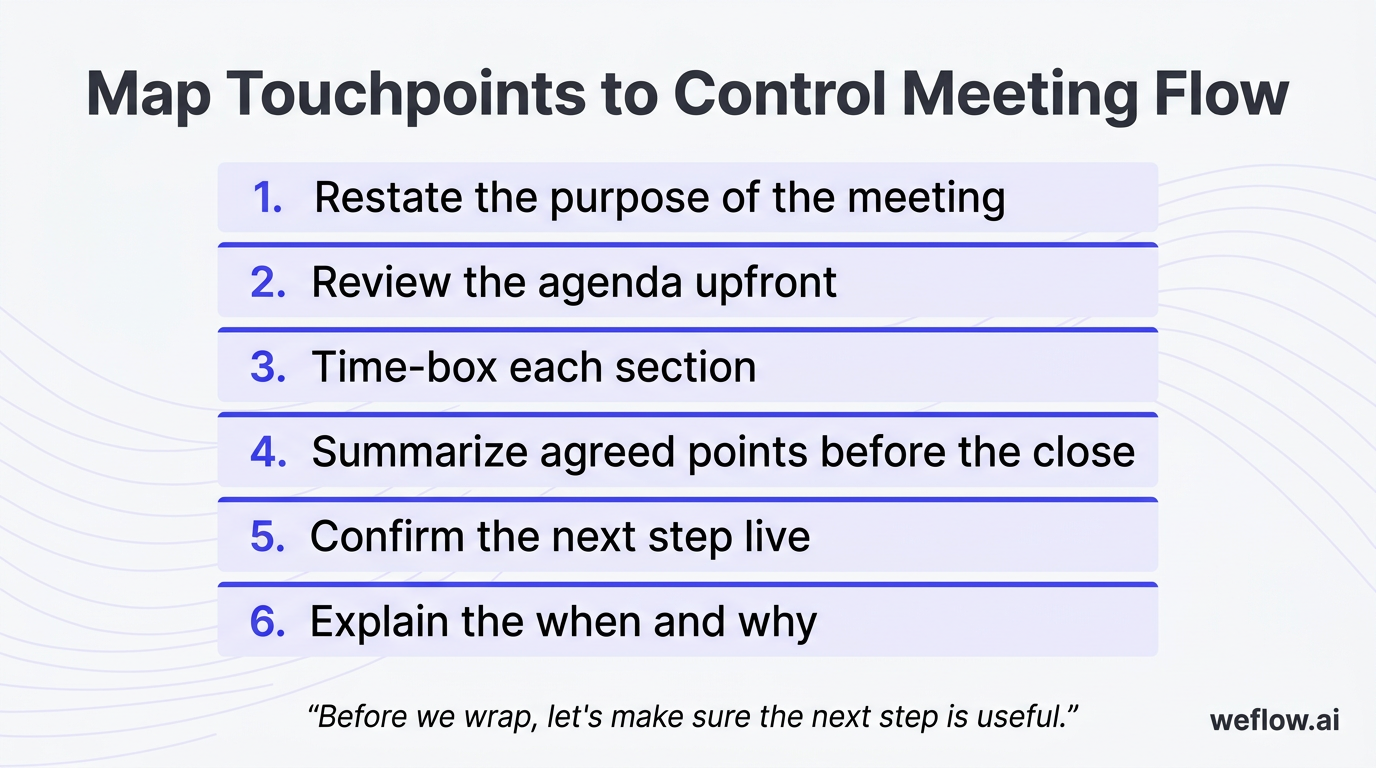
- Restate the purpose of the meeting. Confirm what the buyer wanted to cover and what decision, if any, they’re trying to make.
- Review the agenda upfront. Keep it short—three topics is usually enough.
- Time-box each section. This shows respect for the buyer’s calendar and prevents one topic from swallowing the whole meeting.
- Summarize agreed points before the close. Don’t assume alignment because nobody objected.
- Confirm the next step live. Book the next meeting while everyone is still present.
- Explain the when and why. Buyers are more likely to accept follow-up when they understand what the next conversation is for.
Script template: “Before we wrap, let’s make sure the next step is useful. Based on today, the next meeting should focus on [topic] with [stakeholders]. Does next Tuesday at 2 p.m. work, and would the goal be to confirm [decision/outcome]?”
Value positioning: build trust without overt persuasion
SNAP Selling is not about talking buyers into a decision. It’s about becoming useful enough that the buyer treats you like a credible outside operator, not a rep trying to win an argument.
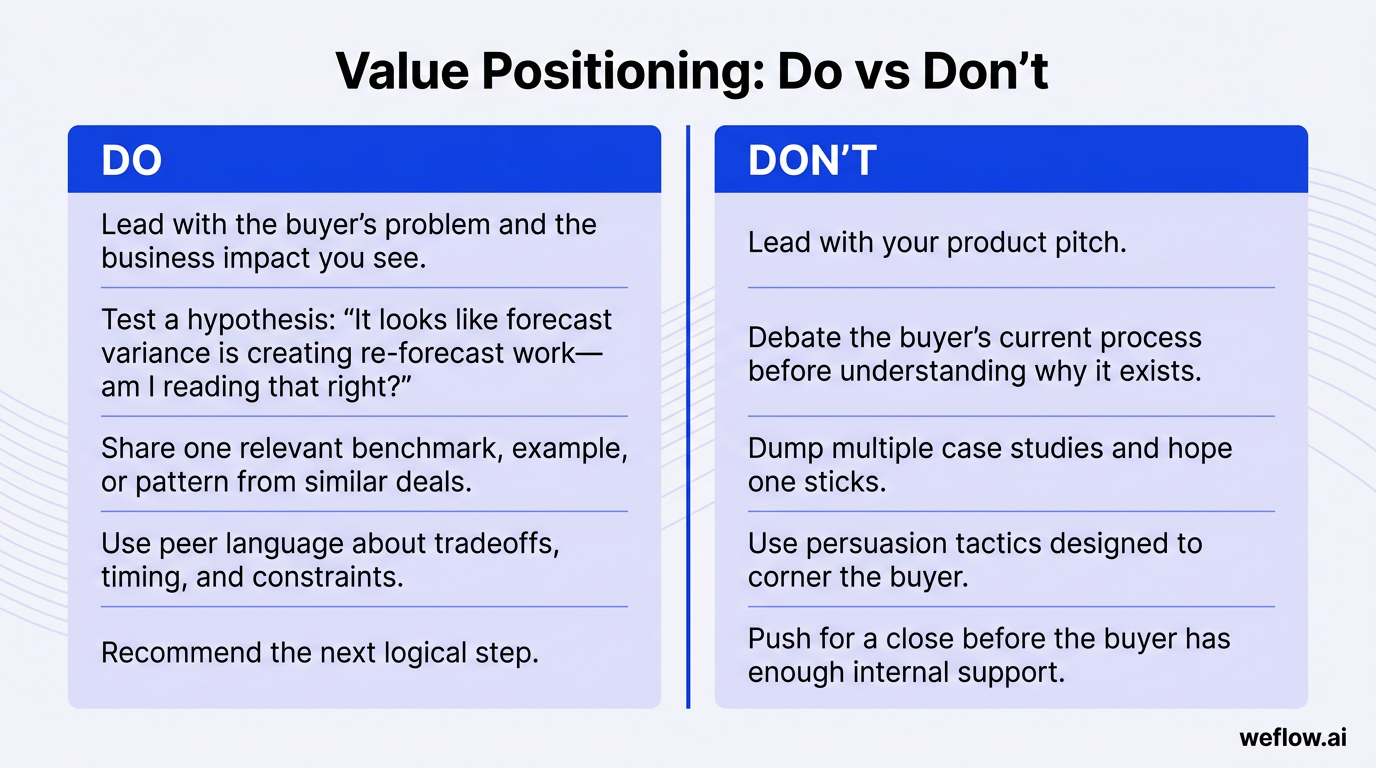
| Do | Don’t |
|---|---|
| Lead with the buyer’s problem and the business impact you see. | Lead with your product pitch. |
| Test a hypothesis: “It looks like forecast variance is creating re-forecast work—am I reading that right?” | Debate the buyer’s current process before understanding why it exists. |
| Share one relevant benchmark, example, or pattern from similar deals. | Dump multiple case studies and hope one sticks. |
| Use peer language about tradeoffs, timing, and constraints. | Use persuasion tactics designed to corner the buyer. |
| Recommend the next logical step. | Push for a close before the buyer has enough internal support. |
Discovery questions that position you as a consultant usually sound different from standard qualification scripts:
- “Where does this problem show up most clearly today—in forecast calls, in reporting, or in deal inspection?”
- “What have you already tried, and where did that approach break down?”
- “If this stays the same for another two quarters, what gets harder for the business?”
Engage buyers as peers on equal footing
Equal footing means you show up with a point of view, not a script. You’re still respectful, but you’re not shrinking yourself in the room or waiting for permission to sound informed.
- Add value every time. Bring a relevant observation, benchmark, or decision framework to each meeting.
- Speak in business terms. Senior buyers care about risk, time, cost, attainment, and execution—not product trivia.
- Ask sharp questions. Peer conversations move from assumptions to implications quickly.
- Challenge carefully. If a buyer’s plan has a hole, point it out with evidence, not ego.
With C-level executives, equal footing looks like this: you come in prepared, you get to the point fast, and you make it easy for them to react to a clear hypothesis. A CRO does not need a long feature tour; they need to know what problem you think matters, why it matters now, and what decision they should sponsor next.
Present data-driven insights confidently
Preparation replaces hard selling. When you show up with a grounded view of the buyer’s business, you don’t need pressure tactics to sound credible.
Checklist: gather these data points before the call
- Company growth signals: hiring trends, territory expansion, new product lines, or restructuring
- Financial context: earnings comments, investor decks, margin pressure, or stated revenue goals
- Leadership priorities: what the CRO, CFO, or CEO has said publicly about efficiency, predictability, or growth
- Operational pressure points: rep productivity, forecast accuracy, sales cycle length, or pipeline coverage gaps
- Industry benchmarks: win rate ranges, conversion benchmarks, attainment patterns, or market shifts affecting the segment
- Internal proof points: discovery notes, current-state metrics, and stakeholder language from earlier calls
Reps can usually find these insights in annual reports, earnings transcripts, investor presentations, press releases, LinkedIn hiring activity, executive interviews, analyst coverage, and industry benchmark reports. If you’re selling into private companies, job postings, headcount changes, new leadership hires, and funding news often tell you what the business is trying to fix.
Goal alignment: map solutions to buyer pain points
Once you’ve reduced noise and built trust, the next step is alignment. This is where many deals go sideways: the rep hears a problem, but not the priority level of that problem.
- Identify the business goal the buyer is being measured on. Start with the outcome leadership cares about, not your solution category.
- Confirm the current obstacle. Ask what is preventing that outcome today.
- Separate immediate pain from background pain. Many issues are real, but only one or two are urgent enough to buy against.
- Map your solution to that urgent pain. Keep the story tight and relevant.
- Check stakeholder agreement. Make sure the champion, economic buyer, and end users are describing the same problem in roughly the same way.
- Reconfirm priorities throughout the cycle. Buyer focus changes. Your messaging should change with it.
Questions that uncover a buyer’s true, immediate priorities:
- “What result is leadership inspecting most closely this quarter?”
- “Which problem has an actual deadline behind it?”
- “If you got budget for only one improvement this half, what would win?”
Identify individual and company goals
A deal usually has two layers of motivation: what the company needs and what each stakeholder needs. You need both to build a case that survives internal review.
| Company goals | Individual goals |
|---|---|
| Improve forecast accuracy before board meetings | A VP Sales wants fewer late-night re-forecast drills |
| Increase pipeline coverage in a weak segment | A frontline manager wants cleaner inspection prep and better rep accountability |
| Reduce sales cycle length | An AE wants fewer internal blockers and faster approvals |
| Standardize process after a reorg or acquisition | A RevOps leader wants fewer exceptions, cleaner reporting, and less manual cleanup |
| Improve efficiency without adding headcount | A CFO wants measurable payback and lower operational waste |
When these goals conflict, anchor to the company goal first because that’s what gets funded. Then show each stakeholder how supporting the broader initiative also helps them hit their own target, reduce risk, or save time. If the personal incentive runs against the company objective, bring that into the open early and widen the buying group.
Match solutions to current priorities
Good alignment is mostly about timing. Even a real problem won’t move a deal forward if it sits below three other issues the buyer has to solve first.
Your pitch should match the pain the buyer is already trying to address. If they’re under pressure to improve pipeline quality this quarter, don’t try to redirect the conversation to a long-term vision they haven’t staffed or funded yet.
Callout: Misaligned pitching slows deals because the buyer now has to do the work of connecting your story to their priority stack—and most won’t do that work for you.
When the fit is clear and current, the next step gets easier: you can start raising the priority of the deal by attaching it to measurable business consequences.
Priority management: keep urgent decisions top of mind
Frazzled buyers don’t ignore deals because they see no value. They ignore them because something else looks more urgent. Your job is to make the cost of delay visible enough that the issue stays on the active list.
- Attach your message to one live business driver. Pick the metric or deadline the buyer already cares about.
- Quantify the status quo. Turn frustration into numbers: hours lost, revenue risk, conversion leakage, or forecast miss.
- Show the future state in concrete terms. Describe what changes in process, metric, and management visibility if the problem gets fixed.
- Use trigger events to create relevance. A reorg, acquisition, funding round, or missed quarter changes what buyers are willing to prioritize.
- Repeat the business case in every late-stage conversation. Priority fades unless someone keeps reconnecting the project to the reason it matters.
Questions that force buyers to quantify the cost of doing nothing:
- “If nothing changes by next quarter, which number misses first?”
- “How much management time is the current process consuming each week?”
- “What happens financially if this slips another six months?”
Quantify the gap to the ideal future state
The goal here is simple: make the current state harder to defend. You do that by measuring the distance between where the buyer is now and where they need to be.
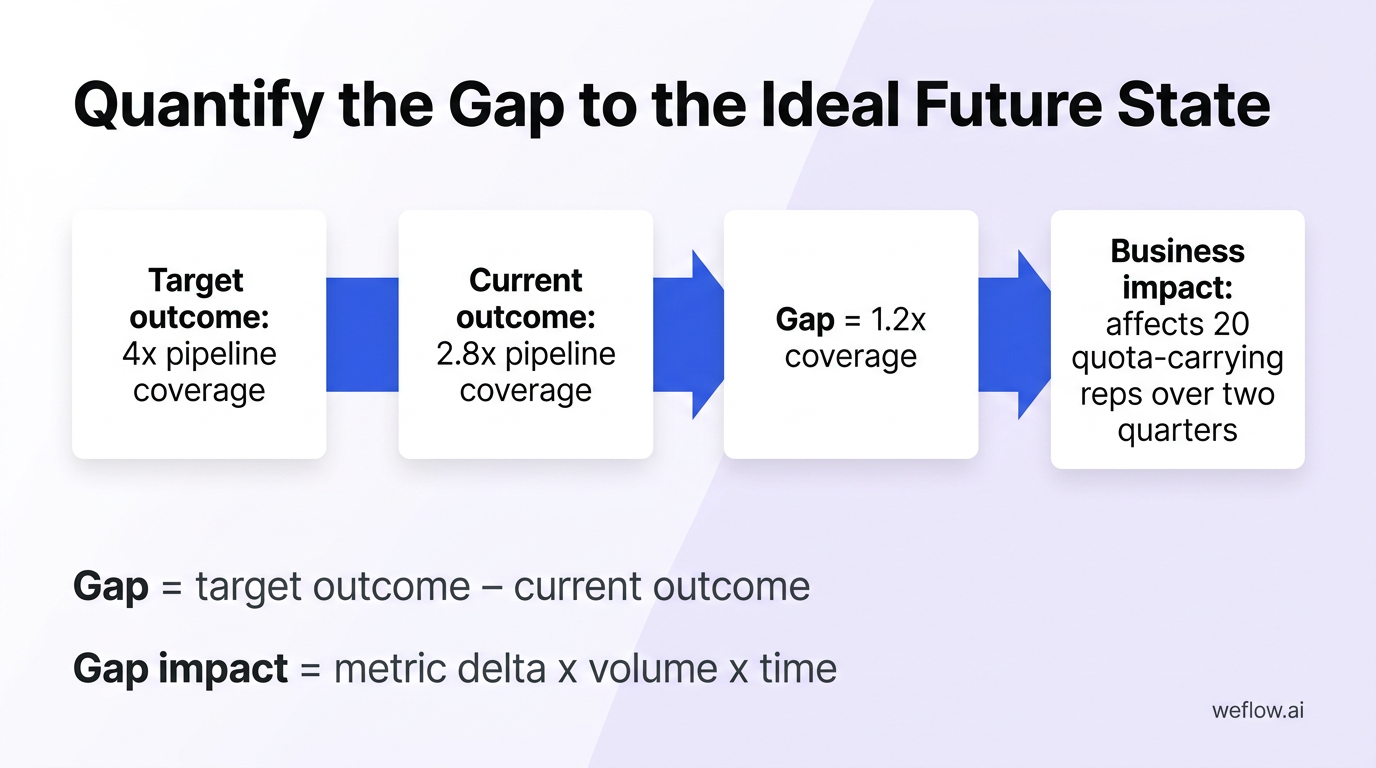
Gap formula: Gap = target outcome - current outcome. To make that gap matter, add business impact: Gap impact = metric delta x volume x time.
For example, if a team needs 4x pipeline coverage and is sitting at 2.8x, the gap is 1.2x coverage. If that shortfall affects 20 quota-carrying reps over two quarters, the conversation quickly moves from “we should improve this” to “we have a measurable planning problem.”
Metrics that resonate with frazzled buyers are usually tied to board pressure, manager time, or revenue risk:
- Forecast error rate
- Pipeline coverage ratio
- Win rate by segment
- Sales cycle length
- Rep ramp time
- Admin hours per manager or rep
- Stage-to-stage conversion rates
- Quota attainment variance across regions
Track trigger events to shift buyer focus
Trigger events matter because they reorder priorities fast. A buyer who had no urgency last month may suddenly have an active project when the business context changes.
- Funding rounds
- Acquisitions or divestitures
- IPO preparation
- Executive leadership changes
- Reorgs or territory changes
- New product launches
- Missed earnings or margin pressure
- New market entry or geographic expansion
- Regulatory changes
- Large competitor moves
To catch these early, set up a repeatable monitoring workflow. Subscribe to company news alerts, track executive changes on LinkedIn, watch funding and M&A databases, and create a simple field in Salesforce for trigger event type and trigger event date. From there, route a task to the account owner, refresh the account plan, and update messaging before the next touchpoint.
FAQ
What does the SNAP selling acronym mean?
SNAP stands for Simple, iNvaluable, Align, and Priorities. It’s a sales framework built for busy buyers: keep the buying process simple, become useful enough to be trusted, align to what matters now, and keep the decision attached to a clear priority.
Who is the ideal buyer for SNAP selling?
The ideal buyer is a time-strapped decision-maker juggling multiple initiatives and internal stakeholders. That often includes CROs, CFOs, RevOps leaders, CIOs, procurement teams, and department heads in B2B environments where buying decisions involve several people and long approval paths.
How does SNAP differ from SPIN selling?
SPIN Selling focuses on question design: situation, problem, implication, and need-payoff. SNAP focuses on the buyer’s mental state and bandwidth, so it helps reps package the conversation in a way that feels easier to process. SNAP is the better framework for managing buyer attention, and SPIN fits well inside it for discovery.
What are trigger events in B2B sales?
Trigger events are internal or external changes that create fresh urgency around a business problem. Common examples include funding rounds, leadership changes, acquisitions, missed earnings, and reorganizations because each one can change budget, timing, or executive attention.
-p-1600.png)

-p-1600.png)
-p-1600.png)

-p-1600.png)
-p-1600.png)
-p-1600.png)
-p-1600.png)
-p-1600.png)
-p-1600.png)
-p-1600.png)