


SPIN Selling Questions That Uncover Buyer Pain and Drive Next Steps


SPIN selling works because the sequence of your questions matters. If you pitch before the buyer has named the problem, felt the cost, and connected it to a next step, discovery turns into a product tour.
This guide turns a SPIN cheat sheet into a practical call structure you can use on your next discovery meeting. We’ll walk through Situation, Problem, Implication, and Need-payoff questions, with examples for each stage and tips on how to keep the conversation useful for the buyer—not just informative for the seller.
Situation questions: map the buyer's current landscape
Situation questions open the call. Their job is simple: build rapport, understand the buyer’s operating context, and gather enough baseline information to make the rest of the conversation relevant.
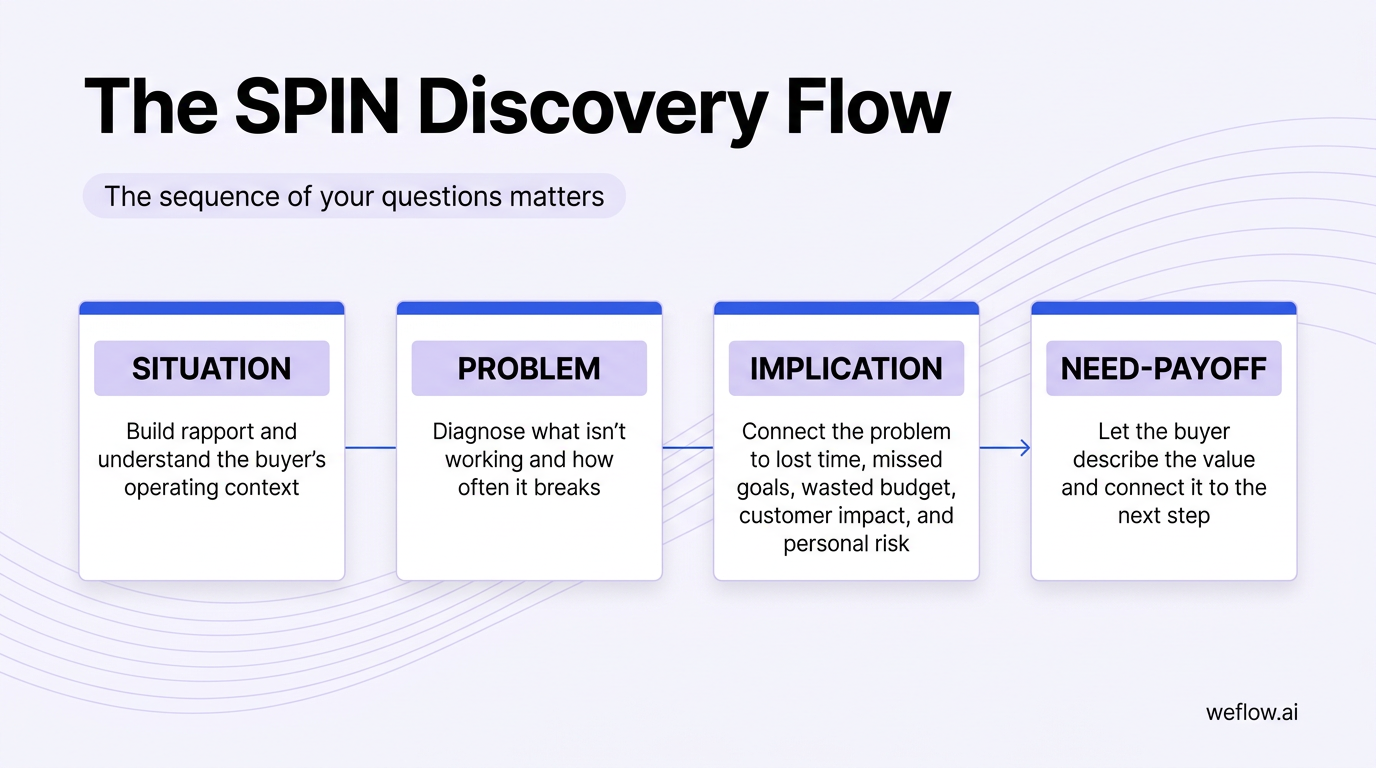
You’re trying to understand four things early: what the company does, who the buyer serves, how their current process works, and who owns strategy and budget. That gives you the context to ask sharper Problem and Implication questions later.
| Information category | Example questions |
|---|---|
| Company and market context |
|
| Role and operating reality |
|
| Current process and tool stack |
|
| Ownership, priorities, and resources |
|
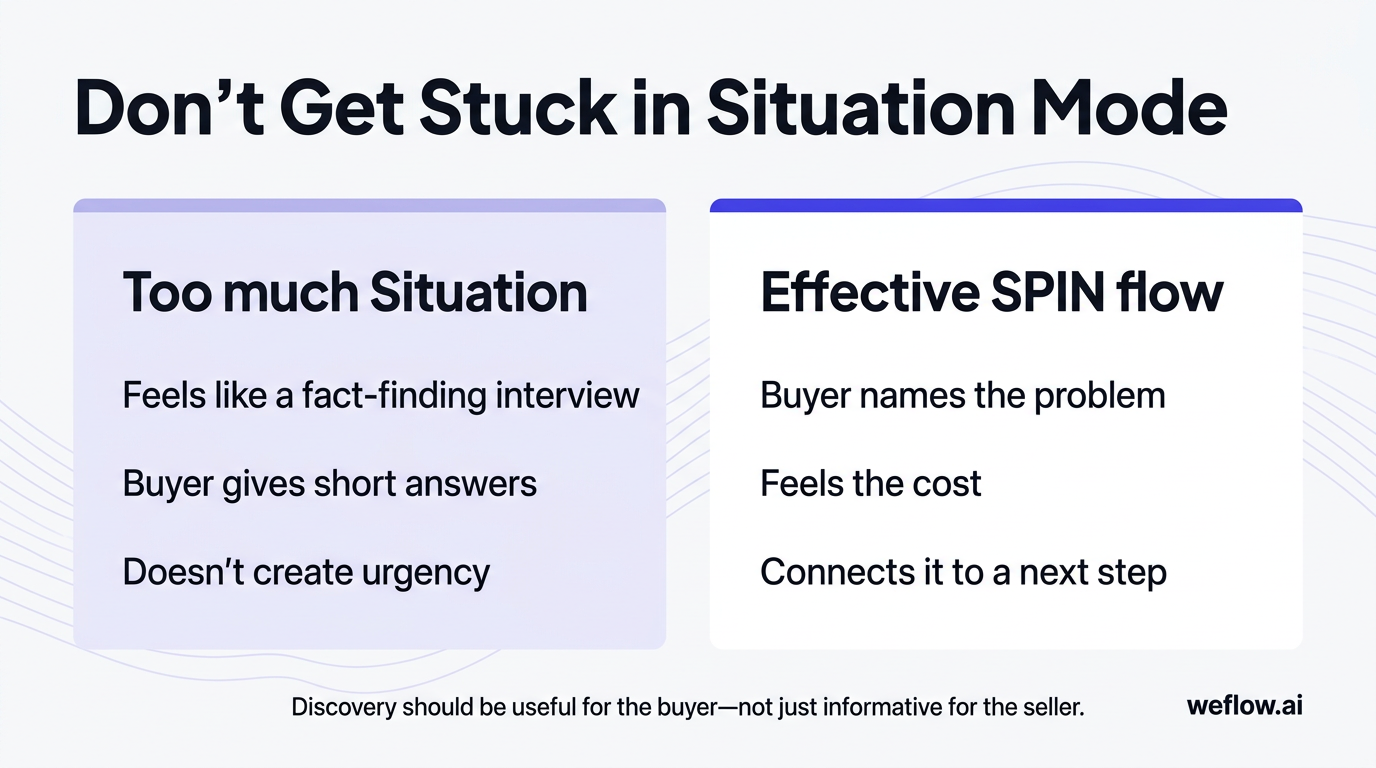
One warning: don’t stay in Situation mode too long. These questions help you orient yourself, but they don’t create urgency on their own. If the first 15 minutes feels like a fact-finding interview, the buyer will start giving short answers and waiting for you to “get to it.”
Assess company structure and daily roles
A buyer’s average day tells you how they think, what constraints they live with, and where your later questions should go. A sales manager, a RevOps leader, and a founder may all describe the same problem differently because they feel the pain in different parts of the workflow.
- Company and offering: Ask what the company sells and who they sell it to. That helps you understand sales complexity, deal size, buying committee size, and whether the problem likely sits in prospecting, qualification, execution, or expansion.
- Target audience: Ask who their buyers are. A team selling into mid-market IT will run a different process than one selling to enterprise finance, and your follow-up questions should reflect that.
- Role clarity: Ask what the prospect owns directly versus what they influence. You want to know whether you’re speaking to a user, a manager, a budget holder, or a future internal champion.
- Daily routine: Ask what an average day looks like. If they spend two hours building reports, coaching reps, or cleaning CRM data, that gives you a direct path into operational pain instead of generic discovery.
Audit current tools and budget owners
This part of Situation discovery is about buying history, not just tool inventory. Knowing what they use matters. Knowing why they picked it matters more, because that tells you the criteria they’ll use again.
- Current tools by use case: Ask what they use today for each part of the workflow. Don’t stop at product names—find out what each tool is supposed to solve.
- Selection logic: Ask why they chose the current solution. Buyers often reveal what they optimized for last time—price, speed, ease of use, security, internal preference, or a specific feature gap.
- Effectiveness: Ask whether the current setup is working. That invites the buyer to grade the status quo without you doing it for them.
- Budget ownership: Ask who controls spending and who signs off. A user can confirm pain, but a budget owner needs to believe the cost of inaction is bigger than the cost of change.
- Resource allocation: Ask what people, budget, or time are assigned to the problem today. If there’s no real allocation, the issue may be real but not urgent.
Problem questions: diagnose pain points without assuming
Goal: Move from surface-level context to the buyer’s actual friction. Your job here is to help the prospect diagnose what isn’t working, how often it breaks, and why it matters—without rushing to your solution.
This is the psychological pivot in SPIN. Situation questions collect facts. Problem questions make the buyer acknowledge gaps in their current state. That shift matters because buyers trust pain they articulate themselves more than pain a rep labels for them.
- Problem importance: Find out how important solving the issue is to the business, the team, and the individual.
- Current-state failure: Ask where the existing approach breaks down and how often it happens.
- Ideal-state thinking: Ask what the buyer would do differently if they had control over the solution.
- Change barriers: Surface the practical blockers—decision-making, implementation, and adoption.
- Cost of inaction: Ask what happens if the problem stays unsolved.
Identify daily friction and process failures
Good Problem questions expose recurring friction, not one-off complaints. You want the buyer to move from “it’s annoying” to “this consistently gets in the way.”
- Ask whether the current approach ever fails. A simple question like “Does your current approach ever fail?” opens the door without sounding combative. If they say yes, ask for the last example instead of the biggest example. Recent stories are easier to remember and usually more honest.
- Ask about day-to-day challenges. “What are your biggest day-to-day challenges?” gets you into operational reality. You’ll hear where time gets lost, where handoffs break, and where team habits create drag.
- Ask what happens if nothing changes. “What happens if you don’t solve this problem?” forces the buyer to project the current pain forward. That’s where a workflow issue starts to sound like a business issue.
Tip: when a prospect mentions a failure, slow down. Reflect back what you heard, then ask one layer deeper: “How often does that happen?” “Who feels that most?” “What does that do to the team?” Active listening is what turns a vague complaint into a usable discovery thread.
Uncover barriers to implementing solutions
A deal rarely stalls because the problem disappeared. It stalls because the buyer saw risk in the path to change. If you surface those risks early, you can handle them while momentum is still on your side.
- Decision barriers: Ask what obstacles they expect in making a decision. This helps you identify approval steps, competing priorities, and internal politics before the proposal stage.
- Implementation hurdles: Ask what they think it would take to get closer to solving the problem. Their answer tells you whether they see the issue as a budget problem, a systems problem, or an execution problem.
- User adoption concerns: Ask what it would take to get users to embrace a new approach. This is where you uncover training needs, workflow resistance, and fears about adding work.
These answers help you prevent late-stage surprises. If adoption is the real blocker, a cheaper price won’t fix the deal. If executive alignment is missing, a stronger demo won’t fix it either.
Implication questions: tie business challenges to real costs
Implication questions are where discovery starts to create urgency. You’ve already confirmed the problem exists. Now you help the buyer connect that problem to lost time, missed goals, wasted budget, customer impact, and personal risk.
A smooth transition into this stage sounds like this: “You mentioned that this slows the team down every week. Can I ask a few questions about what that costs you in practice?” That phrasing feels natural because it builds directly on what the buyer already said.
| Problem identified | Implication question to ask |
|---|---|
| The current process slows down individual work | “How does this problem impact your work day to day?” |
| The issue affects team output | “How does it impact your team’s work?” |
| Customers or internal stakeholders feel the effects | “How does it impact your customers or stakeholders?” |
| The current solution is expensive but underperforming | “How much are you spending on your current solution?” |
| The team spends time managing the workaround | “How many hours do you or your team spend on this each week?” |
| The problem blocks growth or execution | “What goals are you unable to achieve because of this problem?” |
| The issue may already be hurting results | “Has this ever caused you to miss a critical milestone or target?” |
Quantify the financial and operational impact
Most buyers don’t act on pain until the pain has a number attached to it. Your job in this section is to convert inconvenience into measurable loss.
- Current spend: Ask how much they’re spending on the existing solution or workaround. If they’re paying for a tool and still carrying manual overhead, that gap is worth exploring.
- Time cost: Ask how many hours the team spends dealing with the issue. Time is often easier for buyers to estimate than direct revenue impact, and it still builds a strong case.
- Opportunity cost: Ask how they’d use the budget or time differently if the problem didn’t exist. This changes the conversation from “what does a solution cost?” to “what is the current state costing already?”
That shift matters. A buyer may tolerate an annoyance for months. They’re less likely to tolerate a process that burns 10 hours a week across a team or delays a target they’re measured on.
Highlight missed goals and resource drains
Once the buyer sees the operational cost, connect it to business outcomes. This is the part of discovery that helps your champion sell the deal internally.
- Missed milestones: Ask whether the current setup has caused missed targets, delayed launches, or weak execution against plan. Then ask what happened. The story behind the miss is usually more persuasive than the miss itself.
- Blocked goals: Ask what goals are currently out of reach because of the problem. This ties the pain to priorities leadership already cares about.
- Freed-up resources: Ask what the team could achieve each week if the problem were solved, or how they’d deploy more resources if they had them. That helps the buyer imagine the upside in concrete terms.
These questions matter because the ultimate decision-maker often wasn’t in the first discovery call. Your contact needs language they can use to explain why this project deserves budget, attention, and internal support.
Need-payoff questions: guide prospects to close themselves
Need-payoff questions turn urgency into forward motion. Instead of telling the buyer why your solution matters, you ask them to describe the value in their own words and connect it to the next step.
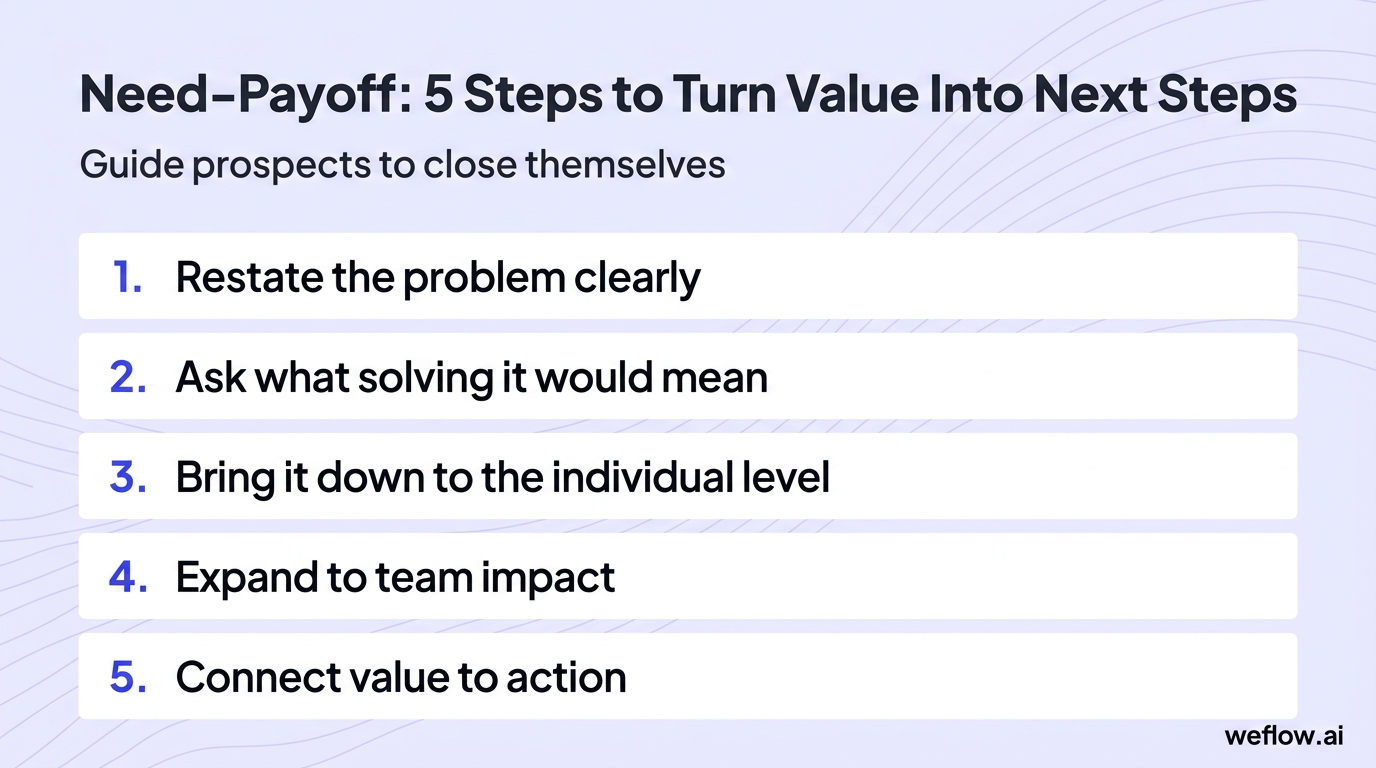
That’s the core secret of SPIN. Buyers believe their own reasoning more than your pitch. When they say what success would look like, who it would help, and what capabilities it would create, they start building the business case themselves.
- Restate the problem clearly. Summarize what you heard in the buyer’s words so they know you understand the issue before you ask them to picture a better state.
- Ask what solving it would mean. Questions like “What would solving this problem mean for your business?” move the conversation from pain to value.
- Bring it down to the individual level. Ask how a solution would help them succeed in their role. This creates personal relevance, not just organizational relevance.
- Expand to team impact. Ask how it would help peers, partners, or direct reports. The wider the value, the easier internal alignment becomes.
- Connect value to action. Once the buyer has defined the payoff, ask whether a solution that enables a specific outcome would justify involving other stakeholders, scheduling a deeper demo, or reviewing commercial terms.
Frame the solution around personal success
People buy for business reasons, but they advocate internally for personal reasons too. If your contact can see how the solution helps them hit goals, reduce stress, or look good with leadership, they’re more likely to champion the deal.
- Business value: Ask what solving the problem would mean for the business overall. This keeps the conversation tied to outcomes, not features.
- Role-specific value: Ask how a solution would help them succeed in their role. For a manager, that might mean cleaner inspection and coaching. For an operator, it might mean less manual work and better reporting confidence.
- Cross-functional value: Ask how it would help peers, partners, or subordinates. This reveals who else benefits and who might become an ally in the buying process.
This is how champions are built. When a buyer can explain the value in language that resonates with finance, leadership, and end users, you’re no longer the only person selling the deal.
Secure stakeholder buy-in for next steps
The last part of Need-payoff is about turning agreement into action. Don’t end with “happy to send more info.” Use the buyer’s own answers to suggest the next concrete step.
- New capabilities: Ask whether solving the problem would enable specific outcomes such as faster execution, better visibility, or stronger team consistency. Specific outcomes make next steps easier to justify.
- Stakeholder support: Ask whether a solution that addresses those outcomes would increase stakeholder buy-in. This tells you whether the buyer sees a path to internal consensus.
- Execution confidence: Ask whether the proposed tool would help the team actually do what leadership expects. That shifts the discussion from interest to operational fit.
Once the buyer confirms those points, the next ask should feel natural: book the working session, invite the budget owner, or review the commercial path. You’re not forcing a close—you’re advancing the process based on value the buyer has already stated.
FAQ
What is the SPIN selling methodology?
SPIN selling is a sales framework created by Neil Rackham. It uses four types of questions—Situation, Problem, Implication, and Need-payoff—to help reps uncover buyer pain, build urgency, and move complex B2B deals forward without pitching too early.
How many SPIN questions should I ask?
There’s no fixed number. The better rule is to keep Situation questions light, spend enough time in Problem to diagnose real friction, and go deeper on Implication and Need-payoff because that’s where urgency and commitment are built.
Which SPIN selling stage is most important?
The Implication stage is usually the most important because it turns a known issue into a business problem that deserves action. Buyers often live with minor pain for a long time, but they move when they understand the cost of leaving it alone.
Can SPIN selling work for shorter sales cycles?
Yes. SPIN was designed for complex sales, but the underlying logic works in shorter cycles too: understand the context, confirm the problem, attach a consequence, and let the buyer articulate the value of solving it. In faster deals, you just do that in fewer questions.
-p-1600.png)

-p-1600.png)
-p-1600.png)

-p-1600.png)
-p-1600.png)
-p-1600.png)
-p-1600.png)
-p-1600.png)
-p-1600.png)
-p-1600.png)