


Triangle Selling Framework: Qualify Buyers, Map Resources, and Handle Objections [Step-by-Step]


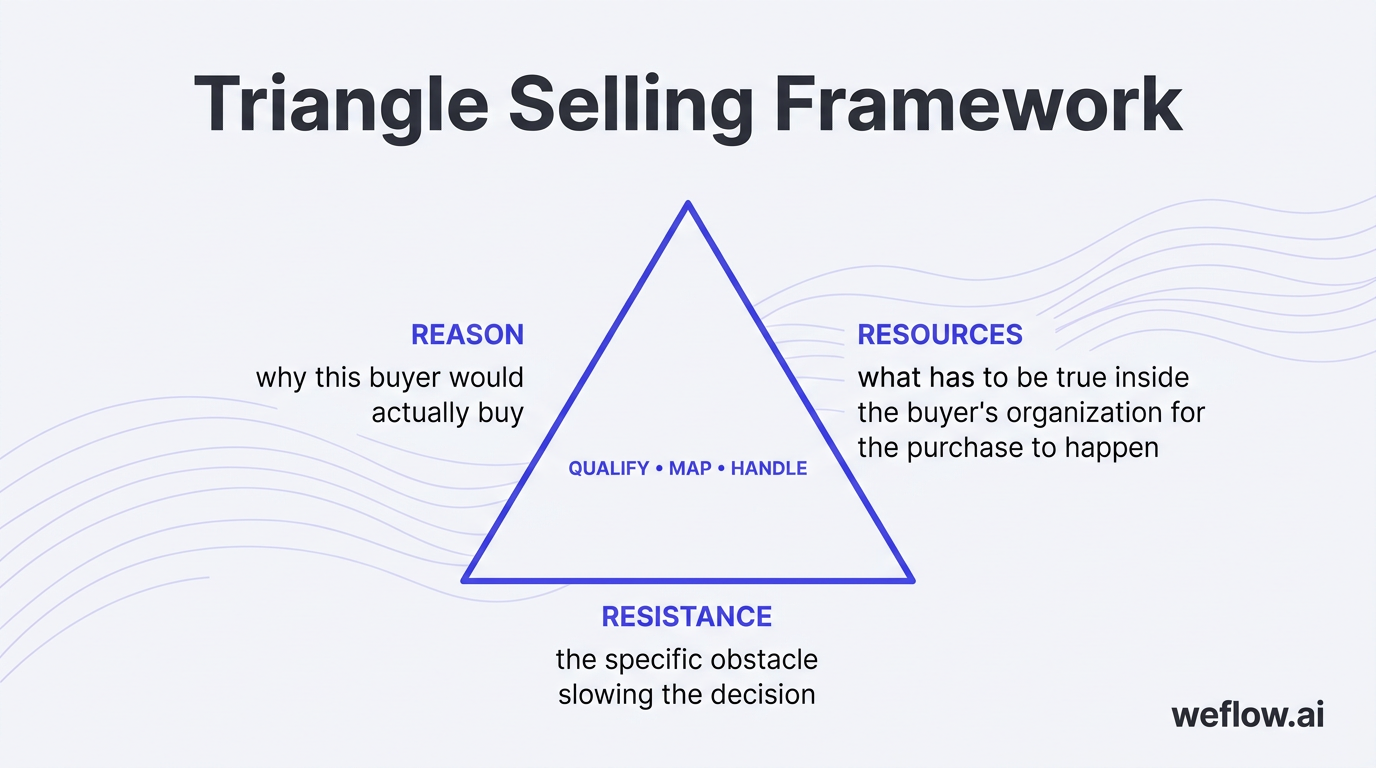
The Triangle Selling Framework gives sales teams a simple structure for one of the hardest parts of B2B selling: figuring out why a buyer would move, what has to line up internally, and what will block the deal on the way through procurement and approval.
This article breaks the framework into three steps—Reason, Resources, and Resistance—so you can use it in discovery, deal reviews, and pipeline inspection. If you’ve ever had a deal look qualified in Salesforce and then stall for reasons nobody captured, this framework helps you catch the gap earlier.
[banner type="download" url="https://www.weflow.ai/content/triangle-selling-checklist" text="Triangle Selling Framework Checklist" subtitle="Get the framework checklist plus qualifying, probative, and Socratic question prompts." button="Download now"]Buyer reasoning: uncover the true motivation to purchase
The first step is reason: why this buyer would actually buy. Not why your product is useful in general, and not why your company thinks the market needs it. You need the buyer’s version of the problem in their own words—what pain they need to stop, or what reward they’re trying to reach.
Starting with reason matters because it anchors the rest of the sales process. If you skip this step and pitch too early, you’ll end up answering objections that don’t matter, chasing stakeholders with no urgency, and building a business case around assumptions instead of something the buyer already cares about.
Probe buyer pain points and desired rewards
Most buyers move for one of two reasons: they want to fix something painful, or they want to achieve something valuable. Good discovery separates those two drivers because they shape urgency, internal alignment, and how you position the deal.
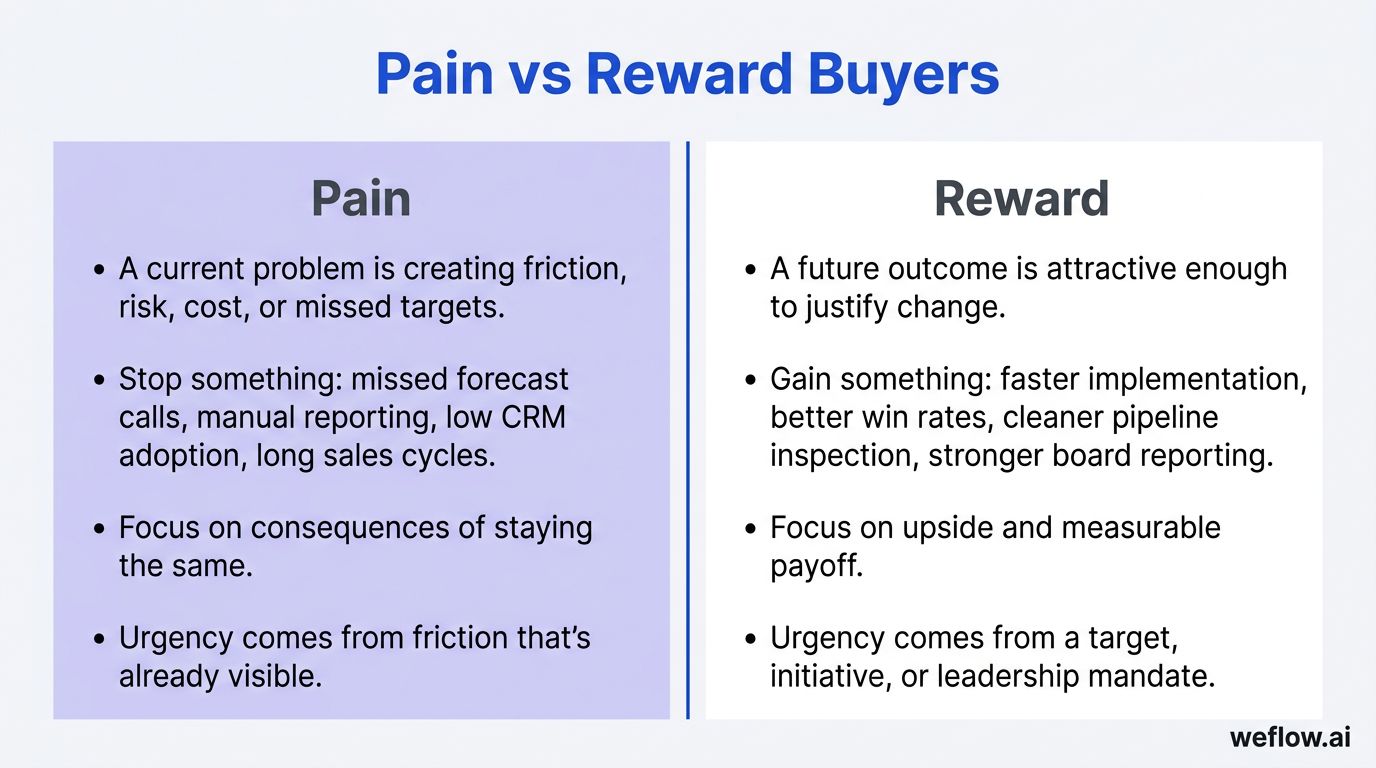
| Pain | Reward |
|---|---|
| A current problem is creating friction, risk, cost, or missed targets. | A future outcome is attractive enough to justify change. |
| The buyer wants to stop something: missed forecast calls, manual reporting, low CRM adoption, or long sales cycles. | The buyer wants to gain something: faster implementation, better win rates, cleaner pipeline inspection, or stronger board reporting. |
| Messaging should focus on consequences of staying the same. | Messaging should focus on upside and measurable payoff. |
| Urgency usually comes from friction that’s already visible. | Urgency usually comes from a target, initiative, or leadership mandate. |
Here’s the difference in practice. A pain-led buyer might say, “Our managers can’t trust rep pipeline updates, so forecast calls turn into cleanup sessions.” A reward-led buyer might say, “We want managers to inspect deals faster and spend more time coaching.” The first case is about removing drag; the second is about gaining operating efficiency. Both can lead to the same purchase, but the sales motion is different.
Ask targeted questions to qualify priorities
You won’t get to the real reason with broad discovery questions alone. The framework uses three question types to move from surface-level interest to clear buying motivation.
- Probative questions: Use these early, right after the buyer shares a broad problem. Their job is specificity. Ask questions like, Can you be more specific? or What does that look like in the current process? This helps you turn vague complaints into concrete process gaps, stakeholders, metrics, and timing.
- Socrative questions: Use these once the buyer names a symptom and you need the underlying reason. Ask, Why did you ask that? or Is there a particular reason this matters now? These questions surface the trigger event, the internal pressure, or the personal stake behind the request.
- Qualifying questions: Use these after you’ve built enough context to rank urgency. Ask, What are your top priorities right now? or Where does this sit relative to other projects this quarter? These questions tell you whether the problem is active, budgeted, and likely to survive internal tradeoffs.
A useful sequence is simple: start probative to narrow the problem, move to socrative to understand why it matters, then use qualifying questions to see whether the issue is urgent enough to earn budget and stakeholder attention.
Resource mapping: identify what buyers need to close
Once you understand the reason, the next step is resources: what has to be true inside the buyer’s organization for the purchase to happen. In this framework, resources means more than budget. It includes the logic of the deal, the people required to support it, the technical fit, the approval path, and the internal momentum to make change happen.
This is where many deals fall apart. The buyer may agree there’s a real problem, but the deal still won’t close if they can’t justify the spend, get the right people involved, support implementation, or build enough urgency to beat the status quo.
Assess emotional and intellectual buy-in
Callout: Buyers usually move emotionally first and justify the decision intellectually second. If you only sell the ROI model and ignore personal stakes, the deal loses momentum. If you only sell emotion and ignore business logic, the deal dies in approval.
Emotional resources answer the question, What’s in it for this person? That can mean less risk, more credibility with leadership, fewer late-night fire drills, faster promotion, or relief from a broken process. In B2B sales, emotional drivers are often professional rather than personal—but they still matter. A RevOps leader may buy because they’re tired of defending numbers they don’t trust.
Intellectual resources answer the question, Does this make business sense? This is where ROI, opportunity cost, benchmarks, and expected payback period come in. Buyers need a rational case they can take to finance, procurement, or an executive sponsor. If the emotional pull starts the motion, the intellectual case carries it through internal scrutiny.
Evaluate human and technical infrastructure
Even a motivated buyer with a solid business case can’t move if the organization lacks the operational support to implement and maintain the solution. Human and technical resources are often the hidden blockers that show up late and create avoidable churn after signature.
- Human resources: Confirm who will own implementation, training, change management, support, and ongoing process improvement.
- Project ownership: Identify whether there’s a clear internal owner or whether the project will be split across sales ops, business systems, IT, and end users.
- User readiness: Check whether frontline teams have capacity to adopt a new workflow without disrupting active pipeline coverage.
- Technical resources: Validate that the buyer has the infrastructure, admin support, security review path, and integration capacity required.
- Tech stack fit: Map how the solution will connect to existing systems, data flows, and reporting processes.
- Post-sale support: Make sure there’s a plan for ongoing administration, process updates, and issue resolution after go-live.
If you ignore these prerequisites during the sales process, the risk doesn’t disappear—it just moves downstream. That’s when deals that looked healthy in pipeline turn into delayed onboarding, weak adoption, or early churn.
Map financial and political stakeholders
The last part of resource mapping is figuring out who controls the money, who influences the decision, and whether the organization has enough momentum to act now.
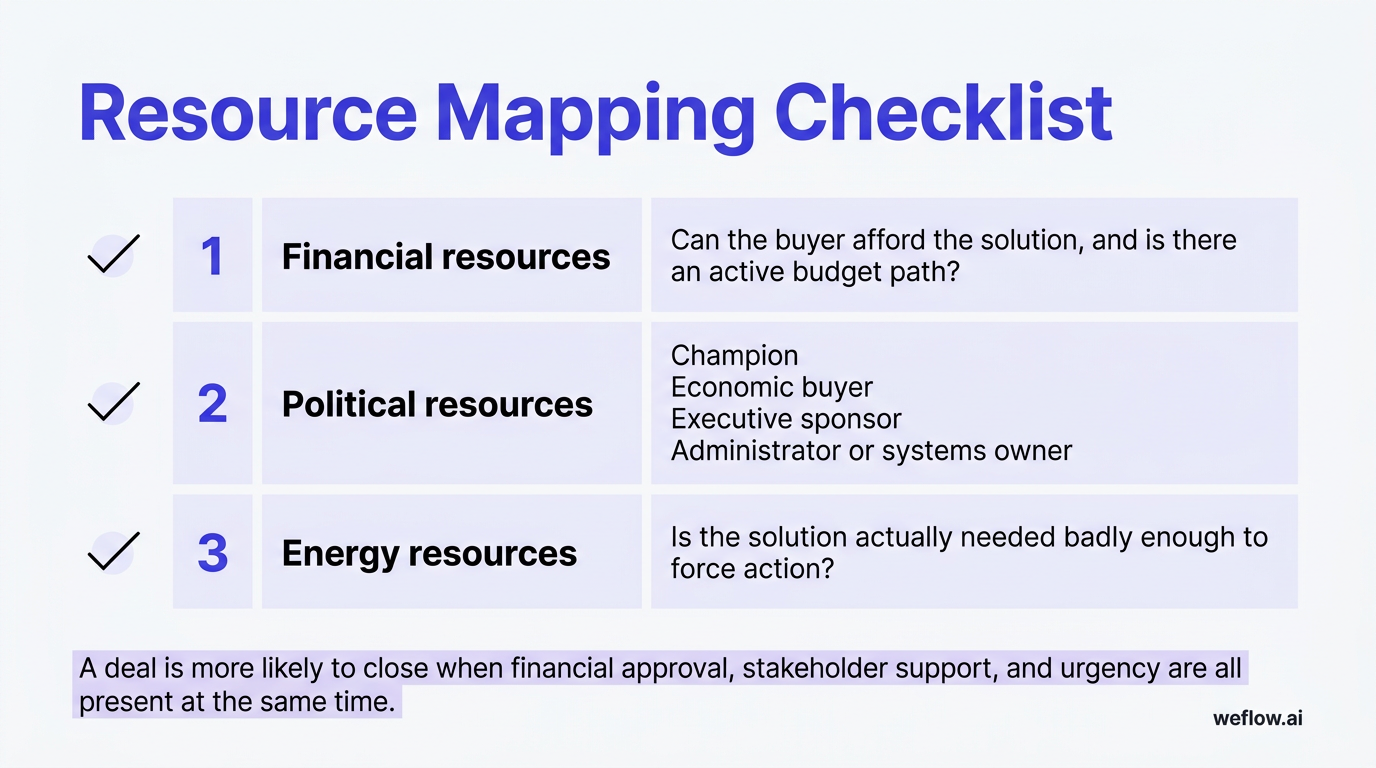
- Financial resources: Can the buyer afford the solution, and is there an active budget path? A deal can have strong interest and still stall if the spend has to wait for a new planning cycle or a CFO review.
- Political resources: Identify the stakeholder map. Your champion is the person pushing the deal forward internally. The economic buyer controls or approves budget. The executive sponsor gives top-down support and clears organizational friction. The administrator or systems owner evaluates feasibility, security, and implementation impact.
- Energy resources: Is the solution actually needed badly enough to force action? This is the buyer’s willingness to spend time, budget, and political capital to make a change. Without energy, even a funded project can drift.
A deal is more likely to close when financial approval, stakeholder support, and urgency are all present at the same time. If one is missing, you don’t have a clean path to signature yet.
Sales resistance: overcome obstacles blocking the deal
Resistance is the third side of the triangle. It’s not a sign that the deal is broken. It’s a normal part of the buying process, especially in B2B environments where multiple stakeholders, process changes, and budget tradeoffs are involved.
The key is to identify what type of resistance you’re dealing with. If you misread the objection, you’ll use the wrong response. A buyer who dislikes the sales process needs something different from a buyer who doubts the product—or a buyer who simply doesn’t want to change.
Handle reactance to the sales process
Reactance happens when the buyer pushes back on the sales motion itself. On a live call, it often sounds like short answers, impatience, guarded responses, or comments such as “Just send me pricing” or “We’re only browsing.” The issue isn’t always your solution. Sometimes the buyer is resisting pressure, effort, or the feeling that they’re being controlled.
- Share relevant success stories: Use short examples from similar buyers to lower perceived risk and show that the process leads somewhere useful.
- Minimize buyer workload: Ask for the fewest steps possible, keep follow-ups tight, and do the synthesis for them instead of assigning homework.
- Validate concerns directly: If the buyer seems defensive or skeptical of the process, say so plainly and acknowledge it before pushing forward.
- Use qualifying questions: Ask what they actually need from the conversation so you can match the pace and scope to their priorities.
Reactance drops when the buyer feels understood, not managed.
Counter skepticism with guarantees and focus
Skepticism is different from reactance. Here, the buyer is willing to engage, but they doubt whether your solution will work in their environment, for their use case, or at the level you claim.
- Create a satisfaction guarantee: Give the buyer a lower-risk way to test the decision, whether that’s a pilot structure, phased rollout, or success criteria agreed in advance.
- Reframe the offer: Shift the conversation from the full purchase to the narrow outcome the buyer cares about most.
- Create a future focus: Help the buyer compare the likely future with the solution against the likely future without it.
A practical B2B example of reframing the offer: if a buyer resists a platform-wide rollout because it feels too large, don’t keep defending the full scope. Reframe it around one team, one workflow, or one measurable gap—such as reducing manual forecast updates for a regional sales group in the first 60 days.
Disrupt buyer inertia to force a decision
Inertia is status quo resistance. The buyer may agree the problem is real and even like your solution, but they still don’t move because change feels expensive, distracting, or politically risky.
- Acknowledge the resistance to change: Say plainly that staying with the current process is easier in the short term, even if it creates costs later.
- Disrupt and reframe the current state: Surface the hidden costs of doing nothing—lost time, missed targets, inconsistent execution, or delayed reporting accuracy.
- Loop back to reason: Revisit the original pain or reward that made the buyer engage in the first place.
Looping back to Step 1 is the strongest way to break inertia because it reconnects the deal to a real business problem. If the reason is still active and meaningful, the status quo becomes harder to defend. If the reason no longer matters, the deal was never as qualified as it looked.
FAQ
What is the Triangle Selling Framework?
The Triangle Selling Framework is a three-step sales method built around Reason, Resources, and Resistance. It helps reps qualify why a buyer would move, what must align internally for the deal to happen, and how to handle the specific obstacle slowing the decision.
How do you uncover buyer pain points?
Use targeted discovery questions that move from surface symptoms to actual buying motivation: probative questions for detail, socrative questions for underlying intent, and qualifying questions for priority. The goal is to get past generic complaints and identify the consequence the buyer wants to stop or the outcome they want to reach.
What are the seven B2B buyer resources?
The seven buyer resources are emotional, intellectual, human, technical, financial, political, and energy resources. A deal is more likely to close and implement cleanly when all seven are present, not just budget and verbal interest.
How do you handle B2B sales reactance?
Handle reactance by lowering friction first: validate the buyer’s concern, reduce the amount of work you’re asking them to do, and use short customer examples to build trust. Once the tension drops, you can ask better qualifying questions and guide the conversation without escalating pressure.
-p-1600.png)

-p-1600.png)
-p-1600.png)

-p-1600.png)
-p-1600.png)
-p-1600.png)
-p-1600.png)
-p-1600.png)
-p-1600.png)
-p-1600.png)