


NEAT Selling Questions That Uncover Buyer Pain, Authority, Budget, and Urgency [Framework]


NEAT gives sellers a more useful way to run discovery than a simple qualification checklist. Instead of stopping at budget and timing, it pushes the conversation toward the problem, the business cost, the buying committee, and the deadline that makes the deal real.
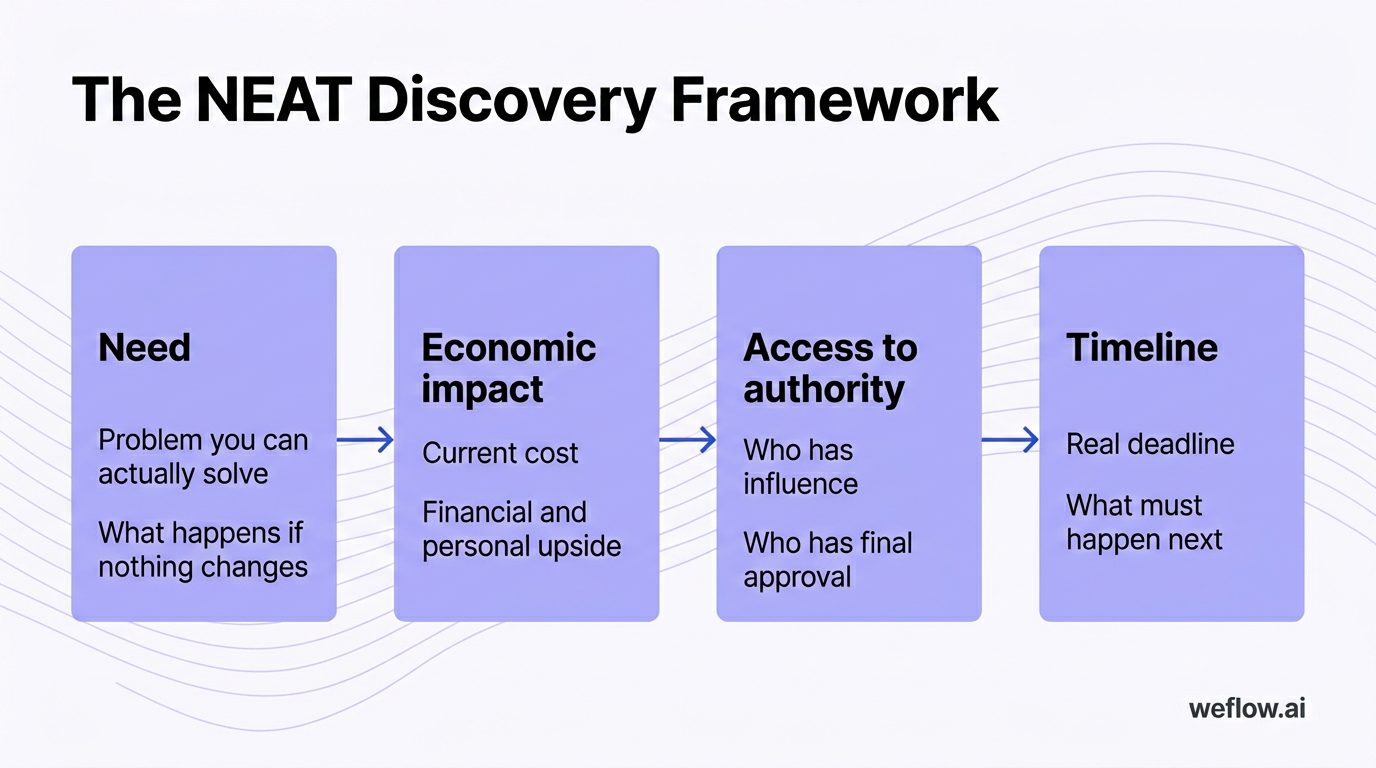
NEAT stands for Need, Economic impact, Access to authority, and Timeline. This framework works because it helps reps get past polite answers early, qualify harder, and build a clearer case for why the buyer should act now.
[banner type="download" url="https://www.weflow.ai/content/neat-selling-checklist" text="NEAT Selling Questions Cheat Sheet" subtitle="Question prompts to uncover needs, pain points, goals, and disqualify poor-fit deals." button="Download now"]Core needs: qualify prospects and uncover deep pain points
The Need stage has two jobs. First, it tells you whether the prospect has a problem you can actually solve. Second, if the fit is real, it helps you move from surface symptoms to the underlying issues affecting goals, teams, and execution.
That means discovery has to do more than collect pain statements. A rep needs to hear how the buyer describes the challenge, what’s blocking progress, and what happens if nothing changes.
| Surface-level answer | Deep pain question to ask next |
|---|---|
| “We need to improve efficiency.” | “What is the biggest challenge you’re facing today, and what barriers are preventing you from solving it?” |
| “Growth is a big priority this year.” | “What are your growth targets this quarter or year, and are you on track to hit them?” |
| “A few teams are feeling the pain.” | “What teams or business units are impacted, and how does the issue show up in their day-to-day work?” |
| “Things changed after a reorg.” | “How have things changed since that event, and what’s keeping you from achieving your goals now?” |
This is also the point where good reps protect pipeline velocity. If the need is weak, the priority is low, or the problem sits outside your solution fit, it’s better to disqualify early than carry a deal that will stall later.
Screen prospects for baseline solution fit
Start with questions that confirm whether the account has a live business problem, enough urgency to care, and enough relevance to continue. You’re not trying to run a full discovery in the first two minutes—you’re checking whether a deeper conversation is worth both sides’ time.
- What are your biggest priorities this quarter or year?
- What are your growth targets for this quarter or year?
- What are your organization’s greatest strengths and biggest weaknesses?
- What do your day-to-day tasks look like, and what’s changed recently inside the business?
If the answers show there’s no clear problem, exit cleanly. A simple line like, “Based on what you’ve shared, I’m not sure we’re the right fit right now. Rather than force it, I’d rather point you in a more relevant direction and stay in touch if priorities change” keeps trust intact.
Probe for underlying organizational challenges
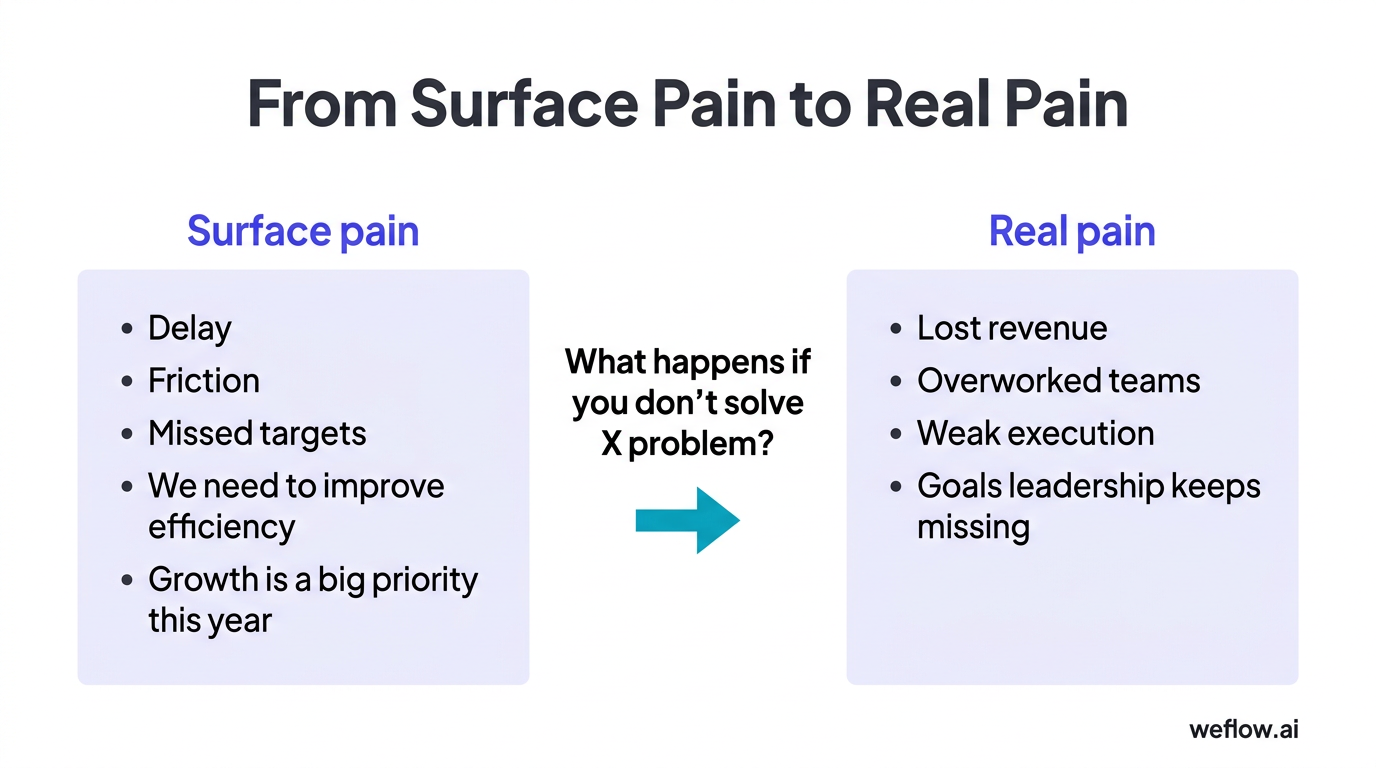
Once basic fit is clear, move from symptoms to consequences. Surface pain sounds like delay, friction, or missed targets. Real pain shows up in lost revenue, overworked teams, weak execution, and goals that leadership keeps missing.
The pivot question: “What happens if you don’t solve X problem?”
That question matters because it shifts the buyer from describing an annoyance to naming the cost of inaction. It also works better when the prospect says the pain out loud instead of hearing it from the seller—people believe their own diagnosis faster than they believe your pitch.
Use follow-ups to widen the frame. Ask what barriers are in the way, which competitors are putting pressure on the business, and which teams or business units feel the impact most. That’s how you learn whether the problem is local to one user or serious enough to support a deal.
Economic impact: tie current problems to bottom-line costs
Once the buyer agrees the problem is real, the next step is to quantify it. The goal is to move from abstract pain to current cost, then from current cost to the financial and personal upside of solving it.
- Start with the current state. Ask what the problem costs today, how much the company spends on the current approach, and whether they believe they’ve underinvested so far.
- Tie the problem to business outcomes. Ask how the issue affects competitiveness, team performance, and the metrics leadership cares about.
- Test the economics of change. Explore whether the buyer would pay a specific amount if the outcome clearly improved revenue, cost, or execution.
- Make the impact personal. Ask how success would affect the buyer directly—less stress, more credibility, a promotion, or a stronger position with the board or leadership team.
The personal piece gets missed in a lot of discovery. Company value matters, but deals often move faster when the buyer can also see what success changes for their own team and career.
Quantify the hard costs of existing processes
At this stage, you want real numbers or at least defensible estimates. If the buyer keeps the conversation at a high level, the business case stays weak and budget discussions stay vague.
Financial data points to gather before moving forward:
- Current spend on the existing solution, vendor, or workaround
- Internal labor hours tied to the problem each week or month
- Revenue loss, delays, or missed opportunities caused by the issue
- Whether the company has budget allocated for a fix
- Whether the team believes it has underinvested in the past
- What happens financially if the initiative does not move forward
If the prospect does not know the exact financial loss, help them calculate a hidden cost. For example, if eight employees spend three hours a week on manual work and their blended hourly cost is $60, that issue costs about $1,440 per week, or roughly $75,000 per year. That estimate is usually enough to keep the conversation grounded.
Measure the financial upside of your solution
Once the cost of the current state is clear, shift the conversation from spend to return. The point is not to ask, “Do you have budget?” and stop there. The point is to ask whether the outcome is worth funding.
Buyers rarely approve a cost in isolation—they approve an investment when the business case is clear.
That’s why good NEAT questions test value against results. Ask whether they would be willing to pay a certain amount if it meant a specific gain, how the C-suite or board will evaluate success, and how the company’s strategy is changing. Those answers tell you what kind of ROI story will hold up internally.
If a prospect hesitates to share exact budget numbers, don’t force it. Ask for a range, ask how similar projects get funded, or ask what level of impact would make the initiative easy to approve. You still learn how they think about investment without turning the conversation into a standoff.
Authority access: map stakeholders to accelerate deal flow
Most B2B deals do not have one decision-maker. There is usually a champion, an economic buyer, a technical reviewer, and at least one stakeholder who can slow the deal down if they are left out too long.
The job in the Access to authority stage is to map that group early. You need to know who has influence, who has final approval, and who may object once legal, finance, IT, or leadership gets involved.
- Champion: The person who feels the pain, wants change, and can help build internal support.
- Decision maker: The person who makes the final call or signs off on spend.
- Blocker: The stakeholder who can stop the deal because of budget, process, risk, or competing priorities.
Ask for access in a way that respects your current contact. Instead of implying they lack authority, frame it around process: “To make this useful for your team, it would help me understand who else weighs in so we can answer their questions early.”
Identify the ultimate decision-maker and blockers
Some reps avoid direct authority questions because they sound abrupt. That usually creates bigger problems later when a “decision-maker” turns out to be a recommender with no signing power.
- Are you the decision maker? If not, who is?
- What is your role in the decision-making process?
- Who makes the final decision?
- Who decided to look for a new solution provider in the first place?
- Do you expect any pushback from other colleagues or decision-makers?
A tactful version of “Are you the decision maker?” sounds like this: “So I can align this to your buying process, how does final approval usually work on a project like this?” That gets you the same answer without putting the contact on the defensive.
Empower internal champions to drive consensus
Your best contact is not just a source of information. They are the person who has to carry the deal into rooms you are not in. That means part of your job is to help them make a strong internal case.
Champion enablement kit:
- A short summary of the problem, business impact, and proposed outcome
- A simple ROI model they can share with leadership
- Clear answers to likely objections from finance, operations, or IT
- A list of stakeholders who should join the next conversation
Always ask who else should be in the room and how your contact prefers to bring them in. The goal is to make your champion look prepared in front of their boss, not force them to defend your solution alone.
Timeline urgency: establish deadlines to prevent stalled deals
The Timeline stage tells you whether a deal is tied to a real deadline or just general interest. A nice-to-have timeline sounds like, “We’d like to do something this year.” A compelling event sounds like, “We need this live before Q3 planning, a board meeting, or a contract renewal.”
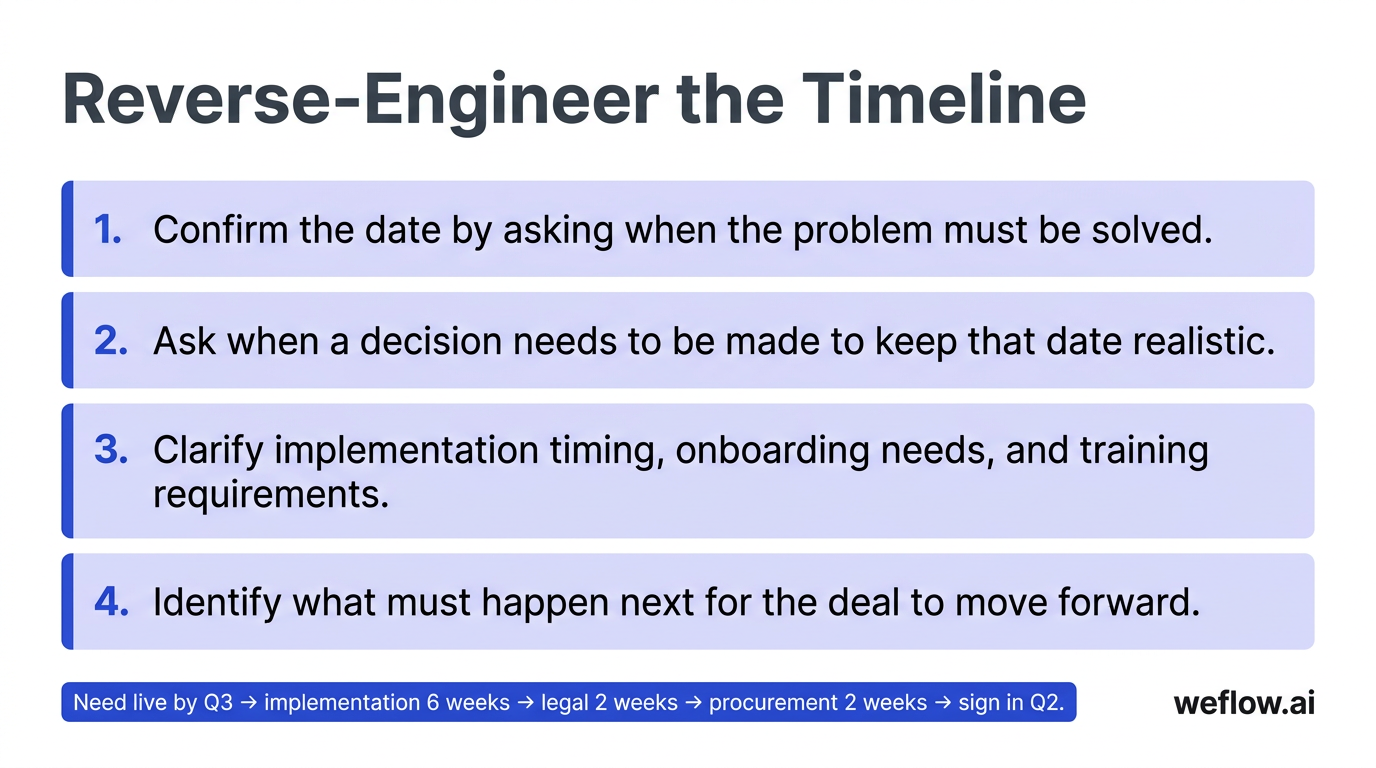
Once you hear a real deadline, map the deal backward from that date. This keeps the conversation tied to the buyer’s schedule instead of your quarter-end.
- Confirm the date by asking when the problem must be solved.
- Ask when a decision needs to be made to keep that date realistic.
- Clarify implementation timing, onboarding needs, and training requirements.
- Identify what must happen next for the deal to move forward.
Pinpoint implementation dates and consequences
Urgency becomes useful only when it is specific. “Soon” does not help you qualify a deal. A date, a consequence, and a set of next steps do.
- What is your deadline for getting this problem solved?
- When do you expect to make a decision?
- When will you need to implement the solution?
- What will it take to move this deal forward?
- What happens if you don’t solve the problem within that time frame?
- If we make a deal, who needs to be trained?
This is where reverse engineering matters. If the buyer says they need the solution live by Q3, and implementation takes six weeks, legal takes two weeks, and procurement takes two more, the deal likely needs to be signed in Q2. That gives you a real milestone plan instead of a vague target.
Build nurture tracks for long-horizon prospects
Not every qualified prospect is ready now. When the timeline stretches out, the right move is usually to lower the forecast weight, keep the relationship warm, and stay relevant until the buying window opens.
- Send a case study that matches the problem they described
- Schedule a quarterly check-in tied to their planning cycle
- Share a short ROI model they can use internally later
- Set CRM reminders for the next milestone instead of relying on memory
A simple reminder in your CRM can keep long-horizon deals from disappearing. When the prospect is ready to move, the rep who followed up at the right time usually gets the meeting.
Next steps: integrate NEAT questions into discovery calls
NEAT works because it pushes discovery past surface qualification. Instead of collecting generic pain points, you learn whether the problem is real, what it costs, who has authority, and what date the deal has to support.
Pick two or three questions from each NEAT category and test them in your next discovery calls. Then save this page and use it as a working cheat sheet before your next high-stakes conversation.
FAQ
What is the NEAT selling methodology?
NEAT is a discovery and qualification framework built around Need, Economic impact, Access to authority, and Timeline. It is designed to uncover real buyer pain and buying conditions instead of stopping at a basic checklist.
How does NEAT differ from BANT or SPIN?
NEAT differs from BANT because it focuses on economic impact rather than treating budget as a fixed gate at the start of the deal. It also differs from SPIN by giving reps a tighter qualification structure for early-stage discovery, especially when they need to decide whether an opportunity belongs in the pipeline at all.
When should sales reps use the NEAT framework?
Use NEAT during discovery calls and early-stage qualification, when you still need to confirm fit, urgency, and buying process. It is most useful before a deal enters the forecast, because that is when weak opportunities should be filtered out.
Can NEAT selling work for inbound sales leads?
Yes—NEAT works well for inbound leads because it helps reps separate active buyers from people who are only researching. It also gives teams a consistent way to prioritize demos, follow-up, and pipeline coverage based on actual buying signals.
-p-1600.png)

-p-1600.png)
-p-1600.png)

-p-1600.png)
-p-1600.png)
-p-1600.png)
-p-1600.png)
-p-1600.png)
-p-1600.png)
-p-1600.png)