4 Bottom-Up Forecasting Steps That Build More Accurate Roll-Ups [Step-by-Step]


Bottom-up forecasting only works when the deal-level inputs are consistent, current, and visible in Salesforce. If reps update pipelines late, managers use different inspection criteria, or activity data never makes it back into Opportunity records, the roll-up is weak before leadership even reviews it.
This guide breaks the process into four practical steps: meeting cadence, pipeline data standards, data collection workflows, and roll-up reviews. The focus is on what RevOps leaders and Salesforce admins need to build a repeatable model that improves forecast accuracy over time.
[banner type="download" url="https://www.weflow.ai/content/bottom-up-sales-forecasting" text="Bottom-Up Forecasting Cheat Sheet" subtitle="4-step framework, meeting cadence checklist, and data collection guide." button="Download now"]Forecasting meeting cadences that drive team accountability
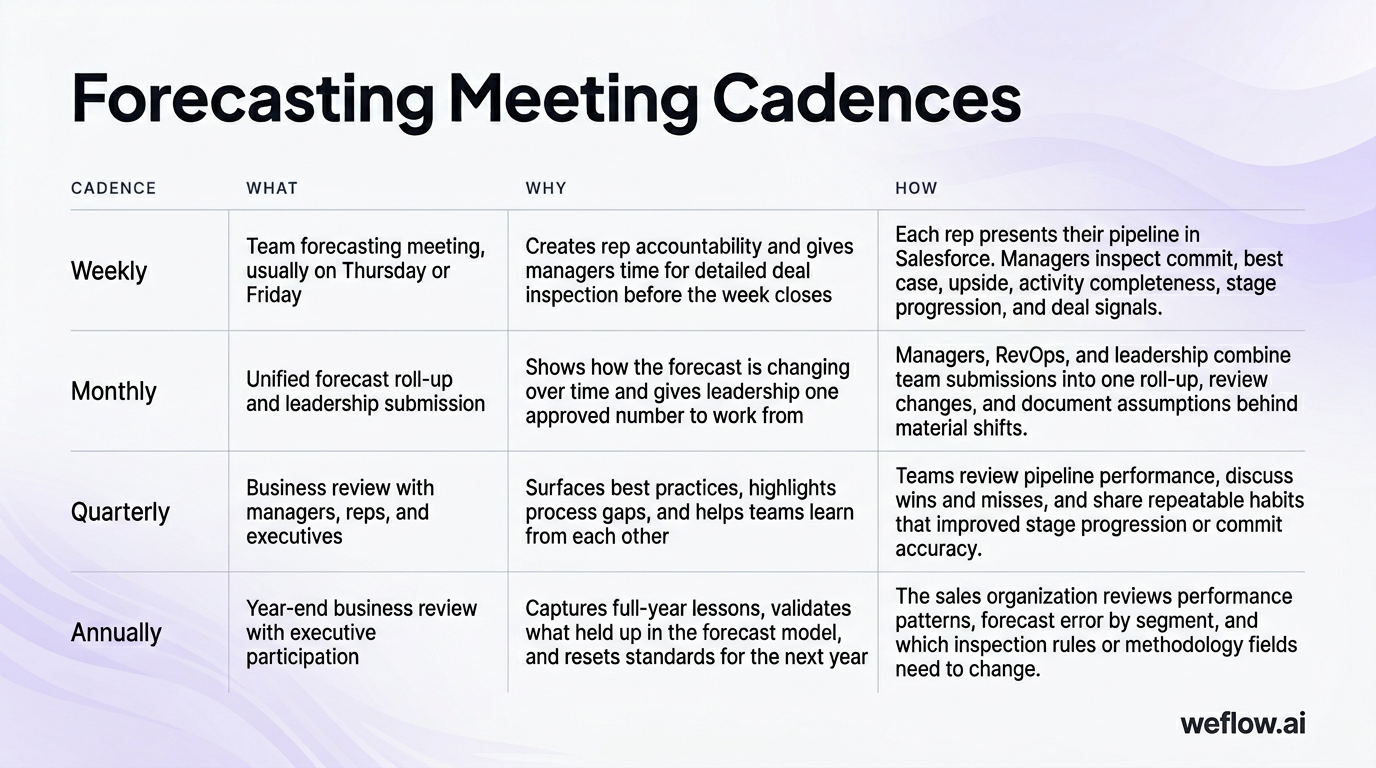
Forecast accuracy improves when review happens on a fixed schedule, not only when the CRO asks for a reforecast. Regular check-ins turn forecasting into an operating rhythm—one where reps expect inspection, managers coach against evidence, and RevOps can track forecast development from one snapshot to the next.
| Cadence | What | Why | How |
|---|---|---|---|
| Weekly | Team forecasting meeting, usually on Thursday or Friday | Creates rep accountability and gives managers time for detailed deal inspection before the week closes | Each rep presents their pipeline in Salesforce. Managers inspect commit, best case, upside, activity completeness, stage progression, and deal signals. |
| Monthly | Unified forecast roll-up and leadership submission | Shows how the forecast is changing over time and gives leadership one approved number to work from | Managers, RevOps, and leadership combine team submissions into one roll-up, review changes, and document assumptions behind material shifts. |
| Quarterly | Business review with managers, reps, and executives | Surfaces best practices, highlights process gaps, and helps teams learn from each other | Teams review pipeline performance, discuss wins and misses, and share repeatable habits that improved stage progression or commit accuracy. |
| Annually | Year-end business review with executive participation | Captures full-year lessons, validates what held up in the forecast model, and resets standards for the next year | The sales organization reviews performance patterns, forecast error by segment, and which inspection rules or methodology fields need to change. |
This cadence matters because it moves forecasting out of end-of-quarter panic mode. Instead of scrambling to explain late-stage slippage in the last 10 days of the quarter, the team is already inspecting those changes every week and preserving monthly roll-ups for context.
Run weekly pipeline inspections for deal accuracy
The weekly meeting is the tactical core of bottom-up forecasting. It should happen late enough in the week that most customer interactions are already captured, but early enough that managers can still push for updates before the next roll-up.
- Schedule the meeting on Thursday or Friday. That gives reps time to log meaningful activity and gives managers a clean view of the week before numbers get rolled up.
- Have reps present directly from Salesforce. Avoid spreadsheets and slide decks. The source record should be the record leadership reviews later.
- Inspect commit, best case, and upside separately. Managers should know why a deal moved between categories, not just whether the rep still feels good about it.
- Question deals using objective KPIs. Ask what changed since the last snapshot, how long the deal has been in stage, whether the close date moved, and whether buyer activity supports the current forecast category.
- Look for hidden risk signals. Good manager questions include: Who is the economic buyer? What mutual next step is booked? Why has reply rate dropped? Why has the amount changed twice in two weeks? What evidence supports this staying in commit?
- Check process compliance. If required MEDDIC fields, exit criteria, or next-step fields are missing, the deal should not move forward without correction.
The point of these questions is to uncover risk that rep confidence alone will miss. A deal can sound healthy in a forecast call and still show clear warning signs in Salesforce—long time in stage, low activity volume, repeated close-date pushes, or no recent buyer response.
Host monthly and quarterly roll-up reviews
- Run a monthly unified roll-up. At minimum, managers and RevOps should merge team submissions into one approved forecast each month, reconcile gaps, and preserve that version as a snapshot for later accuracy analysis.
- Hold a quarterly review with executives. This is where leadership looks beyond the number itself and asks which teams are improving, which segments are slipping, and which inspection patterns should be standardized across the org.
- Close the year with an annual review. Use it to compare forecasted vs actual performance, celebrate teams that improved accuracy, and share the habits, coaching motions, and process changes that helped them do it.
Quarterly reviews should not be only about misses. Teams learn faster when leadership also calls out what worked—better stage hygiene, higher activity completeness, cleaner MEDDIC capture, or stronger manager inspection. That recognition helps build a forecasting culture instead of a blame cycle.
Forecasting data frameworks: standardize your pipeline metrics
A strong meeting cadence still fails if every manager defines deal health differently. Bottom-up forecasting needs a shared data framework so that one rep's “good deal” means the same thing as another rep's “good deal,” regardless of segment, region, or manager.
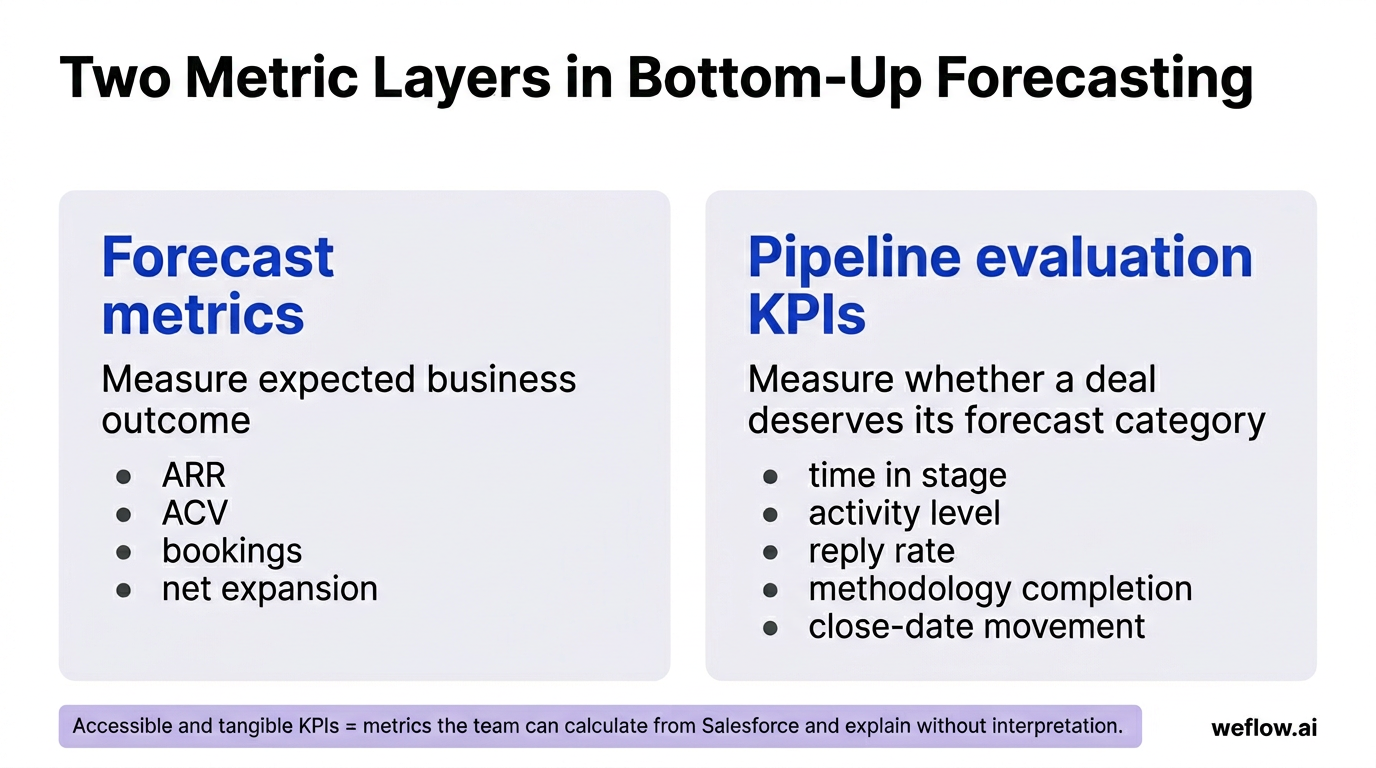
There are two different metric layers to separate clearly. Forecast metrics measure expected business outcome—ARR, ACV, bookings, net expansion. Pipeline evaluation KPIs measure whether a specific deal deserves its forecast category in the first place—time in stage, activity level, reply rate, methodology completion, or close-date movement.
|
Callout: “Accessible and tangible” KPIs means the team can calculate them from Salesforce and explain them without interpretation. If a manager cannot pull the metric from a report or a rep cannot explain what moved it, it should not be a core inspection KPI. |
For most RevOps teams, this also means standardizing the Salesforce data model behind the forecast. Required fields, stage exit criteria, validation rules, and report logic should all point to the same inspection method.
Implement proven sales methodologies like MEDDIC
Methodology gives reps a consistent way to capture comparable deal data. Without it, managers are reviewing a mix of free-text notes, personal judgment, and inconsistent qualification standards.
MEDDIC is the strongest baseline for most B2B companies because it turns qualification into structured, inspectable data: metrics, economic buyer, decision criteria, decision process, identified pain, and champion. In Salesforce, that usually means mapped fields on the Opportunity, clear exit rules by stage, and manager inspection tied to those fields instead of narrative updates.
Frameworks to consider: MEDDIC, MEDDPICC, BANT, Challenger, SPIN Selling, Sandler, SNAP Selling, Solution Selling, Gap Selling.
MEDDIC works well for standardization because it gives RevOps a clean schema for field mapping and reporting. If you require the same qualification data across teams, managers can compare deals more consistently, and Salesforce admins can enforce process compliance with validation rules rather than manual follow-up.
Track objective deal signals across the pipeline
Objective deal signals are what keep forecast review grounded in buyer behavior instead of rep optimism. The exact thresholds will vary by company profile, segment, and sales cycle length, but the signal types stay useful across most mid-market and enterprise B2B organizations.
| Engagement and momentum signals | Change and hygiene signals |
|---|---|
|
|
These signals remove rep “happy ears” because they reflect what the buyer is actually doing and how the record is changing over time. A rep may still feel confident, but if the deal has stalled in stage, reply rate is down, and the close date moved twice, the forecast category should change before the roll-up reaches leadership.
Data collection workflows that eliminate manual entry errors
Bottom-up forecasting depends on data quality. If activity sync is inconsistent, field mapping is shallow, or weekly updates rely on rep memory, the roll-up becomes a manual reconstruction exercise instead of a reliable operating model.
That is why automated collection should come first. Reps get fatigued by CRM admin, especially late in the quarter, and manual entry is where stale stages, missing activities, and inaccurate next steps show up. The more forecast data Salesforce can capture automatically and write back in real time, the lower your error rate will be.
Automate CRM data capture for higher accuracy
Everything system-generated should be automated. That includes both raw activity data and the derived signals managers use in forecast inspection.
- Log calls and emails automatically so activity completeness does not depend on rep memory.
- Capture video call transcripts and summaries so managers can verify deal progression against what was actually discussed.
- Track deal signals automatically including time in stage, opportunity age, email reply rate, email velocity, close-date changes, amount changes, activity volume, and CRM score.
- Write data back to Salesforce records including Opportunities, Contacts, Accounts, and relevant custom objects where the business process requires it.
- Preserve weekly and monthly forecast snapshots so RevOps can compare forecasted vs actual outcomes and measure forecast error by team or segment.
- Respect Salesforce governance by working with validation rules, field-level security, and the existing data model instead of creating a second system of record.
Automation improves forecast reliability because reps cannot forget what the system captures for them. It also improves CRM adoption: when activity sync, write-back, and snapshot creation happen in the background, reps spend more time selling and less time reconstructing their week before the forecast call.
Architecture matters here. Salesforce teams that rely on Einstein Activity Capture or repurpose Gong for forecast workflows often run into reporting limits, shallow field mapping, or manual workarounds when they need activity data available for dashboards, forecast inspection, and historical analysis. If you are migrating from Gong, check whether the replacement supports deep Salesforce write-back, custom object mapping, snapshot history, and low-effort deployment from the start.
Weflow, a Salesforce-native revenue AI platform, is designed for that model. It keeps activity capture, conversation intelligence, forecast workflows, and roll-ups close to the Salesforce data model, which reduces integration footprint and helps teams deploy in weeks, not quarters.
Standardize manual inputs for qualitative deal data
Not every forecast input should be automated. Reps and managers still need to provide context, judgment, and account-specific detail that systems cannot infer with enough reliability.
- Forecast calls and roll-ups still require human review because category decisions often depend on context that is not visible in a single metric.
- Meeting notes and AI-assisted summaries are useful, but they should be checked before they are treated as source data in Salesforce.
- Signal thresholds should be tuned by company profile because enterprise deals, expansion motions, and new-logo opportunities often behave differently.
- Manager overrides should be documented so RevOps can see where judgment improved the forecast and where it introduced avoidable inconsistency.
Human verification matters even when AI generates the first draft of a note or summary. False entries, missing context, or incorrect speaker interpretation can create bad forecast inputs just as easily as manual omissions can.
Forecast roll-up processes: build unified leadership models
Once rep forecasts are submitted, the next job is aggregation. The roll-up should turn individual deal views into one leadership model that can be filtered by team, segment, geo, product, or industry—and compared against prior snapshots to track accuracy over time.
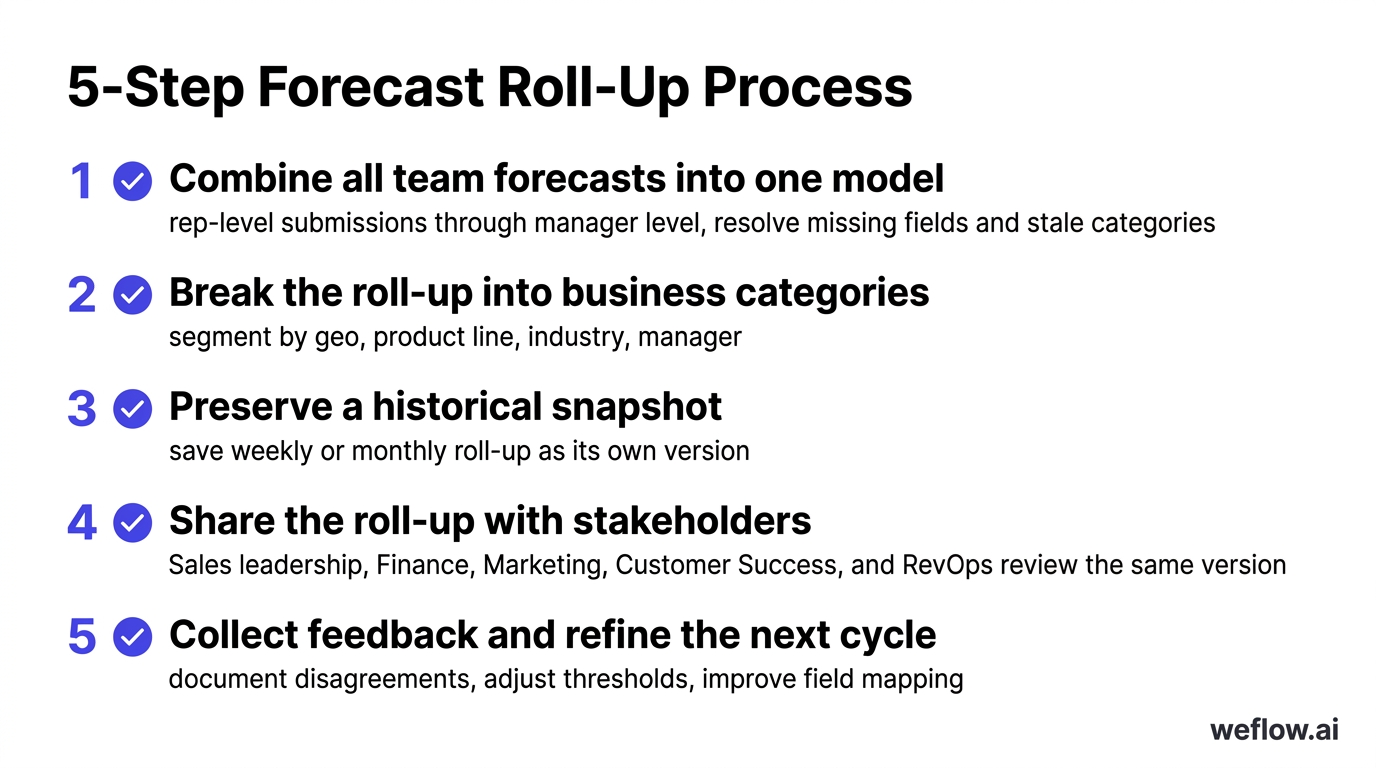
- Combine all team forecasts into one model. Start with rep-level submissions, roll them up through the manager level, and resolve missing fields, duplicate assumptions, and stale forecast categories before leadership review.
- Break the roll-up into business categories. Segment the forecast by geo, product line, industry, manager, or any other driver that leadership uses to run the business.
- Preserve a historical snapshot. Save the weekly or monthly roll-up as its own version so you can measure forecast error, inspect slippage patterns, and see when the number changed.
- Share the roll-up with stakeholders. Sales leadership, Finance, Marketing, Customer Success, and RevOps should all review the same version of the forecast.
- Collect feedback and refine the next cycle. Document disagreements, adjust thresholds, improve field mapping, and repeat the process with cleaner rules the next week or month.
Historical snapshots are what turn forecasting from opinion into a measurable process. Without them, you can report the current number, but you cannot explain how accurate previous roll-ups were, which teams consistently sandbagged or overcommitted, or which signal changes predicted misses early enough to matter.
Consolidate team forecasts into categorized reports
A unified roll-up is only useful if leadership can cut it along the same lines the business is managed. Categorizing by geo, product, industry, or segment helps expose where revenue is leaking, where forecast risk is concentrated, and which part of the business is outperforming expectations. That is much harder to see in one flat company-wide number.
Share roll-ups with stakeholders for cross-team feedback
- Sales leadership should validate commit quality, manager judgment, and whether category changes match the underlying deal evidence.
- Finance should review booking timing, revenue assumptions, and whether the roll-up aligns with board reporting logic.
- Marketing should pressure-test top-of-funnel and pipeline creation assumptions, especially if the forecast depends on late-quarter pipeline generation.
- Customer Success should flag implementation capacity, renewal risk, or expansion dependencies that affect whether a deal can actually close in the expected window.
- RevOps should capture feedback, refine the inspection model, and adjust Salesforce reports, automation rules, or validation rules before the next cycle.
Marketing and Customer Success matter because the sales forecast does not exist in isolation. If pipeline generation is soft, implementation capacity is constrained, or an expansion depends on adoption that is not happening, the sales team's assumptions need to be challenged before the number reaches the board.
FAQ
What is bottom-up forecasting in sales?
Bottom-up forecasting is a method where individual reps estimate the deals in their own pipelines, managers review those estimates, and leadership rolls them up into a company-wide forecast. It is the opposite of top-down planning because the number starts at the deal level, not at a target set by Finance or the board.
How often should sales teams roll up forecasts?
Monthly is the minimum if you want a usable leadership model, but weekly roll-ups are better for teams that want tighter forecast control and cleaner snapshot history. Weekly versions make it easier to spot slippage, close-date movement, and commit changes before they become a quarter-end surprise.
Which deal signals improve forecast accuracy most?
The strongest signals are objective behavior and change metrics: time in stage, email velocity, reply rate, activity volume, and the number of close-date changes. These usually predict forecast risk better than rep confidence because they show what the buyer is doing and how stable the deal really is.
Why is automated data collection critical for forecasting?
Automation reduces human error, improves data completeness, and keeps Salesforce current without asking reps to do more admin work. It also gives RevOps a cleaner audit trail because activity sync, signal tracking, and historical snapshots are captured consistently every cycle.


.webp)
.webp)
.avif)