90-Day Sales Onboarding Plan to Ramp Reps Faster and Certify Readiness [Step-by-Step]


A 90-day sales onboarding plan should do more than introduce your product and hand reps a pitch deck. It should get new hires to buyer-ready execution fast, with clear certification gates, clean Salesforce data, and enough coaching coverage that managers can trust what they see in pipeline.
This guide breaks down how to build that system step by step. You’ll see the foundations of sales enablement, the exact 30/60/90 structure, the CRM evidence needed to certify readiness, and how conversation intelligence and AI workflows can cut admin work while improving forecast accuracy.
Sales enablement foundations: build systems that scale revenue
Sales enablement is the cross-functional system that gives reps the training, content, process guidance, and coaching they need to sell effectively. For RevOps and Sales Ops leaders, the real goal is simpler: get reps productive faster, keep Salesforce data complete, and make performance measurable instead of opinion-based.
That only works when onboarding is designed as an operating system, not a one-time event. Training, content, manager coaching, CRM process, and buyer feedback all need to point to the same stage exits and the same proof standards. If marketing teaches one message, managers inspect another behavior, and Salesforce requires neither, reps default to improvisation—and ramp slows down.
These five pillars show where enablement drives measurable impact.
| Pillar | Focus | Tactical actions | Primary outcome | Observed uplift | Source |
|---|---|---|---|---|---|
| Training and onboarding | Ramp reps to quota faster | Role-based playbooks, certifications, LMS paths, manager coaching | Higher win rates | +27% | CSO Insights, 2023 |
| Content enablement | Give reps the right proof and talk tracks by stage | Stage-aligned content, usage tracking, asset review cycles | Faster time to quota | 35% faster ramp | HubSpot, 2023 |
| Sales readiness | Make sure reps are buyer-ready before they carry pipeline | Mock calls, scorecards, pass/fail certifications | Higher quota attainment | +22% | Sales Enablement Pro, 2024 |
| Cross-functional alignment | Keep sales, marketing, product, and ops working from the same process | SLAs, feedback loops, shared stage definitions, common reporting | More consistent revenue growth | +6% to 12% YoY | SiriusDecisions / Forrester |
| Insights and analytics | Measure what’s working and what needs coaching | Call analytics, CRM evidence checks, content usage, ramp tracking | More selling time | +20% | Gartner, 2023 |
Cross-functional alignment matters because siloed onboarding creates conflicting standards. A new AE shouldn’t hear one definition of “qualified” from enablement, a different one from their manager, and then hit a Salesforce stage path that requires none of it. When the onboarding plan, Salesforce validation rules, certification rubrics, and manager inspection process all use the same evidence, time-to-quota drops and pipeline quality improves.
A simple RACI helps make ownership clear before a new-hire cohort starts.
| Function | Training | Content | Messaging | Feedback loop |
|---|---|---|---|---|
| Sales leadership | Consulted | Consulted | Informed | Accountable |
| Enablement | Accountable | Accountable | Consulted | Consulted |
| Marketing | Informed | Accountable | Accountable | Consulted |
| Product / Product Marketing | Consulted | Informed | Consulted | Consulted |
| RevOps / Business Systems | Consulted | Consulted | Informed | Responsible |
| Frontline managers | Responsible | Informed | Consulted | Responsible |
Map role-specific competencies and KPIs
Onboarding gets easier to manage when each role has a small set of measurable competencies, clear CRM evidence, and an explicit pass/fail gate. This is the shift most teams need: move from “their manager says they’re ready” to “the required evidence exists in Salesforce and in recorded calls.”
That means stage progression should depend on proof. For example, a rep shouldn’t move an Opportunity to Commit because they “feel good” about it. They should show a dated next step, an active mutual action plan, contact role coverage, and a recorded meeting with the right stakeholder. Salesforce should enforce as much of that as possible through required fields, validation rules, path guidance, and, where needed, custom fields or custom objects.
| Role | Core competencies | CRM and call evidence | Certification gate | KPIs |
|---|---|---|---|---|
| SDR | ICP targeting, messaging execution, speed-to-lead, clean handoff | Lead touched within SLA, dated next step, required lead/account fields complete, call evidence of problem statement and next action | Five touches that meet the checklist; no stage move without evidence | Speed-to-lead under 5 minutes for high-intent leads, SAL to SQO rate, meetings with buyer-owned next step |
| AE | Discovery, multithreading, mutual action plan ownership, deal discipline | Discovery notes captured, contact roles set, MAP attached by Qualification, budget decision-maker engaged on Commit deals | One live role-play and two real opportunities meeting exit criteria | Stage conversion, win rate by segment, slip rate, pipeline coverage |
| AM / CSM | Renewal planning, risk forecasting, value realization, expansion spotting | Success plan attached, milestones and risks logged, executive sponsor engaged, dated next steps documented | Two renewals and one expansion with complete evidence | GRR, NRR, expansion coverage, time-to-first-value, renewal slip rate |
| Sales manager | Deal inspection, forecast discipline, coaching cadence, hygiene enforcement | Weekly pipeline review in Salesforce, coaching notes logged, commit deals meeting the two-proof rule, stage moves blocked without evidence | Three inspection passes and two coached calls per rep per week for one month | Forecast error rate, dated-next-step coverage, weakest-stage conversion improvement |
The 90-day onboarding plan: ramp new hires to full productivity
The purpose of a 30/60/90 onboarding path is to reduce time-to-productivity without lowering quality standards. Reps learn the minimum role-critical skills first, practice them every week, and earn certification through stage-based evidence—not attendance.
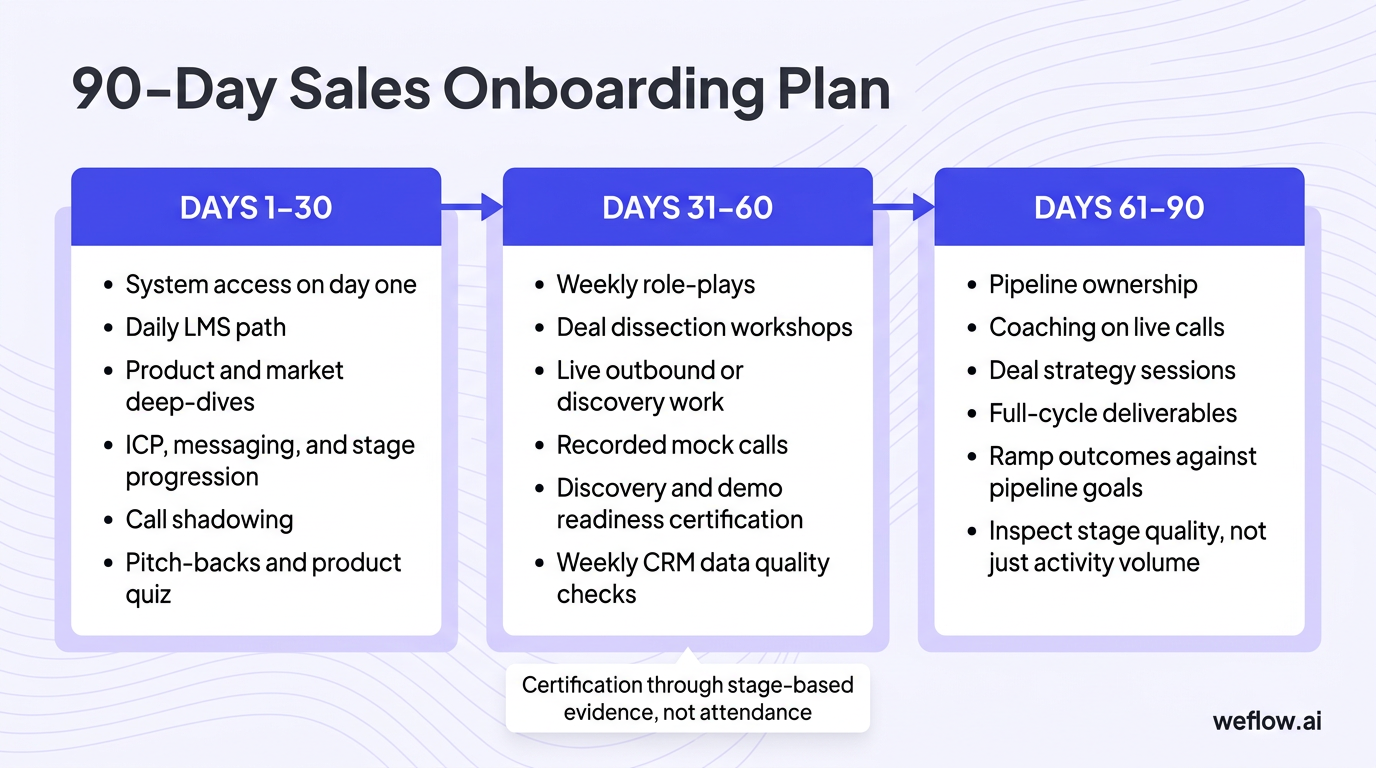
This phased model matters because most training decays fast. Sales Enablement Pro reports that reps forget 87% of training within 30 days without reinforcement. That’s why the best onboarding programs don’t front-load everything into week one. They spread learning across the first 90 days, tie it to real buyer interactions, and use repeated practice, manager coaching, and CRM evidence to lock in behavior.
Prepare essential inputs before day one
If these inputs aren’t ready before a rep starts, ramp time slips immediately. New hires end up waiting for access, working from outdated assets, or guessing what “good” looks like.
- Define stage exits and Salesforce validations: Require a dated next step, mutual action plan where relevant, contact role coverage, and methodology fields before stage progression. Use validation rules so late-stage opportunities can’t move forward without evidence.
- Publish role competency grids: Keep it to three to five competencies per role, how each one is scored, and what evidence counts as pass or fail.
- Build minimum onboarding assets: Discovery checklist, objection guide, value narrative, shadowing log, MAP template, and role-based talk tracks should all exist before cohort launch.
- Prepare the manager coaching kit: Managers need a weekly 1:1 agenda, deal inspection rubric, call-scoring template, and examples of what good discovery, recap, and next steps look like.
- Stand up an Ops Home: One source of truth for stage definitions, dashboards, links, training calendar, change log, and onboarding expectations.
- Set the cohort schedule: Lock facilitators, live sessions, shadowing requirements, certification dates, and executive sponsor involvement.
- Enable conversation intelligence and activity sync: Auto-recording, transcription, speaker identification, and Salesforce write-back should be active before the first buyer-facing meeting.
Missing any of these basics creates the same pattern: slower ramp, inconsistent coaching, low activity completeness, and new hires who learn that Salesforce is optional. That lesson is hard to undo later.
Execute the first 30 days of foundational learning
The first month is about comprehension, not full ownership. Reps need to understand the market, the product, the buyer, the sales process, and how your Salesforce data model reflects that process.
- Get system access done on day one: Salesforce, email, calendar, LMS, call recording, enablement tools, Slack, and knowledge base access should be fully provisioned before the welcome session starts.
- Assign a daily LMS path: Keep self-paced learning to 15 to 30 minutes a day so it reinforces live sessions instead of replacing them.
- Run product and market deep-dives: Product Marketing, solutions engineers, and top reps should explain buyer problems, not just feature lists.
- Break down ICP, messaging, and stage progression: New hires need to know who you sell to, what problems you solve, and what fields, tasks, and contact roles matter in Salesforce at each stage.
- Require call shadowing early: A minimum of five top-rep calls per week gives reps live examples of discovery flow, objection handling, recap quality, and meeting control.
- Use pitch-backs and worksheets: Reps should explain the value proposition back to a manager or peer, complete persona messaging worksheets, and pass a product quiz.
- Measure foundational completion: Track LMS completion, quiz scores, observed call count, time to first activity, and onboarding feedback.
Shadowing matters because reps don’t learn selling from slide decks. They learn it by hearing how a top performer earns the next meeting, handles a skeptical buyer, and translates product detail into business impact.
Transition to controlled execution in days 31 to 60
The second month is where observation turns into controlled execution. Reps start doing the work, but with enough structure that mistakes become coaching moments instead of pipeline damage.
- Run role-plays every week: Focus on discovery, demo flow, objection handling, and next-step setting. Score them against a fixed rubric.
- Use deal dissection workshops: Walk through past wins and losses to show why deals advanced, stalled, or slipped.
- Start live outbound or discovery work: SDRs should begin sequencing and booking meetings. AEs should start first discovery calls and qualification work on live opportunities.
- Require recorded mock calls: Store them in the call library so managers can review them asynchronously and compare progress over time.
- Certify discovery and demo readiness: Don’t move reps into independent buyer-facing work until they pass both certifications.
- Check CRM data quality weekly: Notes, next steps, required fields, and contact mapping should be audited before bad habits become the default.
- Track output and readiness: Measure certification scores, number of role-plays completed, first discovery call, first opportunity created, and note quality in Salesforce.
Peer feedback circles and objection “war rooms” help here because they lower the pressure of first execution. Reps get repetition, hear how others handle the same buyer pushback, and build confidence before they’re responsible for high-stakes opportunities.
Drive full-cycle sales execution in days 61 to 90
The final phase shifts to full ownership with active coaching. By this point, reps should be able to run their own meetings, manage pipeline, and keep Salesforce current without a rescue operation from RevOps.
- Assign pipeline ownership: Reps should set meetings, run discovery, move opportunities, and manage follow-up directly in Salesforce.
- Coach on live calls: Managers should review real discovery and demo calls, not just role-plays, and log coaching notes against the rep or opportunity.
- Run deal strategy sessions: Use mutual action plans, stakeholder maps, and approval-path planning to improve deal discipline.
- Require full-cycle deliverables: Each rep should complete discovery-to-proposal runs, submit a win/loss self-review, and show evidence of clean next-step management.
- Track ramp outcomes against pipeline goals: Measure first opportunity created and advanced, first closed-won deal, pipeline coverage against quota, and CRM hygiene score.
- Inspect stage quality, not just activity volume: A rep with 3x pipeline coverage but weak next-step discipline and missing contact roles is still a forecast risk.
Days 61 to 90 are where onboarding connects directly to revenue math. If a rep is expected to carry quota after ramp, they should have the pipeline coverage to support it, plus a CRM hygiene score that tells leadership the numbers are usable.
Post-onboarding development: sustain high conversion and coverage
Formal onboarding ends. Behavior drift doesn’t. Once reps start carrying full pipeline, most teams stop reinforcing the habits they spent 90 days trying to build. That’s when next steps disappear, mutual action plans get skipped, and coaching moves back to anecdotes instead of evidence.
Post-onboarding development should keep the same logic as onboarding: small process releases, weekly in-CRM coaching, and fresh assets tied to real deal inspection. The goal is simple—keep conversion rates rising, cycle times under control, and next-quarter coverage clean.
| Input | Owner |
|---|---|
| Advanced competency rubrics and certifications tied to real deal evidence | Enablement |
| Content backlog with DRIs, review dates, and sunset rules for battlecards, talk tracks, demo storylines, and MAP templates | Enablement |
| Manager coaching kit v2 with pipeline agenda, inspection checklist, call-scoring rubric, and example clips | Enablement and frontline managers |
| CI playlists, summary templates, and pipeline signals such as no next step, inactivity, or single-threaded deals | Enablement and RevOps |
| Play activation packs with ICP, trigger, talk track, proof assets, and measurement plan | Enablement |
| Ops Home updates and weekly change log so reps know what changed and why | Enablement |
Continuous reinforcement matters because reps revert fast once structured onboarding stops. If you want lasting adoption, coaching, content, and Salesforce evidence checks need to continue after day 90.
Standardize sales motions in the first two quarters
- Roll out Playbook v1.1 immediately after ramp: Tighten stage definitions, refresh discovery checklists, and make mutual action plan usage explicit by stage.
- Run weekly pipeline reviews inside Salesforce: No slides, no separate spreadsheet. Inspect the Opportunity record, activity timeline, contact roles, next step, and forecast category in the system of record.
- Enable CI-based pipeline views: Flag opportunities with no recent activity, no dated next step, low meeting volume, or single-threaded stakeholder coverage.
- Push microlearning tied to stage exits: One short coaching nudge tied to one behavior works better than another long training session.
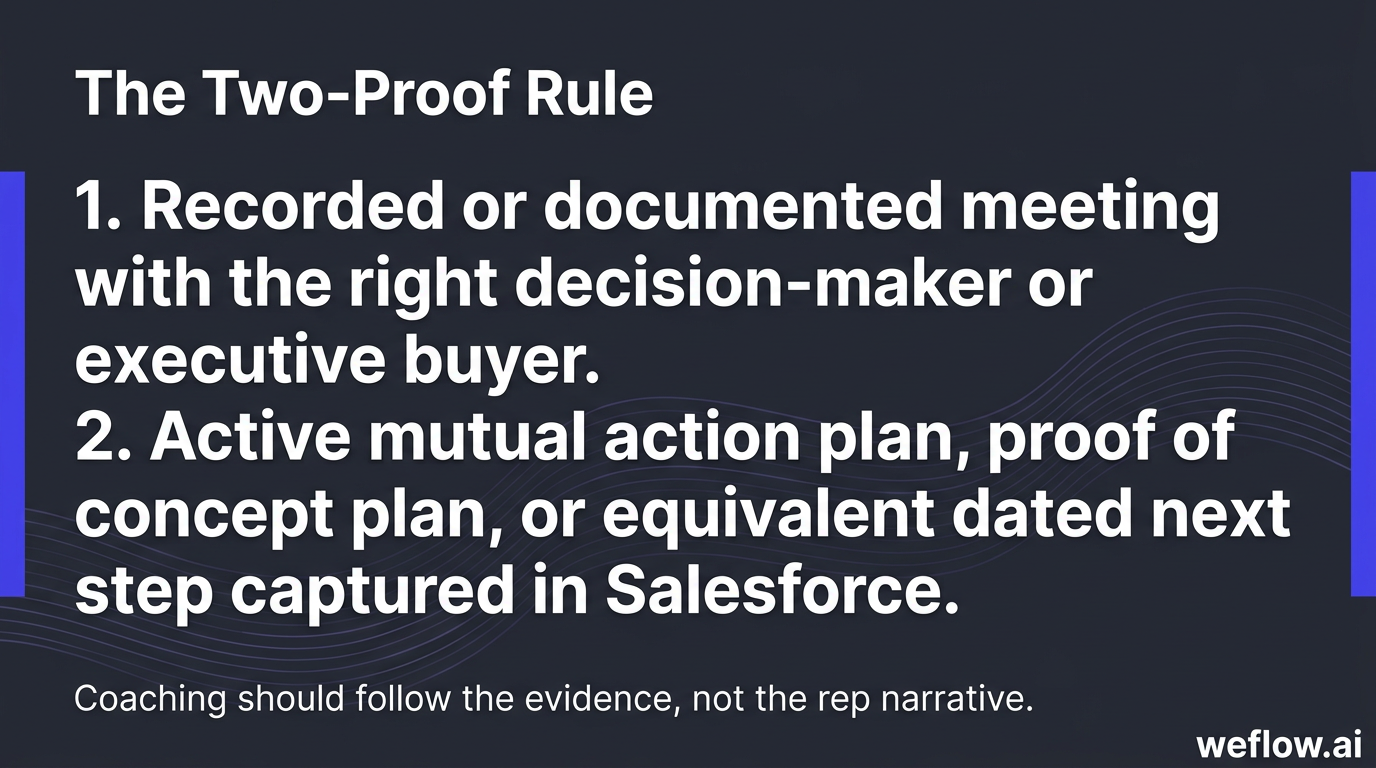
- Use the two-proof rule for manager inspection: For late-stage or commit deals, require two proofs before the deal passes inspection—first, a recorded or documented meeting with the right decision-maker or executive buyer; second, an active mutual action plan, proof of concept plan, or equivalent dated next step captured in Salesforce. Coaching should follow the evidence, not the rep narrative.
Deploy quarterly play activations for ongoing growth
- Pick one or two plays per quarter: Examples include a vertical play, a competitor displacement motion, a pricing trigger, or an expansion path.
- Package each play clearly: Include ICP, trigger event, talk track, discovery questions, objection handling, proof assets, and measurement tags in Salesforce.
- Review win/loss patterns monthly: Feed objection patterns, competitor mentions, and buyer language back into the play.
- Launch advanced certifications: Use live deal reviews and role-plays for multithreading, approval path planning, negotiation, and executive alignment.
- Build segment and renewal tracks: Expansion and renewal motions need their own success plans, QBR structure, and stakeholder evidence—not a reused new-logo process.
Here’s what a vertical-specific play activation looks like in practice: if your team is targeting financial services, the pack should include role-based messaging for operations leaders and IT, approved proof points, compliance objections, a demo storyline that matches the vertical’s workflow, and a tagged Salesforce campaign or opportunity field so RevOps can measure conversion and cycle time for that play.
Conversation intelligence: automate coaching and CRM hygiene
Conversation intelligence gives enablement, managers, and RevOps a usable data layer from buyer conversations. At a basic level, it records, transcribes, and analyzes meetings. At an operational level, it does far more: it shows whether reps follow the playbook, surfaces coaching gaps, and improves Salesforce data completeness through activity sync and AI-assisted write-back.
This matters for onboarding because call data is often the missing link between training and pipeline inspection. Without it, managers coach off memory, reps self-report next steps, and CRM fields lag behind real buyer conversations. With it, readiness becomes measurable.
| Team | Primary CI use cases |
|---|---|
| Sales | Find top-rep behaviors, review objection handling, flag deal risk, shorten ramp time, automate post-meeting workflows |
| Customer Success | Track churn signals, capture product pain points, improve renewal and expansion planning |
| Product and Marketing | Mine buyer language, refine messaging, identify feature requests, and validate objections by segment |
| RevOps | Improve CRM accuracy, standardize stage evidence, benchmark rep behavior, and inspect pipeline based on activity completeness |
The performance impact can be material when the data volume is high enough. Research cited across CI vendors and analysts points to win rate improvement, shorter sales cycles, higher quota attainment, faster ramp time, and better forecast accuracy. The caveat is important: none of those outcomes show up if only a fraction of meetings are recorded or if the call data never makes it back into Salesforce.
Capture meeting data to build a coaching baseline
Callout: Recording ratio is the foundation. If your team records only part of its buyer meetings, every coaching dashboard, AI summary, and pipeline risk model is working on partial data. For onboarding, that’s a serious problem. New hires should record and transcribe nearly every buyer-facing Zoom or Teams meeting unless a legal or procurement restriction blocks it. There’s no real operational excuse for skipping this. Set recording as the default, identify speakers correctly, map meetings to the right Salesforce records, and apply the right GDPR, CCPA, and consent controls by region.
That baseline lets you measure activity completeness, talk-to-listen ratio, meeting follow-up, question rate, and methodology adherence from the start. It also creates a reliable coaching library for future cohorts.
Implement AI summaries and automated field updates
- Create role-based summary templates: SDR summaries should focus on pain, qualification, and next action. AE summaries should cover discovery notes, business impact, stakeholder coverage, MEDDIC or SPICED fields, and next steps. CS templates should track value realization, risk, and renewal timing.
- Map summary outputs to Salesforce fields: Write back to the Event object, related Opportunity, Account, Contact Roles, and any required custom fields so the summary is usable in reporting and deal inspection.
- Set up AI field suggestions by methodology: Proposed updates can include next step, close date risk, stage confidence, champion status, approval path, mutual action plan status, or custom qualification fields.
- Keep a human in the loop: Reps or managers should compare the suggested change against the source conversation and approve it with one click. That preserves data quality and creates an event change log.
- Audit write-back and exceptions: Track failed updates, duplicate activity, unmapped records, and approval rates so RevOps can fix field mapping issues before they affect forecasting.
Automated field updates help forecast accuracy because they remove two common failure modes: human error and rep avoidance. If the buyer gave a concrete next step, named the security reviewer, or changed the timeline on the call, that information should hit Salesforce immediately. When it doesn’t, forecasts drift because the system lags behind reality.
If you’re evaluating CI as part of an onboarding redesign and you’re on Gong today, inspect the Salesforce write-back model closely before you renew. Gong covers recording and call review well, but many RevOps teams still deal with shallow field mapping, manual workarounds, or activity gaps when they try to turn conversation data into reliable CRM evidence. Weflow, a Salesforce-native revenue AI platform, takes a different approach: meeting capture, AI summaries, approved field updates, forecasting, and pipeline intelligence all run against Salesforce as the system of record. For teams migrating from Gong, that usually makes the transition a process and mapping project measured in weeks, not quarters, with a smaller integration footprint and lower total cost of ownership.
Build targeted clip playlists for continuous learning
- Clip moments that teach one behavior: Great discovery question, strong recap, weak next-step setting, pricing pushback, or multithreading done well.
- Organize playlists by use case: Discovery, demo, objections, MEDDIC proof, renewal risk, executive conversations, or certification prep.
- Tag content so it’s findable: Use tags for segment, persona, deal stage, objection type, competitor, and rep role.
- Save playlists inside the playbook: If the playbook says “good discovery includes business impact and dated next step,” include clips that show both.
- Run a “Watch This Call of the Week” program: One annotated clip each week drives peer learning without adding another training block to the calendar.
Enablement metrics: track ramp speed and revenue impact
If onboarding metrics stop at course completion, leadership won’t trust the program. The metrics need to connect training activity to real revenue outcomes: faster ramp, cleaner pipeline, higher conversion, and more predictable forecasting.
| Category | Metric | What it shows | Why leadership cares |
|---|---|---|---|
| Productivity | Time to first meeting, first opportunity, first closed-won, and time to quota | How quickly reps become productive | Direct impact on revenue capacity and hiring efficiency |
| Engagement | LMS completion, certification completion, shadowing count, playlist views | Whether reps are engaging with the program | Early signal for ramp risk and manager follow-through |
| CRM hygiene | Required-field completion, dated-next-step coverage, contact-role completeness, MAP usage | Data quality at stage exit | Improves reporting accuracy and forecast confidence |
| Call quality | Question rate, talk-to-listen ratio, follow-up rate, objection coverage | Whether reps are buyer-ready | Strong proxy for discovery quality and coaching need |
| Impact | Win rate, deal velocity, slip rate, forecast error rate | Whether enablement changes outcomes, not just activity | Proves ROI to CRO, CFO, and board |
The most useful enablement dashboards let you track a cohort from onboarding activity to pipeline outcomes. That’s how you prove the program is helping revenue, not just consuming calendar time.
Measure meeting activity and buyer interaction
Meeting metrics are one of the fastest ways to spot whether a new rep is actually ready. A rep may pass a product quiz and still struggle on live discovery. Buyer interaction data shows that gap quickly.
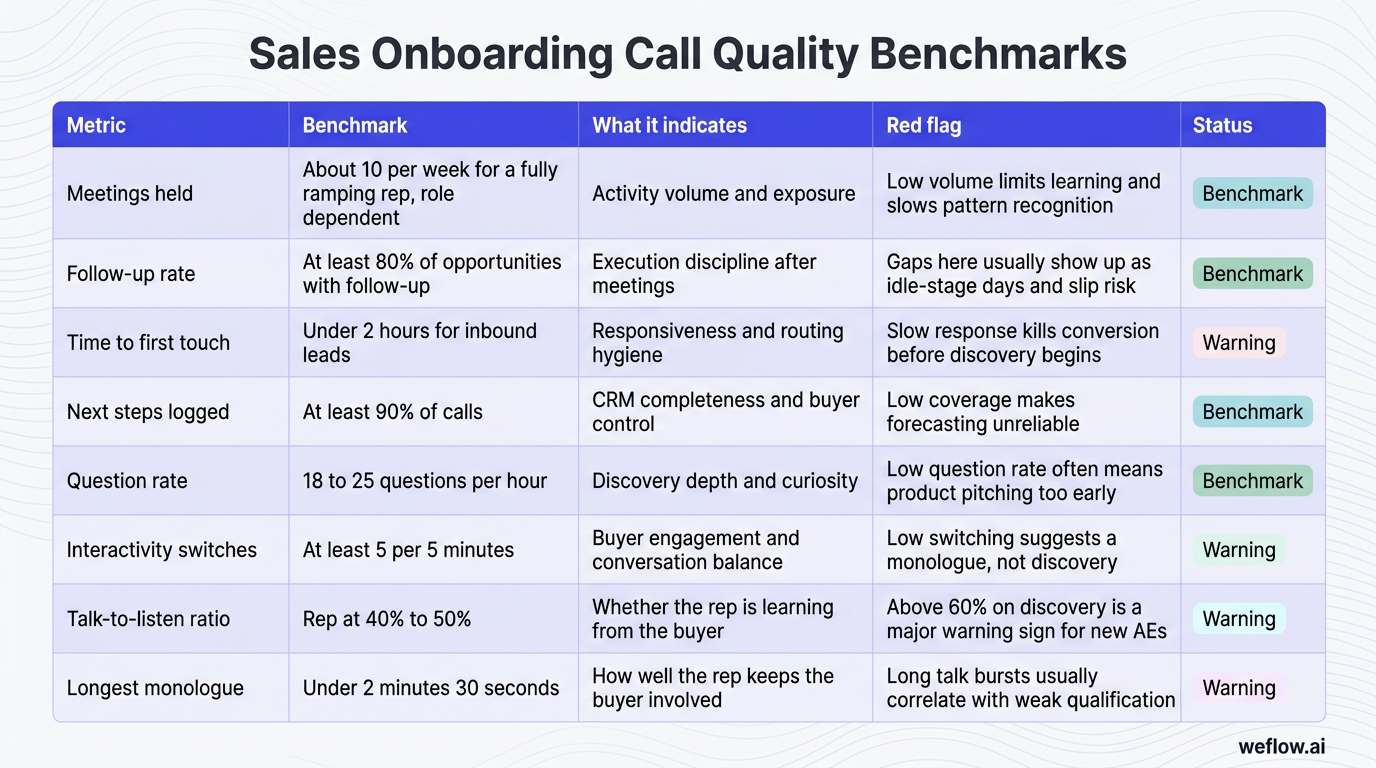
| Metric | Benchmark | What it indicates | Red flag |
|---|---|---|---|
| Meetings held | About 10 per week for a fully ramping rep, role dependent | Activity volume and exposure | Low volume limits learning and slows pattern recognition |
| Follow-up rate | At least 80% of opportunities with follow-up | Execution discipline after meetings | Gaps here usually show up as idle-stage days and slip risk |
| Time to first touch | Under 2 hours for inbound leads | Responsiveness and routing hygiene | Slow response kills conversion before discovery begins |
| Next steps logged | At least 90% of calls | CRM completeness and buyer control | Low coverage makes forecasting unreliable |
| Question rate | 18 to 25 questions per hour | Discovery depth and curiosity | Low question rate often means product pitching too early |
| Interactivity switches | At least 5 per 5 minutes | Buyer engagement and conversation balance | Low switching suggests a monologue, not discovery |
| Talk-to-listen ratio | Rep at 40% to 50% | Whether the rep is learning from the buyer | Above 60% on discovery is a major warning sign for new AEs |
| Longest monologue | Under 2 minutes 30 seconds | How well the rep keeps the buyer involved | Long talk bursts usually correlate with weak qualification |
A high talk-to-listen ratio is one of the clearest early warnings in onboarding. New AEs often over-explain because they’re trying to prove competence. The result is shallow discovery, weak business impact notes, and poor next-step quality. That’s why call metrics belong in the certification process—not just in manager coaching after the fact.
FAQ
What is a 30-60-90 day sales onboarding plan?
A 30-60-90 day sales onboarding plan is a phased ramp model that moves reps from foundational learning to controlled execution to full pipeline ownership. In the first 30 days, reps learn the market, product, messaging, and sales process. In days 31 to 60, they start role-plays, mock calls, and limited live execution. In days 61 to 90, they own real opportunities with manager coaching and certification based on CRM and call evidence. The point isn’t just speed—it’s making readiness measurable.
How do you measure sales enablement success?
Measure it at three levels. First, productivity: time to first meeting, first opportunity, first deal, and time to quota. Second, quality: certification pass rates, call quality metrics, and CRM hygiene scores such as dated-next-step coverage or contact-role completeness. Third, business impact: win rates, stage conversion, deal velocity, slip rate, and forecast error rate. If the program improves completion rates but not pipeline quality or forecast confidence, it isn’t working well enough.
What role does AI play in sales onboarding?
AI helps in three practical ways. It speeds up shadowing by making recorded calls searchable by use case, persona, and objection. It cuts admin work through AI summaries and suggested Salesforce field updates after meetings. And it makes coaching more objective by scoring real conversations against your methodology. For RevOps, the biggest advantage is cleaner Salesforce data with less manual chasing, which means onboarding evidence and forecasting evidence can live in the same system.
How do you certify sales rep readiness?
Use pass/fail gates tied to evidence, not manager instinct. That usually means a mix of live role-plays, recorded calls, and Salesforce proof. For an AE, readiness might require two opportunities with complete discovery notes, the right contact roles, an active mutual action plan, and a dated next step. For a manager, it might require a month of documented coaching coverage plus late-stage deal inspections using the two-proof rule. The standard should be visible, repeatable, and enforced in Salesforce where possible.
Why do sales reps forget training so quickly?
Because most onboarding programs overload reps with information before they have context to use it. Research commonly cited in enablement shows reps can forget 87% of training within 30 days without reinforcement. The fix is spaced repetition: short LMS modules, repeated role-plays, call shadowing, microlearning nudges tied to stage exits, and weekly coaching on live deals. Reps remember what they practice, get inspected on, and have to prove in the workflow.
.webp)

.webp)
.avif)
.avif)