Sales Enablement Framework to Ramp Reps Faster and Improve Win Rates


Sales enablement is often treated like training: a kickoff deck, a few product sessions, then hope the team figures it out. That approach breaks as soon as you add headcount, expand segments, or ask managers to forecast with confidence.
A working enablement framework is a revenue system. It gives reps the training, content, coaching, and feedback loops they need to ramp faster, run better buyer conversations, and create pipeline that actually converts.
This guide breaks down the core pillars of sales enablement, how to structure onboarding, how to map content to the buyer journey, and how to standardize playbooks across sales, marketing, product, and RevOps.
Sales enablement pillars: build systems that scale revenue
Sales enablement is the cross-functional discipline of giving reps the training, content, tools, and guidance they need to move deals forward. The goal is simple: help reps sell more, faster, and with more consistency.
Ad-hoc training fails because it depends on memory, manager heroics, and tribal knowledge. A structured enablement program works because it turns repeatable selling behavior into defined workflows—onboarding paths, certifications, content distribution, coaching, and measurement.
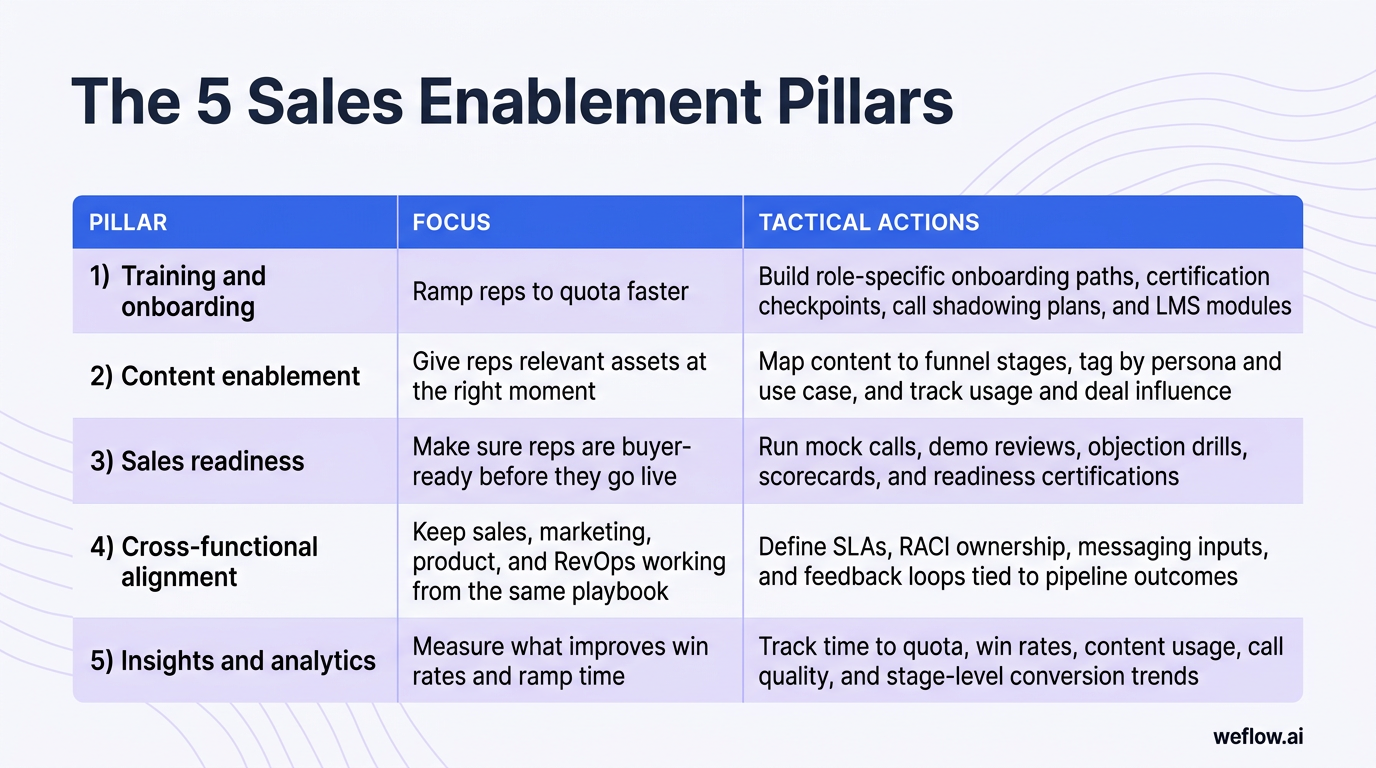
| Pillar | Focus | Tactical actions |
|---|---|---|
| Training and onboarding | Ramp reps to quota faster | Build role-specific onboarding paths, certification checkpoints, call shadowing plans, and LMS modules |
| Content enablement | Give reps relevant assets at the right moment | Map content to funnel stages, tag by persona and use case, and track usage and deal influence |
| Sales readiness | Make sure reps are buyer-ready before they go live | Run mock calls, demo reviews, objection drills, scorecards, and readiness certifications |
| Cross-functional alignment | Keep sales, marketing, product, and RevOps working from the same playbook | Define SLAs, RACI ownership, messaging inputs, and feedback loops tied to pipeline outcomes |
| Insights and analytics | Measure what improves win rates and ramp time | Track time to quota, win rates, content usage, call quality, and stage-level conversion trends |
The five pillars matter because enablement is not one function doing one thing. It’s a system that connects rep behavior to revenue outcomes.
- +27% win rate increase in enabled organizations compared with non-enabled peers
- 35% faster time to quota for new reps with structured ramp programs
- +22% higher quota attainment when readiness and coaching are built into the sales process
- 6–12% year-over-year revenue growth tied to stronger enablement programs
- +20% more selling time when reps spend less time searching for content and guessing next steps
Define the five core enablement pillars
The pillars work best as a sequence, not as separate workstreams. Training creates the baseline, content supports live selling, readiness validates skill, alignment keeps the message consistent, and insights show what to change next.
- 🧠 Training and onboarding: Build the foundation with product knowledge, ICP clarity, messaging, process training, and call shadowing.
- 🧰 Content enablement: Give reps stage-specific assets like case studies, ROI tools, battlecards, and technical one-pagers they can use in active deals.
- 🧪 Sales readiness: Test whether reps can actually run discovery, handle objections, and deliver demos before they own pipeline.
- 🧩 Cross-functional alignment: Make sure marketing, product, enablement, and sales managers reinforce the same story, qualification criteria, and buyer journey.
- 📊 Insights and analytics: Measure ramp time, quota attainment, deal progression, content usage, and call quality so enablement becomes an operating rhythm, not a one-time event.
Measure the revenue impact of enablement
Enablement gets executive support when it maps to numbers leadership already tracks. The CFO cares about time to quota because it affects CAC payback. The CRO cares about win rates and forecast quality because those shape revenue attainment. RevOps cares because incomplete training and uneven process adherence show up as bad pipeline data in Salesforce.
| Outcome | Percentage uplift |
|---|---|
| Win rate | +27% |
| Time to quota ramp | 35% faster |
| Quota attainment | +22% |
| Revenue growth | 6–12% YoY |
| Selling time | +20% |
Benchmarks sourced from CSO Insights, HubSpot, Sales Enablement Pro, Gartner, and SiriusDecisions/Forrester.
Sales onboarding workflows: cut ramp time and boost quota
Most onboarding programs fail because they front-load information, then stop. That’s a problem when reps forget 87% of training within 30 days without reinforcement.
The fix is a structured 30-60-90 day ramp plan paired with a continuous learning cycle. In the first 30 days, reps need orientation and repetition. From days 31 to 60, they need practice in controlled settings. From days 61 to 90, they need ownership, live coaching, and measurable production targets.
-
Days 1–30: Build the foundation
- Teach product, market, ICP, messaging, and sales process
- Set up core systems access, including Salesforce, call libraries, LMS, and documentation
- Require shadowing, not just reading
- Deliverables: product knowledge quiz, persona worksheet, value prop pitch-back, 10+ observed calls
-
Days 31–60: Move into practice
- Run role-plays for discovery, demos, and objection handling
- Introduce outbound activity and qualification scorecards
- Use manager coaching and peer review to close skill gaps early
- Deliverables: discovery certification, demo certification, recorded mock call, first meetings or first opportunities
-
Days 61–90: Shift to execution and ownership
- Give reps live pipeline responsibility
- Coach on deal strategy, forecasting, and stage progression
- Inspect CRM hygiene, not just activity volume
- Deliverables: full discovery-to-proposal motion, qualified pipeline creation, win/loss self-review, ramp feedback survey
The psychological shift matters here. In month one, new reps are trying to make sense of the company and the buyer. By month three, they need to show judgment in live deals. Enablement has to support that transition from passive understanding to active execution.
Structure a 30-60-90 day ramp plan
A good ramp plan is built around measurable deliverables. Passive completion metrics—reading a deck, attending a session, watching a demo—don’t tell you whether a rep can sell.
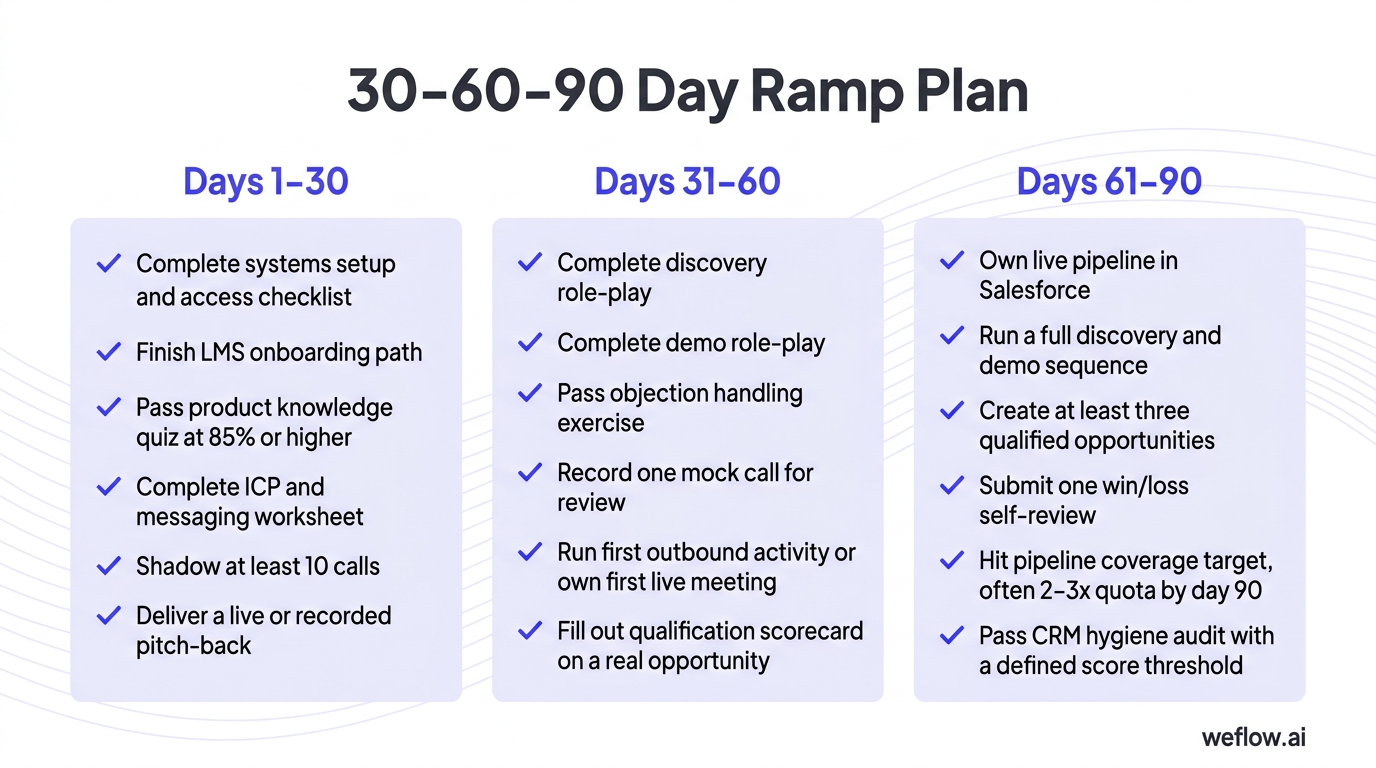
Days 1–30 checklist
- Complete systems setup and access checklist
- Finish LMS onboarding path
- Pass product knowledge quiz at 85% or higher
- Complete ICP and messaging worksheet
- Shadow at least 10 calls
- Deliver a live or recorded pitch-back
Days 31–60 checklist
- Complete discovery role-play
- Complete demo role-play
- Pass objection handling exercise
- Record one mock call for review
- Run first outbound activity or own first live meeting
- Fill out qualification scorecard on a real opportunity
Days 61–90 checklist
- Own live pipeline in Salesforce
- Run a full discovery and demo sequence
- Create at least three qualified opportunities
- Submit one win/loss self-review
- Hit pipeline coverage target, often 2–3x quota by day 90
- Pass CRM hygiene audit with a defined score threshold
Run the five-stage continuous learning cycle
Training sticks when it becomes a loop. The five stages below keep reps from forgetting what they learned and give managers a repeatable coaching system.
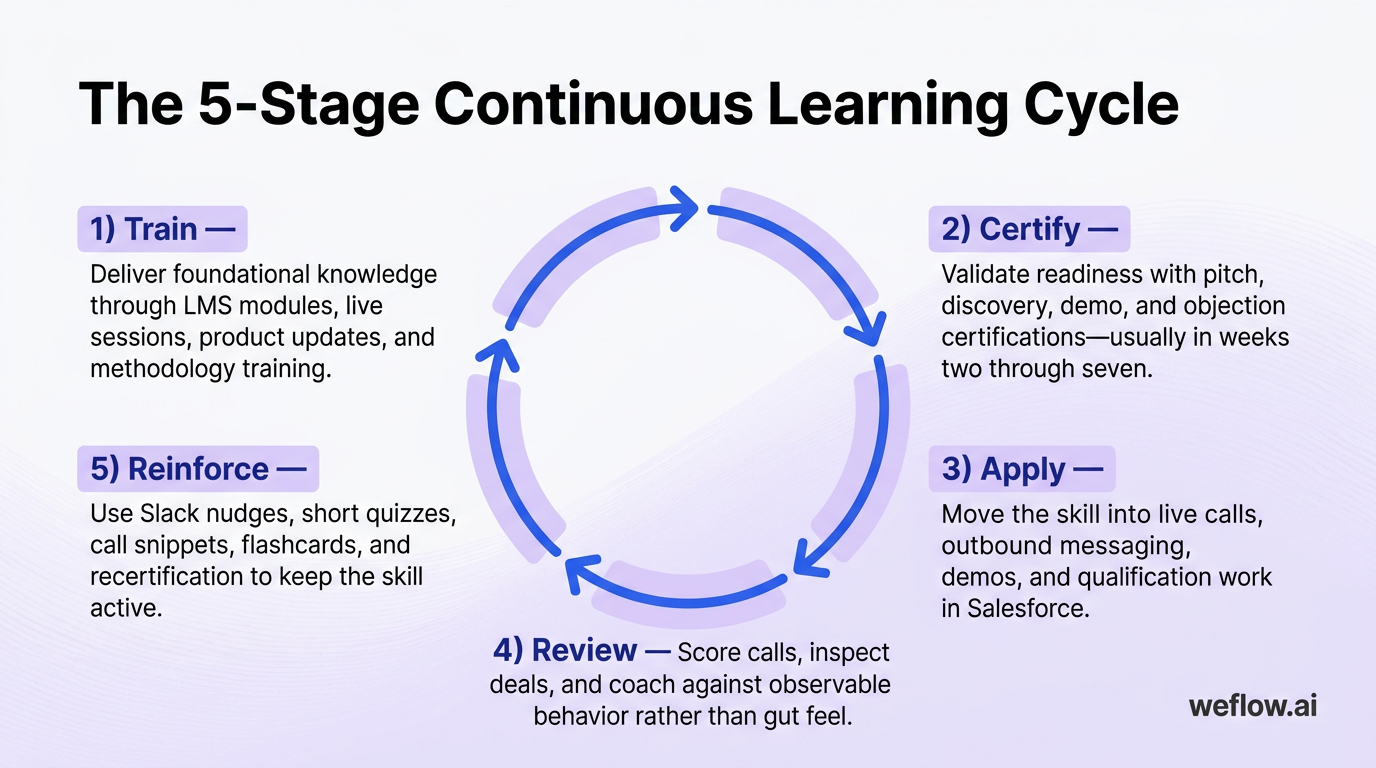
- Train: Deliver foundational knowledge through LMS modules, live sessions, product updates, and methodology training.
- Certify: Validate readiness with pitch, discovery, demo, and objection certifications—usually in weeks two through seven.
- Apply: Move the skill into live calls, outbound messaging, demos, and qualification work in Salesforce.
- Review: Score calls, inspect deals, and coach against observable behavior rather than gut feel.
- Reinforce: Use Slack nudges, short quizzes, call snippets, flashcards, and recertification to keep the skill active.
Review and Reinforce are the steps most teams skip. That’s usually where onboarding loses momentum. You can automate part of this with conversation intelligence, CRM-triggered learning prompts, and manager scorecards tied to stage progression or objection patterns.
Fix common onboarding mistakes that kill momentum
Most onboarding issues aren’t caused by bad intent. They come from unclear ownership, weak manager follow-through, and no shared definition of readiness. Manager alignment matters because enablement can design the program, but front-line managers decide whether the behavior gets reinforced in weekly 1:1s and deal reviews.
| Mistake | Impacted metric | How to fix |
|---|---|---|
| No clear 30-60-90 ramp plan | Time to productivity | Define milestone-based goals, certifications, and pipeline targets for each phase |
| Product-heavy training without buyer context | Win rate | Teach persona pain points, business outcomes, and discovery frameworks alongside product knowledge |
| No practice or role-play | Demo-to-opportunity conversion | Schedule weekly mock calls, manager scoring, and readiness reviews before reps go live |
| No live call shadowing | Rep confidence and call quality | Require shadowing and structured call playback in the first two weeks |
| No certification or skill validation | Pipeline quality | Gate live selling access with discovery, demo, and objection handling certifications |
| Limited access to current sales content | Sales cycle length | Implement version control, clear taxonomy, and CRM-linked asset distribution |
| Onboarding ends after a few weeks | Quota attainment in first 90 days | Extend coaching, reinforcement, and readiness checks through day 90 |
| No feedback loop with new hires | Ramp NPS | Collect structured feedback at days 30, 60, and 90, then update the program |
| Enablement and managers are not aligned | Manager satisfaction and rep consistency | Build the onboarding plan jointly, with shared coaching expectations and certification criteria |
Content enablement strategies: equip reps for every buyer stage
Content only helps revenue when reps can find it, trust it, and use it in the right conversation. Most teams don’t have a content problem. They have a mapping, distribution, and measurement problem.
The easiest way to fix that is to align content to buyer stage, persona, and use case, then distribute it where reps already work—Salesforce, email, Slack, and sequence tools. That cuts search time, reduces outdated asset usage, and gives RevOps clearer data on what influences deal progression.
| Buyer stage | Primary personas | Content types |
|---|---|---|
| Awareness | Executive sponsor, business leader, functional owner | Industry reports, blog posts, problem one-pagers, market education decks |
| Consideration | Department head, evaluator, manager | Case studies, comparison sheets, ROI calculators, workflow explainers |
| Decision | Economic buyer, procurement, security, technical approver | Customer references, pricing decks, technical docs, implementation plans, security materials |
Marketing and sales need to build this together. If marketing creates assets without input from live buyer objections, reps ignore them. If sales asks for custom content for every deal, the content system collapses under one-off requests.
Map sales content to the buyer journey
Start with personas and funnel stages, then audit what you already have. The question isn’t “Do we have content?” It’s “Do we have sales-ready content a rep can use in a live deal?”
- Awareness:
- Use thought leadership, trend reports, and short problem-framing assets
- Focus on category education and urgency, not product detail
- Check whether assets help reps start a conversation or only support marketing campaigns
- Consideration:
- Use case studies, comparison guides, ROI tools, and problem-solution one-pagers
- Align assets to specific personas such as CFO, IT, sales leader, or end user
- Look for content gaps where a common buyer question has no repeatable answer
- Decision:
- Use implementation plans, security docs, pricing narratives, references, and mutual action plans
- Support multi-stakeholder decisions, not just the champion
- Make sure the final-stage assets reflect current packaging, proof points, and legal requirements
A simple audit helps. Pull the top 20 assets, map each one to a persona and stage, then ask sellers whether they’d actually send it in a live cycle. If the answer is no, it’s not sales-ready yet.
Manage and distribute assets in real time
Reps lose hours searching shared drives, Slack threads, and old decks. That cost shows up in lower selling time, inconsistent messaging, and buyers receiving outdated materials.
Good distribution starts with clear tagging and taxonomy: persona, industry, stage, use case, product line, and segment. From there, surface assets inside the workflow instead of asking reps to leave it.
- Salesforce: show stage-specific assets on opportunity or account record pages based on deal stage, segment, or custom object data
- Email plugins: let reps insert approved one-pagers, case studies, and ROI tools from Gmail or Outlook
- Sequence tools: embed approved content in Outreach or Salesloft cadences
- Slack or Teams bots: return the latest pricing deck, battlecard, or security doc instantly
- Enablement platforms: maintain version control, search, and usage analytics in one place
For RevOps and Business Systems teams, this is also a governance problem. If content isn’t version-controlled and tied to a defined taxonomy, you can’t enforce consistency or report on influence later.
Track content usage and deal influence
Content measurement needs both adoption metrics and revenue metrics. Otherwise, you’ll know what gets downloaded, but not what helps win.
- Content usage:
- Shows whether reps are using the asset at all. Low usage usually points to poor findability, weak relevance, or lack of manager reinforcement.
- Time to find:
- Measures how long it takes a rep to locate the right asset. This is one of the cleanest indicators of whether your taxonomy and distribution design are working.
- Deal influence:
- Tracks whether specific assets are used in opportunities that progress or close. In Salesforce, this often means tying content interactions to opportunity stage movement, meeting outcomes, or close rates.
- A/B test results:
- Compares asset variants—subject lines, one-pagers, battlecards, ROI narratives—to see which version performs better in real buyer interactions.
- Rep feedback:
- Captures whether the content reflects real objections, current competitor claims, and up-to-date product packaging.
These metrics help justify future content budget because they connect asset production to pipeline movement, cycle time, and win rate—not just downloads.
Sales playbooks: standardize discovery, demos, and objections
Playbooks turn good seller instincts into repeatable behavior. Without them, each rep runs discovery differently, tells a different product story, and handles objections based on personal style instead of a shared method.
The core playbooks most B2B SaaS teams need are ICP and personas, messaging, qualification, objection handling, discovery guides, demo flows, and deal strategy. Discovery has to shape the demo—not the other way around—because the buyer cares about their problem, not your product tour.
Positioning statement formula: [Product name] is a [category] that helps [target audience] [key benefit] by [unique approach]. Unlike [alternative], it [key differentiator].
| Common objection | Response approach |
|---|---|
| “It’s too expensive.” | Reframe around ROI, cost per outcome, and proof from similar customers |
| “We already use a competitor.” | Diagnose the gap, quantify the reason to change, and explain why the timing matters now |
| “Send me information.” | Clarify what they actually want to evaluate before sending a generic deck |
| “Timing isn’t right.” | Uncover urgency, critical events, and the cost of waiting |
| “We need to talk internally.” | Map stakeholders, offer a joint follow-up, and equip the champion with decision-ready material |
| “There’s no budget.” | Test priority level, reconnect to business pain, and quantify the cost of inaction |
Define your ICP and positioning messaging
A tight ICP keeps reps from spending time on deals that were never likely to close. It also improves forecast quality because pipeline creation starts from better qualification, not just higher activity volume.
| ICP component | What to define |
|---|---|
| Firmographics | Company size, industry, region, business model, and sales motion |
| Pain points and use cases | High-stakes problems your product solves and the workflows affected |
| Buying process | Who signs, who influences, who blocks, and how decisions usually get made |
| Value triggers | Events or metrics that create urgency, such as forecast misses, headcount changes, or system migrations |
| Disqualification criteria | Signals that a lead is outside your core market or lacks the conditions needed for success |
A practical messaging process usually follows six steps: market research, internal discovery, positioning development, messaging architecture, testing, and iteration. If the positioning is vague, reps compensate by talking about features. If the ICP is loose, they compensate by creating pipeline that doesn’t convert.
Handle common objections with discovery frameworks
The best reps don’t fight objections. They diagnose them. A buyer statement is often shorthand for an unresolved risk, unclear value case, or missing stakeholder.
| Objection | What it usually means | Discovery-led strategy |
|---|---|---|
| “It’s too expensive.” | I don’t see enough value yet. | Ask which outcome matters most, what that problem costs today, and whether the current approach is working |
| “We already use a competitor.” | I don’t see a reason to switch. | Ask what’s working, what’s missing, and what would need to change for them to evaluate alternatives |
| “Timing isn’t right.” | This isn’t urgent enough. | Ask about critical events, planning cycles, and the impact of waiting another quarter |
| “Send me info.” | I’m not engaged yet or I need something specific. | Clarify what they want to learn, who else is involved, and what decision they’re trying to make |
| “We need to talk internally.” | The group is not aligned or I’m not fully convinced. | Map the buying group, define next-step criteria, and offer a follow-up with the right stakeholders |
Here’s the difference in practice. A defensive response to “It’s too expensive” is “We actually price competitively.” A discovery-led response is “Compared with what outcome or budget threshold? If you solved this in the next two quarters, what would that change for the team?” One pushes back. The other uncovers the decision logic.
Structure product demos that drive decisions
A good demo is not a feature walk-through. It’s a guided proof that the buyer’s priority problem can be solved in a way they can understand, trust, and buy.
- Recap discovery: Restate the buyer’s goals, pain points, and current process so everyone starts from shared context.
- Frame the outcome: Set the agenda around the result the buyer cares about, not the full product surface area.
- Show, not tell: Walk through three or four high-impact workflows tied to the buyer’s use case.
- Engage the buyer: Ask questions every few minutes to test relevance and surface risk early.
- Confirm and align next steps: Check whether the demo answered the key questions and define the buying path from there.
The “value sandwich” is a useful coaching tool here: outcome > feature > impact. Start with the business result, then show the feature, then explain the operational or financial effect. Example: “This cuts manual forecast prep, here’s the workflow in Salesforce, and that usually gives managers cleaner commit updates before the weekly call.”
Use discovery outcomes to decide what to show. The five most common are pain, priority, process, people, and proof. If discovery didn’t establish those, the demo usually turns into feature dumping.
Cross-functional alignment: sync sales, marketing, and product
Enablement breaks when teams optimize locally. Marketing builds assets sales won’t use. Product ships updates reps can’t explain. Managers coach to one methodology while onboarding teaches another. The buyer feels that fragmentation in every meeting.
Cross-functional alignment solves that by making methodology, ownership, and systems explicit. That includes choosing the right qualification approach, assigning responsibilities through a RACI model, and building a tech stack that supports training, content distribution, coaching, and measurement.
- Enablement platform or CMS: store and distribute approved content
- LMS: run training paths, certifications, and recertification
- Conversation intelligence: review calls, score readiness, and coach from real deal data
- Salesforce: track stage progression, qualification data, pipeline coverage, and rep activity completeness
- Buyer engagement tools: operationalize messaging in sequences and follow-up
- Documentation wiki: keep playbooks, FAQs, and process notes current
Choose the right sales methodology and qualification
Methodology should fit how you sell, not what’s most popular. Many teams blend frameworks—for example, MEDDIC for qualification and Challenger for messaging—because qualification and buyer communication solve different problems.
- Short sales cycle, low-complexity deal: BANT, SNAP, or inbound-led frameworks work well when speed matters more than deep multi-threading.
- Medium to long sales cycle: MEDDIC, SPICED, or solution selling help reps qualify thoroughly and manage risk across multiple stages.
- Complex, multi-stakeholder deal: MEDDIC, Challenger, or SPIN are stronger fits when there are many decision-makers, custom requirements, or long evaluation paths.
- Educated buyers doing self-directed research: Challenger or insight-led approaches work well because the rep needs to differentiate, not just inform.
- Less experienced rep team: more structured frameworks like BANT or NEAT can reduce ambiguity during ramp.
One useful discovery framework is the five P’s: pain, priority, process, people, and proof. Another is SPICED: situation, pain, impact, critical event, and decision. What matters is consistency. If every rep qualifies differently, managers can’t inspect deals the same way and RevOps can’t trust pipeline stages in Salesforce.
Assign ownership using a RACI framework
Enablement should usually be Accountable for program design and operating rhythm because it sits closest to training, readiness, and program measurement. Marketing and Product are often Responsible or Consulted for content and messaging inputs. Sales leaders are often Accountable for feedback quality and field adoption because they own rep behavior.
| Function | Training | Content | Messaging | Feedback |
|---|---|---|---|---|
| Sales | Consulted | Consulted | Informed | Accountable |
| Enablement | Accountable | Accountable | Consulted | Consulted |
| Marketing | Informed | Responsible | Accountable | Consulted |
| Product | Consulted | Informed | Consulted | Consulted |
This avoids the most common failure mode: everyone assumes enablement owns everything, so no one else feels responsible for keeping content current, updating messaging, or feeding field feedback back into the system.
Build a tech stack that supports enablement
The stack should support four jobs: train reps, distribute content, inspect behavior, and connect all of it back to revenue outcomes. For mid-market and enterprise B2B organizations running Salesforce, the key is data flow and operational fit—not adding another disconnected system.
| Category | Example tools |
|---|---|
| Enablement platforms | Highspot, Seismic, Mindtickle |
| LMS | Lessonly, WorkRamp, Docebo |
| Conversation intelligence | Weflow, Gong, Chorus |
| CRM and deal data | Salesforce |
| Buyer engagement | Salesloft, Outreach |
| Documentation and wiki | Notion, Guru |
Conversation intelligence is the feedback loop that makes enablement measurable. It shows whether reps are using the messaging, asking the right discovery questions, handling objections well, and updating Salesforce with enough data completeness to support coaching and forecasting.
If you’re standardizing on Salesforce, tool architecture matters. Systems teams should look at field mapping depth, Salesforce write-back, activity sync logic, custom object support, validation rule behavior, and deployment effort. That’s also why some teams move from Gong to Weflow, a Salesforce-native revenue AI platform: the project is often measured in weeks, not quarters, and the Salesforce integration footprint is typically easier for RevOps and Business Systems teams to manage.
FAQ
What is the difference between sales training and enablement?
Sales training is an event—usually a course, workshop, or onboarding module. Sales enablement is the ongoing system around that training, including content, manager coaching, certifications, workflow support, and measurement.
How do you measure the ROI of sales enablement?
Use lagging indicators like win rate, quota attainment, deal velocity, and revenue growth, then connect them to leading indicators like time to quota, certification scores, content usage, and call quality trends. The strongest ROI model ties enablement activity to pipeline progression and close outcomes in Salesforce.
Who should own sales enablement in a B2B SaaS company?
A dedicated Enablement leader should own the strategy, program design, and operating cadence. Execution still needs RACI alignment with Sales for coaching, Marketing for content and messaging, Product for release input, and RevOps for system design and reporting.
What tools are essential for a sales enablement tech stack?
The core stack is an LMS for training, an enablement platform or CMS for content, and conversation intelligence for call coaching. In Salesforce environments, you also need reliable CRM integration, clear field mapping, and write-back logic so readiness data and deal execution data stay connected.
.webp)

.webp)
.avif)
.avif)