Sales Hiring Cheat Sheet to Build Better Teams and Ramp Managers Faster [Framework]


Most sales hiring problems start before the interview loop. The org design is off, the role is too broad, the manager is overloaded, or the ramp plan lives in a slide deck instead of Salesforce and weekly coaching.
This guide gives you a practical framework for each part of the system: sales org design by ARR stage, sourcing channels, role-specific hiring profiles, 30/60/90-day onboarding, culture management, and performance benchmarks. Use it to tighten hiring decisions, reduce ramp time, and build a sales org that still works when revenue doubles.
Sales org design: structure teams for every ARR stage
Sales org design has to change as revenue grows. What works at $1M ARR usually breaks by $10M, and the founder-led habits that helped win early customers often turn into bottlenecks once you need consistent pipeline coverage, cleaner forecasting, and manager capacity.
If you hold onto an early-stage structure for too long, you usually see the same pattern: unclear role ownership, messy handoffs, territory disputes, and forecast calls built on exceptions instead of process. The fix is not adding more headcount alone. It’s matching structure to the stage you’re actually in.
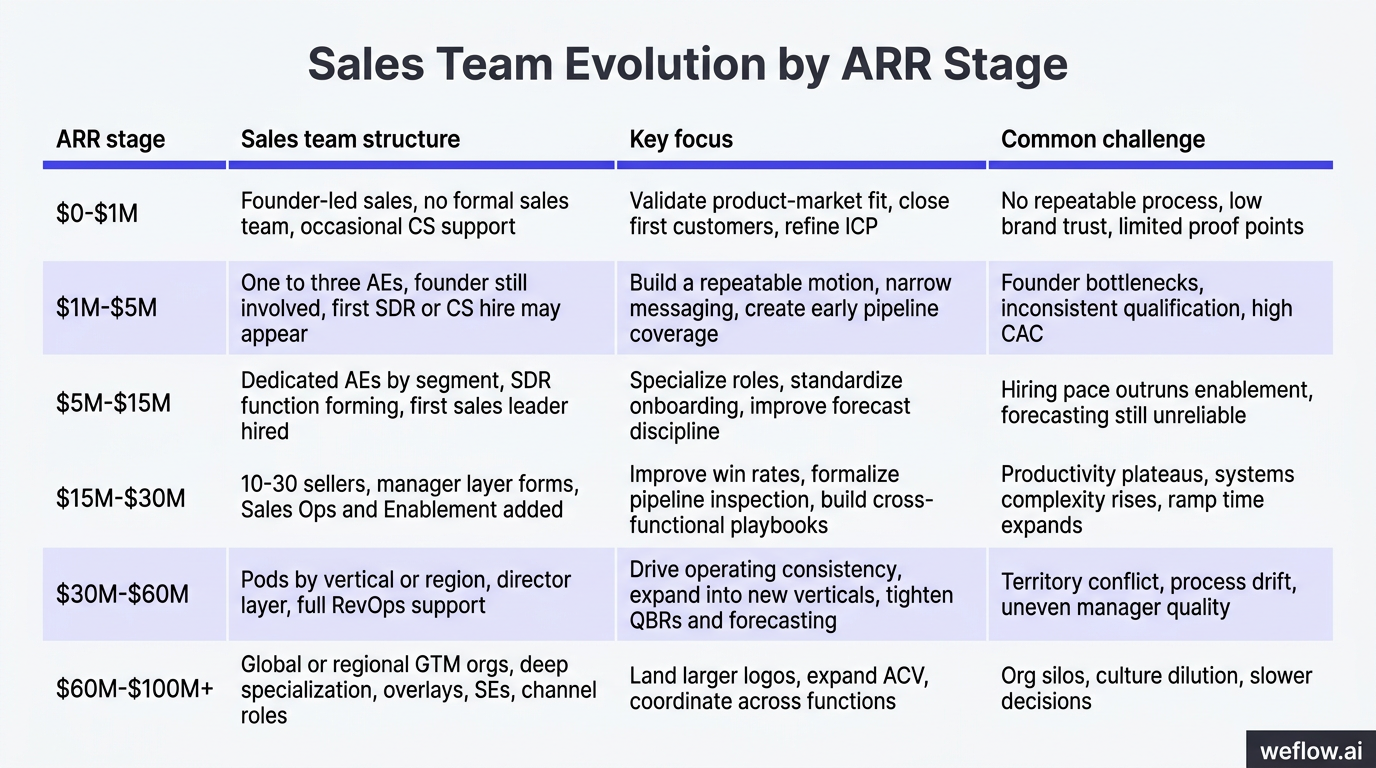
Map sales team evolution from $0 to $100M
Each ARR band has a different hiring profile, management need, and operating risk. The table below shows the structural shifts most B2B sales orgs go through on the path from first revenue to a multi-layered GTM team.
| ARR stage | Sales team structure | Key focus | Common challenge |
|---|---|---|---|
| $0-$1M | Founder-led sales, no formal sales team, occasional CS support | Validate product-market fit, close first customers, refine ICP | No repeatable process, low brand trust, limited proof points |
| $1M-$5M | One to three AEs, founder still involved, first SDR or CS hire may appear | Build a repeatable motion, narrow messaging, create early pipeline coverage | Founder bottlenecks, inconsistent qualification, high CAC |
| $5M-$15M | Dedicated AEs by segment, SDR function forming, first sales leader hired | Specialize roles, standardize onboarding, improve forecast discipline | Hiring pace outruns enablement, forecasting still unreliable |
| $15M-$30M | 10-30 sellers, manager layer forms, Sales Ops and Enablement added | Improve win rates, formalize pipeline inspection, build cross-functional playbooks | Productivity plateaus, systems complexity rises, ramp time expands |
| $30M-$60M | Pods by vertical or region, director layer, full RevOps support | Drive operating consistency, expand into new verticals, tighten QBRs and forecasting | Territory conflict, process drift, uneven manager quality |
| $60M-$100M+ | Global or regional GTM orgs, deep specialization, overlays, SEs, channel roles | Land larger logos, expand ACV, coordinate across functions | Org silos, culture dilution, slower decisions |
The hardest transition is usually founder-led sales to the first dedicated sales leader. Founders often close through product intuition, executive access, and one-off concessions. A first-line leader has to turn that into a process other people can run. If pricing, stage exit criteria, and ICP rules still live in the founder’s head, the new leader inherits noise instead of a motion.
Align CRO sub-functions for revenue growth
Once the company has enough sales headcount to create coordination problems, reporting lines matter. A CRO should own the customer-facing functions that drive revenue execution. The CFO should still own FP&A. That separation keeps forecasting, planning, and operating rhythm connected without mixing commercial execution with finance governance.
- CRO ownership: Sales, Marketing, Customer Success, and Revenue Operations
- CFO ownership: FP&A and financial planning
Revenue Operations usually includes:
- Sales Ops
- Marketing Ops
- CS Ops
- Enablement
- Business Systems
- Data and analytics
- Strategy and planning
- Pricing and deal desk
Investing in RevOps early prevents two expensive problems later: bad Salesforce data and fragmented decision-making. If sales, marketing, and CS each define pipeline stages, handoff rules, and reporting logic differently, leadership spends every forecast cycle arguing about numbers instead of acting on them.
Choose the right org design archetype
There are four common sales org models. The right one depends on how different your deal sizes, buyer personas, and regional needs are. The wrong one usually shows up as territory disputes, inconsistent pipeline rules, or teams protecting local goals at the expense of company revenue.
| Model | Best for | What to watch |
|---|---|---|
| Segmented (SMB, Mid-Market, Enterprise) | Companies with meaningfully different ACVs, sales cycles, and buying motions | You need clear rules of engagement, clean account assignment, and comp plans that fit each segment |
| Geo-based | Global GTM teams or buyers that require local coverage by region | Regional variation can break playbook consistency if Enablement and RevOps are weak |
| Pod-based (SDR + AE + SE) | Mid-market motions where speed and tight coordination matter | Pod output varies fast if managers do not enforce the same qualification and handoff standards |
| Product-line based | Multi-product companies selling to different buyers or use cases | This can create siloed behavior unless RevOps and CS unify account strategy and reporting |
If your current model is causing territory conflict or siloed behavior, do not redraw the whole map in one step. Start with one segment, region, or product line. Freeze rules of engagement, define Salesforce ownership fields, update comp mechanics, and run the new model for one planning cycle before expanding it.
Org design best practices that hold across stages:
- Define role ownership clearly, especially between AE, AM, and CS.
- Keep frontline manager span of control at six to eight direct reports.
- Align comp plans to the motion—hunters and farmers should not be paid on the same logic.
- Design territories carefully and avoid frequent account reshuffles that create rep churn.
- Build RevOps before reporting complexity forces rework.
- Include CS and account management in GTM planning, because revenue does not stop at closed-won.
- Review structure every time the business crosses a major ARR milestone.
Sales sourcing strategies: find and attract top-tier talent
If you rely on inbound job board applicants for most sales hiring, candidate quality usually drops fast. The strongest quota carriers are often still employed, not actively searching, and selective about who they talk to. That’s why high-performing B2B sales orgs treat recruiting more like outbound pipeline generation than passive demand capture.
As a benchmark, more than 60% of high performers are sourced through referrals or targeted outbound. Job boards still have a place, but usually for coverage, not for the core of your hiring plan.
Drive high-converting employee referrals
Referrals work because top performers know other top performers, and they know who actually carried the team versus who just looked good in forecast calls. Referral hires also tend to close faster and stay longer because the job context is clearer before they ever enter the process.
Use this referral checklist:
- Offer a meaningful referral bonus, with payout tied to start date and retention milestone.
- Ask your strongest reps and managers a direct question: Who is the best seller you’ve worked with in the last three years?
- Give hiring managers a short LinkedIn post template so they can share the role with real context, not a copy-pasted job description.
- Create a warm outreach note for executives to send into peer groups such as Pavilion, RevGenius, or other operator communities.
- Remind the team about referral bonuses in monthly all-hands, quarterly kickoffs, and after headcount approvals—not once when the role opens.
A simple cadence works well: mention open roles at every sales all-hands, re-share the top three priority hires at the start of each month, and ask managers to bring one referral name to weekly leadership staff meetings until the role is filled.
Target passive A-players with outbound sourcing
The best outbound recruiting looks a lot like enterprise prospecting. You build a tight list, personalize outreach, run a multi-touch cadence, and qualify fit based on real buying signals—in this case, stage fit and selling context instead of firmographics.
- Build a shortlist by selling context. Target candidates from companies with similar ACV, sales cycle length, buyer persona, and deal complexity. A rep who sold $20K transactional software is not automatically a fit for a $150K multi-threaded motion.
- Read LinkedIn for evidence, not logos. Promotions, territory changes, club awards, consistent tenure, and specific deal language are stronger signals than a recognizable brand name. If a profile says “Top performer” but gives no scope, no segment, and no deal context, treat it as a prompt for deeper screening, not proof.
- Write personalized first touches. Mention the candidate’s segment, market, or relevant experience. A message like “We’re hiring a Mid-Market AE to cover 30-90 day cycles in a $20K-$50K ACV motion” gets better replies than generic praise.
- Run a multi-touch cadence. Email, LinkedIn, and a recruiter follow-up over seven to 10 business days is usually enough to test interest without dragging the process out.
- Qualify quickly. If the first conversation reveals a mismatch on segment, comp, or working model, exit early and keep the experience professional.
Typical hiring teams see 30% to 50% of sales hires come from outbound sourcing when they run this process with discipline. That is usually where passive A-players enter the funnel.
Partner with specialized SaaS sales recruiters
External recruiters can speed up hiring, but only if they know your market and your GTM motion. A niche SaaS recruiter who understands segment fit, quota design, and stage-specific hiring tradeoffs will send fewer resumes and more usable candidates than a broad agency working from job title keywords.
- Work with one or two recruiters who specialize in SaaS sales hiring, not a long list of generalists.
- Give them the same materials you use internally: comp bands, interview scorecard, stage context, ramp expectations, and the actual story behind why the role exists.
- Use peer-led communities and micro-events to meet candidates before they are formally in market.
- Measure recruiter performance by qualified interviews, offer acceptance, and six-month retention—not resume volume.
Communities worth testing: Bravado, SDR Nation, Thursday Night Sales, SaaS Sales Talent, and relevant operator groups where strong reps and managers already spend time.
The hidden cost of poor recruiter onboarding is misalignment. If a recruiter pitches your company as an enterprise brand-builder when you actually need a high-velocity Mid-Market seller, the funnel fills with the wrong profile, interview time gets wasted, and offer acceptance drops because candidate expectations were wrong from the first call.
| Sourcing benchmark | Typical range |
|---|---|
| Referral candidates more likely to become top performers | 3x-4x |
| Sales hires from outbound sourcing | 30%-50% |
| Advanced-stage interviews per AE hire | 6-10 |
| High performers sourced via referral or outbound | >60% |
| AEs sourced primarily through job boards | <15% |
Ideal hiring profiles: match sales skills to market segments
Most hiring mistakes look obvious in hindsight. The resume was strong, but the rep had sold into the wrong segment. The candidate interviewed well, but there was no evidence of coachability. The team hired for pedigree instead of fit.
A standardized scorecard fixes a lot of this. It forces interviewers to evaluate the same criteria, reduces gut-feel bias, and gives the hiring manager something better than “I liked them” when it is time to make a call.
Evaluate AE candidates across SMB, Mid-Market, and Enterprise
AEs should be hired into the motion they know how to run. Segment fit matters because the work is different: SMB is about pace and activity discipline, Mid-Market needs stronger qualification and forecasting, and Enterprise requires deal orchestration across long cycles and many stakeholders.
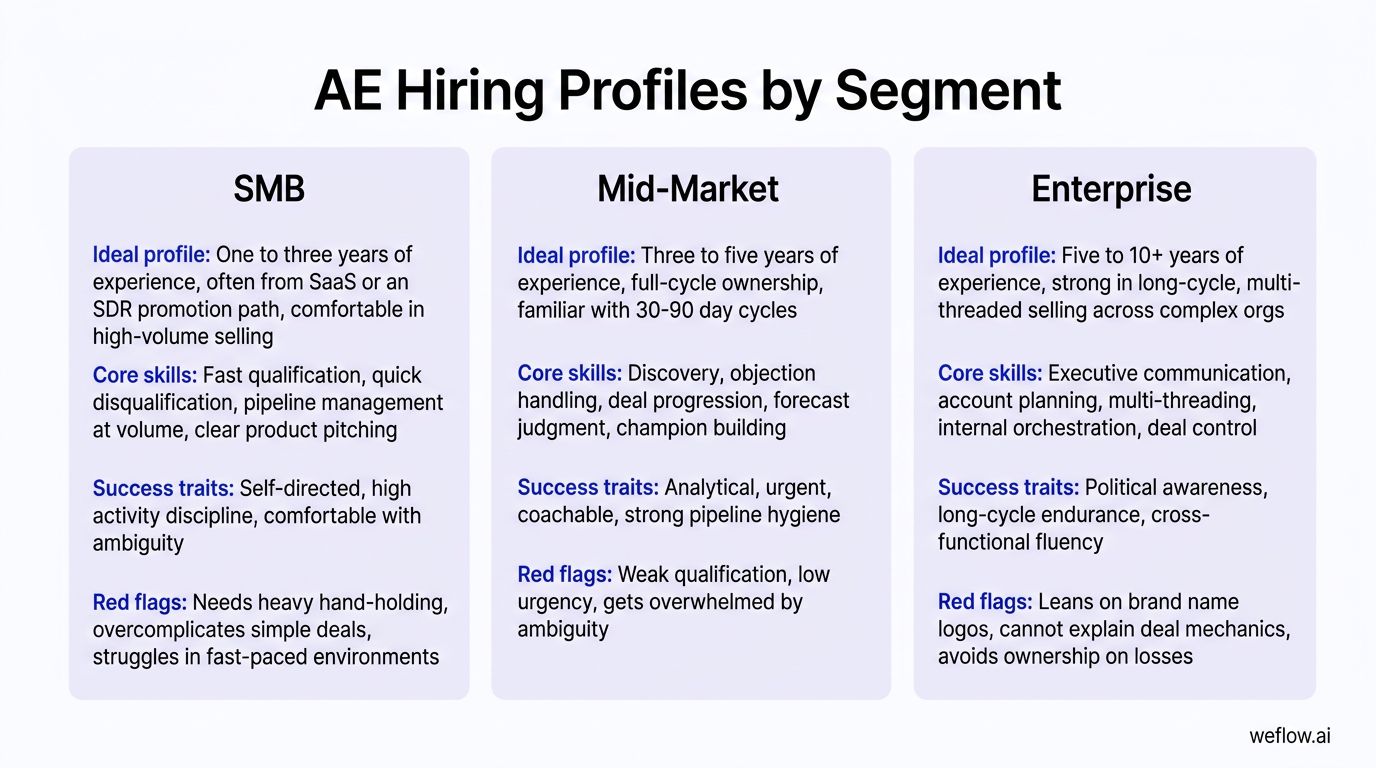
| Segment | Ideal profile | Core skills | Success traits | Red flags | Interview questions | Scorecard criteria |
|---|---|---|---|---|---|---|
| SMB | One to three years of experience, often from SaaS or an SDR promotion path, comfortable in high-volume selling | Fast qualification, quick disqualification, pipeline management at volume, clear product pitching | Self-directed, high activity discipline, comfortable with ambiguity | Needs heavy hand-holding, overcomplicates simple deals, struggles in fast-paced environments | “Tell me about a time you had to hit quota with limited enablement.” “How do you manage 50+ opportunities at once?” | Activity level, time to first deal, deal-cycle speed, win rate in high-volume motion |
| Mid-Market | Three to five years of experience, full-cycle ownership, familiar with 30-90 day cycles | Discovery, objection handling, deal progression, forecast judgment, champion building | Analytical, urgent, coachable, strong pipeline hygiene | Weak qualification, low urgency, gets overwhelmed by ambiguity | “Walk me through a deal you qualified out.” “How do you build and coach a champion?” | Pipeline coverage accuracy, discovery quality, qualification discipline, forecast accuracy |
| Enterprise | Five to 10+ years of experience, strong in long-cycle, multi-threaded selling across complex orgs | Executive communication, account planning, multi-threading, internal orchestration, deal control | Political awareness, long-cycle endurance, cross-functional fluency | Leans on brand name logos, cannot explain deal mechanics, avoids ownership on losses | “Tell me about your last 6-12 month cycle.” “Who were the stakeholders, and how did you create urgency?” | Strategic account execution, deal size and complexity, ability to manage long-cycle opportunities |
A common mistake is hiring an Enterprise rep into an SMB or Mid-Market motion because the resume looks stronger on paper. That usually fails fast. The rep is used to fewer opportunities, more internal support, and longer cycles. The opposite mistake also happens: strong SMB reps can stall in enterprise deals because they have not learned multi-threading or executive alignment.
Identify first-line sales managers who drive quota
The best first-line manager is not just a former closer. The role is part coach, part inspector, part operator. If the manager cannot run clean forecast calls, coach discovery, and enforce process inside Salesforce, team performance usually becomes a collection of individual heroics.
The usual profile is three to seven years of sales experience, one to three years of people management, and prior quota-carrying experience. Their mission is straightforward: improve rep productivity, tighten forecast accuracy, and build a team that hits quota without depending on manager rescue.
| Success traits | Red flags |
|---|---|
| High EQ, coaching discipline, comfortable with difficult feedback, process-oriented, strong CRM hygiene, can manage up and down | “Hero seller” syndrome, closes deals for reps, talks only about their own number, cannot explain how they improve rep performance, avoids operating cadence |
Promoting your best AE to manager often fails for one reason: the skills are different. Great reps win through personal execution. Great managers win through repetition, diagnosis, coaching, and consistency. If the candidate lacks patience, emotional control, or process discipline, the team inherits a top rep’s habits without getting real leadership.
Avoid common sales hiring mistakes and red flags
Most hiring misses come from process shortcuts. The team gets urgent, skips a simulation, ignores a weak reference, or lets one strong interviewer override the scorecard.
| Problem | Why it happens | Consequence | Resolution |
|---|---|---|---|
| Hiring too fast | Open headcount creates pressure to fill seats | Wrong hires cost revenue, morale, and manager time | Keep the full interview loop and use a fixed scorecard even under pressure |
| Hiring for resume over fit | Brand-name companies look safer than real stage fit | The rep cannot adapt to your motion | Test for behavioral fit, segment experience, and stage context |
| Vague job descriptions | Roles are written around aspiration instead of outcomes | You attract mismatched candidates and create false expectations | Define success at 90 days, six months, and 12 months |
| Skipping simulations | Interviewers trust talk over live execution | You miss weak discovery, poor coaching, or shallow deal judgment | Add a mock demo, deal review, or coaching exercise by role |
| Not testing coachability | Confidence gets mistaken for competence | Ramp slows and managers struggle to develop the hire | Ask how the candidate handled hard feedback and what changed after it |
| Ignoring backchannel references | The team trusts the candidate story or runs out of time | Known problems surface after start date | Do two to three backchannel checks with former peers, managers, or customers |
A simple backchannel reference framework:
- Start with context: “We’re evaluating them for a role with [segment, ACV, team size].”
- Ask where they were strongest: pipeline creation, discovery, deal control, forecasting, or coaching.
- Ask what kind of environment fit them best and where they struggled.
- End with the question that matters most: “Would you hire this person again for this exact role?”
Sales onboarding frameworks: ramp reps and managers faster
Hiring well is not enough if onboarding is loose. AEs and managers need structured 30/60/90-day plans with clear milestones, ownership, and reporting inside Salesforce. Otherwise, ramp becomes a guessing exercise and underperformance gets identified too late.
RevOps, Enablement, and frontline managers all own part of this. Enablement handles knowledge transfer. Managers coach application. RevOps makes sure the activity, pipeline, and forecast data is visible enough to spot misses early.
| Phase | AE focus | Manager focus |
|---|---|---|
| Days 1-30 | Product, ICP, process, and call exposure | Observe team, learn systems, assess performance patterns |
| Days 31-60 | Prospecting, discovery, and early pipeline creation | Start coaching, run cadences, enforce process discipline |
| Days 61-90 | Full-cycle deal ownership and quota pacing | Drive performance, influence strategy, improve forecast quality |
Execute a 90-day AE onboarding plan
-
Days 1-30: certify fundamentals.
The AE should complete product and ICP certification, understand competitors, pass discovery and demo role-play, and shadow at least 10 calls with self-review notes. Success means they can explain the value proposition clearly, navigate Salesforce correctly, and document call takeaways with acceptable data completeness.
-
Days 31-60: move into guided execution.
The AE starts outbound prospecting or owns inbound opportunities, runs discovery, and co-pilots demos with a manager or senior rep. A solid milestone is owning 20% to 30% of quota pace, creating at least five qualified opportunities, and maintaining CRM hygiene above 80% on required fields, next steps, and close dates.
-
Days 61-90: own the full cycle.
By this stage, the AE should run deals independently, prepare for pipeline reviews without manager cleanup, and show realistic quota pacing. Closed-won is ideal, but the better signal is whether their pipeline quality, stage progression, and forecast judgment match the segment they were hired into.
A practical Salesforce dashboard for AE ramp tracking should include:
- New hire cohort filter by start month and manager
- Activities logged by week
- Meetings booked and held
- Qualified opportunities created
- Pipeline amount created by stage
- Stage conversion rates
- Next-step completeness and close-date accuracy
- Certification milestones stored as custom fields or a simple onboarding object
Structure a 90-day manager onboarding plan
-
Days 1-30: observe before changing anything.
The new manager should meet every rep and cross-functional partner, sit in on forecast and pipeline reviews, learn the dashboards, and document team strengths and gaps. They should resist changing the sales process in the first month because they have not yet separated root causes from symptoms.
-
Days 31-60: install operating cadence.
Now the manager starts running one-on-ones, forecast calls, and pipeline inspections using the company’s existing rules. Success looks like coaching plans for every rep, predictable weekly cadence, and better process compliance in opportunity data and forecast category use.
-
Days 61-90: drive performance and shape the plan.
By this point, the manager should be influencing win rates, sales velocity, or forecast accuracy, while also contributing hiring plans, territory changes, or enablement requests. They are no longer learning the system—they are improving it with evidence.
Sales culture and performance: manage accountability and churn
Sales culture is not the list of values on the wall. It is what gets reinforced in pipeline reviews, forecast calls, coaching sessions, and post-mortems. If accountability, curiosity, and collaboration do not show up in those moments, they are not real operating values.
Embed core values into daily sales behaviors
| Value in action | Warning signal |
|---|---|
| Accountability: reps own pipeline quality, forecast judgment, and follow-up; managers coach to outcomes, not just activity totals | Reps blame Marketing, Product, or CS; forecasts stay inaccurate; “happy ears” shows up in late-stage deals |
| Curiosity: discovery goes beyond surface pain, deal notes map real business problems and urgency | Calls turn into feature tours, reps cannot explain the buyer’s “why now,” and low-fit deals fill the funnel |
| Velocity: every meeting ends with a clear next step, and reps spend time on high-probability deals | Deals stall with no owner, follow-up drifts, and cycle times expand without a clear cause |
| Collaboration: sales, CS, Product, and Marketing share context and solve handoff issues early | Internal finger-pointing follows churn, poor handoffs, or inconsistent messaging |
| Learning obsessed: weekly call review, win-loss analysis, peer coaching, and fast feedback loops | The same mistakes repeat, enablement becomes a checkbox, and the team stops sharing what works |
A manager can enforce these values in a weekly pipeline review without turning the meeting into a lecture. Ask for the buyer’s business pain, next step date, champion strength, and risk to close. If the rep cannot answer those questions clearly, you are not just seeing a deal problem—you are seeing a behavior problem.
A learning-obsessed culture usually shows up in win rates and cycle times. Teams that review calls, inspect losses, and apply feedback quickly waste less time on poor-fit deals and get to stronger discovery faster.
Execute termination best practices professionally
Underperformance should be handled with clear documentation and respect. A clean process protects the company, gives the employee a fair shot to improve, and creates useful feedback for future hiring and onboarding.
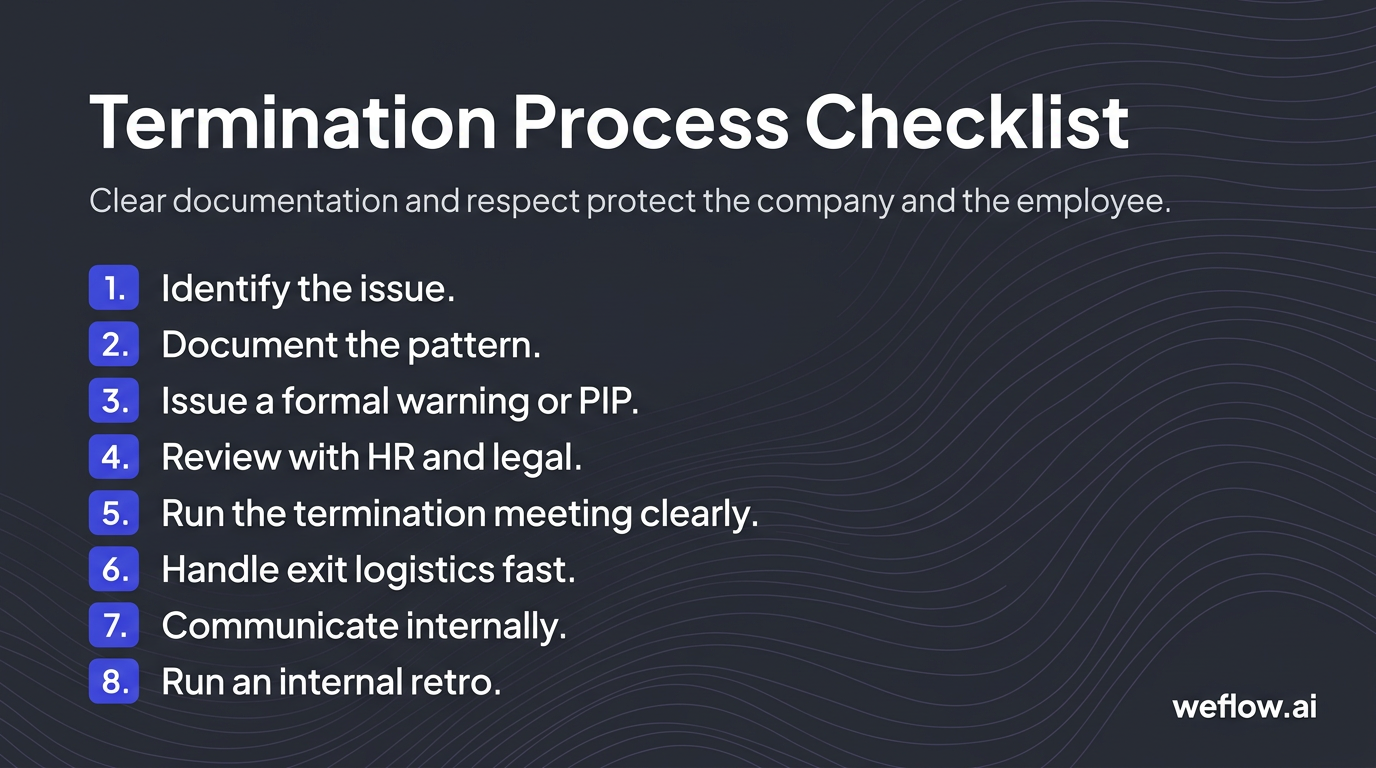
- Identify the issue. Use objective data such as quota attainment, pipeline coverage, stage conversion, activity completeness, and coaching patterns.
- Document the pattern. Keep records from one-on-ones, forecast reviews, call coaching, and written feedback.
- Issue a formal warning or PIP. Define what must change, by when, and what support the company will provide.
- Review with HR and legal. Confirm compliance, severance policy, local labor requirements, and commission treatment.
- Run the termination meeting clearly. Keep the message direct, respectful, and short. Do not turn it into a debate.
- Handle exit logistics fast. Reassign pipeline, revoke access, collect equipment, and update system ownership.
- Communicate internally. Share a simple notice that avoids speculation and protects the person’s dignity.
- Run an internal retro. Decide whether the miss came from hiring, onboarding, enablement, coaching, or role design.
The internal retro matters more than most teams admit. If two reps fail in the same role for the same reasons, you probably do not have an individual performance problem—you have a hiring profile or ramp design problem.
Sales compensation and performance benchmarks: measure success
Benchmarks are useful only if you apply them in context. A healthy comp plan for a high-margin SaaS company with a 30-day cycle will not look the same as one for a complex enterprise motion with heavy pre-sales support. Use the ranges below as a starting point, then adjust for your gross margins, funding stage, and market.
Benchmark AE and manager compensation by segment
| Role | Base salary | OTE | Quota range |
|---|---|---|---|
| SMB AE | $55K-$75K | $100K-$130K | $400K-$600K |
| Mid-Market AE | $70K-$90K | $150K-$180K | $700K-$1M |
| Enterprise AE | $90K-$140K | $200K-$300K+ | $1.2M-$2M+ |
| Sales Manager | $100K-$130K | $180K-$240K+ | Team quota: $2M-$5M+ |
| VP of Sales stage | Base salary | OTE | Equity range |
|---|---|---|---|
| $1M-$5M ARR | $160K-$180K | $250K-$300K | 0.5%-1.0% |
| $5M-$20M ARR | $180K-$200K | $300K-$400K | 0.3%-0.7% |
| $20M-$50M ARR | $200K-$225K | $350K-$450K | 0.15%-0.4% |
| $50M-$100M ARR | $225K-$250K+ | $400K-$500K+ | 0.05%-0.2% |
The standard quota-to-OTE guideline is about 5x for many AE roles. That means a rep with $200K OTE might carry about $1M in quota. It makes sense to go below that in lower-margin or harder-to-sell motions, and above that in faster-cycle, high-efficiency segments where rep productivity is easier to repeat.
Track ramp, tenure, and quota attainment metrics
- Average AE ramp time: 4.5 to 6 months. If your average ramp is longer than a full sales cycle, revisit onboarding, segment fit, and manager capacity.
- Average AE tenure: about 18 months. That short tenure window means weak hiring decisions get expensive fast.
- Reps leaving before full productivity: about 26%. This is a hiring and onboarding signal, not just an attrition metric.
- Percentage of AEs hitting quota: about 53%. If only a handful of reps hit, the motion may be broken. If 100% of reps hit for multiple quarters, quotas may be too low.
- Revenue concentration: top 20% of reps often drive 50% to 60% of team revenue. That is normal to a point, but extreme concentration increases forecast risk.
- Quota attainment spread: low to high performers often range from 30% to 150% of quota. Use that spread to spot bad territory design and weak coaching.
- Time to hire a quota-carrying AE: 45 to 60 days. Longer cycles usually mean weak sourcing or slow interviewer coordination.
- Candidates interviewed per AE hire: five to eight. If you need far more than that, your scorecard or top-of-funnel quality may be off.
- Offer acceptance rate: 40% to 60%. Low acceptance often points to comp mismatch, weak role framing, or a sloppy interview process.
- Cost of a bad hire: three to five times OTE, plus an estimated $500K to $2M in stalled or lost pipeline.
FAQ
What is the average ramp time for a new AE?
Average AE ramp time is usually 4.5 to 6 months, depending on product complexity and sales cycle length. If your reps are still not pacing after that point, check segment fit, manager span of control, and whether onboarding milestones are tracked in Salesforce or only discussed informally.
How many direct reports should a sales manager have?
Six to eight direct reports is the usual limit if you want real coaching, weekly pipeline inspection, and usable forecast reviews. Once managers consistently carry more than that, one-on-ones get shallow and deal inspection turns reactive.
What is the cost of a bad sales hire?
A bad sales hire usually costs three to five times their OTE, and the larger hit often comes from $500K to $2M in stalled or lost pipeline. The hidden cost is manager time spent rescuing deals, re-running interviews, and rebuilding team morale.
How do you source the best sales candidates?
More than 60% of high performers come through employee referrals or targeted outbound, not inbound job boards. The best hiring teams treat sourcing like account planning: they define the segment, build a tight list, and use warm intros whenever possible.
When should a startup hire its first sales leader?
Most companies hire the first dedicated sales leader between $5M and $15M ARR, once there is a repeatable motion to manage. If founders still cannot describe the ICP, qualification rules, and basic sales process clearly, hiring that leader early usually creates noise instead of scale.
.webp)

.webp)
.avif)
.avif)