7 Sales Methodologies to Qualify Deals, Coach Reps, and Improve Forecasts [Cheat Sheet]


Sales methodologies give reps a structure for discovery, qualification, and deal progression. The right framework helps teams ask better questions, inspect deals with less guesswork, and keep weak opportunities out of the forecast.
This guide breaks down seven widely used frameworks—MEDDIC, Challenger, Sandler, SPIN, SNAP, GPCT, and SPICED—and shows how to operationalize them in Salesforce. If the methodology lives only in a slide deck, it won’t change pipeline quality or forecast confidence.
[banner type="download" url="https://www.weflow.ai/content/sales-methodology-guide" text="The Book of Sales Methodologies" subtitle="Get MEDDIC frameworks, CRM setup checklists, compliance tips, and coaching guidance." button="Download now"]Sales methodology selection: match frameworks to deal complexity
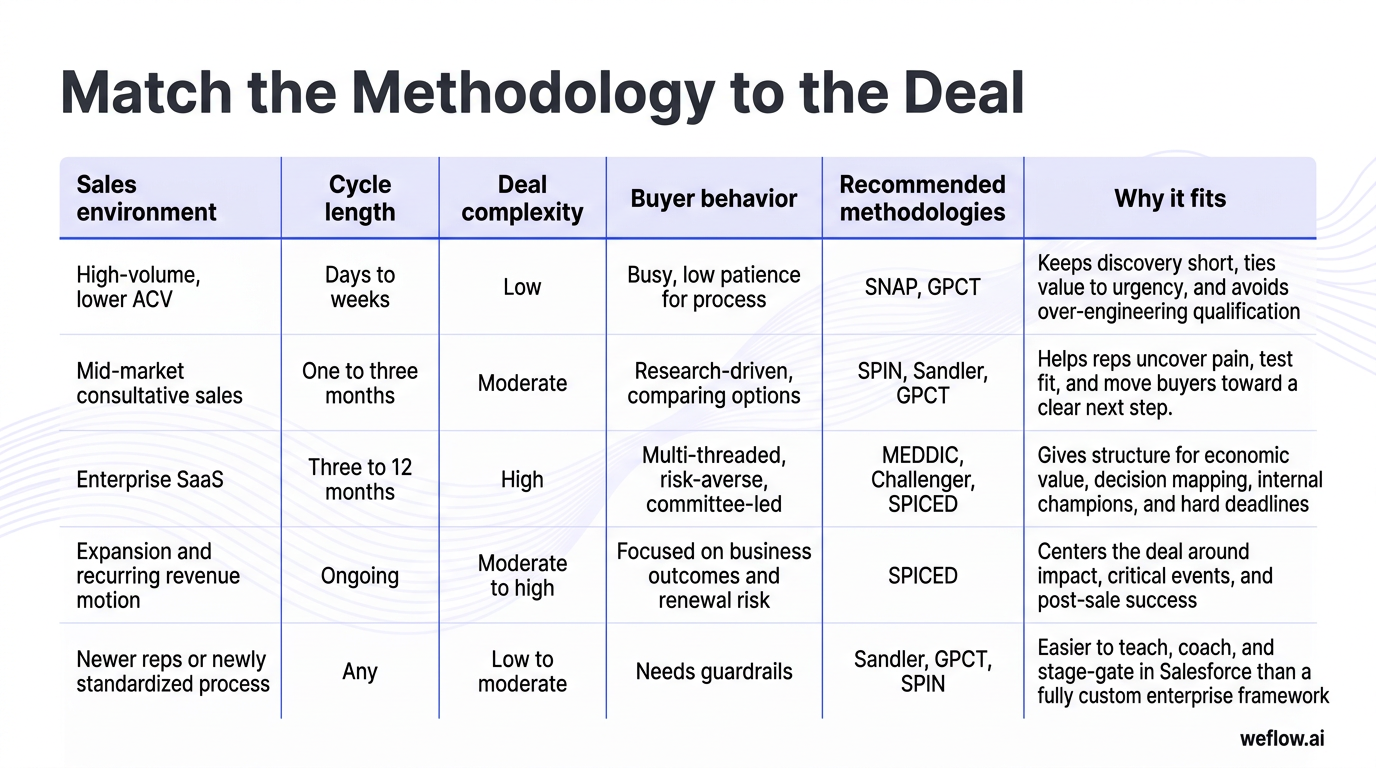
The best methodology depends on how your team sells: cycle length, number of stakeholders, buyer sophistication, and how much change the buyer needs to make internally. A transactional SMB motion and a six-month enterprise security review should not use the same qualification standard.
For RevOps leaders, the second decision matters just as much as the first: how the methodology gets embedded into Salesforce. If reps can skip the required fields, hide critical details in call notes, or advance stages without proof, the framework won’t reduce pipeline bloat. It will just create a new enablement artifact nobody follows.
| Sales environment | Cycle length | Deal complexity | Buyer behavior | Recommended methodologies | Why it fits |
|---|---|---|---|---|---|
| High-volume, lower ACV | Days to weeks | Low | Busy, low patience for process | SNAP, GPCT | Keeps discovery short, ties value to urgency, and avoids over-engineering qualification. |
| Mid-market consultative sales | One to three months | Moderate | Research-driven, comparing options | SPIN, Sandler, GPCT | Helps reps uncover pain, test fit, and move buyers toward a clear next step. |
| Enterprise SaaS | Three to 12 months | High | Multi-threaded, risk-averse, committee-led | MEDDIC, Challenger, SPICED | Gives structure for economic value, decision mapping, internal champions, and hard deadlines. |
| Expansion and recurring revenue motion | Ongoing | Moderate to high | Focused on business outcomes and renewal risk | SPICED | Centers the deal around impact, critical events, and post-sale success. |
| Newer reps or newly standardized process | Any | Low to moderate | Needs guardrails | Sandler, GPCT, SPIN | Easier to teach, coach, and stage-gate in Salesforce than a fully custom enterprise framework. |
Assess sales cycle length and buyer behavior
- If your deals close in days or a few weeks, use a lighter framework. Reps need enough structure to qualify fit and urgency, but not so much that the CRM turns into a questionnaire.
- If your deals run for months and involve Legal, Security, Finance, and an executive sponsor, use a framework that forces multi-threading and decision-process mapping. MEDDIC and SPICED usually fit better here.
- If buyers already know the category and are comparing vendors, SPIN or GPCT works well because the rep’s job is to sharpen the business case, not teach the entire market.
- If buyers are stuck in the status quo or thinking about the problem the wrong way, Challenger helps reps reframe the issue before they pitch.
- If your prospects are risk-averse and don’t want hard-sell tactics, Sandler gives reps a cleaner path to mutual qualification and early disqualification.
Most teams don’t use one framework in isolation. A common setup is Sandler or SPIN for discovery, MEDDIC for late-stage enterprise qualification, and SPICED for handoff into onboarding and Customer Success.
Configure CRM workflows for automated data capture
A methodology becomes real when it shows up in page layouts, validation rules, forecast logic, and manager inspection. That means mapping each step to Salesforce fields and reducing free-text updates wherever possible.
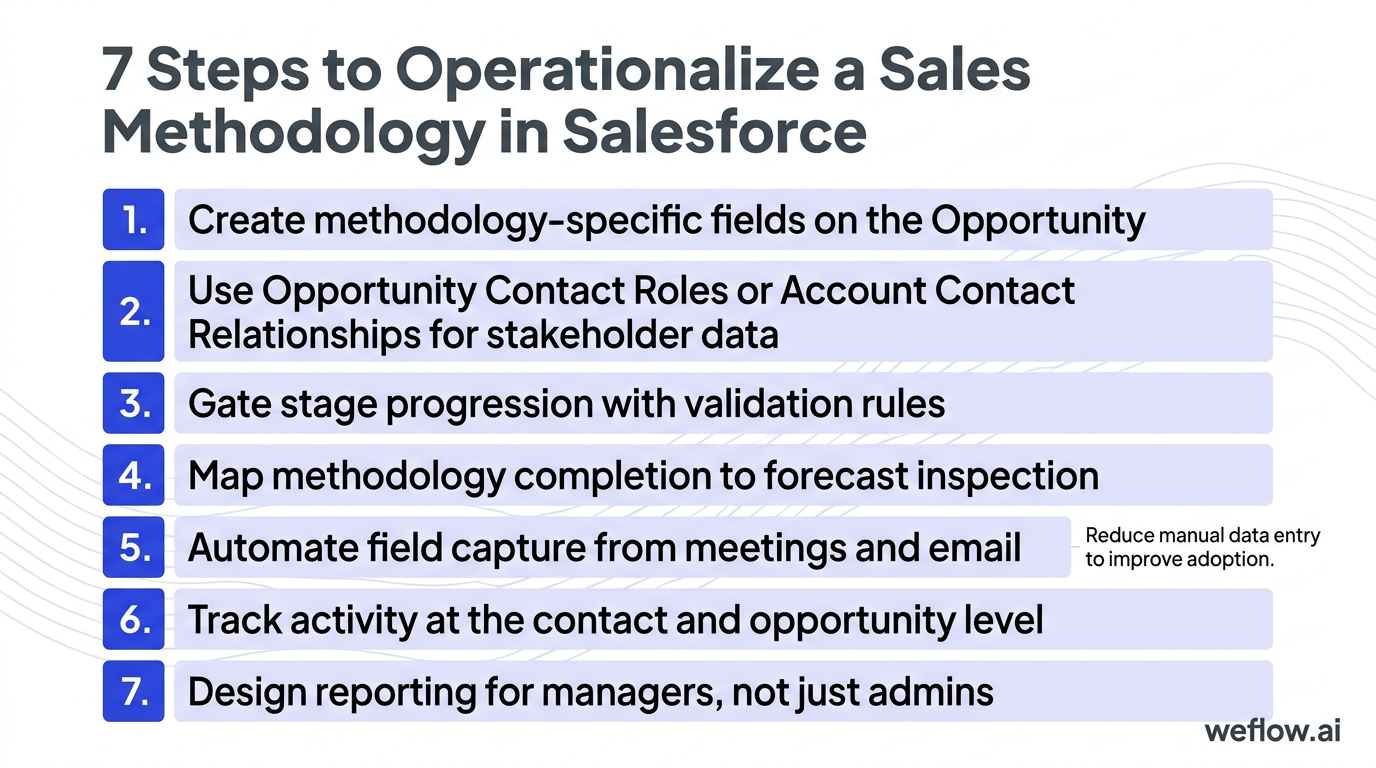
- Create methodology-specific fields on the Opportunity. Add fields for items like Economic Buyer, Decision Criteria, Champion, Critical Event Date, Pain Summary, or Need-Payoff. Use structured field types where possible—picklists, dates, lookup fields, and checkboxes—so reporting stays usable.
- Use the right Salesforce objects for stakeholder data. Store buying committee members in Opportunity Contact Roles or Account Contact Relationships instead of burying names in notes. If reps need to track multiple evaluators, sponsors, and blockers, that structure matters.
- Gate stage progression with validation rules. For example, don’t let an opportunity move to Proposal or Commit unless the Economic Buyer is identified, the next step is populated, and the Critical Event date is known. This is where methodology discipline starts to affect forecast accuracy.
- Map methodology completion to forecast inspection. Build reports that show missing qualification fields by stage, aging by methodology milestone, and pipeline value where required fields are blank. Pipeline coverage looks different when 30% of late-stage opportunities are missing a decision process.
- Automate field capture from meetings and email. If reps have to type every MEDDIC or SPICED note manually, adoption will drop. Weflow, a Salesforce-native revenue AI platform, can map conversation summaries to Salesforce fields with write-back, auto-capture emails and meetings, and keep activity completeness high without another tab.
- Track activity at the contact and opportunity level. For methodology coaching, you need more than a meeting count. You need to know whether the right people were engaged, whether follow-ups happened, and whether contact roles were added.
- Design reporting for managers, not just admins. A sales manager should be able to open one dashboard and see stage hygiene, missing qualification data, inactive late-stage deals, and commit opportunities with no executive sponsor.
Reducing manual data entry is the difference between theoretical adoption and actual adoption. Reps will follow the process more consistently when the CRM captures what happened in the call and asks them only to confirm or correct it.
This is also where many teams hit the limits of shallow Salesforce integrations. If you’re migrating from Gong or trying to make Gong fit a deeper qualification workflow, the common friction points are narrow field mapping, manual workarounds for Salesforce write-back, and activity gaps once you need data at the Opportunity Contact Role level. For RevOps teams, that turns a methodology rollout into an admin project. A Salesforce-native setup usually makes the migration a field-mapping and enablement exercise measured in weeks, not quarters—especially in Salesforce Enterprise and Unlimited editions.
One more point for Salesforce admins: Einstein Activity Capture can help with basic activity logging, but it wasn’t built to operationalize MEDDIC, SPICED, or custom qualification frameworks. If the goal is board-trusted reporting, you need activity data and qualification data written back in a way reporting, automation, and validation rules can use.
Drive process compliance through targeted coaching
Compliance doesn’t come from telling reps to “use MEDDIC.” It comes from stage definitions, manager inspection, and a coaching loop that turns methodology gaps into rep behavior change.
Start with mandatory qualification fields for stage progression. Then make those same fields part of weekly pipeline reviews and win-loss analysis. If a deal slips because the team never identified the economic buyer, that should show up in coaching, not just in the postmortem.
| 5-stage training framework | What it looks like |
|---|---|
| Learn | Workshops, enablement sessions, short playbooks, and field definitions inside Salesforce. |
| Practice | Role-plays, call shadowing, and deal mapping against live opportunities. |
| Apply | Managers coach on active deals, not hypothetical examples. |
| Reinforce | Weekly inspection, AI coaching prompts, and stage-based reminders. |
| Optimize | Review win rates, stage conversion, and forecast error rate by methodology completion. |
A light gamification layer can help without turning the process into theater. For example, you can reward reps whose late-stage opportunities have complete qualification records, clean contact roles, and no stale next steps. That reinforces data quality and coaching discipline at the same time.
MEDDIC framework: qualify complex enterprise deals
MEDDIC is one of the most established qualification frameworks for enterprise B2B sales. It helps teams narrow the pipeline to opportunities that have quantified value, a real buyer, a known decision path, and internal support.
PTC popularized MEDDIC in the 1990s, and the framework is closely tied to the company’s run from roughly $300 million to $1 billion in revenue over four years. That history is one reason MEDDIC remains dominant in SaaS and enterprise software: those deals live or die on internal approval, business value, and stakeholder management.
| Letter | Meaning | What to track in Salesforce |
|---|---|---|
| M | Metrics | Quantified ROI, cost reduction, time savings, revenue upside |
| E | Economic buyer | Executive owner, contact role, sponsor status |
| D | Decision criteria | Business, technical, security, and procurement requirements |
| D | Decision process | Approval path, paper process, legal review, target dates |
| I | Identify pain | Business problem, impact, risk of no decision |
| C | Champion | Internal advocate, influence level, access to decision-makers |
Quantify economic benefits and identify the buyer
The first two parts of MEDDIC do most of the qualification work. Metrics make the deal real. The economic buyer tells you whether the deal can move.
| MEDDIC step | Discovery questions |
|---|---|
| Metrics | What business outcome are you trying to improve? How do you measure it today? What would success look like in 6 or 12 months? What is the cost of staying with the current process? |
| Economic buyer | Who owns the budget for this initiative? Who carries the risk if this project fails? Who can approve spend without another layer of sign-off? Who else needs to agree before funds are released? |
Metrics are where reps turn a vague problem into a business case. “We need better visibility” is weak. “Managers spend eight hours a week chasing updates, and forecast error is running at 18%” is usable.
The economic buyer matters because plenty of deals look healthy while the rep is selling to an influencer. That person may love the solution, attend every demo, and still have no authority to release budget. MEDDIC cuts that risk early.
Map the decision process and connect with a champion
Once you know the deal matters, you need to know how it gets approved. MEDDIC usually breaks that into three routes:
- Technical route: integration requirements, security review, data model fit, SSO, field mapping, admin acceptance.
- Business route: budget ownership, ROI threshold, executive sponsorship, prioritization against other projects.
- Paper route: procurement, legal review, MSA, DPA, security forms, and signature flow.
This is also where teams confuse a coach with a champion. A coach gives you information. A champion uses their internal credibility to sell the project when you’re not in the room. In Salesforce terms, a champion is not just a populated contact field. It’s a stakeholder who advances the deal.
Challenger sales model: reframe buyer perspectives
Challenger is built for complex sales where the buyer has done research, formed an opinion, and may still be framing the problem incorrectly. The model assumes that relationship-building alone is not enough. Sometimes the rep needs to teach the buyer something they haven’t seen yet.
The model groups reps into five profiles:
- The Hard Worker—high effort, disciplined, persistent.
- The Lone Wolf—self-directed, confident, harder to coach.
- The Relationship Builder—trusted, supportive, consensus-oriented.
- The Problem Solver—responsive, detail-focused, service-minded.
- The Challenger—teaches, pushes constructively, and takes control of the conversation.
Challenger works best when the buyer is overwhelmed by options, stuck in legacy thinking, or underestimating the cost of inaction. It does not work when reps rely on surface-level research. Without deep industry knowledge, “challenging” just sounds like generic objection handling.
Debate industry challenges to shift prospect thinking
The first half of Challenger is about warming up and reframing the problem. Reps need customer conversations, industry publications, and competitive context before they try to shift the buyer’s view.
| Do this | Not that |
|---|---|
| Show the buyer why their current framing of the problem is too narrow. | Jump straight into a product demo. |
| Use data, customer patterns, and industry evidence to support the reframe. | State an opinion without proof. |
| Challenge the logic behind the current approach. | Challenge the buyer personally. |
| Explain the consequence of staying with the current model. | List features and hope the buyer connects the dots. |
A respectful reframe might sound like this: the buyer says they need better project management software, and the rep responds that the deeper issue is throughput, not coordination. The rep is not dismissing the buyer. The rep is widening the diagnosis before prescribing the solution.
Sell the future value proposition before the pitch
Challenger asks reps to create buy-in on the future state before they show the product. That means connecting the business problem to a better outcome the buyer can picture clearly.
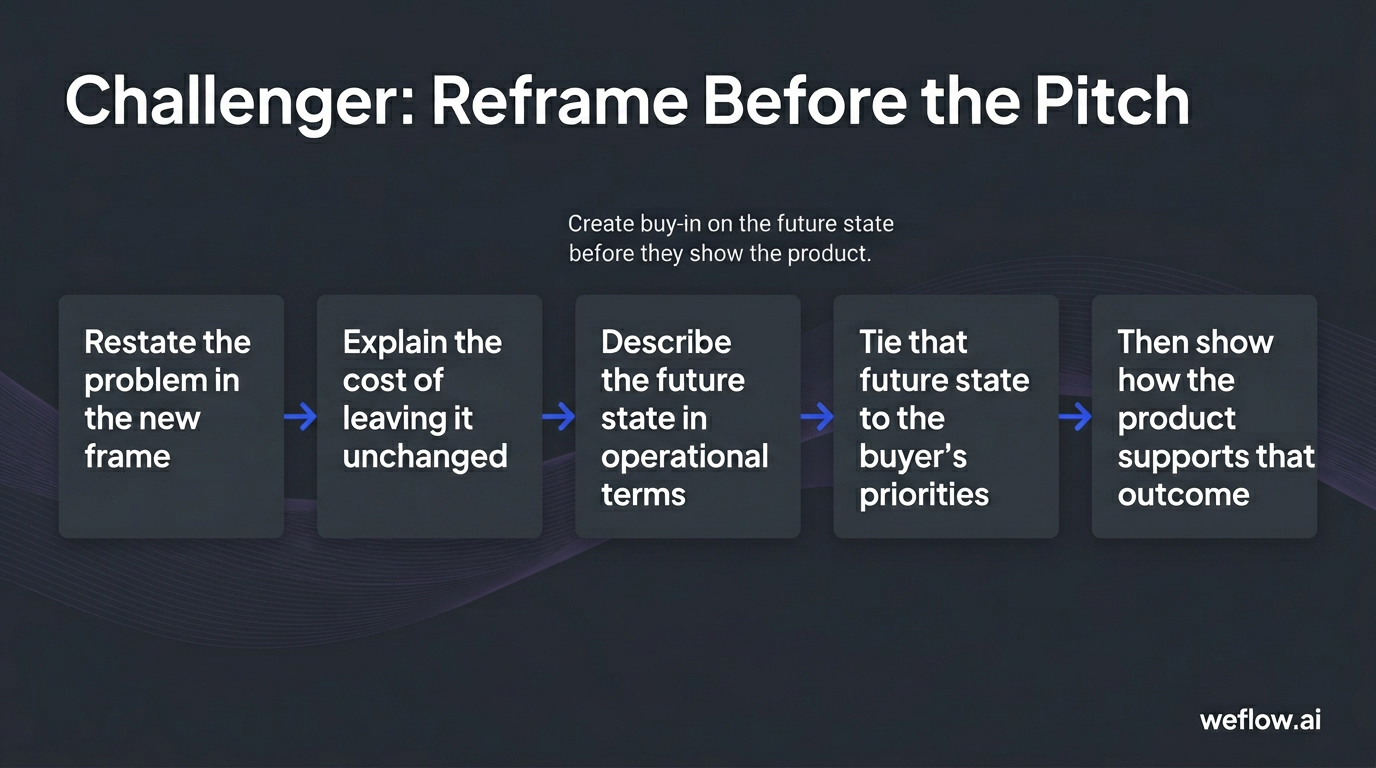
| Sample “Imagine the Future” flow |
|---|
| 1. Restate the problem in the new frame. 2. Explain the cost of leaving it unchanged. 3. Describe the future state in operational terms. 4. Tie that future state to the buyer’s priorities. 5. Then show how the product supports that outcome. |
Pitch features too early and the buyer mentally files you with every other vendor. The reframe works only if the product arrives after the buyer agrees the problem is different—or bigger—than they first thought.
Sandler selling system: build trust and uncover pain
Sandler is a mutual qualification system. It positions the rep as a trusted advisor, but it is not passive. The framework gives reps a way to build rapport, surface pain, discuss money early, and disqualify cleanly when the fit isn’t there.
The “submarine” analogy is useful because it explains why skipping steps hurts pipeline quality. If a rep moves forward without securing a compartment—pain, budget, or decision process—the deal floods later. What looked like forward movement was just hidden risk.
- Build rapport
- Upfront contracts
- Uncover pain
- Discuss budget
- Decision
- Solution
- Post-sell
Sandler works well as a foundational operating model for mid-market teams because it is teachable, coachable, and easy to stage-gate in Salesforce. It also pairs well with MEDDIC for larger deals where the team needs deeper late-stage qualification.
Establish upfront contracts to set meeting expectations
Upfront contracts are one of Sandler’s most practical ideas. They make the meeting objective explicit and give the buyer permission to say no. That saves time and reduces false-positive pipeline creation.
- Objective: Why are we meeting, and what does each side want from the conversation?
- Rep agenda: What will the rep cover, ask, or show?
- Buyer agenda: What does the buyer want addressed?
- Time: How long will the meeting take?
- Outcome: What happens next if there is fit—or if there isn’t?
That final point matters. When the buyer knows they can decline without pressure, the conversation gets more honest. For qualification, that’s better than a polite maybe.
Navigate the pain funnel to qualify the opportunity
The pain funnel starts broad and gets specific. First identify the problem, then probe the cause, then measure the impact. Reps who stop at surface pain end up selling features to symptoms.
- Can you walk me through what’s not working today?
- How long has this been a problem?
- What have you tried so far?
- What still breaks after those fixes?
- What does this issue cost in time, headcount, or missed targets?
- What happens if it stays unresolved for another two quarters?
- Who feels the pain most directly?
- What would have to be true for you to change the current approach?
Sandler also asks reps to discuss budget earlier than many teams find comfortable. That’s the point. If a rep can’t talk about money clearly and politely, the pipeline will fill with deals that were never financeable.
SPIN selling questions: guide buyers to their own solutions
Neil Rackham introduced SPIN in 1988, and it still holds up because it is built around disciplined questioning and active listening. SPIN gives reps four question types that match the buyer’s progression through discovery and evaluation.
It is the opposite of feature-dumping. Instead of starting with the product, the rep helps the buyer diagnose the problem, understand its consequences, and articulate the value of solving it.
| SPIN element | Meaning |
|---|---|
| Situation | Gather the background facts about the buyer’s current setup. |
| Problem | Uncover what is broken, inefficient, or risky. |
| Implication | Make the cost of the problem visible. |
| Need-payoff | Get the buyer to state the value of solving it. |
Investigate problems without pushing premature solutions
Situation and Problem questions should set context, not turn discovery into an intake form. Buyers expect reps to know basic facts already, so overloading the first call with company-background questions can make the rep sound unprepared.
| Situation questions | Problem questions |
|---|---|
| What tools are you using today? Who owns this process? How do you currently track the workflow? What is the target for this quarter? | Where does the current process break? What slows the team down? What happens when data is missing or late? Why hasn’t the current approach solved it? |
The handoff from Situation to Problem is where good reps separate themselves. They stop collecting facts once they have enough context and start digging into why those facts matter.
Demonstrate capability through implication and payoff
Implication questions make the problem hurt in operational terms. Need-payoff questions then get the buyer to describe what improves if the problem goes away.
- What does this issue cost your team each week?
- How does it affect your ability to hit plan?
- If the workflow were fixed, what would your managers spend time on instead?
- Would solving this make forecasting more reliable?
- How would it change handoffs across Sales, RevOps, and leadership?
- What would that mean for your own goals this year?
Rackham’s feature-advantage-benefit distinction is useful here. Features describe the product. Advantages explain why it’s better than an alternative. Benefits tie that capability to the buyer’s outcome. Need-payoff questions help the buyer state the benefit themselves, which is why they are so effective.
SNAP selling principles: win over frazzled customers
SNAP is built for buyers who are overloaded, distracted, and cautious about adding complexity. That maps closely to modern B2B buying committees, where each stakeholder has limited time and different concerns.
Jill Konrath’s point is simple: if the buying process feels confusing or expensive in time, buyers default to the status quo. That makes SNAP useful for teams selling into crowded categories or time-poor prospect groups.
- Access: Will the buyer even give you attention?
- Status quo: Will they decide change is worth the effort?
- Changing resources: Will they commit budget, people, and time to your solution?
Simplify the decision process to maintain buyer access
The first half of SNAP is about reducing friction. The buyer should understand quickly what you do, why it matters, and what the next step is.
- Keep meetings short and structured. Send an agenda, stay on it, and end with one clear next step.
- Limit the number of options. More options often create delay, not confidence.
- Use short content. A concise business case usually beats a long deck for first and second meetings.
- Act like an expert, not a persuader. Buyers trust insight more than pressure.
- Make implementation easy to understand. Complexity kills deals because it raises perceived risk.
If the buyer leaves confused, the status quo wins.
Align with business priorities to drive urgent action
The second half of SNAP is about alignment and prioritization. Reps need to know what matters to each stakeholder and what event might raise the urgency of change.
| Buyer’s Matrix component | What to capture |
|---|---|
| Role | Title, functional ownership, influence on the deal |
| Objectives | Team goals, KPIs, board targets, project ownership |
| Challenges | Internal blockers, external pressure, current process gaps |
| Status quo | Current tools, incumbent vendor, manual workaround, political constraints |
Trigger events are often what move a buyer from interest to action. Common examples include a funding round, new CRO or CIO, board pressure on forecast accuracy, a Salesforce cleanup initiative, post-merger system consolidation, or an upcoming renewal with an underperforming vendor.
GPCT framework: upgrade outdated BANT qualification
BANT was built for a different sales era. It starts with the seller’s constraints—budget and authority—and assumes decision-making is centralized and fixed. That is a poor fit for modern SaaS buying, where committees are common and budgets can be created when the business case is strong.
| BANT | GPCT |
|---|---|
| Starts with budget and authority | Starts with goals and current plans |
| Seller-first qualification | Buyer-first discovery |
| Assumes static budget | Treats budget as part of the business case |
| Works better for transactional motions | Works better for consultative SaaS sales |
| Weak on change drivers | Adds challenges, consequences, and implications |
Winner: GPCT is the better framework for modern B2B SaaS qualification.
The extended version—GPCTBA/C&I—stands for Goals, Plans, Challenges, Timeline, Budget, Authority, Negative Consequences, and Positive Implications. The order matters because it forces the rep to understand why the buyer would change before asking how they would buy.
Uncover long-term goals and current business plans
Goals and Plans are the front half of GPCT. They tell you what the buyer is trying to achieve and whether the current roadmap is good enough to get there.
- Goals: What needs to improve this quarter? What is the annual target? What would success look like 12 months from now?
- Goals: Which KPI is under pressure—revenue, cycle time, rep productivity, forecast accuracy, retention?
- Plans: What are you doing today to reach those targets?
- Plans: What tools, headcount, or process changes are already in flight?
- Plans: Where is the current plan falling short?
If the current plan is already working and the buyer is on track, there may not be a deal. GPCT helps reps find that out early instead of trying to force urgency where none exists.
Evaluate timelines and authority to secure commitment
The back half of GPCT gets more operational. Once the business case exists, the rep needs to test whether the deal can move on a real timeline with the right stakeholders involved.
- Timeline: Is there a fixed deadline tied to a project, quarter-end, system launch, or leadership commitment?
- Authority: Who is on the buying committee, and who can stop the deal?
- Budget: What return would justify investment, and where would funding come from?
- Negative consequences: What happens if the team misses the timeline or stays with the current process?
- Positive implications: What changes if the project succeeds?
The Negative Consequences step is where urgency becomes concrete. “We’d like this live by Q3” is soft. “If this is not live before Q3 planning, we miss the board reforecast and keep running with manual pipeline inspections” is real.
SPICED methodology: center deals on customer impact
SPICED was built for recurring revenue businesses where the sale is only the beginning. That makes it a strong fit for SaaS teams that care about adoption, renewals, expansion, and a cleaner handoff from Sales to Customer Success.
The framework stands for Situation, Pain, Impact, Critical Event, and Decision. Its core idea is that the deal should center on the customer’s desired impact, not just on closing the contract.
| SPICED element | Meaning |
|---|---|
| Situation | Who the customer is, what environment they operate in, and whether the account fits. |
| Pain | The root business problem driving change. |
| Impact | The result the customer wants if the problem is solved. |
| Critical Event | The hard business deadline driving the timeline. |
| Decision | The committee, process, and criteria required for approval. |
Diagnose the root pain to define the desired outcome
SPICED starts with diagnosis. That means separating the symptom from the real issue. A buyer might say they need better reporting, but the root pain may be low data completeness, poor Salesforce adoption, or a board-level forecast credibility problem.
| Rational impact | Emotional impact |
|---|---|
| Higher revenue, lower cost, faster ramp, better forecast accuracy, lower admin time, cleaner handoffs | Less stress, more credibility with leadership, internal recognition, confidence in board reporting, fewer fire drills |
That distinction matters because solving a symptom does not guarantee retention. Reps need to understand what outcome the company needs and what personal win the buyer is looking for. That creates a better sales process and a better post-sale plan.
Identify critical events driving the purchase timeline
Critical Events are one of SPICED’s strongest ideas because they keep teams from mistaking a preference for a deadline. “We want something by Q3” is not a Critical Event. “We need this live before Q3 planning, before a security audit, or before a CRM migration cutover” is.
- Why is that date important?
- What happens if you miss it?
- Who feels the impact if the timeline slips?
- Is this tied to a renewal, hiring plan, product launch, fiscal year boundary, or audit?
- What work has to happen backward from that date?
SPICED also creates a cleaner handoff across revenue teams. Marketing can align messaging around Situation, Pain, and Impact. Sales can qualify around Critical Event and Decision. Customer Success can use the same impact statement to drive adoption and renewal planning.
FAQ
Can a sales team use multiple methodologies at once?
Yes. Most mature teams use one framework for call structure and another for deal inspection. A common setup is Sandler or SPIN for discovery behavior, MEDDIC for late-stage enterprise qualification, and SPICED for handoff into onboarding and renewal planning. The key is not to make reps fill out three separate worksheets in Salesforce. RevOps should translate the overlap into one field model, one stage definition, and one inspection view for managers.
How do we enforce methodology compliance in our CRM?
Use three layers. First, create required Salesforce fields tied to stage progression through validation rules. Second, build manager dashboards that flag missing qualification data, stale next steps, and late-stage opportunities with weak activity completeness. Third, reduce manual work with AI notetakers that write meeting outcomes back to Salesforce fields. If reps still have to retype every discovery note after the call, compliance will drop. For teams replacing Gong because they need deeper Salesforce write-back and less manual cleanup, this is usually where the business case for migration becomes clear.
Which sales methodology is best for SaaS startups?
For subscription businesses, SPICED usually fits best because it ties the sale to customer impact and gives Customer Success a usable handoff. For inbound-heavy motions with shorter cycles, GPCT is often the better starting point because it helps reps qualify around goals, plans, and urgency without overcomplicating discovery. If the startup sells into enterprise accounts with six-figure ACVs, MEDDIC should enter the process as deal size and buying committee complexity increase.
What is the difference between MEDDIC and SPICED?
MEDDIC is primarily a qualification and risk-reduction framework for complex enterprise deals. It is strongest when the sales team needs to verify business value, find the economic buyer, map the decision process, and build a champion. SPICED starts earlier on customer impact and carries farther into post-sale success. That makes it more useful when the company cares about renewal, expansion, and cross-functional alignment after the contract is signed. If the question is enterprise qualification rigor, MEDDIC wins. If the question is long-term customer outcome alignment, SPICED wins.
.png)
-p-1600.png)
.webp)
.webp)