Customer-Centric Selling Checklist to Uncover Buyer Needs and Guide Better Decisions


Customer-centric selling starts before the call. If a rep shows up focused on quota, product slides, or getting to demo as fast as possible, the buyer will feel it.
This checklist gives you a better way to prepare and run discovery. It helps reps research the account, shift their mindset, and ask questions that surface real needs instead of collecting surface-level pain.
For sales leaders and RevOps teams, it also gives you a framework you can standardize across calls, coaching, and Salesforce stage criteria.
[banner type="download" url="https://www.weflow.ai/content/customer-centric-selling-checklist" text="Customer-Centric Selling Checklist" subtitle="Includes mindset checklist, discovery prompts, and customer-first qualification questions." button="Get checklist"]Sales mindset shifts: prioritize buyers to build trust
Goal: Prioritize the customer—not your bottom line.
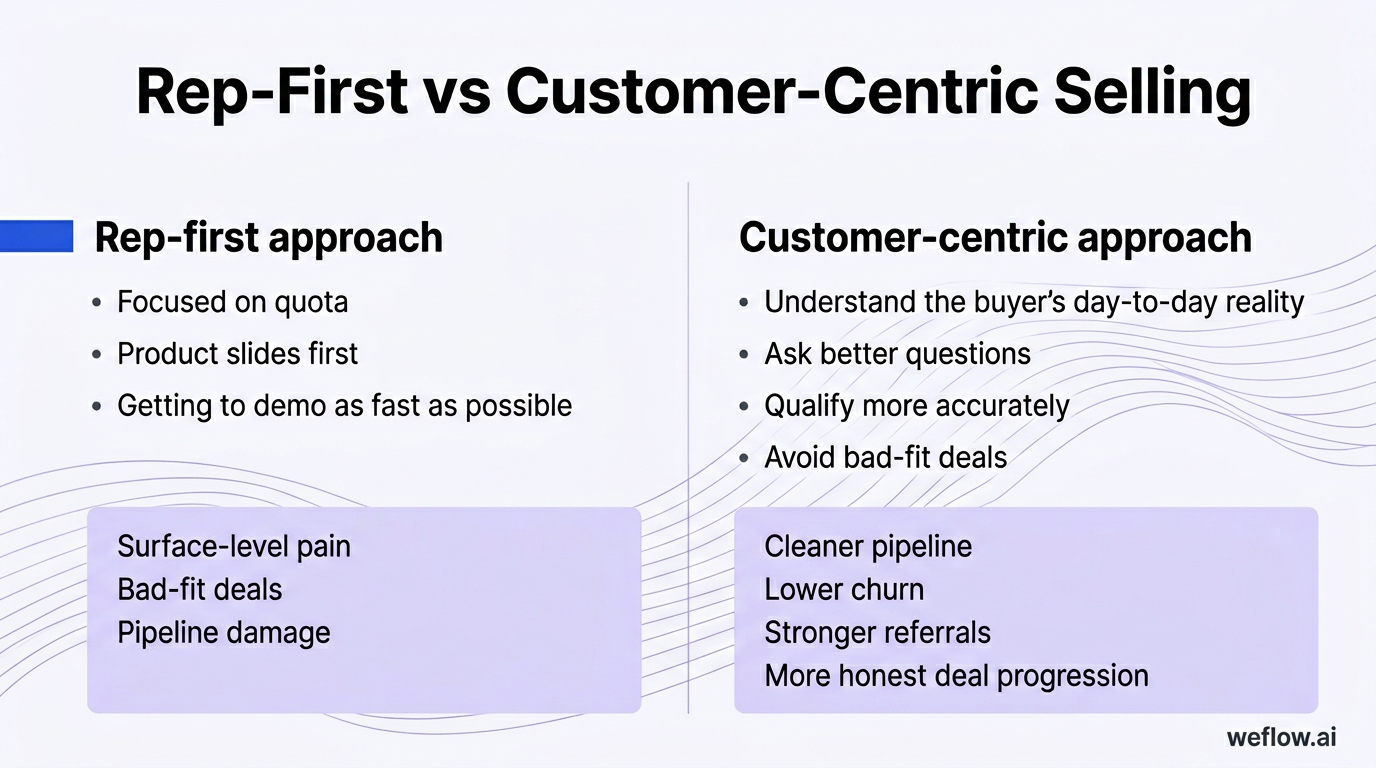
That sounds soft, but it has hard revenue consequences. Reps who understand the buyer's day-to-day reality ask better questions, qualify more accurately, avoid bad-fit deals, and build more trust with champions and buying committees.
Customer-first selling also improves long-term performance. You get cleaner pipeline, lower churn, stronger referrals, and more honest deal progression because the conversation is built around the buyer's problem, not the rep's timeline.
Evaluate your underlying selling motives
Before a rep sends the calendar invite or opens the call, they should pressure-test their own intent. If the real goal is to force a fit, discovery turns into confirmation bias.
- Am I trying to understand this buyer's situation, or am I trying to prove my product fits?
- Would I still give useful advice if this deal never closed?
- Am I willing to tell the buyer that another product, process, or service might be a better fit?
- Do I want the buyer to succeed after purchase, or do I mainly want this quarter's number?
- What assumptions have I already made about their problem before hearing them explain it?
Example: A rep pushes a bad-fit deal through because the prospect has budget and urgency. The deal closes, adoption stalls, the customer churns within two quarters, and the account becomes a cautionary story shared with peers. One forced win can create pipeline damage that lasts longer than the commission payout.
Commit to solving the actual problem
Customer-centric discovery works when reps try to learn how the buyer's world actually operates. That means understanding workflow, constraints, internal pressure, and what "better" looks like in practice—not jumping straight to feature mapping.
- Learn what the buyer's day looks like before recommending a solution.
- Look for process friction, not just stated pain points.
- Ask how the issue affects other teams, systems, or goals.
- Share relevant knowledge that helps the buyer evaluate options clearly.
- Stay open to the possibility that the right answer may not be your product.
If you want to ask about day-to-day work without sounding clinical, keep it simple. Questions like "Walk me through how your team handles this today," "Where does the process usually slow down?" and "What happens before this becomes a problem?" feel natural because they invite a story instead of a yes-or-no answer.
Pre-call research: uncover challenges before you speak
Good discovery starts with preparation. Reps should enter the call with a working view of the buyer's industry, company context, likely pressure points, and the language insiders use to describe them.
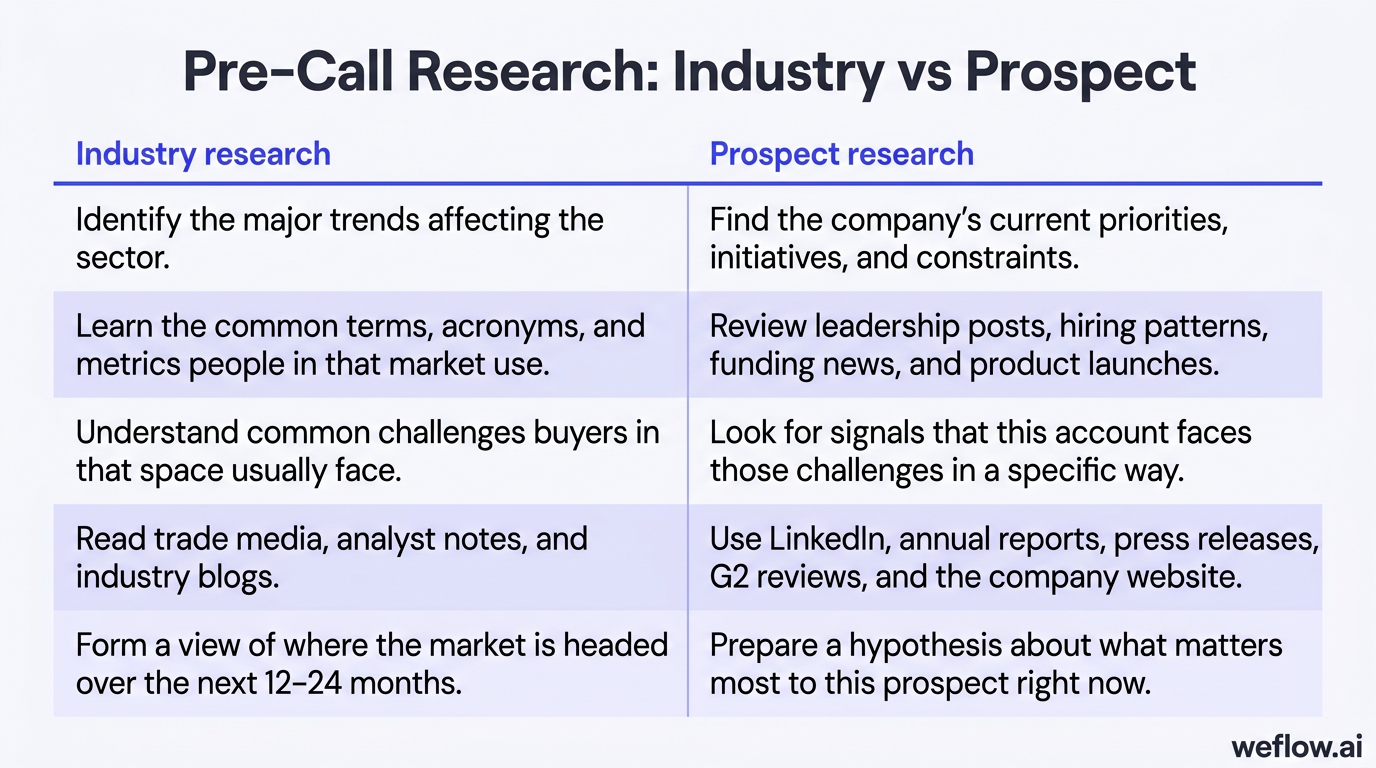
You don't need hours of research to do this well. LinkedIn, annual reports, earnings calls, company blogs, trade publications, G2 reviews, and competitor websites usually give enough signal to shape a stronger first conversation.
| Industry research | Prospect research |
|---|---|
| Identify the major trends affecting the sector. | Find the company's current priorities, initiatives, and constraints. |
| Learn the common terms, acronyms, and metrics people in that market use. | Review leadership posts, hiring patterns, funding news, and product launches. |
| Understand common challenges buyers in that space usually face. | Look for signals that this account faces those challenges in a specific way. |
| Read trade media, analyst notes, and industry blogs. | Use LinkedIn, annual reports, press releases, G2 reviews, and the company website. |
| Form a view of where the market is headed over the next 12–24 months. | Prepare a hypothesis about what matters most to this prospect right now. |
Map the broader industry landscape first
Start at the market level before narrowing into the account. That gives you context for what the buyer is likely measured on, what changes are creating pressure, and which words signal that you understand their environment.
- Read two or three recent trade publications or analyst summaries to spot the main trends.
- Write down the terms, acronyms, and metrics the market uses repeatedly.
- List the top three industry-wide challenges buyers in that sector are likely dealing with.
- Identify the main opportunities the market is chasing, such as expansion, efficiency, or margin improvement.
- Note what external changes could affect the industry next—regulation, consolidation, budget pressure, AI adoption, or shifts in buyer behavior.
Using the buyer's language matters because it lowers friction fast. When a prospect hears you describe their world with the right terminology, they spend less energy correcting you and more energy explaining what is actually happening.
Identify challenges unique to your prospect
Industry context gives you a starting point. Prospect research tells you where this company's version of the problem is different.
- Review the company's website for messaging changes, product focus, target segments, and customer proof.
- Check leadership interviews or LinkedIn posts for strategic priorities.
- Look at hiring trends to see where the business is investing or struggling.
- Read customer reviews to find repeated complaints, praise, or service gaps.
- Compare the company to close competitors to see where positioning differs.
- Build a short hypothesis about the account's likely constraints, timing, and upside.
The difference is simple: industry-wide problems affect nearly everyone in the category, while company-specific problems come from the prospect's strategy, maturity, team structure, systems, or market position. For example, "rising customer acquisition cost" might be a market issue, while "expansion into enterprise with an SMB sales process" is company-specific.
Discovery questions: reveal deep needs and drive decisions
The point of discovery is not to get through a script. It's to understand the problem well enough that the buyer feels heard, the rep can qualify accurately, and both sides can decide whether to keep moving.
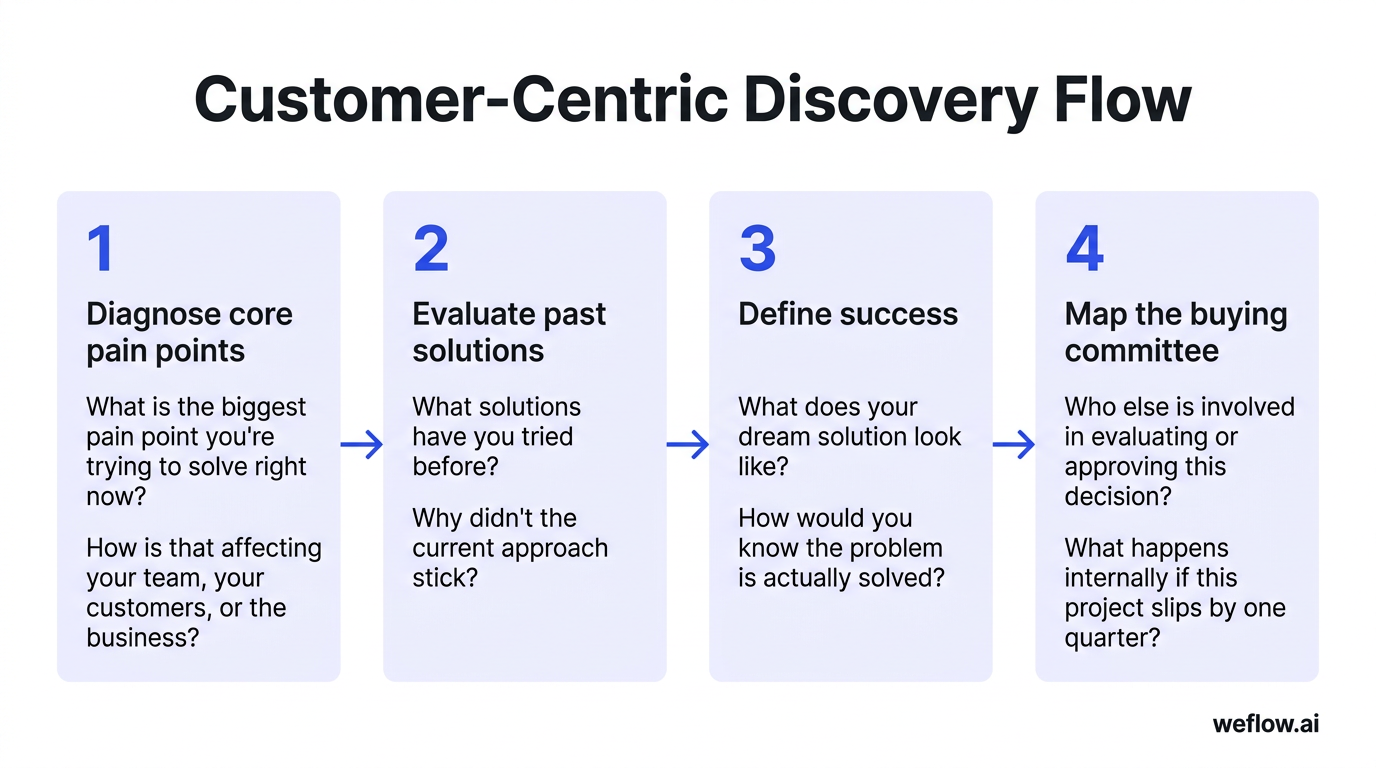
Use these questions as anchors, not a sequence you read word for word. Listen closely, follow the thread, and let the buyer's answers determine what comes next.
Diagnose the core business pain points
Start with the pain that created urgency. Then go one layer deeper into impact, unmet needs, and downstream consequences.
- What is the biggest pain point you're trying to solve right now?
- What needs are currently going unmet?
- How is that affecting your team, your customers, or the business?
- Where does the current process break down most often?
- How does this issue affect other parts of your day or other functions around you?
When the buyer gives an initial answer, don't move on too quickly. Follow-up prompts such as "Tell me more about that," "What happens when that slips?" and "How does that impact your team?" usually surface the cost of the problem, which is what creates urgency and budget.
Evaluate past solutions and failures
Most buyers have already tried something—another vendor, an internal workaround, a manual process, or no-change discipline from management. You need that history so you don't repeat the same failure pattern.
| Question area | What to learn |
|---|---|
| What solutions have you tried before? | Whether they used a vendor, built internally, or relied on process alone. |
| What did you expect those solutions to do? | The original buying criteria and success assumptions. |
| Where did they meet expectations? | The parts of the prior approach the buyer still values. |
| Where did they fall short? | The gaps, failure points, and risks your solution must address. |
| Why didn't the current approach stick? | Whether the root issue was adoption, fit, timing, budget, or internal alignment. |
This matters later in the call and during the demo. If you know exactly where prior tools or processes failed, you can position your product against those specific gaps instead of giving a generic pitch that sounds interchangeable with what they've already tried.
Define the ideal successful outcome
Once the pain is clear, help the buyer describe success in concrete terms. That moves the conversation from frustration to decision criteria.
- What does your dream solution look like?
- What outcomes matter most to you?
- What would a successful solution change for your team or business?
- How would you know the problem is actually solved?
- Which result matters most if you have to prioritize one?
These answers should shape the rest of your sales process. During the demo, tie your product back to the outcomes the buyer named in their own words—time saved, risk reduced, handoff improved, or revenue protected—not the list of features you planned to show before the call started.
Map the complete buying committee structure
Single-threaded deals are fragile. If your only contact goes quiet, changes roles, or loses internal support, the deal often stalls even when the problem is real.
- Who else is involved in evaluating or approving this decision?
- What does each stakeholder care about most?
- Do any of their goals differ from yours?
- Who will use the solution day to day, and who will measure success?
- What outside factors could change your needs or timeline?
- What happens internally if this project slips by one quarter?
This is the basis of multithreading: building relationships with more than one person in the account so the deal doesn't depend on a single champion. In modern B2B sales, that's not optional—it's risk control.
FAQ
What defines a customer-centric selling model?
A customer-centric selling model prioritizes solving the buyer's actual problem over pushing a product or rushing toward quota. The rep's job is to understand the buyer's context, help them evaluate options honestly, and recommend the right next step—even if that means no deal.
How do I research a prospect's industry?
Start with trade publications, analyst coverage, and competitor messaging to understand common terms, trends, and pressure points. Then set up Google Alerts for the company, review leadership interviews, and scan recent news so you can connect industry trends to the prospect's current situation.
Why should I recommend a competitor's product?
You should do it when your solution is clearly the wrong fit. Walking away from a bad-fit deal protects your reputation, prevents predictable churn, and often earns trust that brings the buyer back later when the need is better aligned.
What makes a good sales discovery question?
A good discovery question is open-ended, tied to business impact, and built to uncover why the problem matters now. It should help the buyer explain process, consequences, and decision criteria rather than invite a short answer the rep can't learn from.
.png)
-p-1600.png)
.webp)
.webp)