7 Sales Methodologies That Help Reps Qualify Better and Close More Deals [Cheat Sheet]


Sales methodologies are structured frameworks for qualifying leads, running better discovery, and guiding prospects toward a buying decision. When reps use them well, they waste less time on weak-fit deals and spend more time advancing opportunities that can actually close.
This guide breaks down seven of the most useful B2B sales frameworks—MEDDIC, Challenger, Sandler, SPIN, SNAP, GPCT, and SPICED. You’ll see how each one works, when to use it, and what questions reps should ask if they want to improve qualification, increase win rates, and give managers a cleaner view of pipeline quality.
[banner type="download" url="https://www.weflow.ai/content/sales-methodologies-book" text="The Book of Sales Methodologies" subtitle="Framework summaries and comparison checklists for MEDDIC, Challenger, Sandler, SPIN, SNAP, BANT/GPCT, SPICED." button="Download now"]MEDDIC framework: qualify B2B leads and increase close rates
MEDDIC is one of the clearest qualification frameworks in B2B sales. Its job is simple: narrow the pipeline to deals with a real path to close, then help reps build a business case around those deals.
The acronym stands for Metrics, Economic buyer, Decision criteria, decision process, Identify pain, and Champion. The framework came out of PTC in the 1990s and became well known because it gave sales teams a repeatable way to qualify large, complex software deals.
That discipline matters. Poor qualification doesn’t just lower close rates—it distorts pipeline coverage, wastes discovery time, and creates false forecast confidence. The upside of MEDDIC is that it forces reps to prove a deal is real before the team invests heavy solutioning, demo time, legal effort, and manager attention.
PTC example: PTC used MEDDIC as part of its sales operating model and reportedly grew revenue from $300 million to $1 billion in four years. The lesson isn’t that an acronym caused the growth. It’s that strict qualification gave the team a shared standard for what counted as a real opportunity.
One of the hardest habits for reps to build is disqualifying bad-fit leads early. But that’s where MEDDIC earns its keep. If a prospect can’t show measurable value, won’t introduce the economic buyer, or has no workable decision path, that deal usually gets stuck later anyway. Walking away early saves selling time, solution consultant time, and pipeline inspection time.
Qualify prospects using the six criteria
The six MEDDIC criteria work best in sequence. Each one sharpens the business case and makes the next one easier to uncover. Skip steps, and the deal often looks qualified in Salesforce while the buying process is still vague.
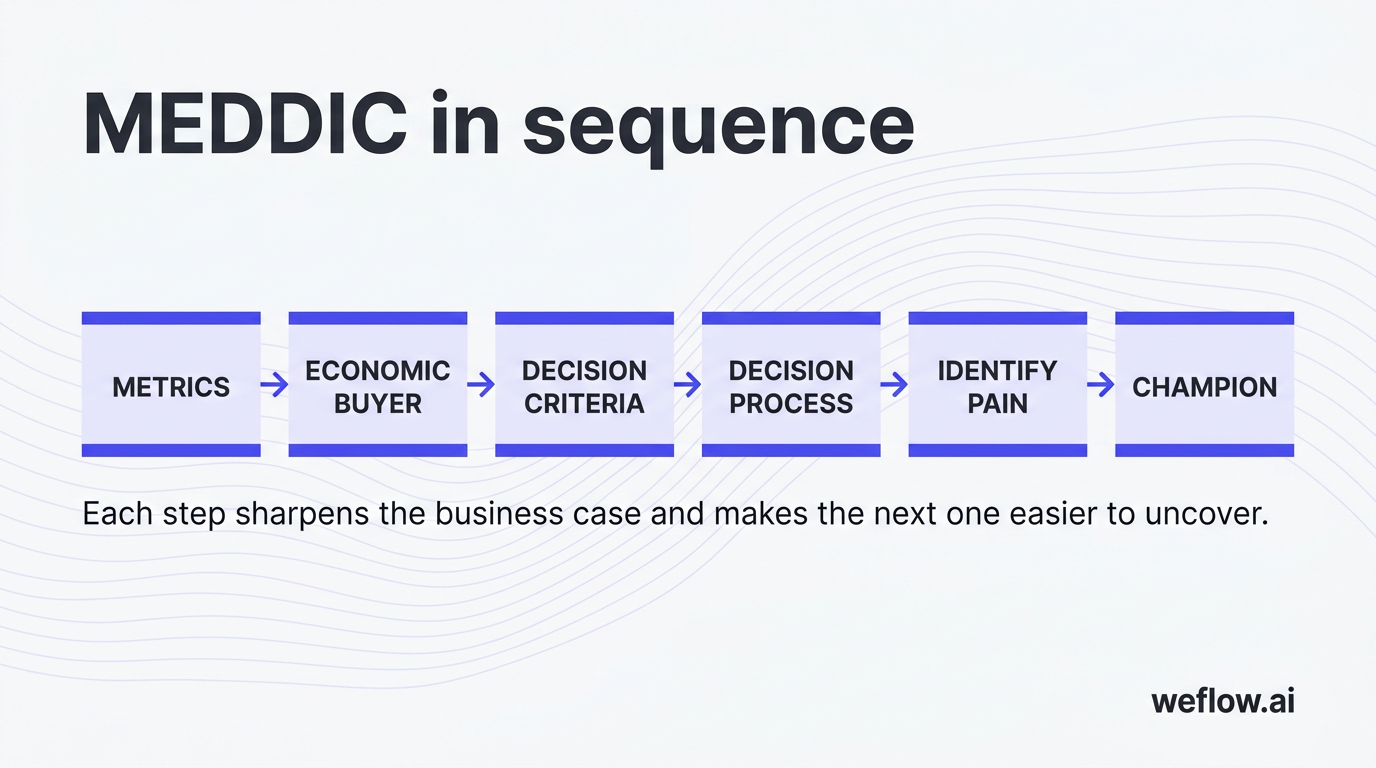
- Metrics — Quantify the business outcome the buyer wants. This could be revenue gained, costs reduced, cycle time cut, or risk avoided.
- Economic buyer — Identify the person who can approve the investment or strongly influence that approval.
- Decision criteria — Learn how the buyer will judge options. This usually includes technical fit, business value, implementation risk, and vendor support.
- Decision process — Map how the decision will actually happen, including security review, procurement, legal, executive sign-off, and timing.
- Identify pain — Get specific about the problem, its root cause, and the cost of leaving it unresolved.
- Champion — Find an internal person with influence, urgency, and a reason to help your deal move forward.
Ask the right questions for each stage
The best MEDDIC questions don’t sound like a checklist. They sound like a rep trying to understand how the buyer justifies change. The goal is to surface facts the prospect would use internally, not just facts the seller wants for a CRM field.
Pay close attention to pain quality here. A weak pain statement sounds like “we have some technical issues.” A strong pain statement sounds like “ABC Company will miss its year-end project deadline, which puts $50,000 in penalties and executive credibility at risk.” Strong pain is specific, measurable, and tied to consequences.
| MEDDIC stage | Example questions |
|---|---|
| Metrics | What business result are you trying to improve? How do you measure success today? If this problem were fixed, what would that be worth in dollars, hours, or headcount? |
| Economic buyer | Who owns the budget for this initiative? Who would need to believe the ROI case for this to move forward? Are you sponsoring this project, or should we involve someone else? |
| Decision criteria | What matters most in your evaluation—time to value, integration fit, cost, security, user adoption, or something else? How are you comparing vendors internally? |
| Decision process | What steps happen between shortlist and signature? Does this need procurement, legal, security, or executive approval? What can slow the process down on your side? |
| Identify pain | What’s not working in the current process? What happens if nothing changes this quarter? What’s the cost of delay for the team or the business? |
| Champion | Who feels this problem most day to day? Who would be willing to help build the case internally? What does that person stand to gain if this project succeeds? |
Challenger sales model: take control of complex buying cycles
The Challenger model flips a lot of classic sales advice on its head. Instead of treating the rep as a helpful guide who mostly responds to buyer questions, Challenger says the rep should teach, reframe, and push the buyer to see the problem differently.
That approach works best in complex sales—especially when the buyer has a partial diagnosis, too many stakeholders, or a weak understanding of what’s actually causing the problem. In those cases, passive relationship selling often keeps the conversation comfortable but doesn’t move the deal.
Verdict: In complex buying cycles, the Challenger beats the Relationship Builder because insight creates momentum faster than likability alone.
The model groups reps into five common profiles:
- The Hard Worker — dependable, persistent, and coachable.
- The Lone Wolf — self-directed and confident, but harder to standardize.
- The Relationship Builder — patient, supportive, and focused on trust.
- The Problem Solver — detail-oriented and reliable after the sale.
- The Challenger — comfortable teaching, debating assumptions, and steering the conversation.
The Relationship Builder usually struggles in complex sales because consensus deals rarely stall due to lack of friendliness. They stall because buyers can’t agree on the problem, the cost of inaction, or the path to change. Challengers do better when they can teach the buying group something useful that reshapes the decision.
Execute the five-step challenger process
The Challenger method needs judgment. Push too softly and nothing changes. Push too hard without proof and the rep sounds arrogant. The balance only works when the rep brings strong industry knowledge, customer patterns, and evidence.
-
Warm up with serious research
Before the first call, reps need a view of the account’s business model, market pressure, likely failure points, and current approach. A shallow LinkedIn scan won’t cut it.
Rep example: “We’re seeing companies in your segment miss margin targets because manual handoffs add approval delays. I’d like to test whether that’s happening in your process, too.”
-
Reframe the buyer’s current thinking
Once the rep understands the buyer’s initial diagnosis, they introduce a more accurate one. The goal isn’t to contradict for the sake of it. The goal is to show that the buyer’s current plan won’t solve the root problem.
Rep example: “Project management might help your team stay organized, but it probably won’t remove the workload that’s slowing output. The issue looks more like process automation than task visibility.”
-
Connect the insight to human stakes
Data gets attention. Personal stakes create urgency. Good Challenger reps tie the business problem to stress, missed goals, customer risk, or team burnout.
Rep example: “If the team keeps carrying this process manually, they’ll hit the same bottleneck next quarter with higher volume and less room for error.”
-
Sell the future state before the product
At this point, the rep paints the outcome. What changes if the buyer solves the problem the right way? What does the buyer gain operationally and personally?
Rep example: “If you remove that manual work, your team can absorb growth without adding headcount and leadership gets a more predictable operating rhythm.”
-
Pitch the product as proof of that future state
Only after the buyer accepts the new framing does the rep introduce the solution. The product pitch should feel like the natural next step, not a switch into vendor mode.
Rep example: “Here’s how our platform automates those handoffs, gives managers visibility, and cuts the lag you’ve been seeing between teams.”
Sandler selling system: build trust and surface deal-breakers
Sandler is a consultative methodology built around mutual trust, qualification, and clear expectations. It treats the rep less like a closer and more like an advisor who helps both sides decide whether there’s a real fit.
That’s a sharp contrast to the aggressive sales-floor model many teams copied in the 1980s and 1990s. In those environments, reps were pushed to control the call, overcome objections by force, and get to a close even when fit was shaky. Sandler rejects that. It favors honest qualification, direct budget conversations, and explicit next steps.
The framework breaks sales into three broad stages: Relationships, Qualification, and Closing. Inside those stages sits the “Sandler Submarine,” a seven-part sequence that helps reps move through a deal without letting hidden risk flood the next stage.
Sandler Submarine: Think of each sales stage like a compartment in a submarine. You secure one compartment before moving to the next. In practice, that means you don’t jump into demos, pricing, or proposals before you’ve confirmed pain, budget, decision path, and fit. That structure is why Sandler helps teams surface deal-breakers early instead of discovering them after a late-stage ghosting.
Implement the seven-step Sandler submarine
One of Sandler’s most useful ideas is the upfront contract—a simple agreement at the start of a meeting about purpose, timing, agenda, and next steps. It prevents the vague “great chat, we’ll circle back” ending that usually turns into silence.
-
Build rapport
- What were you hoping I could help you with?
- What motivated you to take this meeting now?
- What’s changed since you started looking at this area?
-
Set an upfront contract
- Can we use this meeting to understand your goals, current blockers, and whether a next step makes sense?
- We’ve got 30 minutes—does that still work?
- If we both think there’s a fit, should we leave with a defined next step?
-
Uncover pain
- What’s the biggest challenge in the current setup?
- How long has this been affecting the team?
- What happens if the problem stays in place for another six months?
-
Discuss budget
- How are you thinking about budget for this initiative?
- What are you spending today on the current approach?
- If the ROI case is strong, is there room to increase investment?
-
Secure the decision path
- Who else needs to weigh in before you can move forward?
- What does the approval process look like?
- What timeline are you working toward for a decision?
-
Present the solution
- Based on what you shared, here’s the part of our solution that addresses the gap.
- Have we covered the risks or constraints your team cares most about?
- What would a successful rollout look like on your side?
-
Post-sell
- What does your team need for a strong start?
- Who should be involved in onboarding?
- How should we define success in the first 30, 60, and 90 days?
SPIN selling methodology: uncover pain with targeted questions
SPIN Selling, introduced by Neil Rackham, is one of the most durable frameworks in B2B sales because it gives reps a simple rule: ask questions in the right order, listen closely, and let the buyer build the case for change.
The acronym stands for Situation, Problem, Implication, and Need-payoff. The seller’s role isn’t to rush to a pitch. It’s to diagnose what’s going on, deepen the buyer’s understanding of the problem, and connect that problem to a meaningful outcome.
Even though the framework is more than 30 years old, the core idea still fits modern digital sales. Buyers have more information than ever, but they still need help organizing it, interpreting it, and connecting it to an actual decision.
| Question type | Definition | Stage | Example |
|---|---|---|---|
| Situation | Questions that establish facts about the buyer’s current environment, tools, goals, and process. | Opening | What tools are you using today to manage this workflow? |
| Problem | Questions that uncover friction, gaps, and issues in the current state. | Investigating | Where does the current process break down most often? |
| Implication | Questions that expose the business cost of the problem and make urgency real. | Demonstrating capability | What happens to team output when that delay shows up every week? |
| Need-payoff | Questions that get the buyer to describe the value of solving the problem. | Obtaining commitment | If you fixed that bottleneck, what would it let your team do next? |
Master the four essential question types
SPIN works best when reps treat it as a conversational guide, not a rigid script. The point isn’t to force every call through the same wording. The point is to keep the buyer talking while the rep learns enough to move the deal forward.
-
Situation questions
- How is this process handled today?
- Who owns the workflow internally?
- What tools or vendors are involved right now?
-
Problem questions
- What’s frustrating about the current approach?
- Where do delays or errors happen most often?
- What have you tried already that didn’t solve it?
-
Implication questions
- How does that issue affect revenue, cost, or team capacity?
- What happens if the process stays the same through the next planning cycle?
- Does this create downstream risk for customers or leadership reporting?
-
Need-payoff questions
- What would improve if your team solved this by next quarter?
- How would a fix change priorities for you personally?
- Would that make it easier to hit the targets leadership cares about?
SNAP selling strategy: win deals with overwhelmed modern buyers
SNAP Selling, created by Jill Konrath, is built for a specific buyer reality: decision-makers are overloaded. They’re juggling too many tools, too much outreach, and too little time to evaluate every option carefully.
That environment creates what Konrath calls Frazzled Customer Syndrome. Buyers don’t ignore sellers because they hate buying. They ignore sellers because most outreach adds work instead of reducing it.
SNAP gives reps four rules for earning attention: Keep it Simple, Be Invaluable, Always Align, and Raise Priorities. Under that model, buyers also work through three decisions before they buy: whether to let you in, whether to move away from the status quo, and whether to commit resources to your solution.
- Frazzled Customer
- A buyer who is distracted, short on time, wary of complexity, and quick to ignore anything that feels vague or high-effort.
- Go Zone
- The point where your message feels relevant, simple, and worth engaging with, so the buyer responds instead of deleting it.
- D-Zone
- The place most outreach lands when it’s generic, too long, or disconnected from what the buyer cares about right now.
SNAP maps well to modern B2B software buying because most executives are flooded with software pitches that all sound similar. Reps win when they reduce friction, narrow the message, and make the next step easy to say yes to.
Apply the four basics of SNAP selling
The easiest way to put SNAP into practice is to treat each principle like a short checklist before every call, email, and demo. If your message fails one of these tests, it probably won’t land.
-
Keep it simple
- Lead with one problem, not five.
- Offer one clear next step.
- Cut long decks and overloaded demos.
- End every meeting with a confirmed follow-up plan.
-
Be invaluable
- Bring one useful insight the buyer didn’t already have.
- Use customer patterns, benchmarks, or data to support your point.
- Act like a peer with a point of view, not a script reader.
-
Always align
- Match your message to the buyer’s current goals, not your full product story.
- Adjust by stakeholder—finance, sales, IT, and operations won’t care about the same outcomes.
- Keep tying the conversation back to the business priority they named.
-
Raise priorities
- Show the gap between the status quo and the result the buyer wants.
- Use trigger events like hiring plans, board pressure, or a renewal deadline to create urgency.
- Make the cost of waiting easy to understand.
Konrath’s Buyer’s Matrix is useful here. It helps reps prepare by mapping each stakeholder’s role, goals, internal blockers, change drivers, and likely objections. Used well, it makes outreach more relevant without burying the buyer in detail. The point isn’t to know everything. It’s to know enough to make the next conversation feel immediately useful.
GPCT qualification: upgrade outdated BANT for modern consumers
BANT—Budget, Authority, Need, Timeline—still shows up in sales training, but it feels dated in most modern SaaS environments. It was built for a world with simpler buying committees, clearer budget ownership, and more transactional sales motions.
That’s why many teams moved to GPCTBA/C&I, HubSpot’s expanded framework for qualification. The acronym stands for Goals, Plans, Challenges, Timeline, Budget, Authority, Negative Consequences, and Positive Implications.
The shift matters because buyers rarely show up with a fixed budget and a single decision-maker. More often, they have a business problem, a rough plan, several stakeholders, and a budget that can move if the ROI case is strong enough.
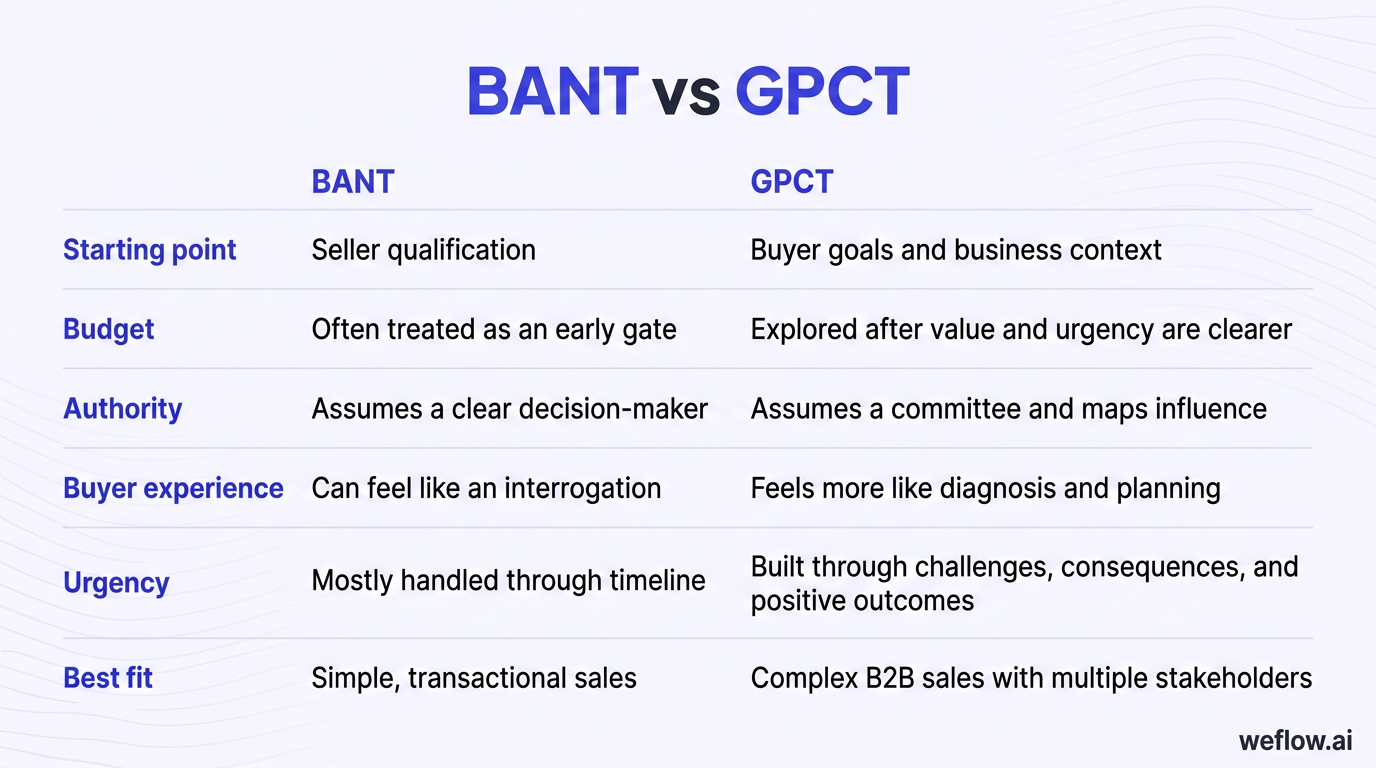
Verdict: For modern B2B SaaS qualification, GPCT beats BANT because it starts with buyer outcomes instead of seller checkboxes.
| Area | BANT | GPCT |
|---|---|---|
| Starting point | Seller qualification | Buyer goals and business context |
| Budget | Often treated as an early gate | Explored after value and urgency are clearer |
| Authority | Assumes a clear decision-maker | Assumes a committee and maps influence |
| Buyer experience | Can feel like an interrogation | Feels more like diagnosis and planning |
| Urgency | Mostly handled through timeline | Built through challenges, consequences, and positive outcomes |
| Best fit | Simple, transactional sales | Complex B2B sales with multiple stakeholders |
One of the biggest differences is how each framework treats budget. In subscription software, budget is rarely a clean yes or no at the first meeting. If the business case is strong, teams often reallocate spend, shift priorities, or replace existing tools. That’s why treating “no approved budget” as an automatic disqualifier can remove good deals too early.
Qualify leads using the GPCTBA/C&I method
-
Goals
- What are you trying to achieve this quarter or this year?
- How will leadership measure success?
-
Plans
- What’s your current plan for getting there?
- What have you already put in motion?
-
Challenges
- What’s getting in the way right now?
- Where has the current approach fallen short?
-
Timeline
- When do you need this solved?
- Is there a deadline or event driving that timing?
-
Budget
- How are you thinking about funding for this project?
- If the ROI case is clear, can budget move?
-
Authority
- Who else needs to be involved in the decision?
- Who signs off on spend at this level?
-
Negative consequences
- What happens if this problem doesn’t get solved?
- What risk does the business carry if the status quo stays in place?
-
Positive implications
- If you fix this, what improves for the team or the business?
- What does success unlock for you personally or for leadership?
The last two letters matter more than most reps realize. Consequences and implications are where the business case gets teeth. Without them, the deal stays in “nice to have” territory. With them, the buyer has language they can use internally to justify change.
SPICED sales framework: drive recurring revenue and renewals
SPICED, developed by Winning by Design, was built for SaaS and subscription revenue models where the job isn’t just to close a deal once. It’s to land the customer with the right expectations, create value early, and make expansion and renewal possible later.
The framework stands for Situation, Pain, Impact, Critical Event, and Decision. It pushes reps to go deeper than one-time close tactics by connecting discovery to long-term customer outcomes.
That’s why SPICED often works well across teams. Marketing can use it to sharpen messaging. Sales can use it on discovery calls. Customer Success can use it during handoff and onboarding to keep the account focused on the outcome that justified the purchase in the first place.
Quantitative vs. qualitative pain: Quantitative pain shows up in numbers—wasted spend, low conversion, missed capacity, slow ramp. Qualitative pain shows up in confidence, friction, reputation risk, burnout, or executive frustration. Good discovery captures both, because buyers usually justify purchases with numbers and remember them through emotion.
The most important letter in SPICED is often Critical Event. In subscription sales, urgency usually comes from a date, milestone, or deadline tied to business risk—a board meeting, annual planning cycle, contract renewal, audit, product launch, or hiring target. Without that event, deals drift.
Apply the five-step SPICED methodology
-
Situation
Map the current environment: team size, process, tools, ownership, and operating constraints.
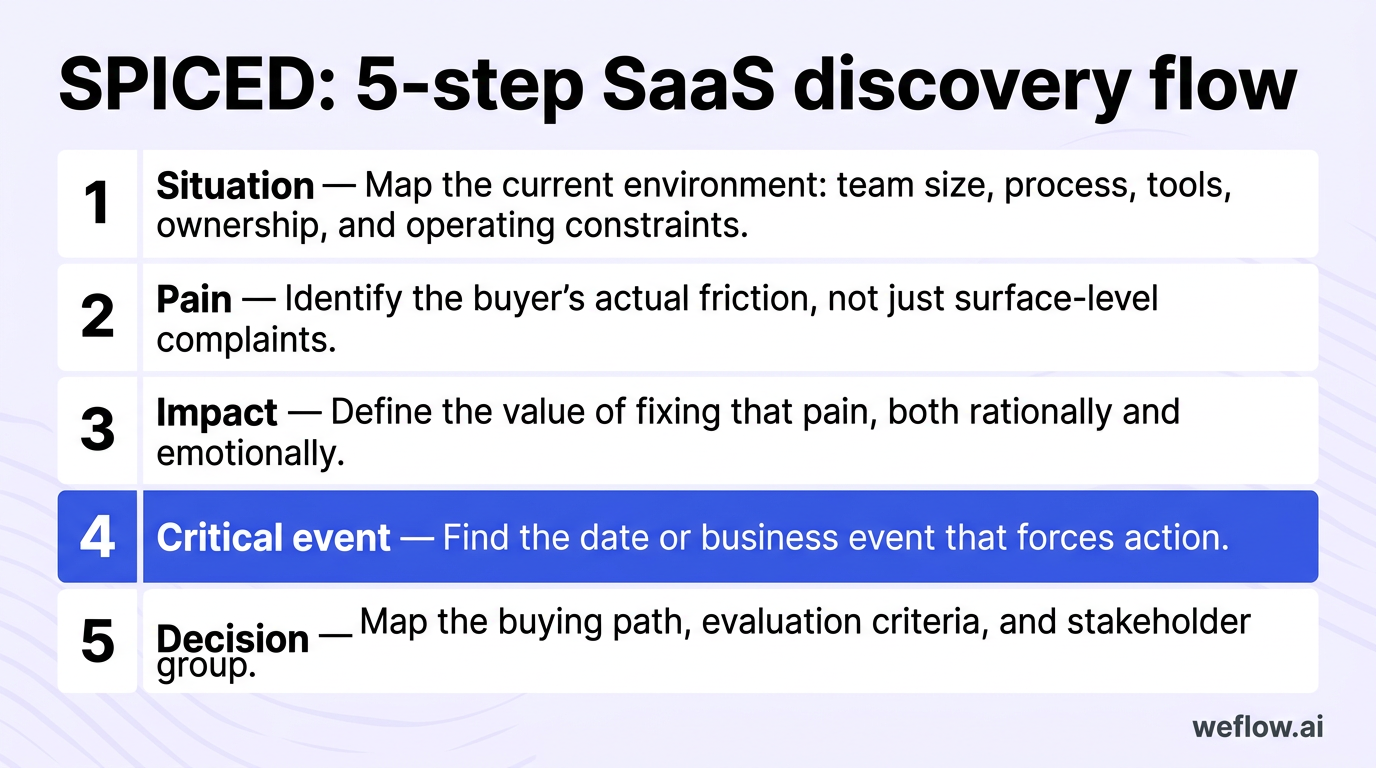
Scenario: A sales leader manages three regional teams, each using a different process and a separate reporting workflow.
-
Pain
Identify the buyer’s actual friction, not just surface-level complaints.
Scenario: Forecast calls take hours because managers can’t trust the underlying deal data, and reps update opportunities late.
-
Impact
Define the value of fixing that pain, both rationally and emotionally.
Scenario: Better visibility could cut forecast error, save manager time each week, and help the VP show cleaner numbers to the board.
-
Critical event
Find the date or business event that forces action.
Scenario: The company is entering annual planning in six weeks and needs a clean view of pipeline coverage before headcount decisions are finalized.
-
Decision
Map the buying path, evaluation criteria, and stakeholder group.
Scenario: Sales leadership owns the project, RevOps runs evaluation, IT reviews security, and finance signs off if the solution replaces two existing vendors.
SPICED is also useful after the deal. A well-documented SPICED record acts like a clean handoff document from Sales to Customer Success. Instead of starting from scratch, the post-sale team can see the customer’s situation, pain, expected impact, deadline, and decision logic in one place.
Methodology selection: combine frameworks for maximum impact
You don’t need to force one methodology across every deal and every rep motion. Most high-performing teams combine frameworks based on what problem they’re trying to solve.
A common setup looks like this: use MEDDIC or GPCT for qualification discipline, SPIN for discovery conversations, Challenger for insight-led selling in complex deals, and SPICED for cleaner handoffs in a recurring revenue model. Sandler helps when reps need stronger call control and expectation setting. SNAP helps when the buyer is overloaded and attention is the first hurdle.
The key is to treat methodologies like tools, not scripts. If reps memorize questions without listening, the framework becomes noise. If managers coach to the underlying logic—what pain sounds like, how urgency is built, what a real decision path looks like—the framework becomes useful.
If you’re choosing one for your team, start with your bottleneck. Are deals entering pipeline too early? Start with MEDDIC or GPCT. Are discovery calls shallow? Start with SPIN. Are late-stage deals stalling because buyers don’t agree on the problem? Add Challenger. Are handoffs weak and renewals hard to predict? Put SPICED in place.
Pick one framework to pilot for 30 days, review call recordings and stage progression, and inspect whether deal quality improves. The goal of any methodology is the same: help buyers make a better decision and help your team spend time on deals worth winning.
FAQ
What is the best sales methodology for B2B?
There isn’t one universal winner because the right framework depends on deal complexity, stakeholder count, and where your team struggles. MEDDIC is strong when qualification discipline is weak, Challenger works well in complex consensus deals, SNAP helps with overloaded executive buyers, and SPICED fits SaaS teams that care about renewals as much as closed-won revenue.
How do you choose the right sales methodology?
Start by auditing your sales cycle instead of copying what another team uses. Look at where deals stall: early discovery, qualification, budget alignment, committee consensus, or late-stage approval. Then choose the framework that addresses that exact bottleneck, train managers on the same language, and measure changes in stage conversion and win rate.
Can you combine different sales methodologies?
Yes—and most strong teams do. A practical mix is to use SPIN for front-line questioning, MEDDIC for opportunity qualification, and SPICED for internal deal reviews and post-sale handoff. The rule is simple: each framework should have a defined job, or reps end up juggling overlapping terms with no real process change.
Why is the BANT sales framework considered outdated?
BANT tends to break down in modern SaaS because it assumes buyers have fixed budgets, simple org charts, and transactional purchase behavior. Many B2B deals now involve multiple stakeholders, flexible budgets, and a longer internal case-building process. That makes outcome-first frameworks like GPCT more useful because they uncover goals, blockers, consequences, and urgency before treating budget as a pass-fail gate.
.png)
-p-1600.png)
.webp)
.webp)