10 B2B Sales Methodologies to Build Better Qualification and Forecast Accuracy [Cheat Sheet]


Most forecast problems start long before the forecast call. They start with inconsistent qualification, missing activity data, and opportunity stages that mean something different to every rep.
A sales methodology fixes that—if it lives inside Salesforce, not in a training deck. This guide covers how to choose the right framework for your motion, how 10 popular methodologies work, and how RevOps leaders can embed them into Salesforce to improve pipeline hygiene, data completeness, and forecast accuracy.
[banner type="download" url="https://www.weflow.ai/content/sales-methodology-cheat-sheet" text="B2B Sales Methodology & Frameworks Cheat Sheet" subtitle="Framework selection checklist, sales-cycle matching guide, and qualification method comparisons." button="Download now"]Methodology selection: match frameworks to your sales cycle
The right methodology gives reps a shared way to qualify, inspect, and advance deals. The wrong one adds friction—either by forcing enterprise-level rigor into a fast transactional motion, or by giving enterprise reps a lightweight framework that misses risk until late in the quarter.
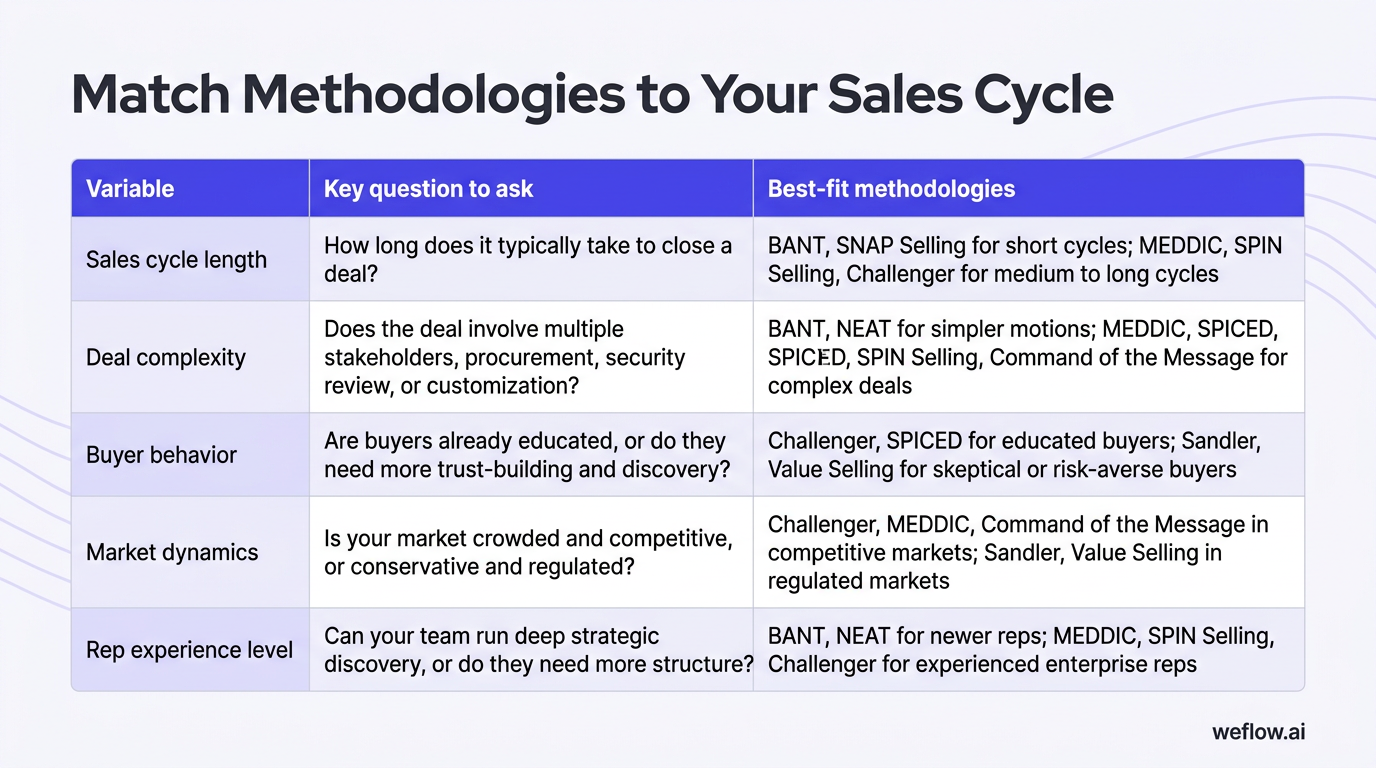
| Variable | Key question to ask | Best-fit methodologies |
|---|---|---|
| Sales cycle length | How long does it typically take to close a deal? | BANT, SNAP Selling for short cycles; MEDDIC, SPIN Selling, Challenger for medium to long cycles |
| Deal complexity | Does the deal involve multiple stakeholders, procurement, security review, or customization? | BANT, NEAT for simpler motions; MEDDIC, SPICED, SPIN Selling, Command of the Message for complex deals |
| Buyer behavior | Are buyers already educated, or do they need more trust-building and discovery? | Challenger, SPICED for educated buyers; Sandler, Value Selling for skeptical or risk-averse buyers |
| Market dynamics | Is your market crowded and competitive, or conservative and regulated? | Challenger, MEDDIC, Command of the Message in competitive markets; Sandler, Value Selling in regulated markets |
| Rep experience level | Can your team run deep strategic discovery, or do they need more structure? | BANT, NEAT for newer reps; MEDDIC, SPIN Selling, Challenger for experienced enterprise reps |
Methodology choice affects more than call structure. It affects which Salesforce fields you need, how stage gates should work, what managers coach to, and whether your forecast categories reflect real buyer progress or rep optimism.
Assess deal complexity and average sales cycle length
Sales cycle length and stakeholder count usually narrow the decision fast. If deals close in days or weeks, you need a lightweight framework. If deals run for quarters and involve finance, procurement, legal, and multiple business owners, you need deeper qualification.
- BANT fits short-cycle deals where reps need to confirm basic fit fast—budget, authority, need, and timeline.
- SNAP Selling works for high-volume, low-friction motions where the buyer values speed and simplicity.
- MEDDIC fits long enterprise cycles where one missing stakeholder or unclear decision process can stall a deal for 30 days.
- Challenger works when reps must build consensus across a buying committee, not just respond to an inbound request.
A transactional SaaS sale might involve one manager, one demo, and a close inside 14 days. A multi-year enterprise software deployment might involve an evaluator, a budget owner, security review, legal redlines, procurement, and regional approvers—two different motions, two different qualification needs.
Evaluate buyer behavior and market competitiveness
Buyer behavior matters as much as cycle length. Some buyers have already done the research and need a point of view. Others need proof, patience, and a lower-pressure discovery style before they’ll share real risk.
| Buyer state | Frameworks that usually fit best |
|---|---|
| Educated buyers in competitive markets | Challenger, SPICED, Command of the Message |
| Skeptical buyers in conservative or regulated markets | Sandler, Value Selling, SPIN Selling |
A highly aggressive approach often backfires in regulated industries like financial services, healthcare, or public sector sales. If the buyer’s main concern is risk reduction, auditability, and internal approval, a methodology built around pressure and control can create resistance instead of momentum.
Align frameworks with sales team experience levels
New reps usually need a framework that tells them what to ask, when to ask it, and what good looks like in Salesforce. Experienced enterprise reps can work inside more adaptive methodologies because they already know how to read political risk, expand discovery, and build a business case across stakeholders.
Manager tip: Don’t hand a new hire MEDDIC in week one and expect clean qualification data by week three. Start with a simpler structure like BANT or NEAT, coach discovery quality hard, then layer in more advanced criteria once the rep can consistently capture complete opportunity data in Salesforce.
Top 10 sales methodologies: frameworks that drive revenue
Below are 10 common B2B sales methodologies, what they’re built for, and how hard they are to operationalize. For RevOps leaders, the key question is not just which one sounds good in training—it’s which one can be translated into repeatable fields, stage gates, and coaching motions in Salesforce.
Qualify fast transactional deals with BANT
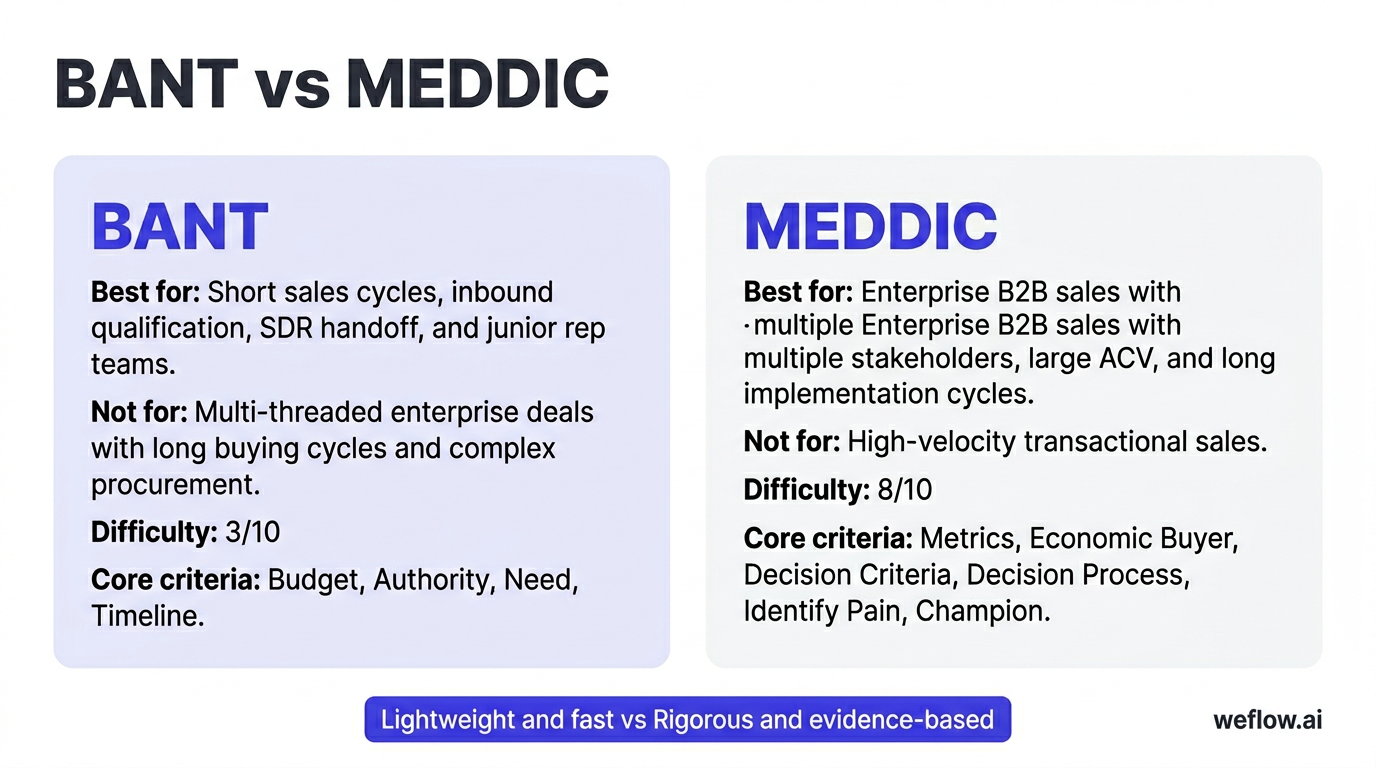
- Best for: Short sales cycles, inbound qualification, SDR handoff, and junior rep teams
- Not for: Multi-threaded enterprise deals with long buying cycles and complex procurement
- Difficulty: 3/10
BANT is one of the oldest qualification frameworks because it’s simple and fast. That simplicity is the strength—and the limitation.
- B — Budget: Is there money allocated, or a realistic path to funding? Discovery question: “Has budget already been set aside for this project?”
- A — Authority: Are you talking to the person who can approve the purchase, or to an evaluator? Discovery question: “Who has final sign-off on this decision?”
- N — Need: Is there a clear problem worth solving? Discovery question: “What problem are you trying to fix right now?”
- T — Timeline: Is there a real buying window, or just light interest? Discovery question: “When do you need a solution in place?”
BANT works well when speed matters more than deep diagnosis. It breaks down when reps ask about budget too early, before they’ve built enough business context to justify the spend.
Qualify complex enterprise deals with MEDDIC
- Best for: Enterprise B2B sales with multiple stakeholders, large ACV, and long implementation cycles
- Not for: High-velocity transactional sales
- Difficulty: 8/10
MEDDIC is built for rigorous qualification. It forces reps to prove deal quality with evidence, not confidence.
- M — Metrics: What measurable business outcome will this deal improve? Core question: “What specific business results are you trying to drive, and how are they measured today?”
- E — Economic Buyer: Who owns budget and final approval? Core question: “Who ultimately signs off on the investment?”
- D — Decision Criteria: How will the buyer compare options? Core question: “What criteria will you use to evaluate solutions?”
- D — Decision Process: What steps must happen to get to signature? Core question: “What internal steps and approvals are required before a decision is made?”
- I — Identify Pain: What problem is painful enough to justify change? Core question: “What happens if this problem remains unsolved?”
- C — Champion: Who will sell on your behalf when you’re not in the room? Core question: “Who has the most to gain from solving this, and will advocate internally?”
For highly competitive enterprise deals, MEDDPICC adds two more layers: Paper Process and Competitor. That variation is useful when legal, procurement, and active competitive pressure regularly affect forecast outcomes.
Uncover customer impact using the SPICED framework
- Best for: SaaS and recurring revenue motions where business impact and timing matter
- Not for: One-call transactional deals with minimal discovery
- Difficulty: 7/10
SPICED is popular in recurring revenue businesses because it ties discovery to measurable outcomes and timing. It also maps well to manager inspection because each element can be captured as a distinct Salesforce field.
- S — Situation: What does the current setup look like? Core question: “How are you handling this today?”
- P — Pain: What friction is blocking results? Core question: “Where is the current approach breaking down?”
- I — Impact: What business outcome does that pain affect? Core question: “How is this issue affecting revenue, cost, time, or risk?”
- C — Critical Event: What deadline or trigger creates urgency? Core question: “What date, event, or milestone makes this a priority now?”
- E — Decision Criteria: What matters most in evaluation? Core question: “What will matter most when your team compares solutions?”
- D — Decision Process: How will the decision actually get made? Core question: “What steps need to happen internally to move this forward?”
The Critical Event is often the difference between a deal that closes and a deal that lingers in best case for six weeks. In SaaS, urgency usually comes from a contract renewal, board date, headcount ramp, territory planning cycle, or a failed manual process—not from generic interest.
Diagnose deep buyer pain points with SPIN Selling
- Best for: Consultative selling, multi-stakeholder discovery, and deals where problem diagnosis matters
- Not for: Short transactional motions with low discovery depth
- Difficulty: 6/10
SPIN Selling gives reps a questioning sequence that moves from facts to consequences to value. It’s especially useful for teams that need better discovery quality, not just tighter qualification.
- S — Situation: Understand the current environment. Core question: “Can you walk me through your current process today?”
- P — Problem: Find what isn’t working. Core question: “What challenges are you running into with that process?”
- I — Implication: Expand the business cost of the problem. Core question: “What does that issue cause downstream for the team or the business?”
- N — Need-Payoff: Get the buyer to describe the value of change. Core question: “If you solved this, what would improve?”
The Implication stage is what prevents deals from stalling. Once the buyer has stated the cost of doing nothing in their own words, it becomes harder for the opportunity to slip back into low-priority status.
Position measurable outcomes via Command of the Message
- Best for: Enterprise sales teams that need a consistent value story across reps and segments
- Not for: Feature-led transactional sales with little customization
- Difficulty: 9/10
Command of the Message is not an acronym. It’s a messaging framework designed to stop reps from leading with product features and getting commoditized.
- Customer Value: Tie the conversation to the buyer’s business objectives. Core question: “What business outcome matters most here?”
- Differentiation: Show why your approach is meaningfully different. Core question: “Why is our approach a better fit than the alternatives?”
- Proof: Support the value claim with evidence. Core question: “What proof can we show that this outcome is achievable?”
- Economic Impact: Translate value into financial terms. Core question: “What revenue gain, cost reduction, or risk reduction does this create?”
- Decision Process: Make sure value can turn into a buying motion. Core question: “What approvals and stakeholders need to align before purchase?”
This framework works best when product marketing, sales enablement, and sales management all coach to the same economic narrative. If each rep tells a different story, the framework usually collapses into generic talk tracks.
Reshape buyer thinking through the Challenger Sale
- Best for: Competitive markets where reps need to teach and differentiate, not just respond
- Not for: Highly transactional environments or teams without strong industry fluency
- Difficulty: 9/10
Challenger works by changing how the buyer thinks about a problem, not by waiting for the buyer to define it perfectly first.
- Teach: Bring a point of view the buyer didn’t have. Core question: “What business problem is the customer underestimating?”
- Tailor: Adapt that insight to the role, segment, and company context. Core question: “How does this issue show up differently for this buyer?”
- Take Control: Push the deal toward a decision with authority. Core question: “What next step should happen now to keep this issue from staying unresolved?”
This methodology requires strong industry knowledge and good messaging discipline. It is rarely a fit for low-ACV, one-call closes where speed matters more than buyer reframing.
Build consultative trust with the Sandler System
- Best for: Consultative B2B sales where trust, mutual qualification, and objection prevention matter
- Not for: Very short sales cycles with limited discovery time
- Difficulty: 7/10
Sandler focuses on balanced conversations and mutual qualification. Instead of chasing every prospect, reps test whether both sides should move forward.
- Bonding and Rapport: Establish trust. Core question: “What prompted you to take this meeting?”
- Up-Front Contracts: Set expectations for the conversation. Core question: “Can we agree on what we want to accomplish in this meeting?”
- Pain: Find the deeper issue, not just the surface symptom. Core question: “What’s preventing you from hitting your goals?”
- Budget: Confirm financial viability. Core question: “What level of investment would be realistic for solving this?”
- Decision: Clarify who decides and how. Core question: “How does your team typically make a purchase like this?”
- Fulfillment: Present the solution against the stated pain. Core question: “If we solve the issues you raised, would that meet the need?”
- Post-Sell: Surface remaining concerns before they kill the deal later. Core question: “What objections or roadblocks could still come up?”
The Up-Front Contract is one of the most practical parts of Sandler. Clear meeting expectations reduce ghosting, improve next-step discipline, and make rep follow-up less reactive.
Bridge current and future states using GAP Selling
- Best for: Deals where the rep must diagnose the current state, future state, and cost of staying put
- Not for: Fast transactional motions with little room for diagnosis
- Difficulty: 8/10
GAP Selling focuses on the distance between where the buyer is today and where they need to be. Many teams teach it as GAPS because the framework includes Solution as the final step.
- G — Goal: Define the future state. Core question: “What specific result are you trying to achieve?”
- A — Acid Test: Validate urgency with real consequences. Core question: “What does it cost the business if this doesn’t get fixed?”
- P — Problem: Diagnose what is blocking the goal. Core question: “What issues are stopping you from reaching that result?”
- S — Solution: Connect the fix to business impact. Core question: “If you solved this gap, what would change operationally or financially?”
The Acid Test is the real filter. It forces the rep to confirm whether the pain is meaningful enough to justify internal effort, budget, and political capital. Without that test, many deals look active but never become urgent.
Map economic impact and timelines with NEAT Selling
- Best for: Mid-market and enterprise B2B sales teams that want more depth than BANT without the weight of MEDDIC
- Not for: Very short, low-value deals where quick qualification matters more than quantified impact
- Difficulty: 6/10
NEAT is often positioned as a modern alternative to BANT because it replaces early budget questions with business impact. For most mid-market SaaS teams, NEAT is the better fit than BANT.
- N — Need: Confirm the underlying problem. Core question: “What business challenge are you trying to solve?”
- E — Economic Impact: Quantify the business effect. Core question: “What financial or operational impact would solving this have?”
- A — Authority: Identify the decision group. Core question: “Who else is involved in approving this?”
- T — Timeline: Understand timing and priority. Core question: “What is your target timing for a decision or rollout?”
The advantage over BANT is simple: buyers often won’t disclose a fixed budget early, but they will talk about cost, waste, delay, missed revenue, or team capacity. That makes Economic Impact easier to capture in discovery and more useful later in the forecast.
Demonstrate tangible ROI through Value Selling
- Best for: Complex solutions that require a clear business case and ROI narrative
- Not for: Price-first transactional sales
- Difficulty: 7/10
Value Selling can look intimidating because the acronym is long. It becomes easier to use when you group it into phases instead of treating it like 11 unrelated checkpoints.
Phase one: discovery and problem framing
- V — Vision: What future state does the buyer want? Core question: “What are your long-term goals here?”
- A — Analysis: What is blocking that future state? Core question: “What is stopping you from getting there today?”
- L — Leverage: Why does fixing it matter? Core question: “What changes if this problem gets solved?”
- U — Urgency: Why act now? Core question: “What happens if this stays unresolved?”
Phase two: proof and fit
- E — Evidence: What proof supports the claim? Core question: “What examples or results can validate this outcome?”
- S — Solution: How does your offer fit the need? Core question: “How would this solution help you reach the result you want?”
- E — Evaluate: How will the buyer assess options? Core question: “What criteria will your team use to compare solutions?”
Phase three: business case and commitment
- L — Leverage: What matters most in the proposed solution? Core question: “Which capabilities will have the biggest effect for your team?”
- I — Impact: What measurable gain should the buyer expect? Core question: “What ROI or business result would make this successful?”
- N — Need: Does the buyer agree the solution fits? Core question: “Do you believe this approach addresses the need we defined?”
- G — Gain: What lasting benefit does the organization get? Core question: “How will the business benefit in the short and long term?”
Value Selling is useful when finance scrutiny is high and the rep needs more than a pain story. It gives teams a structure for building an ROI case that stands up in executive review.
CRM methodology integration: automate data and compliance
A methodology only works if it lives in Salesforce. If the framework exists only in call notes, manager memory, or a quarterly enablement deck, it won’t improve data completeness, pipeline inspection, or forecast reliability.
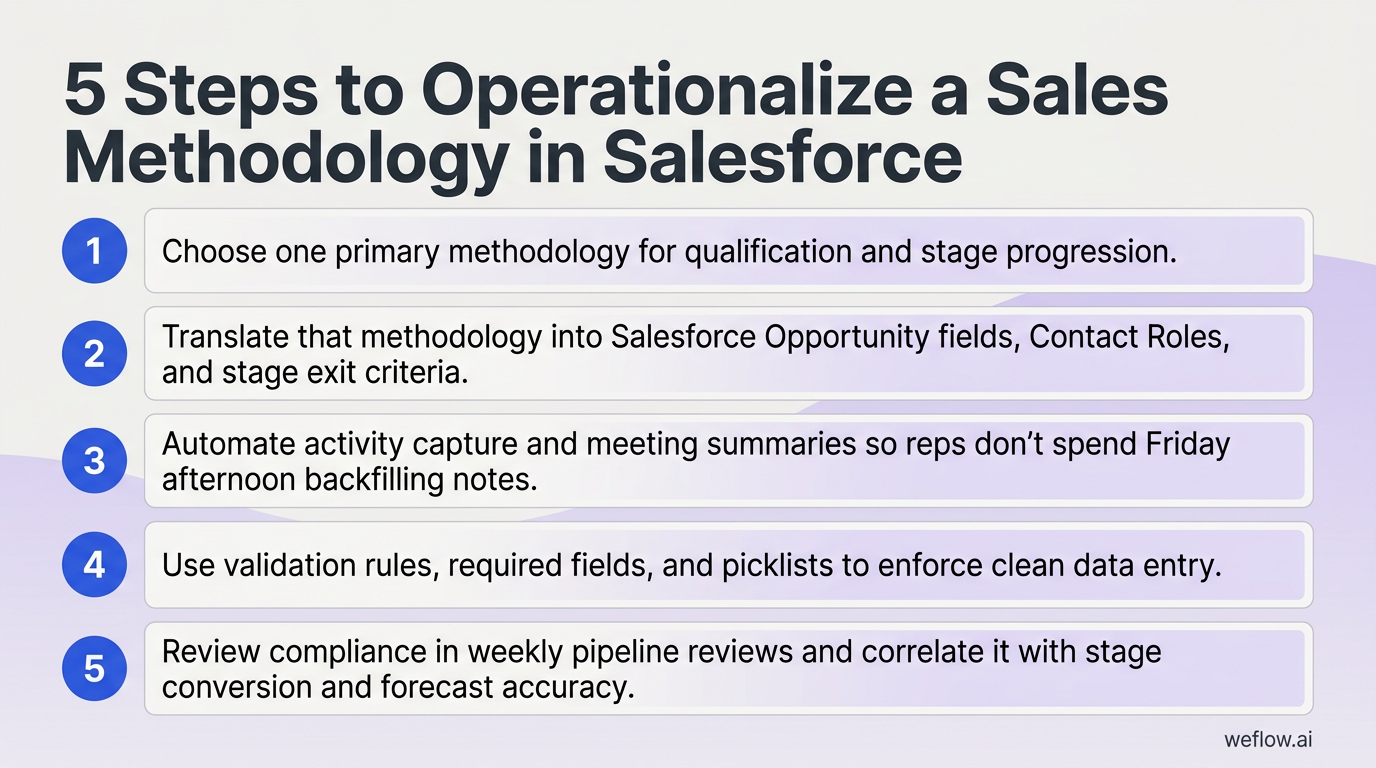
- Choose one primary methodology for qualification and stage progression.
- Translate that methodology into Salesforce Opportunity fields, Contact Roles, and stage exit criteria.
- Automate activity capture and meeting summaries so reps don’t spend Friday afternoon backfilling notes.
- Use validation rules, required fields, and picklists to enforce clean data entry.
- Review compliance in weekly pipeline reviews and correlate it with stage conversion and forecast accuracy.
Structure custom CRM fields and pipeline stages
Your CRM architecture should reflect the methodology’s decision points. If stage names are generic and fields are optional, managers will still end up asking subjective questions in pipeline reviews.
- Map Opportunity stages to methodology milestones, not vague seller actions.
- Create custom qualification fields for the framework you chose—for example, MEDDIC Metrics, Economic Buyer, Decision Process, and Champion.
- Track buying committee roles on Contact Roles or a custom object if your sales cycle involves multiple evaluators and approvers.
- Use separate fields for buyer pain, business impact, and critical event instead of one open text area called “notes.”
- Store methodology fields where reporting can actually use them—usually on the Opportunity, sometimes with related custom objects for committee mapping or implementation criteria.
A concrete example: instead of a generic stage called Negotiation, a MEDDIC-driven team might use a milestone like Economic Buyer Engaged or Decision Process Validated. That stage name gives managers a cleaner inspection point and gives RevOps a clearer stage definition to enforce with validation rules.
Automate methodology data capture via AI tools
Problem: Reps hate data entry, so qualification data gets skipped, entered late, or entered as junk just before the forecast call.
Solution: Use AI notetaking and activity sync to map methodology cues from meetings, email, and calendar data directly into Salesforce fields.
Weflow, a Salesforce-native revenue AI platform, lets RevOps teams map methodology templates like MEDDIC or SPICED to Salesforce write-back. That means AI meeting summaries can populate qualification fields, create follow-up tasks, and update Opportunity records without relying on rep memory.
- Auto-populate fields from AI meeting summaries tied to a specific framework.
- Auto-log emails, calls, and meetings for higher activity completeness and better pipeline inspection.
- Capture multi-threading signals by creating contacts and Contact Roles from email and meeting data.
- Use custom AI prompts for methodology-specific summaries such as pain, impact, critical event, champion status, or economic buyer signals.
If you’re migrating from Gong, the main concern is usually implementation effort. In practice, the project is often lighter than teams expect because the work is mostly field mapping, template setup, and change management—not a rebuild of the Salesforce data model.
The common issue with Gong is not conversation intelligence quality. It’s that Salesforce integration often stops at shallow field mapping, basic activity records, or manual workarounds for write-back. If your RevOps team wants SPICED Pain, MEDDIC Economic Buyer, or buying committee data written into Salesforce fields and custom objects, Weflow usually gives you a deeper Salesforce footprint with deployment measured in weeks, not quarters. It supports Salesforce Enterprise and Unlimited editions, writes back directly to Salesforce, and helps teams move past the activity gaps many run into with EAC or limited sync setups.
Enforce process compliance through mandatory fields
Training alone won’t create clean methodology data. Reps follow the framework consistently when Salesforce requires the right information before a deal can move forward—and when managers inspect that data every week.
Do:
- Require a small set of key fields before stage progression—for example, Critical Event, Economic Buyer, or Decision Criteria.
- Use picklists where standardization matters, such as Champion Status, Competitive Position, or Buying Role.
- Make validation rules stage-specific so reps only see required fields when they’re relevant.
- Tie methodology compliance to pipeline reviews and forecast calls.
Don’t:
- Make 15 fields mandatory on day one.
- Force reps into large free-text fields that can’t be reported on.
- Let managers bypass the methodology in deal reviews while expecting reps to maintain the data.
- Ignore bad data just because the stage advanced.
The main limitation here is adoption risk. If you make too many fields mandatory too early, reps will enter placeholder text just to move an opportunity forward. Start with the fields that most directly affect stage quality and forecast reliability, then add more structure once completion rates are stable.
Methodology performance: track win rates and forecast accuracy
A well-implemented methodology improves more than rep talk tracks. It changes the quality of the data inside Salesforce, which changes the quality of your reporting, coaching, and forecast call.
- Deal review efficiency: Managers inspect specific gaps instead of debating rep sentiment.
- Stage-to-stage conversion: Better qualification filters out weak deals earlier and improves progression on the remaining pipeline.
- Forecast reliability: Consistent qualification criteria reduce inflated best case and commit numbers.
- Sales cycle length and CAC: Teams spend less time on bad-fit deals and more time on opportunities with real business pain.
The operational logic is simple: clean inputs produce reliable outputs. If qualification data is inconsistent, forecast categories will be inconsistent too.
Standardize deal reviews to identify pipeline risks
Methodologies turn deal reviews from subjective updates into evidence-based inspection. That helps managers coach faster and helps RevOps identify which missing data points correlate with slippage.
- Use shared qualification criteria to spot missing elements like no Champion, no Economic Buyer, or no Critical Event.
- Coach reps on one missing item at a time instead of giving vague feedback like “tighten up discovery.”
- Hold every rep to the same definition of a stage, regardless of segment or manager style.
- Flag risk earlier because incomplete methodology fields usually show up before stage conversion problems do.
Bad deal review: “How do you feel about this deal?”
Methodology-driven deal review: “Have we validated the Economic Impact, confirmed the Economic Buyer, and identified a Critical Event?”
Shorten sales cycles to boost stage conversion rates
Structured selling improves velocity because reps spend less time guessing what to do next. They know which question to ask, which stakeholder to engage, and which risk must be cleared before the deal advances.
- Better discovery aligns the solution to real buyer pain earlier in the cycle.
- Structured qualification surfaces objections before proposal or legal, where delays are more expensive.
- Reps spend more time on high-probability deals and less time rescuing weak opportunities.
There’s an important measurement point here: strong methodologies often lower top-of-funnel stage progression at first because reps disqualify bad-fit deals sooner. That is a healthy change. The remaining pipeline usually converts better because it contains fewer deals that were never real to begin with.
Evaluate deal criteria to improve forecast accuracy
Forecast accuracy improves when every rep qualifies deals against the same criteria and those criteria are visible in Salesforce. That replaces “happy ears” with a shared inspection model.
- Consistent deal evaluation reduces rep subjectivity and manager interpretation gaps.
- Mandatory fields stop stalled deals from inflating late-stage pipeline.
- Qualification completeness gives RevOps cleaner forecast inputs for commit, best case, and pipeline categories.
- Managers can identify forecast risk from missing methodology data before the quarter-end scramble.
Once every team uses the same definitions, leadership can trust the forecast dashboard more because stage movement reflects buyer progress—not just seller optimism.
Methodology adoption: turn frameworks into daily habits
Methodology rollout usually fails for one of three reasons: the framework is too complex for the motion, managers don’t coach to it consistently, or the CRM never gets updated cleanly enough to measure adoption. Training is only step one.
The better rollout plan is operational. Pick one primary framework, map it to Salesforce fields and stage gates, automate the data capture, then coach to those fields in every pipeline review for the next 90 days. That’s how a methodology becomes part of forecast discipline instead of a one-time enablement event.
Before you launch a big training program, audit your current Salesforce stages, required fields, and activity completeness. If stage names are vague and qualification data is missing today, fix the CRM foundation first.
FAQ
What is the difference between a sales process and a sales methodology?
A sales process is the sequence of steps a deal moves through—qualification, discovery, demo, proposal, procurement, close. A sales methodology is the framework reps use inside those steps, including the questions they ask, the risks they inspect, and the criteria they use to qualify a deal. In Salesforce terms, the process usually maps to stages, while the methodology maps to fields, stage exit criteria, and coaching rules.
Can a sales team use multiple sales methodologies at once?
Yes, but only one should be the primary framework captured in Salesforce. Teams often mix methods in practice—for example, MEDDIC for qualification and Challenger for messaging—but if you try to operationalize several frameworks at the field level, reporting gets messy fast. The cleaner approach is one CRM standard, with secondary techniques used in coaching and enablement.
How long does it take to implement a new sales methodology?
Initial training can happen in a few weeks, but full adoption usually takes three to six months. That timeline includes manager reinforcement, Salesforce field and validation rule changes, stage definition cleanup, and enough deal volume to see whether compliance is improving win rates or forecast accuracy. If you’re also replacing an existing conversation platform or activity sync setup, include time for field mapping and user behavior change.
Which sales methodology is best for SaaS companies?
For most SaaS teams, SPICED and MEDDIC are the strongest options. SPICED is a strong fit when the motion depends on recurring revenue, measurable business impact, and time-based urgency such as renewals or implementation deadlines. MEDDIC is the better fit when SaaS deals look more like enterprise software deployments with large buying committees, procurement steps, and executive approval.
How does CRM automation improve methodology adoption?
CRM automation removes the biggest adoption blocker: manual data entry. AI summaries, activity sync, and Salesforce write-back can capture methodology data from calls and emails as the work happens, so reps don’t have to update fields from memory at the end of the week. It also improves data completeness beyond what basic activity capture tools or EAC can provide, because the system can fill qualification fields—not just log that a meeting occurred.
.png)
-p-1600.png)
.webp)
.webp)